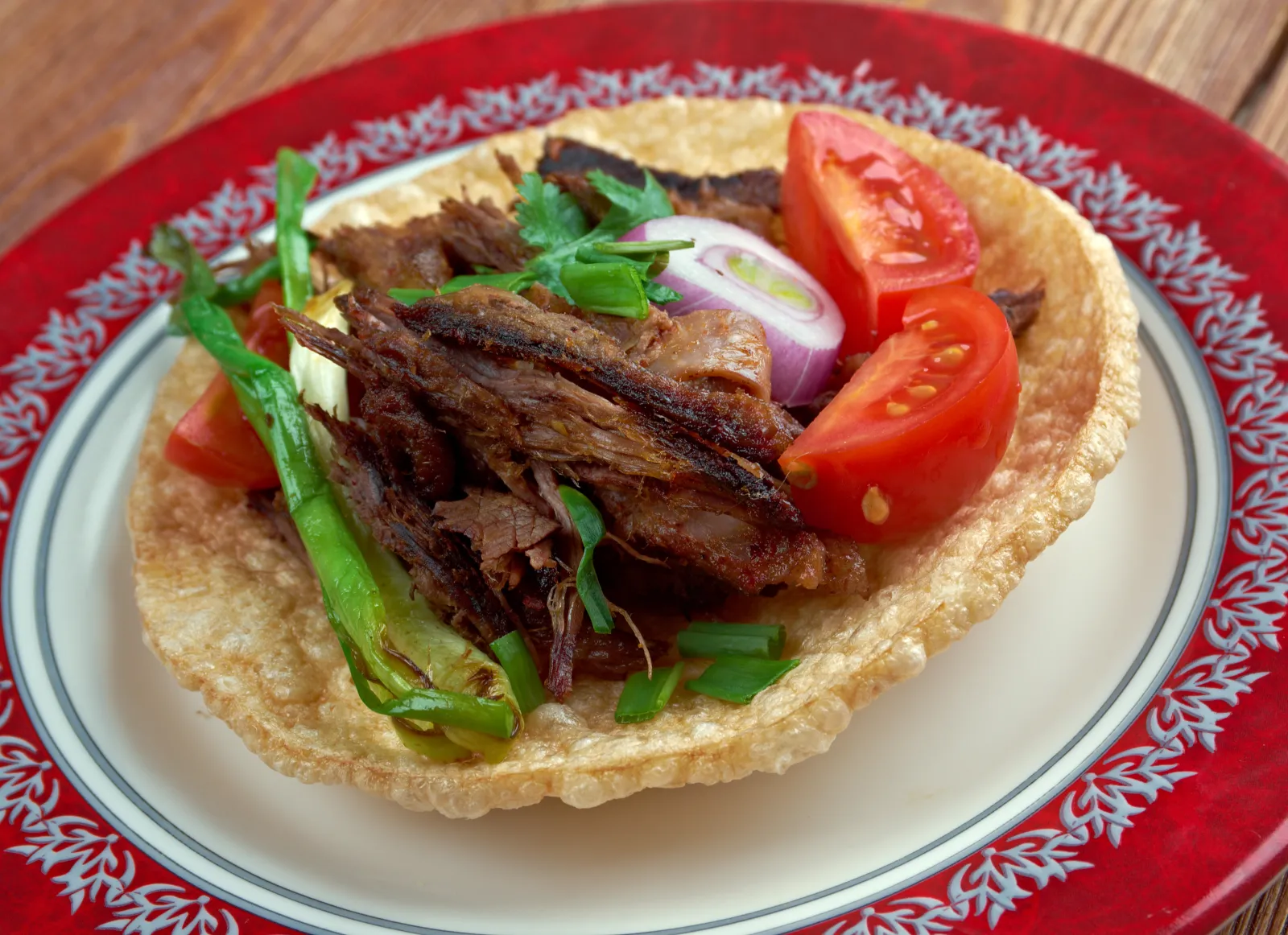

Chilorio (chee-LOH-ree-oh) takes 2.2 lb (1 kg) of pork shoulder, cooks it in water until the water is gone, lets it fry in the fat it gave up, then shreds it and fries it again in a vinegary paste of dried chiles. The result is closer to a filling than a stew: dark red, nearly dry, tangy and only mildly hot. It comes from Sinaloa, on Mexico’s Pacific northwest coast, where it’s eaten mostly rolled into flour-tortilla burritos, and a jar of it in the fridge turns into breakfast, lunch and tacos for most of a week.
What is chilorio, and is it worth making from scratch
How do you make chilorio? Simmer 1 kg (2.2 lb) of cubed pork shoulder covered in salted water for 40 minutes, then uncover and boil off all the liquid so the pork browns in its own fat with a little lard. Shred it, add a blended sauce of ancho and guajillo chiles, vinegar, garlic, oregano and cumin, and fry it 15-20 minutes until almost dry. 125 minutes for 6 servings.
If you like cooking once and eating three times, yes. Of the 125 minutes, about 65 are hands-on, and the payoff keeps 3-4 days in the fridge and months in the freezer.
Make it when you want a filling ready for burritos, tacos, quesadillas or eggs; you’re feeding a group and want something that holds well; or you’ve already made carnitas and want the next step up.
Skip it when you want saucy, juicy pulled pork (chilorio is meant to be dry), you don’t eat pork (there’s a chicken version below), or vinegar isn’t your thing, because the tang is the point.
Honest difficulty: easy. Nothing is technical. The two places it goes wrong are scorching the chiles and adding the sauce before the water has fully boiled off.
Chilorio vs carnitas vs cochinita pibil
All three are Mexican pork, and they get confused. Carnitas use the same shoulder and the same simmer-then-fry trick, but stay as golden chunks with no sauce, in 145 minutes. Cochinita pibil is juicy shredded pork marinated in achiote and sour orange and baked in banana leaves, about 1010 minutes counting the overnight marinade. Chilorio sits between them: browned like carnitas, shredded like cochinita, then fried in chile until it’s the driest and longest-keeping of the three. If you’d rather use chicken, chicken tinga is the shredded-in-sauce cousin, ready in 60 minutes.
Ingredients and US and UK swaps for chilorio
Everything is in the recipe card: 2.2 lb (1 kg) of pork, 4 anchos, 3 guajillos and ½ cup (120 ml) of vinegar for 6 servings. These are the ones worth a second look.
The pork
Pork shoulder, fat on. In the US ask for boneless pork shoulder or Boston butt; picnic shoulder works too. In the UK, a boneless pork shoulder joint, cubed by the butcher. Raw shoulder carries about 18 g of fat per 100 g, and that fat is the frying medium once the water evaporates, so don’t trim it. Pork leg works but comes out drier; add another 1-2 tablespoons of lard. Skip loin: it’s too lean to fry in its own fat and ends up stringy.
The chiles
Ancho is a dried poblano: almost black-red, wrinkled, raisin-sweet and very mild. Guajillo is smoother and brighter red, with more tang and a little more heat. Together they make a deep red sauce that tastes of dried fruit more than fire. I use about 80 g (2.8 oz) of dried chiles per kilo of pork.
- In the US, both are in Latin grocers, many Walmarts and online. The 2 oz bags at MexGrocer were $5.95 each. Dried New Mexico or California pods, sold in the regular spice or produce aisle, are the easiest swap for guajillo.
- In the UK, Cool Chile Co sells whole anchos (70 g, £4.69 at Real Foods) and guajillos (50 g, £4.29), and you’ll also find them at Sous Chef and Mexican grocers online.
- Avoid supermarket chili powder. In the US it’s a blend with cumin, garlic and salt, and it gives you a Tex-Mex chili flavor, not chilorio.
Vinegar and fat
Plain distilled white vinegar or cider vinegar, ½ cup (120 ml) per kilo. It cooks down to a clean sourness without a sharp smell; if you’re cautious, start with ⅓ cup (80 ml) and add at the end. For fat, lard is traditional and tastes best; vegetable oil works with no other change.
Equipment
A wide, heavy pot about 10 inches (24-26 cm) across: a narrow pot takes much longer to boil dry and the meat piles up instead of browning. A blender, a dry skillet for the chiles and two forks. A potato masher shreds the whole batch in half the time.
Step-by-step timing and how to tell each stage is right
The sauce is done long before the pork needs it, so the only time you need to stay at the stove is the last 35 minutes.
- Covered simmer, 40 minutes → a cube squashes with no pressure. If not, 10 minutes more.
- Toasted chiles → fragrant, pliable, no black spots. Black or smoking means bitter; toast fresh ones.
- Sauce → smooth, brick red, about the thickness of light cream.
- Boil-off, 20-25 minutes → the sound changes from bubbling to sizzling, and the pot holds clear fat with no broth.
- Browning, 10 minutes → brown edges and a thin crust on the bottom of the pot that lifts when you scrape.
- Done → glossy dark red strands, a thread of red fat at the edges, and no liquid running when you drag a spoon across the bottom.
Why the water has to go before anything browns
Water boils at 212°F (100°C), and while there’s any left, the pork can’t get hotter than that, so no browning happens. Once it’s gone, the rendered fat heats past that point and the pork starts to fry. Food safety is not the issue here: whole cuts of pork are safe at 145°F (63°C) with a 3-minute rest, and this pork has simmered for over an hour.
Make-ahead plan
- Up to 2 days ahead: blend the sauce and keep it in a sealed jar in the fridge.
- The day before: simmer the pork and refrigerate it in its broth; next day, boil off, brown and finish.
- Fully cooked: chilorio is better the next day, so I usually make the whole thing a day early.
Stovetop, Instant Pot or slow cooker chilorio
| Method | Pork cook | Then | Result |
|---|---|---|---|
| Stovetop (this recipe) | 40 min covered + 20-25 min boil-off | brown 10 min, sauce 15-20 min | most browned, driest |
| Instant Pot or pressure cooker | 30 min high pressure, 1 cup (250 ml) water, 15 min natural release | boil off on Sauté, brown, sauce | saves about 25 min |
| Slow cooker | pork and sauce together, 8 hours on low | dry it in a wide skillet 10 min | juicier, less toasty |
Don’t brown in lard under pressure: the Instant Pot is for the water stage only. Do the frying on Sauté with the lid off, or in a skillet.
Variations
- Orange juice version: swap half the cooking water for orange juice. Sweeter, browns faster, so watch the bottom.
- Lighter: pork leg, 1 tablespoon of lard, and spoon off the fat before the sauce goes in. Leaner but drier.
- Chicken: 2.2 lb (1 kg) boneless thighs, 25 minutes covered, cooked to 165°F (74°C) in the center, with extra lard because chicken renders little fat.
- Vegetarian: drained canned young green jackfruit, shredded, browned in oil and cooked 15 minutes with the same sauce. Same flavor, softer texture.
- Hotter: blend 2-3 toasted chiles de árbol into the sauce.
Scaling for a crowd
| 6 servings | 12 servings | 20 servings | |
|---|---|---|---|
| Pork shoulder | 2.2 lb (1 kg) | 4.4 lb (2 kg) | 7.7 lb (3.5 kg) |
| Water | 3 cups (750 ml) | 6 cups (1.5 l) | 10½ cups (2.5 l) |
| Ancho / guajillo | 4 / 3 | 8 / 6 | 14 / 10 |
| Vinegar | ½ cup (120 ml) | 1 cup (240 ml) | 1¾ cups (420 ml) |
| Garlic | 5 cloves | 10 cloves | 17 cloves |
| Lard | 3 tbsp (40 g) | 6 tbsp (80 g) | 10 tbsp (140 g) |
| Large flour tortillas | 6 | 12 | 20 |
| Pots | one 10-inch | one 12-inch | two pots |
The boil-off takes longer as the batch grows, so go by the sound, not the clock. For 20 I’d rather use two pots than one huge one, where the bottom layer stews and the top never browns.
Before you cook, mistakes, heat, kids and allergens
Common mistakes:
- Bitter sauce → burnt chiles or seeds left in. 10-15 seconds per side, seeds and veins out.
- Soupy → not enough time with the sauce. Keep going on low until nothing runs across the bottom.
- Won’t brown → there’s still water. Wait for the sizzle.
- Dry and stringy → loin or lean leg, or browned too long. Use shoulder.
- Scorched bottom → thin pot or high heat in the last stage. Heavy pot, low heat once the sauce is in.
- Too sour → the final 15-20 minutes mellow it; if it’s still sharp, stir in another tablespoon of lard.
Heat: 1-2 out of 5. Anchos are barely hot and guajillos are mild. Most kids eat it happily; if they don’t, it’s the vinegar, so cut it to ⅓ cup (80 ml) for them.
Allergens. No gluten, dairy, egg, nuts or fish in the recipe itself. Corn tortillas keep it gluten-free; flour tortillas don’t. Some packaged dried chiles are made in facilities that handle peanuts and tree nuts, so read the label if that matters.
What chilorio costs in the US
At the US average price for this kind of pork in September 2026, $3.679 per pound, 2.2 lb (1 kg) of shoulder comes to $8.11. Add a 2 oz bag of anchos and a 2 oz bag of guajillos at $5.95 each, and the batch costs $20.01, about $3.34 a serving, with guajillos left over. A ready-made 8.8 oz (250 g) pouch of Chata chilorio was $12.95 at the same store, so six homemade servings cost about one and a half pouches. Outside Mexico the chiles, not the pork, are the expensive part; a larger bag from a Latin grocer brings the cost down, and dried chiles keep for months in a sealed jar.
Yield: 6 servings, enough for 6 large burritos or 18 tacos. Count about 6 oz (170 g) of raw shoulder per person for burritos, more if it’s the main event with rice and beans.
Serving, storing and reheating chilorio
How it’s eaten in Sinaloa: in flour-tortilla burritos, with a smear of refried beans, rolled and crisped on a griddle for a minute per side. Homemade flour tortillas hold the filling well. It also goes into corn tacos with onion, cilantro and lime, into tortas and quesadillas, or onto a plate next to Mexican red rice.
Chilorio and eggs: warm 3 oz (80 g) of chilorio per person in a skillet in its own fat for 2 minutes, add 2 beaten eggs and stir until the eggs are fully set with no runny parts. Wrap in a flour tortilla.
Fridge: refrigerate within 2 hours of cooking and eat within 3-4 days, kept at 40°F (4°C) or below. The vinegar doesn’t make homemade chilorio a preserve; the shelf-stable pouches go through an industrial process you can’t copy at home.
Freezer: 2-6 months in flat bags or 5-7 oz (150-200 g) portions, enough for two burritos. Thaw overnight in the fridge.
Reheating: in a skillet over medium heat with 1-2 tablespoons of water per 7 oz (200 g), stirring until it reaches 165°F (74°C) in the center. In the microwave, covered, in 1-minute bursts with a stir in between. On a buffet, hold it at 140°F (60°C) or above.
Chilorio FAQ
What does chilorio taste like? Sweet dried chile first, then a clean vinegar sourness, then fried pork and cumin. It’s only mildly spicy.
What’s the difference between chilorio and carnitas? Both start with pork shoulder cooked in water until it fries in its own fat. Carnitas stop there, as crisp chunks; chilorio is shredded and fried again in an ancho and vinegar chile sauce.
What chiles are in chilorio? Ancho, usually with guajillo, sometimes pasilla. This recipe uses 4 anchos and 3 guajillos per 2.2 lb (1 kg) of pork.
What can I use instead of guajillo chiles? Dried New Mexico or California chiles, the same weight. The sauce is a little brighter and thinner in flavor.
Can I make chilorio in an Instant Pot? Yes: the pork with 1 cup (250 ml) of water, 30 minutes on high pressure and 15 minutes of natural release. Then boil off the liquid on Sauté, brown and add the sauce.
How long does chilorio last? Homemade, 3-4 days in the fridge and 2-6 months in the freezer.
Is chilorio spicy? Mildly, about 1-2 out of 5. Blend in a few chiles de árbol if you want more.
What do you eat chilorio with? Flour tortillas as burritos, corn tortillas as tacos, scrambled eggs, refried beans and rice.
Chilorio nutrition per serving
Per serving (one sixth of the recipe, without tortillas), calculated from the recipe amounts: 2.2 lb (1 kg) of shoulder with its fat, 40 g of lard, 80 g of dried chiles and 12 g of salt.
- Calories: 500 kcal
- Protein: 30 g
- Carbohydrates: 8 g
- Fat: 38 g, of which 13 g saturated
- Fiber: 3 g
- Sodium: 890 mg
The fat figure includes all the fat in the raw shoulder, about 180 g per kilo, because it stays in the pot; spoon off what separates at the end and it drops. A 10-inch (25 cm) flour tortilla (72 g) adds about 234 kcal and 40 g of carbohydrates; three corn tortillas (72 g) add about 157 kcal and 32 g.
Back home in Venezuela, shredded beef means pabellón: soft, saucy, spooned over rice. Chilorio asked me to trust the opposite instinct, to keep cooking past the point where it looks done until the pot goes quiet and then starts to fry. The batch I rushed made burritos that fell apart in our hands. These days half of every pot goes into the freezer in two-burrito bags, and Dylan’s school mornings are sorted for weeks. Josnaisis.