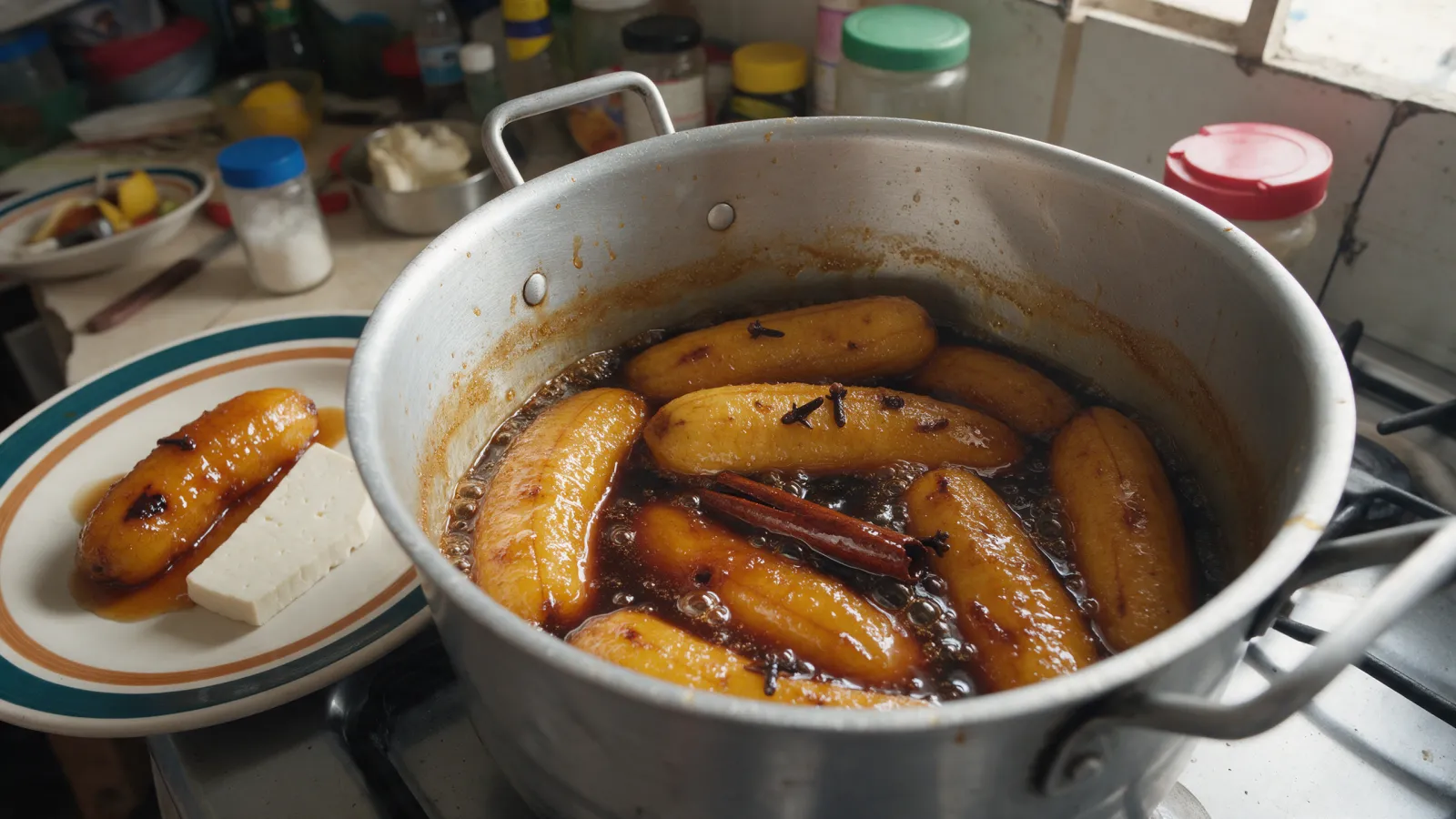

Plátanos calados (PLAH-tah-nohs kah-LAH-dohs) are ripe plantains simmered for 35 minutes in panela syrup until the syrup soaks right through them, which is what calado means: soaked through. Think of a cross between candied yams and bananas Foster, except the plantain holds its shape and nothing is flambéed. In Colombia they sit on the table as a dessert or as a sweet side next to rice and meat, very often with a slice of salty white cheese. Some regions call them plátanos en tentación. My version skips the frying that some cooks do first and lets the fruit cook in the syrup from the start, and I’ll show you how to tell when the syrup is done without a candy thermometer.
Should you make candied plantains?
How do you make Colombian candied plantains? Dissolve 200 g (7 oz) of panela in 500 ml (2 cups) of water with a cinnamon stick, 4 cloves and a pinch of salt, add 4 very ripe plantains cut into chunks, and simmer covered for 20 minutes. Uncover and keep basting for 10-15 minutes until the syrup coats a spoon, then rest for 5 minutes. Ready in 50 minutes for 6 servings.
Make them if you have plantains that went black on the counter and you were about to throw them out. That is exactly the fruit this dish wants.
What you get. Soft chunks you can cut with a spoon, dark all the way through, in a glossy syrup with cane-sugar and cinnamon notes. Ripe plantain already carries about 17.5 g of sugar per 100 g, so the result is very sweet; the salty cheese is there to cut it.
Who it suits. Anyone who likes sticky, spiced desserts, kids, and dairy-free or vegan tables if you drop the butter and cheese. It is also gluten-free.
Who it may not suit. If you want something light: about 326 calories a serving, nearly all of it sugar. And if you can only find yellow plantains today, wait.
Effort. Easy. 50 minutes on the clock, about 25 of them hands-on.
Plantains, not bananas, and how ripe they need to be
A plantain is a starchy cooking banana, bigger and firmer than the banana you slice over cereal. In the US it is sold as plantain, usually next to the bananas; in the UK, in big supermarkets and in Caribbean and African grocers. A dessert banana cooked this way falls apart in half the time.
What you want is black or nearly black skin and fruit that gives like a ripe avocado. That is riper than you would choose for frying, as with Venezuelan fried sweet plantains, where the plantain needs to stay firm enough for hot oil. Here nothing is fried, so a black plantain survives 35 minutes in syrup and gets darker and sweeter. If yours are leaking and mushy, cut the covered time to 10-12 minutes.
Ripen plantains on the counter, ideally in a paper bag. The fridge turns the skin black without ripening the inside.
What to buy, and what to swap in the US and UK
| Ingredient | Best choice | US swap | UK swap | What changes |
|---|---|---|---|---|
| Panela, 200 g (7 oz) | panela from a Latin grocer | piloncillo, about 1 cone of 8 oz (227 g) | panela online, or dark muscovado | muscovado is close; plain brown sugar gives a lighter, thinner-tasting syrup |
| Plantains, 4 large | black-skinned plantains | plantains at most supermarkets | supermarkets or Caribbean and African grocers | none if ripe enough |
| Queso costeño, 240 g (8½ oz) | queso costeño | queso blanco or queso fresco, or crumbly cotija to grate | a mild feta | feta and cotija are saltier; use a little less |
| Butter, 1 tbsp (14 g) | butter | any butter | any butter | leave it out for a dairy-free pot; the syrup is less glossy |
Use whole cinnamon sticks and whole cloves, not ground: ground spices cloud the syrup. Four cloves is enough for 200 g of panela; more and it tastes medicinal.
Pot. A wide 24-26 cm (10-inch) pot or deep skillet with a lid, so all 16 pieces sit in one layer. In a narrow pot they stack, the bottom ones break when you turn them and the top ones never soak. Turn them with two spoons, not a fork.
The 50-minute plan
Start the syrup before you peel: by the time the plantains are cut, the panela has dissolved. Then 20 minutes covered and unattended, and 10-15 minutes of basting at the end, which is the only part that needs you.
How to tell when the syrup is done
Without a thermometer, watch the bubbles and the spoon. Small, fast bubbles turn big and slow, the syrup coats the back of a spoon and drips off in fat drops. Take it off then, even if it looks runny. It thickens during the 5-minute rest and a lot more in the fridge.
With a thermometer, measure against your own boiling point. The rule I use is to pull the syrup 7-9°F (4-5°C) above the temperature at which plain water boils in your kitchen. At sea level that is 219-221°F (104-105°C). At altitude water boils lower, so the target drops with it: in Bogotá, where water boils at about 196°F (91°C), I stop at 203-205°F (95-96°C). If a cooled drop pulls into a thin thread between your fingers, the syrup has reached thread stage, around 106-112°C (223-234°F) at sea level, and it will set firm in the fridge. The same rule works for the panela syrup of Colombian cuajada with melao.
Signs it is going right
- Dissolving → the water turns the color of strong tea and no panela is left on the bottom.
- 10 minutes covered → the chunks are deep yellow and starting to give. Turn them now.
- 20 minutes → dark orange, a knife goes in with little resistance, the syrup is still thin.
- The end → mahogany outside and inside when you cut a piece, and a glossy syrup.
Making it ahead and cooking for a crowd
Candied plantains are better on day two, so make them the day before, cool them in their syrup and refrigerate. They are eaten cold straight from the fridge or warmed gently.
| Servings | Plantains | Panela | Water | Pots |
|---|---|---|---|---|
| 4 | 3 | 150 g (5¼ oz) | 375 ml (1½ cups) | one 24 cm (9½ in) |
| 6 | 4 | 200 g (7 oz) | 500 ml (2 cups) | one 24-26 cm (10 in) |
| 12 | 8 | 400 g (14 oz) | 1 liter (4¼ cups) | two 24-26 cm, or one 32 cm (12½ in) |
| 20 | 14 | 700 g (1½ lb) | 1.75 liters (7½ cups) | three |
Cooking times stay the same per pot. With more liquid in a bigger pot the final reduction takes longer, so go by the spoon, not the clock.
Mistakes that ruin candied plantains
- Pale and starchy pieces → the plantains were yellow. Nothing fixes this in the pot; wait until they are black.
- Plantains falling apart → overripe fruit cooked too long, or stirring with a spoon. Shorten the covered time and swirl the pot.
- Syrup turns to hard candy in the fridge → overcooked. Warm it with 1-2 tablespoons of hot water.
- Bitter, burnt taste → high heat at the end, when the syrup is reduced and the bottom of the pot heats fast. Stay on medium and baste.
- Raw in the middle → pieces too big or no lid at the start. Four pieces per plantain and 20 minutes covered.
- Tastes like medicine → too many cloves. Four is enough.
Spice level, 0 out of 5. Cinnamon and cloves are warm, not hot. Allergens. Milk in the butter and cheese; otherwise no gluten, eggs or nuts.
Other ways to make plátanos calados
- Fried first → brown the chunks for about 10 minutes over medium heat in 1 tablespoon of oil and 2 tablespoons of butter, pour off the fat, add the water, panela and spices, and reduce until the syrup coats a spoon. You get a golden crust and a soft middle, much like Dominican plátanos al caldero.
- With cola → in Cartagena the syrup is often made with Kola Román, a red Colombian soda. Swap half the water, 250 ml (1 cup), for a dark or red cola; the syrup comes out darker and tastes of it.
- With milk → around Copacabana, near Medellín, once the water has cooked off, milk and cream go into the pot and reduce until slightly thick, and the plantains are served with grated cheese and honey.
- Lighter → half the panela, 100 g (3½ oz), with 375 ml (1½ cups) of water. About 60 calories less per serving and a thinner syrup.
- Quicker → very black, soft plantains, 10-12 minutes covered and 10 uncovered: about 35 minutes in all.
What candied plantains cost
In the US, at an average of $0.88 a pound for plantains in the week of October 9, 2026, and $1.28 for an 8 oz cone of piloncillo at H-E-B, the batch costs $3.65 without cheese, about 61 cents a serving. Adding 8½ oz of Cacique queso fresco ($3.84 for 10 oz at H-E-B) brings it to $6.90, about $1.15 a serving. In the UK, Tesco lists plantains at £0.75 each, so the four come to £3.
The cheese is the expensive part, almost half the bill. Cinnamon, cloves, butter and salt are not counted.
How to serve and store them
Serving. Warm or cold in a shallow bowl with plenty of syrup, with the cheese sliced on the side or grated on top, about 40 g (1½ oz) per person. As a dessert they are good with vanilla ice cream. As a sweet side, they belong next to a Caribbean-coast plate like Colombian posta negra with Colombian coconut rice, or beside Colombian chicken and rice. For another Colombian fruit in syrup that takes much longer, see figs in syrup.
Fridge. Refrigerate within 2 hours, covered in their syrup, at 40°F (4°C) or below, and eat within 3-4 days.
Freezer. For best quality, 3-4 months in a sealed container with the syrup covering the plantains. Thaw in the fridge; in my experience the plantain softens a little and the flavor does not change.
Reheating. In a small pot over low heat with 1-2 tablespoons of water, swirling, until they reach 165°F (74°C) in the center. In the microwave, in 30-second bursts. Or skip it and eat them cold.
Leftover syrup sweetens a mug of hot Colombian aguapanela nicely.
FAQ
What are plátanos calados? Ripe plantains simmered in a thick panela syrup with cinnamon, and often cloves, until the syrup soaks into the fruit. They are served as a dessert or a sweet side, often with salty white cheese.
Are plátanos calados the same as plátanos en tentación? Yes, same dish, different regional name. Guatemala calls a similar dish plátanos en gloria, and in the Dominican Republic the plantains are fried first and called plátanos al caldero.
Do you have to fry the plantains first? No. This recipe cooks them straight in the syrup. Frying first for about 10 minutes gives a golden crust and more fat.
Can I use bananas instead of plantains? They work in a pinch but fall apart much faster. Cut the cooking time in half.
What can I use instead of panela? Piloncillo in the US, which is the same product, or dark muscovado in the UK. Dark brown sugar works but gives a lighter syrup.
What cheese goes with candied plantains? In Colombia, queso costeño, a firm, salty white cheese. Queso blanco, queso fresco or a mild feta are the closest swaps.
How long do they keep? 3-4 days in the fridge in their syrup, and 3-4 months frozen.
Nutrition per serving
Per serving (one sixth, about 150 g or 5¼ oz of plantain plus its syrup), calculated from the weights in the recipe, with panela counted as brown sugar and without cheese:
- Calories: 326 kcal
- Protein: 2 g
- Carbohydrates: 81 g
- Fat: 2 g, of which 1 g saturated
- Fiber: 3 g
- Sugars: 59 g
- Sodium: 63 mg
About 26 g of the sugar comes from the plantain itself and 32 g from the panela. Forty grams (1½ oz) of white cheese adds roughly 120 calories, 8 g of protein and 10 g of fat. With 100 g of panela instead of 200, a serving drops to about 265 calories.
In Venezuela I made this with papelón, our name for panela, and I cooked the syrup until it looked thick, which meant a block of candy in the fridge the next morning. In Colombia I learned to stop early, while the syrup still looks too thin, and to put salty cheese on top. Now the black plantains nobody in my house wants end up in this pot. Josnaisis.