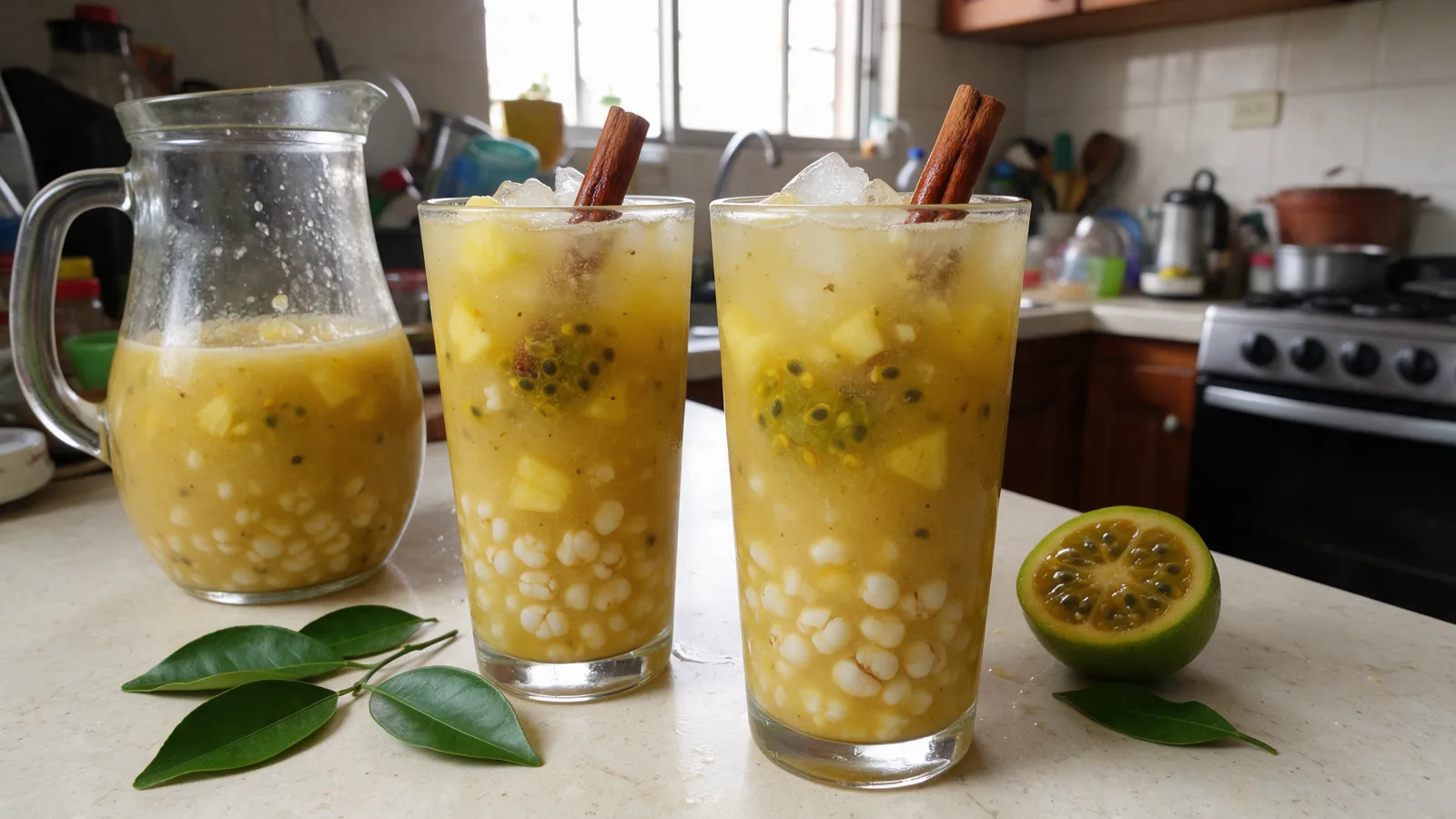

Champús is the drink people in Cali reach for on a hot afternoon, and the first thing to know is that you chew it. It’s cracked white corn simmered until it falls apart, stirred into a panela syrup scented with cinnamon, clove and orange leaves, then loaded with diced lulo and pineapple and poured over ice. It isn’t fermented and it has no alcohol. One pot gives 12 glasses from just 10.6 ounces (300 g) of dried corn, with about 55 minutes of actual work.
What champús is and whether it’s worth making
How do you make Colombian champús? Soak 300 g (10.6 oz) of dried cracked corn for 8 hours, then simmer it in 2.5 liters (10½ cups) of water for 2 hours until the grains squash. Blend 1 cup of the corn back in, add a syrup of 300 g of panela with cinnamon, clove and orange leaves, chill, and stir in 6 diced lulos and 600 g (1⅓ lb) of pineapple. 810 minutes for 12 servings, with about 55 minutes of hands-on time.
Champús comes from southwestern Colombia: Valle del Cauca, Cauca and Nariño. The Valle version, the one here, is thin enough to drink, served very cold and made all year. In Nariño it’s thicker, almost a spoon dessert, and mostly a December thing. Ecuador and Peru have their own champús, and in Lima it’s served hot.
Why make it. Nothing in a US or UK supermarket tastes like it. The base is soft, starchy corn; the lulo brings a sharp sourness somewhere between pineapple and lime; the panela gives a deep, molasses-like sweetness. It’s a drink and a snack at once.
When it fits. A summer party, a backyard barbecue, a Colombian get-together where you need one big pot that waits in the fridge. It’s naturally gluten-free, dairy-free and vegan, so it suits a mixed crowd.
When it doesn’t. If you want something tonight: with the soak, it takes 13½ hours start to finish. There’s a canned hominy shortcut further down, with an honest note on what it costs you in flavor. It’s also not for anyone who dislikes bits in their drink.
Active time and difficulty. About 55 minutes: 10 to rinse the corn, 15 for the syrup, 10 to blend and combine, 20 to dice the fruit. Easy. The only judgment call is knowing when the corn is done.
Lulo, naranjilla and the corn, explained
Lulo (Solanum quitoense) is a small orange fruit with green, very tart, seedy flesh. In Ecuador it’s called naranjilla, and that’s the name on most frozen pulp packs in the US. Maíz trillado is dried white corn with the hull and germ removed, sold cracked; Colombians use the same corn for mazamorra, the plain cracked corn eaten cold with milk. Panela is unrefined cane sugar, sold in Mexican stores as piloncillo.
If you’ve had my lulada, that’s mashed lulo with lime and sugar, no corn, about 100 g (3.5 oz) of pulp per glass. Lulo juice is blended and strained, 280 g of pulp per liter. Champús shares the lulo with both, but the corn and spiced syrup make it a different drink altogether. It’s also not masato, the rice drink that ferments for 24 hours, or cholado, which is shaved ice and fruit eaten as dessert.
Ingredients and what to buy in the US and UK
My ratio is 25 g (just under 1 oz) of dried corn per glass, with roughly 33 g of lulo pulp and 50 g of pineapple. That gives a drinkable Valle-style champús. For a thicker, spoonable one, raise the corn to 400 g (14 oz) and change nothing else.
Cracked corn. In the US, look in the Latin aisle for a 1-pound (454 g) bag of dried white hominy corn, labeled maíz pelado or maíz trillado; Goya sells one. In the UK, Latin grocers and online Colombian shops stock maíz trillado or maíz peto. Don’t confuse it with cornmeal or grits: you need whole or cracked dried kernels.
Lulo. Fresh lulo is rare outside Colombia. Frozen pulp is the practical answer: in the US, Goya sells a 14-ounce (396 g) naranjilla pulp pack, which is exactly what this recipe needs, and some stores carry El Sembrador lulo pulp in the same size. In the UK, search Latin grocers’ freezers for pulpa de lulo or naranjilla. With pulp, the drink tastes the same but loses the little chunks of fruit. Kiwi is sometimes suggested; it brings acidity, not the flavor.
Orange leaves. Sour orange leaves give champús its scent, citrusy and green at once. They’re the hardest thing to find. If you have access to an orange tree that hasn’t been sprayed, fresh leaves work. Otherwise, 1 teaspoon of orange zest in the syrup covers the citrus side; the herbal note is lost.
Panela. Piloncillo cones from Mexican stores are the same product. Dark brown sugar works too, with less molasses depth. Start with 250 g (9 oz) if your fruit is very ripe; the pineapple adds sweetness as well.
Equipment. A 4 to 5 quart (4 to 5 liter) pot, a small saucepan, a blender, a strainer and some wide containers for cooling. No blender? Mash the cup of corn with a potato masher. It’s more rustic but thickens just as well.
Make-ahead plan and how to tell each step is right
Soak before bed, cook in the morning, add the fruit last. That’s the whole plan, and it’s why champús is a party drink: almost nothing needs you.
What you can make ahead. The cooked corn with its liquid and the syrup keep 3 to 4 days in the fridge, separately or combined. Dice the fruit on the day. For a Saturday party, cook the corn on Friday and add the fruit around noon on Saturday.
Signs you’re on track.
- Soaked corn → the grains look larger, opaque, and break with a fingernail.
- Cooked corn → a grain squashes between thumb and finger with no hard center, and the water is white and milky. Still firm at 2 hours? Give it 20 to 30 minutes more.
- Syrup → fully dissolved, the color of light coffee, coating the back of a spoon. Don’t take it to honey thickness or it sets as it cools.
- Base ready for fruit → cold to the touch, no steam, after about 3 hours at 40°F (4°C).
- Finished → thick but drinkable. If it clings to the spoon, add cold water.
Scaling for a crowd
Everything scales in a straight line and the timings don’t change; only the pot size does.
| Glasses | Dried corn | Panela | Lulo pulp | Pineapple |
|---|---|---|---|---|
| 12 | 300 g (10.6 oz) | 300 g (10.6 oz) | 400 g (14 oz) | 1 small |
| 24 | 600 g (1.3 lb) | 600 g (1.3 lb) | 800 g (1.8 lb) | 2 small |
| 48 | 1.2 kg (2.6 lb) | 1.2 kg (2.6 lb) | 1.6 kg (3.5 lb) | 4 small |
For a big party, keep the base cold in the fridge and add fruit to one pitcher at a time. Leftover base without fruit lasts longer.
Mistakes to avoid, and who it suits
- Corn won’t soften → it needed a longer soak, or the corn is old. Soaked 8 hours, it takes 2 hours; unsoaked, about 4.
- Thin and watery → the corn was undercooked, or you skipped blending the cup of corn. That starch is what thickens it.
- Bitter → the lulo went into the blender and the seeds broke. Dice it with a knife.
- Tastes sour or fizzy too soon → the fruit went into a warm base, or the pot sat out for more than 2 hours.
- Too sweet → the fruit sweetens it too. Start at 250 g of panela and taste at the end.
Food safety. Cooked corn spoils if it’s left warm. Cool it in shallow containers and refrigerate within 2 hours at 40°F (4°C) or below. At a party, put out one pitcher at a time and keep the rest cold. If it smells sour, bubbles or shows mold, throw it out.
Heat level 0 out of 5. Kids usually like it for the sweetness and fruit, though some won’t love the chunks or the tartness. No alcohol. Allergens: none of the major ones; it’s gluten-free, dairy-free and vegan.
Versions to choose from
- Short on time → two 15 oz (425 g) cans of hominy, drained and rinsed, boiled for 10 minutes in 1 liter (4 cups) of water, blending 2 cups instead of 1. About 1½ hours with chilling. Canned hominy is lime-treated, so it tastes more like pozole corn than mazamorra, but it’s still champús.
- Pressure cooker → 35 to 40 minutes at pressure with soaked corn and 2 liters (8½ cups) of water. Less evaporation means a thinner liquid, so blend 1½ cups of corn.
- Lighter → 200 g (7 oz) of panela instead of 300: about 188 kcal a glass instead of 220, and tarter.
- With soursop → some cooks add guanábana; about 200 g (7 oz) of seedless pulp per pot.
- Nariño style → made with añejo, yellow corn dough fermented for about 10 days, plus herbs, hominy and lulo. It’s a different process, not an add-on to this recipe.
- Peruvian style → served hot in Lima, with hominy, chancaca (Peruvian panela) and fruit such as soursop, apple and quince.
What champús costs
In the US, a 12-glass pot comes to $9.10 to $10.83, about 76 to 90 cents a glass, with prices I checked in October 2026: a 1-pound bag of Goya dried white hominy at $1.49, a 14-ounce naranjilla pulp pack at $2.99 to $4.29, pineapple at 79 cents a pound, and piloncillo from a two-pack of 8-ounce cones at $4.58 to $5.23. Spices aren’t counted.
What drives the cost. The lulo pulp, then the piloncillo. The corn, the heart of the drink, costs under a dollar. In Cali, where lulo and pineapple are cheap, the same pot cost about 10,191 pesos at wholesale prices in mid-September 2026, and there the pineapple is the biggest line.
Yield. About 3.6 liters (15 cups): 12 glasses of 300 ml (10 oz) without ice, or 18 smaller 7-ounce (200 ml) glasses alongside snacks.
What to expect, how to serve it and how long it keeps
Taste and texture. Thick, cold and chunky. The first sip is panela and clove, then the lulo’s sourness, then soft corn to chew. The orange leaf is more in the aroma than the taste.
How to serve it. Tall glass, plenty of ice, a spoon or a wide straw. In Cali it comes with empanadas or warm Colombian cheese bread, and the acidity is a good match for anything fried.
Fridge. With the fruit in, 3 days covered at 40°F (4°C) or below. By day three it tastes sharper and may show a few bubbles as the fruit and sugar start to ferment; I don’t keep it past that. The base alone, corn, liquid and syrup, keeps 3 to 4 days.
Freezer. Freeze the base without fruit for up to 2 months in containers or flat bags. Thaw overnight in the fridge, stir well and add fresh fruit. I don’t freeze it with fruit in: the lulo and pineapple go soft and watery.
Reheating. Valle-style champús is never heated. If it’s too thick straight from the fridge, stir in a splash of cold water.
Champús FAQs
What is champús made of? Cracked white corn, lulo, pineapple and panela syrup flavored with cinnamon, cloves and sour orange leaves. It’s served cold over ice.
Is champús fermented or alcoholic? The Valle del Cauca version isn’t: it’s made and drunk fresh, with no alcohol. Nariño’s version uses a fermented corn dough, and traditional homemade batches can pick up some natural fermentation.
What can I use instead of lulo? Frozen lulo or naranjilla pulp, 14 oz (396 g) for this recipe. Kiwi adds acidity but changes the flavor.
Can I make champús with canned hominy? Yes, as a shortcut: two drained 15 oz cans, 10 minutes of boiling and twice as much blended corn. It tastes more like pozole corn.
How long does champús keep? With the fruit, 3 days in the fridge. The base without fruit, 3 to 4 days, or 2 months frozen.
What does champús taste like? Sweet and tart at once, like a spiced pineapple drink with a sour citrus edge, thickened with soft corn.
Is champús served hot or cold? Cold, with ice, in Colombia. In Lima it’s served hot, but that’s a different recipe.
Nutrition per glass
Per 300 ml (10 oz) glass, one twelfth of a pot made with 300 g corn, 400 g lulo pulp, 600 g pineapple and 300 g panela, without ice, worked out ingredient by ingredient:
- Calories: 220 kcal
- Protein: 3 g
- Carbohydrates: 52 g
- Fat: 1 g
- Sugars: 30 g
- Sodium: 18 mg
The panela carries most of the calories: with 200 g instead of 300, a glass drops to about 188 kcal. The sugar figure covers the panela and fruit, not the corn.
I grew up in Venezuela without ever seeing champús, and the first glass I had in Cali seemed to me like mazamorra that had wandered into a fruit bowl, which isn’t far off. Chewing a drink took some getting used to. Now it’s what I make when the house fills up, because one pot goes a long way, and Dylan always gets a glass with more pineapple than lulo. Josnaisis.