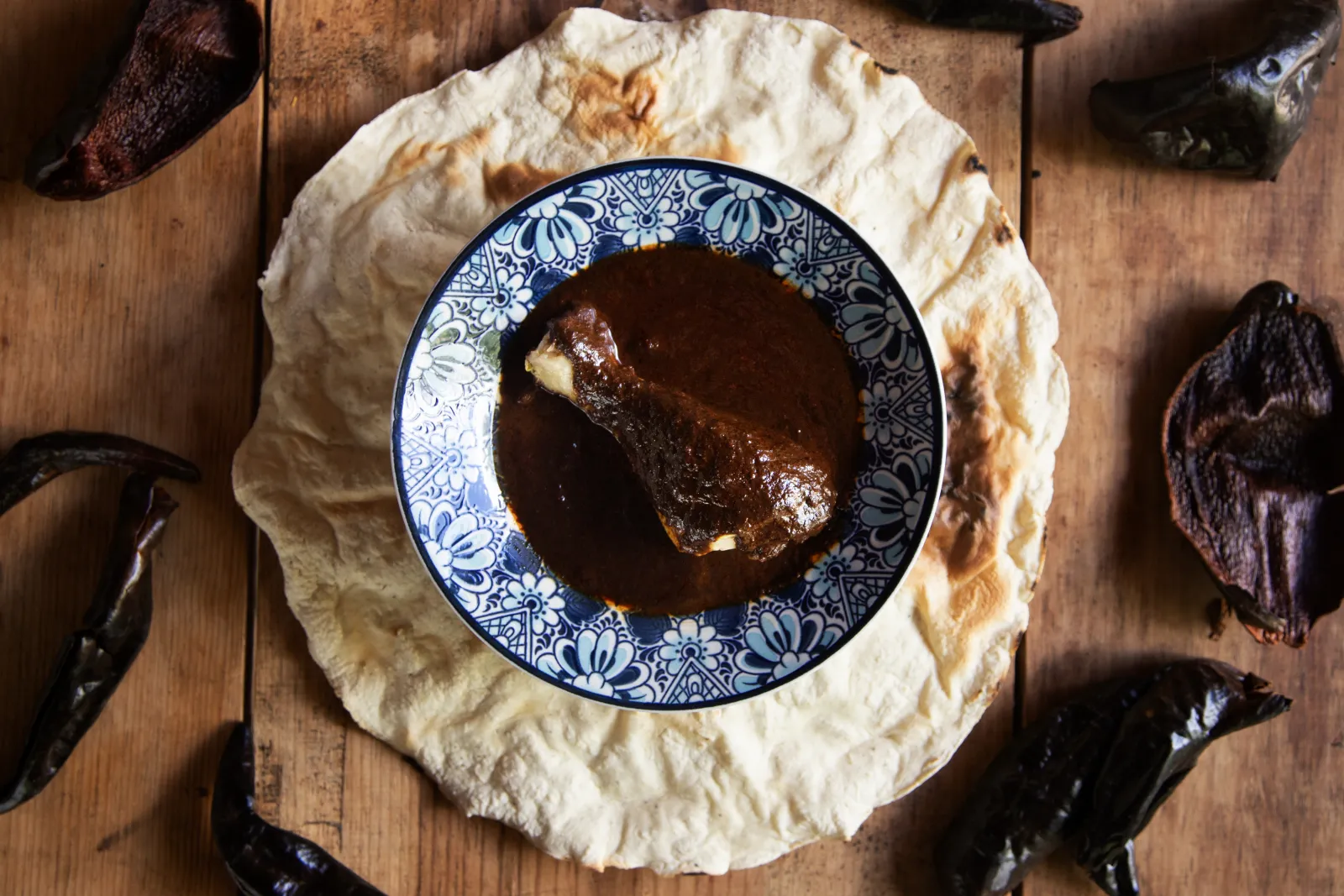

Most of the black in Oaxaca’s mole negro comes from ¼ cup of chile seeds you set out to burn. They go into a dry skillet until they’re shiny and jet black, get a rinse in cold water to wash off the ash, and end up in the blender. The chiles themselves are treated more gently: 8 to 12 minutes per batch over medium-low heat, just until they turn chocolate brown inside. Mole negro is the darkest of the moles of Oaxaca, a state in southern Mexico, a thick bittersweet sauce of dried chiles, nuts, seeds, plantain and chocolate served over chicken or turkey at big celebrations. This is the version I make for 8.
What is mole negro, and is it worth a weekend
How do you make Oaxacan mole negro? Toast 220 g (7.8 oz) of dried chilhuacle, mulato and pasilla chiles 8 to 12 minutes per batch until chocolate brown inside, soak and blend them. Separately blend the chile seeds charred black and rinsed, a blackened tortilla, almonds, sesame, plantain, raisins, spices and roasted tomatoes. Fry both purees in lard, then simmer 90 minutes with chocolate and avocado leaves before adding poached chicken. Ready in 240 minutes for 8 servings.
Yes, if you like bitter-edged flavors such as espresso or very dark chocolate, and you can split the work over two days. Oaxacans talk about seven moles (negro, coloradito, rojo, amarillo, verde, chichilo and manchamanteles), and negro is the one people plan a party around.
Who it’s for, honestly:
- Good fit → a dinner for 8 to 20 that you want mostly done ahead, or a cook who has already made mole poblano from scratch and wants the next step.
- Not a weeknight project → it takes 240 minutes in one go, about 130 of them hands-on.
- Not for a nut-allergic table without the swaps further down.
- Not for anyone who hates bitterness. The sweetness is there to balance it, not to hide it.
Difficulty, honestly hard. No single step is tricky, but there are many of them, the charring smokes up the kitchen, and you have to judge the chiles by their color inside rather than by the clock.
Mole negro vs mole poblano
The two are often lumped together as “chocolate sauce,” and neither tastes of chocolate. The real split is the toasting. My poblano gets its chiles 10 to 20 seconds a side and anything that smokes goes in the bin, because that sauce wants a barely toasted chile and comes out reddish brown. Mole negro pushes the chiles to chocolate brown and adds charred seeds and a blackened tortilla. It also brings two flavors the poblano doesn’t have: ripe plantain and the anise of avocado leaves. Both rate about 2 out of 5 for heat.
The chiles, and what to buy if you can’t find chilhuacle
For 8 servings, 60 g (2.1 oz) chilhuacle negro, 100 g (3.5 oz) mulato and 60 g (2.1 oz) pasilla, weighed after stemming. Weigh rather than count: dried chiles vary a lot in size.
- Chilhuacle negro (chee-WAH-cleh) → a squat, very dark Oaxacan chile, sweet and tart with a smoky finish. It grows in small plots in the Cañada region of Oaxaca and is expensive even in Mexico.
- Mulato → a dried poblano, almost black, tastes of raisins. Mexican grocers in the US; online in the UK.
- Pasilla → long, thin, dry and slightly bitter. Sold as pasilla or chile negro. Watch out: in some US stores, anchos are labeled “pasilla,” so go by shape.
My no-chilhuacle blend is 120 g (4.2 oz) mulato, 60 g (2.1 oz) pasilla and 40 g (1.4 oz) ancho. The sauce turns out a shade sweeter and browner, without the chilhuacle’s tart edge, but it still goes black, because the color depends mostly on how far you toast the chiles and on the charred seeds. Guajillo sometimes gets suggested as a stand-in; it pulls the color toward red, so I leave it out.
Avocado leaves, which ones are safe to cook with
Use only dried Mexican avocado leaves sold for cooking, the kind that smell of anise when you crush one. Don’t pick leaves off a backyard Hass tree or any tree whose variety you don’t know. Avocado plants contain persin, which is toxic to goats, horses, birds and other animals. The livestock poisonings on record involved leaves of Guatemalan-type avocados, the line Hass descends from, while Mexican-type leaves caused no problems in the same trials. Hass leaves also have almost no smell, so they add nothing anyway.
The 3 leaves go in whole and come out before serving. Their anise aroma comes from the same compound as tarragon’s; at this amount I don’t see a reason for concern, but I wouldn’t drink avocado-leaf tea daily during pregnancy.
Where to buy them. Mexican grocers in the US sell them dried; in the UK, small 10 g packets turn up at online Mexican and spice shops. No leaves at all? Use 2 bay leaves and ¼ tsp anise seed. Some Oaxacan cooks use hoja santa instead, which tastes greener and more herbal.
Other swaps for a US or UK kitchen
| In the recipe | Easy substitute | What changes |
|---|---|---|
| Lard, 100 g (½ cup) | Vegetable oil, 110 ml (scant ½ cup) | Cleaner, less rich, less savory |
| Mexican table chocolate, 60 g (2.1 oz) | 40 g (1.4 oz) dark chocolate + 1 tbsp sugar + pinch of cinnamon | Close; slightly less grainy |
| Ripe plantain, 100 g (3.5 oz) | Half a firm banana | Sweeter, softer, more banana flavor |
| Brioche-style bread, 40 g (1.4 oz) | Any day-old white roll | Nothing you’d notice |
| Tomatillos, 170 g (6 oz) | Canned tomatillos, drained | Skip the roasting; a little less smoky |
| Piloncillo | Dark brown sugar | Nothing you’d notice |
Equipment. A heavy griddle or cast-iron skillet, a strong blender, a fine strainer and a heavy pot of at least 6 quarts (6 liters). With a weaker blender, work in smaller batches and strain twice. A range hood or an open window is not optional on charring day.
How dark to toast, and why mole negro turns bitter
Mole negro should be a little bitter; it should never taste burnt. Three things cross that line:
- A carbonized chile → once a chile turns ash grey and crumbles, it won’t rehydrate and it leaves the sauce gritty and acrid. Toss it.
- Bitter soaking water → always taste it. If it’s bitter, blend with broth instead.
- Unrinsed seeds → the loose ash tastes like a dirty grill. A swirl in cold water removes it.
If the finished sauce is still too bitter, add sugar a tablespoon at a time until the sweetness wraps around the bitterness without masking it. Undertoasting is the opposite mistake: chiles left at tobacco brown give you a reddish-brown mole, not a black one.
A two-day plan, and scaling it up
- Day 1, about 220 minutes → poach the chicken, refrigerate the meat and broth separately, and make the base through the 90-minute simmer. Cool it uncovered in shallow containers and cover once cold.
- Day 2, about 40 minutes → rewarm the base with a splash of broth, thin it, add the chicken for 20 minutes and cook rice alongside.
- Three days, as many Oaxacan households do it → shop, stem and toast on day 1; blend and cook the base on day 2; serve on day 3.
Scaling. Allow about 27.5 g (1 oz) dried chile and 250 g (9 oz) bone-in meat per person: 165 g (5.8 oz) chiles and 1.5 kg (3.3 lb) chicken for 6; 330 g (11.6 oz) and 3 kg (6.6 lb) for 12; 550 g (1.2 lb) and 5 kg (11 lb) for 20. For 20, make the base in two batches, because a home blender and pot can’t fry that much puree properly at once.
Mistakes that ruin mole negro
- Raising the heat under the chiles → the outside burns before the inside darkens. Medium-low, and patience.
- Skipping the strainer → the sauce feels sandy. Strain both purees, every time.
- Cutting the frying short → each puree needs its full 10 minutes in hot lard, or the sauce tastes raw.
- Simmering over medium → the bottom catches and that burnt layer spreads through the pot. Low heat, stir every 10 minutes.
- Panicking when it thickens overnight → it always does. Loosen with broth when reheating.
Heat, kids and allergens
Heat, about 2 out of 5. Chilhuacle, mulato and pasilla are mild chiles; the bitterness registers before the heat.
Kids. Many find it too bitter at first. For them, sweeten their portion a little more and serve it with more rice than sauce.
Allergens. Almonds (tree nut), peanuts, sesame and wheat from the bread. Some Mexican table chocolates contain soy lecithin or traces of milk, so check the label.
- Gluten-free → swap the bread for a second corn tortilla, toasted but not blackened.
- Nut-free → drop the almonds and peanuts and add 30 g (¼ cup) extra toasted pepitas.
- Sesame-free → 30 g more pepitas, and skip the sesame on top.
Shortcuts and variations
- Jarred or packaged mole negro paste → start with equal weights of paste and broth and add more broth if the package calls for it. I fry it first in 1 tbsp lard, add 2 toasted avocado leaves and a blended roasted tomato, and simmer 15 minutes.
- Turkey → bone-in turkey breast poached in salted water 35 to 40 minutes, to 165°F (74°C) in the thickest part, for two half breasts weighing 5 to 6 lb (2.3 to 2.7 kg) in total. Thighs take longer, so use a thermometer.
- Pork → pork broth and pork instead of chicken; the base stays the same.
- Vegetarian → vegetable broth and 1 kg (2.2 lb) boiled potato, zucchini and chayote, or corn tortillas dipped in the sauce and folded around fresh cheese (enmoladas).
- In Oaxaca → mole negro also fills tamales wrapped in banana leaves.
What mole negro costs in the US
The chilhuacle dominates the bill. Mexican-grown dried chilhuacles often sell for over $200 a pound in the US, so the 60 g (2.1 oz) in this recipe runs more than $26 on its own. That’s the strongest argument for the no-chilhuacle blend.
The chicken is cheap by comparison: at the August 2026 US average of $1.67 a pound for bone-in chicken legs, 2 kg (4.4 lb) costs $7.36, about $0.92 a serving. A 500 g (17.6 oz) packet of Oaxacan mole negro paste was selling at Walmart from $15 in October 2026.
Yield. 8 servings of 2 chicken pieces with about 250 ml (1 cup) of sauce each; the batch makes roughly 2 liters (8½ cups) of mole in my kitchen.
Serving, storing and freezing the paste
How it’s served. Chicken or turkey pieces covered in sauce, toasted sesame on top, warm corn tortillas, and Mexican red rice or plain white rice on the side. For a longer meal, a pot of frijoles de la olla made with black beans fits right in, and a mug of champurrado uses the same table chocolate. For a full Oaxacan spread, start with tlayudas. If what you want is a brothy weeknight mole, mole de olla is a different dish entirely, a beef and vegetable soup with chile.
Fridge. With the chicken in it, treat it like any cooked poultry dish: no more than 2 hours at room temperature and 3 to 4 days at 40°F (4°C) or below, in containers under 3 in (7.5 cm) deep. The undiluted base keeps the same 3 to 4 days.
Freezer. The undiluted base freezes best: in flat 300 g (10.5 oz) bags, each enough for 2 or 3 people once thinned, it keeps good quality for up to 6 months. Sauce with the chicken in it, 2 to 6 months. Thaw overnight in the fridge.
Reheating. Add ½ cup broth for every 2 cups of mole, warm over low heat while stirring until it bubbles and the chicken reaches 165°F (74°C) in the center. High heat makes it catch, and then it really does taste burnt.
Frequently asked questions
What is mole negro made of? Dried chiles (chilhuacle negro, mulato and pasilla), their charred seeds, a blackened tortilla, almonds, peanuts, sesame, raisins, ripe plantain, bread, roasted tomatoes and tomatillos, onion, garlic, spices, Mexican chocolate and avocado leaves, cooked in lard and chicken broth.
What’s the difference between mole negro and mole poblano? Mole negro is from Oaxaca and uses chilhuacle negro, chiles toasted to chocolate brown, charred seeds, plantain and avocado leaves. Mole poblano is from Puebla, with barely toasted chiles, and comes out reddish brown. Negro is also more bitter and the longer job, by about 80 minutes for the same 8 servings.
What can I substitute for chilhuacle chiles? Mulato plus ancho. For 8 servings, 120 g (4.2 oz) mulato, 60 g (2.1 oz) pasilla and 40 g (1.4 oz) ancho. Slightly sweeter and browner, still black.
Are avocado leaves safe to eat? Dried Mexican avocado leaves sold for cooking are the ones used in Mexican kitchens, in small amounts, and are removed before serving. Don’t use leaves from Hass or unknown trees: Guatemalan-type avocado leaves have poisoned livestock, and Hass leaves have little flavor anyway.
Why is my mole negro bitter? Carbonized chiles, bitter soaking water or unrinsed seeds. Some bitterness is the point; balance it with sugar a tablespoon at a time.
Can you freeze mole negro paste? Yes. The undiluted base keeps good quality up to 6 months in flat freezer bags. Thaw in the fridge and thin with broth as you reheat.
Is mole negro spicy? Not very, about 2 out of 5. The bitterness comes through before the heat.
Nutrition
Per serving (2 chicken pieces with about 250 ml / 1 cup sauce, without rice or tortillas), worked out ingredient by ingredient from the quantities above, counting 1.4 kg (3.1 lb) of meat in the 2 kg of bone-in thighs, all the lard and the 2 tbsp sugar. Chilhuacle and mulato use the values for dried ancho, the closest match:
- Calories: 611 kcal
- Protein: 43 g
- Carbohydrates: 45 g
- Fat: 31 g, of which 9 g saturated
- Fiber: 10 g
- Sodium: 947 mg
Cutting the lard by 40 g (about 3 tbsp) saves roughly 45 kcal a serving. Each extra tablespoon of sugar adds about 6 kcal per serving.
The first time I crushed a dried avocado leaf over my counter in Colombia, I expected something green and buttery and got a clear smell of anise instead. That is the note people can’t place when they taste this sauce, and it’s why I’d rather use bay and anise than skip the leaves altogether. Mole negro rewards the cook who lets the chiles take their time. Josnaisis.