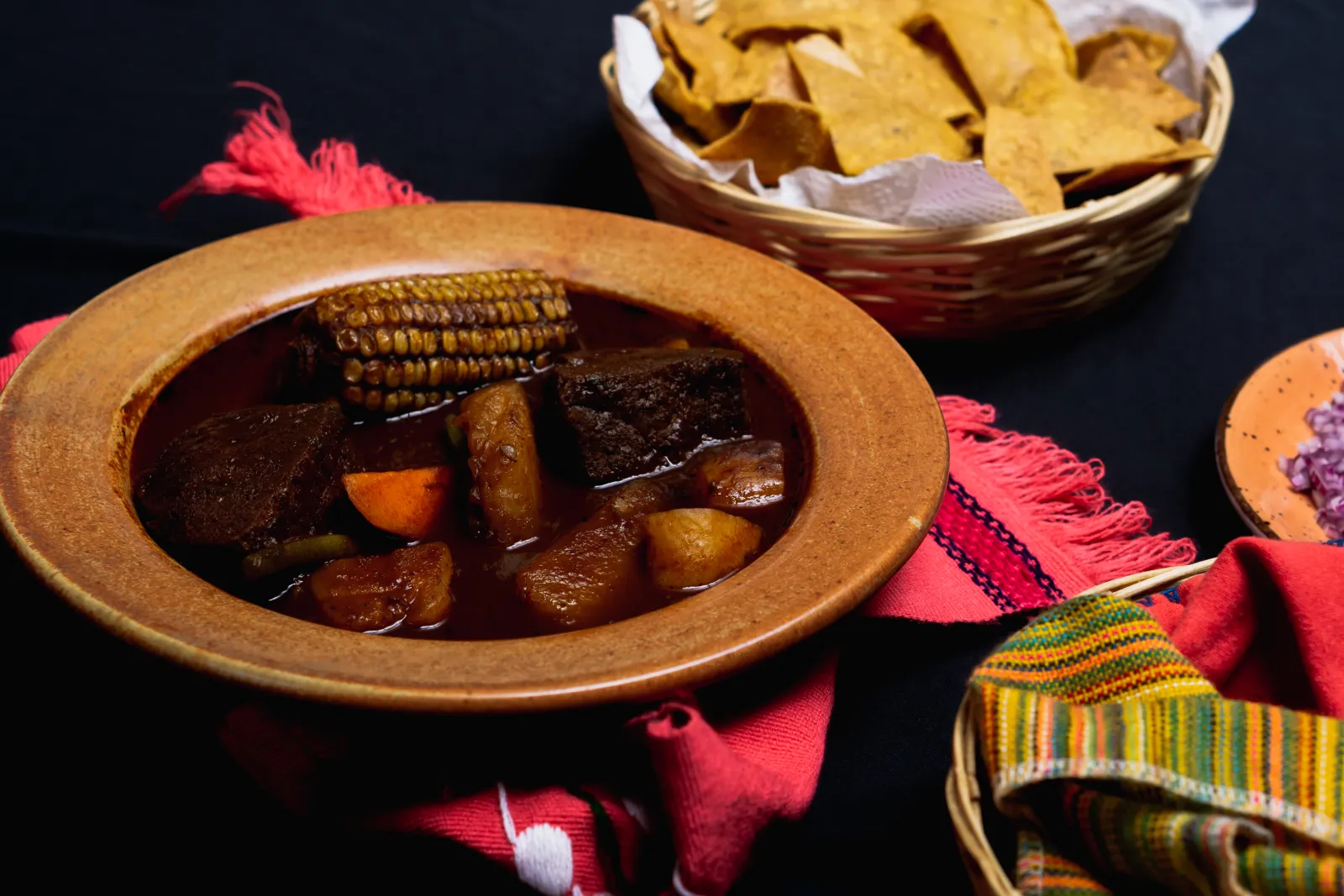

Mole de olla (MOH-leh deh OH-yah) translates as pot mole, and it is the soup side of the Mexican mole family: beef shank simmered on the bone until it falls away, a thin sauce of dried guajillo and ancho chiles strained into the broth, then corn, chayote, carrots, potatoes, squash and green beans. A tart cactus fruit called xoconostle and a pungent herb called epazote finish it. Most of the three hours are hands-off, and both of the hard-to-find ingredients have supermarket stand-ins.
What is mole de olla, and is it worth three hours?
How do you make mole de olla? Simmer bone-in beef shank from cold water with onion, garlic and bay, skim the foam for 10 to 15 minutes and simmer gently for 90 minutes. Strain in a fried sauce of toasted guajillo and ancho chiles blended with charred tomato, cook 30 minutes more, then add the vegetables in three waves over the last 30, with xoconostle and epazote near the end. 185 minutes for 6 servings.
It is a central Mexican beef and vegetable soup, and it is flavored with a thin mole of guajillo, pasilla, garlic, onion and epazote and served with chopped serrano and lime. The word mole comes from the Nahuatl molli, which can mean sauce or soup; this one has no chocolate, nuts or seeds, and nothing in common with mole poblano beyond dried chiles.
Worth it? Yes, on a weekend. About 75 of the 185 minutes are hands-on, most of them while the beef simmers on its own, and the pot feeds six as a full meal. It tastes even better the next day. Skip it on a weeknight unless you own a pressure cooker, which brings it to about 2½ hours. Difficulty, medium: more steps than a plain beef soup, and the one that can ruin it is scorching the chiles.
How it compares with other Mexican soups
| Soup | Meat | What defines it | Time | Calories per bowl |
|---|---|---|---|---|
| Mole de olla | bone-in shank | guajillo and ancho broth, xoconostle, epazote | 185 min | 427 |
| Caldo de res | shank and short ribs | clear broth, chile only at the table | 185 min | 524 |
| Menudo | tripe and feet | guajillo broth, no vegetables in the pot | 270 min | 407 |
| Pozole rojo | pork | hominy in red chile, raw garnishes | 150 min | 671 |
If anyone at your table refuses chile, caldo de res is the same pot without the sauce. Mole de olla is leaner per bowl because it uses shank alone, no short ribs. And if what you want is a Sunday pot thickened with starch rather than chile, Colombian sancocho gets its body from green plantain and cassava.
Ingredients, and the four you may need to hunt for
The full list is in the recipe card: 1.5 kg (3.3 lb) of bone-in shank, 3 liters (about 3 quarts) of water, 6 dried chiles, 9 oz (250 g) of tomatoes and about 4½ lb (2 kg) of vegetables, cob included. Most of it is in any supermarket. Four items are not.
Beef shank. Lower-leg meat sold in round slices with bone and marrow in the center. Its connective tissue melts into gelatin over 2 hours at a bare simmer, which gives the broth body. Ask for slices about 1½ inches (4 cm) thick and plan on 9 oz (250 g) bone-in per bowl, which leaves roughly 3½ oz (100 g) of cooked meat. US Latino butchers call it chambarete; supermarkets label it beef shank, cross cut. In the UK ask for beef shin on the bone, cut across like osso buco. Boneless stew meat works if you add 1 lb (500 g) of marrow bones.
Guajillo and ancho chiles. Guajillo gives the red color and a clean, mild heat, 2,500 to 5,000 Scoville units. Ancho, the dried poblano, adds sweetness and depth at 1,000 to 2,000. Pasilla can replace the ancho for a darker, slightly bitter broth. All three are in the Hispanic aisle of most large US chains; in the UK, buy them from Mexican specialist shops online.
Xoconostle. A sour prickly pear from certain cactus species of central Mexico. It stays firm in the soup and adds tartness. Latino groceries in the US sell it fresh or dried, and it turns up online. The swap is 6 small tomatillos, halved, for 2 to 3 xoconostles: same sourness, softer texture. In the UK, canned tomatillos from Mexican specialist shops are the practical option. Chopped nopales also work but turn a little slimy.
Epazote. A pungent herb used in Mexican beans and soups. You need 2 fresh sprigs (10 g) or 1 tsp dried, and it goes in for the last 5 minutes, because in my kitchen a longer cook turns the broth bitter. No epazote? A few mint leaves (some cooks put a mint sprig in their mole de olla broth) or cilantro. Good soup, different smell.
Chayote is a pale green, pear-shaped squash, mild and slightly crisp after cooking, sold in most large US chains; in the UK and the Caribbean it is christophene or cho cho. Peel it under running water, since the sap leaves your hands tacky.
The stovetop plan, minute by minute
The chile sauce is made while the beef simmers, so it adds work but not time.
The key technique, when the sauce goes in
The sauce goes in at 90 minutes, after the skimming. Once the broth is red you can no longer see the foam, and anything you don’t remove clouds the pot. Thirty minutes with the beef is enough to cook out the raw chile taste before the vegetables arrive.
Toast for seconds. 10 to 15 seconds a side over medium heat, until the chile smells toasty and turns a shade darker. If it smokes or blackens, throw it out and toast another.
Blend with broth, strain, fry. I blend with broth from the pot instead of the soaking water, which carries bitterness from the chile skins. Straining removes the tough guajillo skin. Frying the sauce for 5 minutes darkens it from bright red to brick red and cooks off the raw tomato.
The vegetable order
| Minutes before the end | Vegetables | Why |
|---|---|---|
| 30 | corn, carrots | the hardest |
| 20 | potatoes, chayote, xoconostle | need time to turn tender |
| 10 | zucchini, green beans | they turn mushy if they go in earlier |
| 5 | epazote | turns bitter with longer cooking |
With sweet yellow supermarket corn, which cooks faster, add it with the potatoes.
Signs it is going well. Grey foam turns to a thin white film after 10 to 15 minutes; the fried sauce goes from bright to brick red; at 2 hours a fork slides into the beef. If it resists, give it 15 to 20 more minutes before the first vegetables.
Pressure cooker, Instant Pot and slow cooker
- Stovetop pressure cooker → skim with the lid off, lock it and cook 35 minutes from when it reaches pressure for 1½-inch slices, up to 45 for thicker ones, then 10 minutes of natural release. Add the sauce and finish uncovered. About 2½ hours in all.
- Instant Pot → skim on Sauté, then 40 minutes at high pressure and 15 minutes natural release. Simmer the sauce in on Sauté for 15 minutes, then the corn, carrots, potatoes, chayote and xoconostle 3 minutes at high pressure with quick release; zucchini, green beans and epazote on Sauté for 8.
- Slow cooker → the beef with the onion, garlic and bay for 8 hours on low, then sauce and vegetables on the stove, about 45 minutes.
The pressure only speeds up the beef. The sauce and vegetables take the same time either way.
Mistakes that ruin mole de olla
- Bitter broth. Over-toasted chiles, seeds or veins left in, or epazote cooked too long. Seconds on the skillet, clean chiles, epazote at the end.
- Cloudy broth. The sauce went in before skimming, or the pot boiled hard. Skim first and keep it trembling, not bubbling.
- Gritty texture. The sauce was not strained. Use a fine sieve even with a strong blender.
- Mushy vegetables. Everything went in at once. Three waves.
- Too salty. All the salt went in at the start. One teaspoon to begin, the rest at the end.
- Tough beef. Not enough time. Shank firms up before it softens; give it 20 more minutes.
Before you cook, heat, kids and allergens
Heat, 1 out of 5. With seeds and veins removed the broth is warm, not hot. The heat sits on the table: serrano runs 10,000 to 23,000 Scoville units. For more, blend 2 dried árbol chiles into the sauce or put a chile de árbol salsa on the table.
Kids usually like it, since it is mild and a little sweet from the corn and carrots. Serve their beef off the bone and check for splinters.
Allergens. No gluten, dairy, egg, nuts or fish. With corn tortillas the whole meal is gluten-free. If you add bouillon, read the label.
Versions worth knowing
- With chochoyotes, little corn-masa dumplings → mix 7 oz (200 g) of fresh masa with 1 tsp lard or oil, 1 tbsp chopped epazote and salt. Roll 3/4-inch (2 cm) balls, press a dimple in each with a fingertip and add them for the last 10 minutes at a gentle simmer; a hard boil breaks them.
- Ancho and pasilla instead of guajillo and ancho → a darker, slightly bitter broth with the same heat.
- Pork → there are home versions with pork backbone or pork shank in place of beef. Cook it until fork-tender before the sauce goes in.
- Vegetarian → vegetable stock with mushrooms instead of beef, same sauce. A different soup, but it keeps the chile, the tartness and the epazote.
- Lighter → chill it overnight and lift off the fat. Each tablespoon removed, about ½ oz (13 g), is roughly 115 calories out of the pot.
Make-ahead plan
Cook the beef with the sauce the day before, cool it and refrigerate. Next day the fat sets in a hard layer you lift off with a spoon. On serving day only the vegetables are left, 30 minutes once the broth is back at a boil, which takes about 20: dinner in an hour.
Scaling for 4, 12 or 20
| People | Bone-in shank | Water | Guajillo | Ancho | Tomatoes | Vegetables | Pot |
|---|---|---|---|---|---|---|---|
| 4 | 1 kg (2.2 lb) | 2 L (2 qt) | 3 | 1 | 170 g (6 oz) | 1.35 kg (3 lb) | 6 L (6 qt) |
| 6 | 1.5 kg (3.3 lb) | 3 L (3 qt) | 4 | 2 | 250 g (9 oz) | 2 kg (4½ lb) | 8 L (8 qt) |
| 12 | 3 kg (6.6 lb) | 6 L (6⅓ qt) | 8 | 4 | 500 g (1.1 lb) | 4 kg (8¾ lb) | 15 L (16 qt) |
| 20 | 5 kg (11 lb) | 9 L (9½ qt) | 13 | 7 | 830 g (1.8 lb) | 6.7 kg (14¾ lb) | 20 L (21 qt) |
The beef times do not change. A 15- or 20-liter pot can take 40 minutes or more to come to a boil, so start earlier, and blend the sauce for 20 in two batches.
What mole de olla costs in the US
With US average prices for August 2026 and retail vegetable prices from October 2026, a pot for 6 costs about $36.78, or $6.13 a bowl. The beef is 77% of it.
Shank has no national average price, so the beef line uses the average for boneless beef for stew, $8.587 a pound; bone-in shank from a Latino butcher may cost less. The total leaves out the dried chiles, green beans, epazote and xoconostle, which vary too much by store to price, plus oil, salt and spices. For the UK I won’t give you a pound figure here.
How to serve it, store it and reheat it
What to expect. A light, brick-red broth with a gentle chile warmth, a little sourness from the xoconostle and the smell of epazote; beef that slides off the bone; vegetables in whole pieces.
Serving. One piece of beef on the bone, a piece of corn and some of each vegetable per bowl, broth over the top. Chopped onion, serrano, lime and warm tortillas on the table. A side of Mexican red rice is common.
Fridge. No more than 2 hours at room temperature, then 3 to 4 days at 40°F (4°C) or below, in shallow containers. Use glass if you can: chile broth has stained more than one plastic tub in my kitchen.
Freezer. Soups and stews with meat keep their quality for 2 to 3 months. Freeze the broth with the beef, corn and carrots; potatoes turn mealy and zucchini watery once thawed, so add them fresh when you reheat.
Reheating. Thaw in the fridge and bring to a full boil, as you should with any soup, or at least 165°F (74°C). If the zucchini is already in, heat more gently, just until it bubbles at the edge.
Mole de olla questions
Is mole de olla the same as caldo de res? Almost. It is the same beef-and-vegetable soup with a strained sauce of dried chiles and tomato added, plus xoconostle and epazote. Caldo de res has a clear broth, and the chile goes on the table.
Why is it called mole if it is a soup? Because molli, in Nahuatl, can mean sauce or soup. It shares dried chiles with mole poblano and little else.
What can I use instead of xoconostle? Tomatillos. For 2 to 3 xoconostles, use 6 small ones, halved. Chopped nopales work too. With neither, squeeze extra lime into each bowl.
What can I use instead of epazote? A few mint or cilantro leaves. The soup is still good; it just smells different.
Is mole de olla spicy? Mildly. Guajillo and ancho without seeds or veins give warmth, not burn; the serrano on the table is where the heat is.
How long does beef shank take to get tender? In an Instant Pot, 40 minutes at high pressure plus 15 of natural release; in a stovetop pressure cooker, 35 plus 10; on a plain stovetop, about 2 hours at a bare simmer.
Can you freeze mole de olla? Yes, for 2 to 3 months at best quality. Freeze broth, beef, corn and carrots; add fresh potatoes and zucchini when reheating.
What are chochoyotes? Small corn-masa dumplings with a dimple in the center, cooked in the broth for the last 10 minutes.
Nutrition per bowl
Per bowl (1 of 6, without tortillas or dumplings), worked out ingredient by ingredient with the amounts in this recipe, counting 1,050 g (2.3 lb) of edible meat in the 1.5 kg (3.3 lb) of shank:
- Calories: 427
- Protein: 45 g
- Carbohydrates: 40 g
- Fat: 11 g, of which 3 g saturated
- Fiber: 9 g
- Sugars: 10 g
- Sodium: 936 mg
The figures use lean shank meat, so they leave out the marrow and any fat you don’t skim; read them as a floor. Of the sodium, 775 mg per bowl comes from the salt in the pot. Two corn tortillas add about 105 calories.
In Venezuela the beef soup of my childhood was hervido, with a clear broth, so the first time I strained a guajillo sauce into a pot of beef I felt I was muddying something that was finished. The next day’s bowl changed my mind. Now when I cook beef broth for the week I turn half of it red, with a xoconostle when I find one and tomatillos when I don’t. The chile has to wait until the foam is gone. Josnaisis.