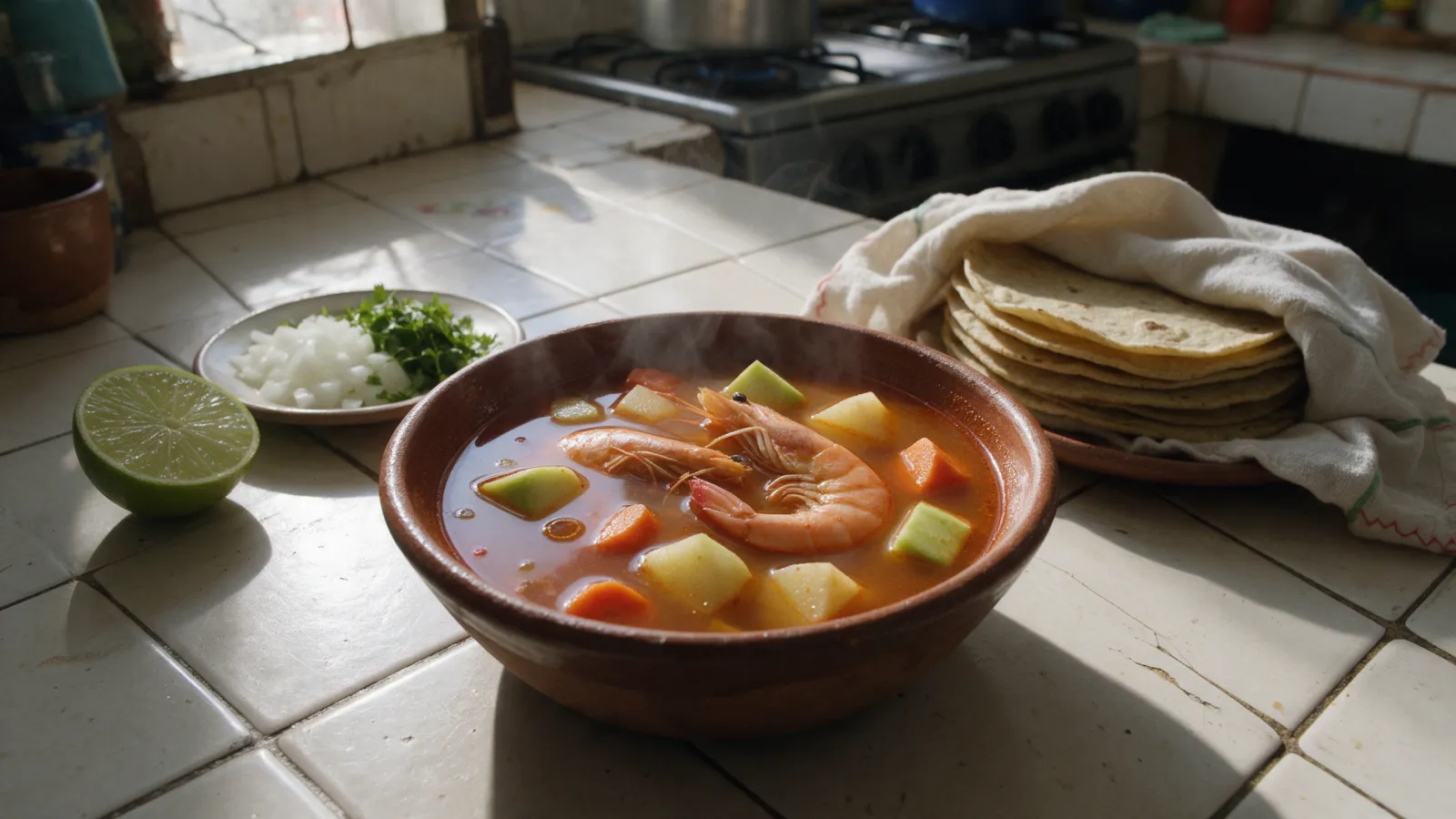

Caldo de camarón (KAHL-doh deh kah-mah-ROHN) is Mexico’s red shrimp soup: a brothy, gently spicy soup tinted with dried guajillo chiles and chipotle, with potato, carrot and chayote, whole shrimp, and a squeeze of lime at the table. Mexican seafood restaurants and cantinas serve it, and plenty of Mexican families make it during Lent. The flavor comes less from the shrimp you eat than from the parts you would normally throw away, the shells and heads, plus a handful of dried shrimp blended into the chile base. That is why this version treats the shrimp as two ingredients: the shells go into a 20-minute broth, and the meat goes in last, for 3 minutes.
Is caldo de camarón worth making at home
How do you make caldo de camarón? Peel raw shell-on shrimp, toast the shells in oil and simmer them for 20 minutes to make the broth. Simmer guajillo chiles, tomatoes and dried shrimp, blend with chipotle, strain and fry for 8 minutes. Add the strained broth, cook potato, carrot and chayote for 15 minutes, and add the raw shrimp for the last 3. Ready in 75 minutes for 6 servings.
Yes, if you like seafood and want a one-pot meal that stretches 1⅓ lb (600 g) of shrimp across 6 bowls. It is a good pick for a cold evening, a Lenten Friday or a crowd, since the broth and chile base can be made the day before.
What makes it different from other shrimp soups. It is not creamy like a chowder or a bisque. The body is a light, brick-red broth; the flavor is concentrated shrimp, the fruity, mild heat of guajillo and a slow, smoky warmth from chipotle.
Who might skip it. Anyone with a shellfish allergy, obviously. And if you dislike a strong seafood taste, the dried shrimp gives it a briny edge that is not for everyone; leave it out and the soup is cleaner and milder.
Time and effort. 75 minutes from start to finish, about 35 of them hands-on. Peeling the shrimp is the slowest job, around 10 minutes in my kitchen for 1⅓ lb. Nothing here is technically hard; the three things to watch are not burning the guajillos, straining the chile base and pulling the shrimp in time.
Ingredients for caldo de camarón and what to buy in the US and UK
Most of this is a normal supermarket shop. Three items may need a Latin, Mexican or Asian grocery, or an online order: dried shrimp, guajillo chiles and epazote.
Shrimp. Buy raw, shell-on shrimp, fresh or frozen; head-on if you can find them, because the heads make the richest broth. In the UK, raw shell-on king prawns are the closest match. Peeled or precooked shrimp leave you with no shells, which is most of the soup’s flavor. Trust your nose: fresh shrimp smell mild, never sour or of ammonia. Black spots near the head or tail are not spoilage but melanosis, an enzyme reaction.
Dried shrimp. Small, salty, sun-dried shrimp sold in bags. They are salted to preserve them, so the salt is intense; look for them in Latin and Asian stores or online. In this recipe they are simmered with the chiles and blended, so they season the broth rather than being eaten whole. Pinch off the eyes first, because they can make the broth bitter.
| If you can’t find | Use | What changes |
|---|---|---|
| Dried shrimp, 50 g (1¾ oz) | Leave it out, and toast the shells and heads well | Cleaner, less salty broth; you will need the full 1 tsp salt |
| Guajillo chiles, 4 | 2 tbsp sweet paprika in the blender | Same color, flatter flavor, no fruity note |
| Chipotle in adobo, 2 | 1 tsp hot smoked paprika (pimentón) | The smoke stays, the tang of the adobo goes |
| Epazote, 2 sprigs | 10 g (a small handful) extra cilantro | Fresher, less herbal aroma |
| Chayote, 1 | 1 zucchini (courgette), added for the last 5 minutes | Softer texture; it cooks faster |
Equipment. A 4- to 5-quart (4-5 liter) pot, a small saucepan, a blender and a sieve. An instant-read thermometer is optional, handy with jumbo shrimp.
How to plan caldo de camarón, make-ahead and scaling
The order that works: peel everything first, get the shells simmering, and make the chile base while the broth looks after itself.
The day before. Make the shell broth and the fried chile base and refrigerate them in separate covered containers; keep the cut potatoes in cold water. On the day, it is broth and base into the pot, a boil, 15 minutes of vegetables and 3 minutes of shrimp, about 25 minutes. Buy fresh shrimp no more than a day or two ahead: raw seafood keeps 1 to 2 days in a fridge at 40°F (4°C) or below. Frozen raw shrimp thaw best in the fridge overnight, or in their sealed bag in cold water.
Cues that each step is on track.
- Shells turn from grey to orange and smell like grilled shrimp after 3 to 4 minutes in the oil.
- Guajillos turn bright red and fragrant within a minute, flipped once halfway; dark smoke means they burned and will make the soup bitter.
- Chile base darkens from bright red to brick red and thickens a little in about 8 minutes of frying.
- Vegetables are ready when a knife slides into the potato and carrot easily, at around 15 minutes.
Feeding a crowd. Allow about 100 g (3½ oz) of shell-on shrimp and 400 ml (1⅔ cups) of soup per person as a main course; served in mugs as an appetizer, the pot covers twice as many.
| Servings | Shell-on shrimp | Dried shrimp | Guajillos | Chipotles | Tomatoes | Total water | Pot |
|---|---|---|---|---|---|---|---|
| 6 | 600 g (1⅓ lb) | 50 g (1¾ oz) | 4 | 2 | 400 g (14 oz) | 2 liters (8½ cups) | 5 qt (5 l) |
| 12 | 1.2 kg (2⅔ lb) | 100 g (3½ oz) | 8 | 4 | 800 g (1¾ lb) | 4 liters (4¼ qt) | 10 qt (10 l) |
| 20 | 2 kg (4½ lb) | 170 g (6 oz) | 13 | 6 to 7 | 1.35 kg (3 lb) | 6.7 liters (7 qt) | two 8 qt (8 l) |
Scale the vegetables the same way; for 20, that is 1 kg (2¼ lb) potatoes, 670 g (1½ lb) carrots and 3 to 4 chayotes. For 12 or more, make the base the day before and cook the shrimp at the end in 1 kg (2¼ lb) batches. Salt rises with the dried shrimp, so add half and taste.
What to know before you cook, shrimp doneness, heat and allergens
The one thing that ruins caldo de camarón is overcooked shrimp. Shrimp proteins tighten as they heat; once set, more heat squeezes out their water and they turn rubbery. In a soup the risk is higher than in a pan, because the shrimp sit in hot liquid even after the burner is off.
So the broth should barely bubble when the shrimp go in, medium shrimp come out after 2 minutes and large ones after 3, and the soup goes straight to the table. Look for a loose C; a tight O means overcooked. Cooked shrimp are firm, pearly and opaque, and most seafood is done at 145°F (63°C). If the soup has to wait, keep it hot without the shrimp and add them when people sit down.
Other mistakes, and the fix.
- Bitter soup → burned guajillos or the eyes left on the dried shrimp. Toast the chiles 30 seconds per side at most.
- Gritty soup → the chile base was not strained.
- Too salty → all the salt went in at the start. Dried shrimp and adobo are salty; add ½ tsp, then taste at the end.
- Weak, watery flavor → plain water instead of shell broth, or peeled shrimp. Toasting the shells before simmering is the 4 minutes that matter most.
Heat level. About 2 out of 5 with 2 chipotles, 3 out of 5 with 3. Guajillos are mild, 2,500 to 5,000 Scoville heat units, so for kids leave the chipotle out of the blender and put chopped chipotle on the table for the adults.
Allergens. Crustacean shellfish, one of the 9 major allergens in the US and one of the 14 the EU and UK require on labels. A shellfish-allergic guest cannot have the broth either: the shells and dried shrimp are in the base. Some shrimp are treated with sulfites to prevent black spot, and in the US sulfited shrimp must say so on the label. No gluten, dairy, egg or nuts in the recipe; check the chipotle can if you cook for someone with celiac disease.
Epazote in pregnancy. Epazote is generally advised against in pregnancy, mainly because of its oil and medicinal use. When I cook for someone pregnant, I use cilantro.
Which version of caldo de camarón to make
- Quickest → skip the shell broth, simmer the chiles with double the dried shrimp, 100 g (3½ oz), blend, fry and top up with 1.5 liters (6⅓ cups) water. With shrimp already peeled, it takes about 50 minutes, and it is saltier and more concentrated, closer to the cantina style. Salt only at the end.
- Cantina style → a concentrated broth with few vegetables, served in a mug as a snack with lime, onion and chile. Some older versions make it with dried shrimp, morita chiles and rice.
- Without dried shrimp → works if the shells and heads are well toasted; a lighter broth that needs almost the full teaspoon of salt.
- Lighter → 1 tbsp oil for the chile base and none for the shells, toasted in a nonstick pot; about 40 kcal less per bowl.
- Hotter → 3 chipotles plus 2 dried chiles de árbol simmered with the guajillos.
- More seafood → add chunks of white fish 5 minutes before the shrimp. For a coconut-based seafood pot, the Colombian seafood stew goes another way entirely.
Caldo de camarón or caldo tlalpeño? Both lean on chipotle, but caldo tlalpeño is a chicken soup with chickpeas and avocado. If you want shrimp in a thick chile sauce rather than a broth, that is camarones a la diabla.
What caldo de camarón costs, and what drives the price
At US prices the pot comes to about $17.61, or $2.94 a bowl. That’s with shrimp at the average supermarket sale price of early 2026, $8.53 a pound, tomatoes and potatoes at August 2026 US averages, and the rest at supermarket ad prices of 9 October 2026.
What drives the cost. The fresh shrimp, 64 % of the total. Dried shrimp, guajillos, chipotle and epazote are left out, but a bag of dried chiles covers several batches.
How to spend less without tasting it. Buy medium raw shell-on shrimp, frozen if they are cheaper; the broth is the same. Keep a bag in the freezer for shells from other shrimp dishes, such as a Mexican shrimp cocktail, and use them for the broth; with extra shells you can drop the fresh shrimp to 400 g (14 oz) and still get a deep flavor.
What to expect from caldo de camarón, serving and storage
Taste and texture. A light, brick-red broth with a clear shrimp flavor, the fruity base of guajillo and a slow chipotle heat; tender, intact vegetables; firm, juicy shrimp.
How it is served. Piping hot in deep bowls or mugs, with chopped white onion, cilantro and half a lime per person squeezed in at the table, which gives the soup its acidity. Corn tortillas or tostadas on the side, a bowl of Mexican red rice if you want it more filling, and an ice-cold michelada on a lazy Sunday.
Storage, in short. Cooked soup keeps 3 to 4 days in the fridge at 40°F (4°C) or below, the same as any cooked seafood, soup or stew; never leave it out more than 2 hours. Cool a big pot quickly by dividing it into shallow containers. The broth and the chile base freeze for 2 to 3 months; I freeze them without the shrimp and cook fresh ones when I reheat.
Reheating without rubbery shrimp. Lift the shrimp out, bring the soup back to a boil, turn off the heat and return the shrimp for 1 minute. Leftovers should be reheated to 165°F (74°C); for a soup, a full boil gets you there. In the microwave, go in 1-minute bursts and stir.
Caldo de camarón FAQ
What is caldo de camarón made of? Fresh shrimp and often dried shrimp, a blended base of guajillo, chipotle, tomato, onion and garlic, potato, carrot and usually chayote or celery, with epazote or cilantro and lime to finish. In Colombia the same chayote is sold as cidra, which is not the squash behind Venezuelan cabello de angel.
What is the difference between caldo de camarón and shrimp bisque? Bisque is a smooth, creamy, thickened soup. Caldo de camarón is a clear, chile-red broth with whole shrimp and chunky vegetables, and no cream.
How long do shrimp take to cook in soup? Two to 3 minutes in barely simmering broth, depending on size, until pink, opaque and curled into a C. Most seafood is done at 145°F (63°C).
Do I have to use dried shrimp? No. It adds depth and salt; without it, toast the shells and heads well and use the full teaspoon of salt.
Can I use frozen shrimp? Yes, raw and shell-on. Thaw overnight in the fridge or in the sealed bag in cold water, and pat dry before peeling.
Can I use the shrimp heads? Yes, they give the broth its deepest flavor. Toast them with the shells, press them with a spoon to release their juices, then strain.
Can you freeze caldo de camarón? Yes, for 2 to 3 months, ideally without the cooked shrimp, which firm up when thawed. Add fresh shrimp when you reheat.
Is caldo de camarón good for a hangover? In Mexico plenty of people swear by it. Treat it as tradition, not a cure.
Nutrition per serving
Per bowl (about 400 ml / 1⅔ cups, one sixth of the pot), calculated ingredient by ingredient with the quantities above and roughly 480 g (17 oz) of shrimp meat after peeling, which is my own estimate. Guajillo was counted as dried ancho chile and chipotle in adobo as canned jalapeño.
- Calories: 252 kcal
- Protein: 24 g
- Carbohydrates: 23 g
- Fat: 8 g, of which 1 g saturated
- Fiber: 6 g
- Sugars: 6 g
- Sodium: 790 mg
Salt supplies about 390 mg of the sodium per bowl, dried shrimp 180 mg, fresh shrimp 95 mg and the adobo 85 mg. Without dried shrimp and with ½ tsp salt, it drops to about 410 mg. The oil adds roughly 60 kcal per bowl; the shell broth adds next to nothing and was not counted.
Shrimp shells used to go straight into my bin. This soup changed that: there is now a bag in my freezer that fills up a little every time I cook shrimp, and a full bag means a pot of caldo. What took me longest to accept was pulling the shrimp after 3 minutes in a soup that has been going for over an hour. Josnaisis.