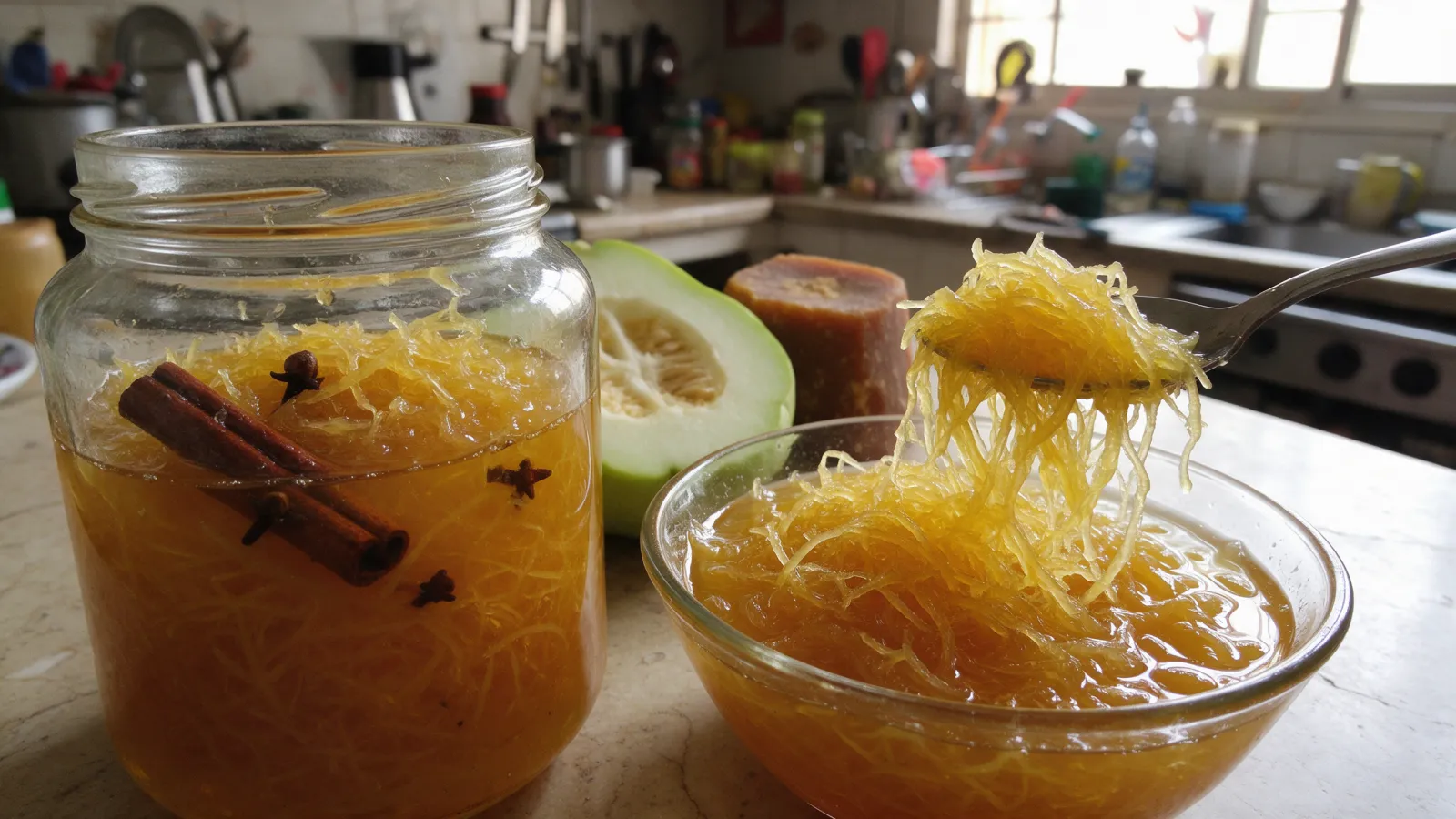

Spaghetti squash is the only squash in a US supermarket that can make this Venezuelan candy, and that is not a coincidence: some Spanish speakers call spaghetti squash cabello de ángel (kah-BEH-yoh deh AHN-hel), “angel hair”, for the same strands. The original fruit is a different squash, the figleaf gourd, Cucurbita ficifolia, known as cabello de ángel in Venezuela, cidra in Spain and chilacayote in Mexico. Either way, the method is the same: cook the squash until it falls into threads, squeeze them dry, and simmer them in their own weight of sugar with cinnamon and cloves until they turn gold and glassy.
What is cabello de angel, and is it worth making?
How do you make cabello de angel? Boil figleaf gourd for 60 minutes, or roast spaghetti squash at 400°F (200°C) for about 40, then pull the flesh into strands and press out the water. Weigh the strands and simmer them for 90 minutes with the same weight of sugar, a cinnamon stick, cloves and lemon, until the syrup reaches 220°F (104-105°C). 240 minutes for 16 servings.
It sits somewhere between a jam and a candied fruit: soft golden threads with a little bite, in a clear syrup that tastes of cinnamon, clove and vanilla. In Venezuela it’s a Christmas sweet kept in jars and eaten cold from a small dish. In Spain it’s mostly a pastry filling, inside ensaimadas, puff pastry turnovers and the small square cakes called cortadillos.
Worth it if you have a free afternoon and like preserves. One batch makes about 1.6 kg (3½ lb), enough for two pint jars and one half-pint, or 16 servings of 100 g (3½ oz).
Maybe skip it if you want a low-sugar dessert: each serving has about 64 g of sugars. And don’t try it with butternut, pumpkin or acorn squash; they collapse into purée.
Time and effort. Four hours on the clock, about 60 minutes hands-on. Nothing is technically hard. People go wrong in three places: the wrong squash, wet strands, and syrup taken too far.
Which squash to use, and why the names get confusing
The squash decides the result: threads, or jam. Only two kinds work.
Figleaf gourd (Cucurbita ficifolia). The traditional one: a hard, smooth green rind with pale streaks, white fibrous flesh and black seeds. It goes by a pile of names, which is why it’s hard to shop for: chilacayote in Mexico and Guatemala, cidra or calabaza confitera in Spain, cabello de ángel in Venezuela, zambo in Ecuador, lacayote in Peru, cayote in Chile and Argentina. Outside Latin America and Spain it’s a rare find. If you see chilacayote, buy it.
Spaghetti squash. The practical choice in the US. Its strands are finer and shorter, it holds more water, and the finished candy is softer, with less chew. After 90 minutes in spiced syrup the flavor is very close. To get 1 kg (2.2 lb) of pressed strands you need about 2-2.3 kg (4½-5 lb) of whole squash, usually two medium ones.
The Colombian trap. In Colombian markets, cidra means chayote, a completely different plant with dense flesh and no strands. If a Colombian shop sells you “cidra” for this recipe, you’ll end up with chunks.
Ingredient swaps for a US or UK kitchen
| Ingredient | What it does | Swap | What changes |
|---|---|---|---|
| Figleaf gourd | Long, firm strands | Spaghetti squash, 2-2.3 kg (4½-5 lb) whole | Finer, softer threads; press harder |
| Granulated sugar, 1 kg (5 cups) | Sweetens and preserves | Piloncillo or panela, 1 kg grated | Dark brown candy, deeper molasses flavor |
| Cinnamon and cloves | The Venezuelan spice | Lemon peel only | The Spanish pastry-filling style |
| Vanilla extract, 1 tsp (5 ml) | Rounds off the syrup | Leave it out | Plainer, more lemony |
Keep the 1:1 ratio by weight: 1 kg (2.2 lb) of sugar for every 1 kg of strands weighed after pressing. Weighing them wet is the most common reason the candy ends up runny or cloying. A kitchen scale matters more here than a thermometer.
How to make spaghetti squash cabello de angel, step by step
The recipe card gives the full figleaf gourd method. With spaghetti squash, the first stage is shorter:
- Roast. Halve the squash lengthwise, scoop out the seeds and roast cut side down at 400°F (200°C) for about 40 minutes, until a fork goes through the skin easily and the flesh pulls into strands.
- Scrape and press. Let it cool for 10 minutes, scrape out the strands with a fork and press them in a colander, or twisted in a kitchen towel, until no more liquid comes out. This is the step that matters most with spaghetti squash.
- Weigh and match. Weigh the strands and measure the same weight of sugar.
- Simmer. Dissolve the sugar in 100 ml (7 tablespoons) of water with the cinnamon, cloves and lemon peel, add the strands and lemon juice, and cook uncovered over low heat, scraping the bottom every 15 minutes, until 220°F (104-105°C).
Make-ahead plan
The strands, cooked, pressed and weighed, keep for 1 day in the fridge in a covered container. Do that the day before and candy day is just the syrup: about 100 minutes. The finished candy is better the next day, so for Christmas I make it two or three days ahead.
Scaling. For 6-8 people, make half: 500 g (1.1 lb) of strands and 500 g (2½ cups) of sugar in a 3-liter (3-quart) pot. For a party of 20, use 1.25 kg (2¾ lb) of each in a 6-8 liter (6-8 quart) pot; it needs longer in the syrup because there is more water to cook off, so go by the thermometer. For baking, a large puff pastry slab or a tray of turnovers takes about 400-500 g (1 lb) of filling.
Who this recipe is for
- If you have a Mexican or Latin market nearby → ask for chilacayote and use the traditional method.
- If you only have a supermarket → spaghetti squash, roasted, and pressed hard.
- If you want it for pastry → take it off at the top of the range, 221°F (105°C), and drain the syrup before filling, so the dough doesn’t go soggy.
- If you’re giving it as a gift → small 250 ml (half-pint) jars, labeled “keep refrigerated”.
The syrup temperature, 220°F (104-105°C)
Cabello de angel comes off the heat at the jelly point, 220°F (104-105°C) at sea level, about 8°F above boiling. That’s lower than the other Venezuelan sweets on this site: the green papaya dessert comes off at 223°F (106°C), and coconut conservas go to 234-237°F (112-114°C) because they have to set firm enough to cut. Here the strands need to stay loose in a spreadable syrup.
At altitude, subtract. Check what temperature water boils at in your kitchen and add about 8°F (4-5°C).
No thermometer? Put a plate in the freezer when you start the syrup. When the strands look translucent, take the pot off the heat, drop a little syrup on the plate and wait 30 seconds. If it runs slowly, like thin honey, it’s done. If it runs like water, give it 5-10 more minutes. If it sets hard, you went too far: add ½ cup (120 ml) of hot water and boil for 2 minutes.
Mistakes that ruin cabello de angel
- No strands. Wrong squash. Butternut, pumpkin, acorn and Colombian “cidra” (chayote) won’t make threads.
- Runny candy. The strands weren’t pressed dry before weighing. Spaghetti squash in particular needs a firm squeeze.
- Hard or grainy threads. The syrup went past 230°F (110°C), or sugar crystals on the sides of the pot fell back in. Take it off at 220°F (104-105°C) and brush the pot walls with a wet pastry brush if a crust forms. The lemon juice helps: acid breaks some of the sugar into glucose and fructose, which don’t crystallize with it.
- Scorched bottom. Heat too high or a thin pot. Low heat, a heavy pot and a spoon along the bottom every 15 minutes.
- Seeds in the jar. Some are pale and hide among the strands. Run your fingers through them when you separate them.
Heat level, 0 out of 5. Cloves perfume it; nothing is spicy. Kids usually like it because it’s sweet and soft; cut the cloves to 2 if they don’t. Allergens: no gluten, dairy, egg or nuts in the candy itself, though the pastries it goes into usually have wheat and butter.
Versions worth knowing
- Quickest → spaghetti squash, roasted instead of boiled twice. It saves close to an hour.
- Piloncillo version → swap the white sugar for 1 kg (2.2 lb) of grated piloncillo or panela. Dark, molasses-rich, close to Mexican chilacayote candy.
- Spanish pastry filling → lemon peel or cinnamon only, no cloves or vanilla.
- Less sweet → 700 g (3½ cups) of sugar per 1 kg of strands. Looser, and it keeps less well; I eat it within a week.
- Party batch for 20 → 1.25 kg (2¾ lb) of strands and the same of sugar, made two or three days ahead.
What it costs to make in the US
With spaghetti squash at $1.11 a pound in supermarket ads in early October 2026 and sugar at $1.024 a pound, a batch comes to about $8.50, or $0.53 a serving.
Yield. About 1.6 kg (3½ lb) of candy, worked out by mass balance: the sugar plus the squash solids, minus the water that boils off on the way to the jelly point. That fills two pint jars and one half-pint, 16 servings of 100 g (3½ oz).
What drives the cost. The squash: you buy more than 2 kg (4½ lb) to get 1 kg of strands, and it’s two thirds of the bill. I don’t have a reliable UK price for spaghetti squash, so I’m not giving a sterling figure.
How to serve and store it
Serving. Cold, in a small dish with a spoonful of syrup, Venezuelan style, or next to a slice of fresh white cheese, the way Colombian figs in syrup are served: the salt cuts the sugar. On a Venezuelan Christmas table it shares space with hallacas and a slice of quesillo. For pastry, use it straight from the fridge, drained of syrup. If you like candied squash in syrup, Mexican calabaza en tacha is the chunky, piloncillo-dark cousin. And for a December main, it’s a light finish after Colombian lechona.
Fridge. Once cool, don’t leave it out more than 2 hours, and keep it at 40°F (4°C) or below in clean, covered jars, always with a clean spoon. I eat it within 3 weeks. Mold, bubbles or a fermented smell mean the whole jar goes.
Freezer. I freeze it for up to 3 months in an airtight container; at 0°F (−18°C) it stays safe indefinitely and only quality fades. Thaw it in the fridge; the strands come out a little softer.
Gifting and the pantry question. Give it refrigerated, labeled with the date and “keep refrigerated”. Don’t water-bath can it for the pantry: squash is a low-acid food, with a pH above 4.6, and there is no tested home-canning process for squash jams, butters or purées that makes them safe at room temperature. The sugar doesn’t replace that testing.
Frequently asked questions
What is cabello de angel made of? Squash strands cooked in sugar syrup. Traditionally the squash is the figleaf gourd, Cucurbita ficifolia, called chilacayote in Mexico and cidra in Spain; spaghetti squash is the usual substitute.
Can you make cabello de angel with spaghetti squash? Yes. Roast it at 400°F (200°C) for about 40 minutes, scrape out the strands, press them dry, weigh them and simmer with the same weight of sugar to 220°F (104-105°C). The threads are finer and softer than with figleaf gourd.
Can I use butternut squash or pumpkin? No. They don’t form strands and break down into jam.
Is cabello de angel the same as spaghetti squash? The name is used for both. Cabello de ángel is the candy, and in Venezuela also the figleaf gourd it’s made from; some Spanish speakers use it for spaghetti squash too, because of the strands.
How much sugar does cabello de angel need? The same weight as the pressed strands: 1 kg (5 cups) of sugar for 1 kg (2.2 lb) of strands. With 700 g (3½ cups) it’s less sweet and keeps for less time.
How long does homemade cabello de angel last? In the fridge at 40°F (4°C) or below, in a covered jar, I eat it within 3 weeks. Frozen, up to 3 months. Not at room temperature: squash is low-acid and there’s no tested home-canning method for it.
Can I can cabello de angel in a water bath? Not safely. Squash preserves and purées have no tested home-canning process, so keep it in the fridge or freezer.
Nutrition per serving
Per 100 g (3½ oz) serving with its syrup, worked out ingredient by ingredient for this recipe. There’s no nutrition profile for figleaf gourd, so I used cooked spaghetti squash, the closest match.
- Calories: 260 kcal
- Carbohydrates: 67 g
- Sugars: 64 g
- Fiber: 1 g
- Protein: 0 g
- Fat: 0 g
- Sodium: 12 mg
Nearly all of it is the sugar; the squash adds about 17 kcal per serving. As a pastry filling you use far less, around 30-40 g (1-1½ oz) per piece.
At home in Venezuela this was the jar that came out in December, and I never wondered what fruit was inside. In Colombia I learned that asking for cidra at the market gets you chayote, which stays in chunks no matter how long it cooks. Now I make it with figleaf gourd when I find one and spaghetti squash when I don’t. The threads are what people remember, so press them dry and don’t rush the syrup. Josnaisis.