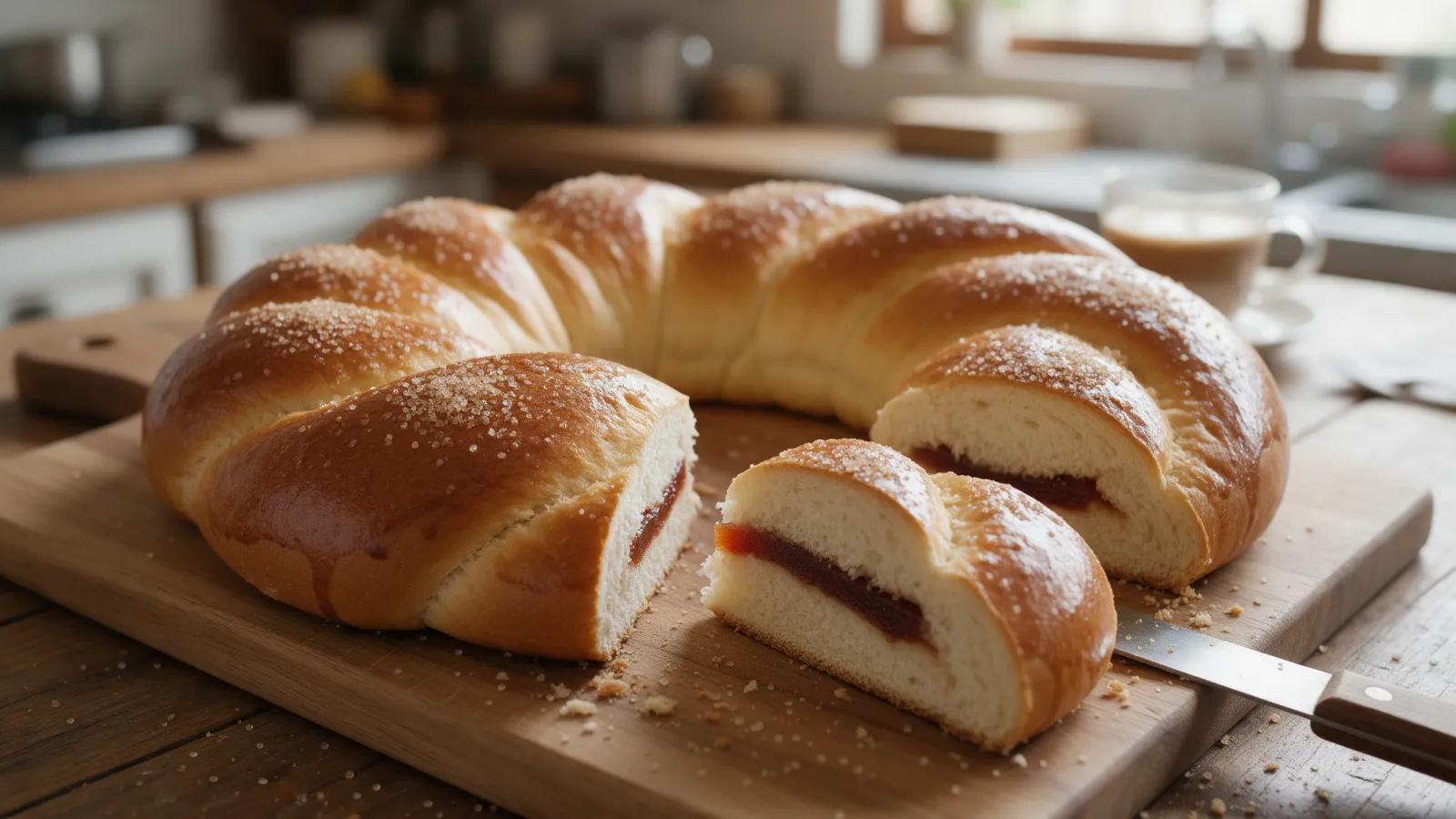

In Colombia, bakeries sell a sugar-crusted bread ring with a strip of guava paste hidden inside. That’s the roscón (ross-KOHN): a soft, lightly sweet yeast bread made with milk, eggs and a little butter, rolled around bocadillo, Colombia’s firm guava paste, and shaped into a circle. Bakeries also make it with dulce de leche, which Colombians call arequipe. This version bakes one big ring that feeds 12, with dual measurements, the supermarket swaps that work in the US and UK, and the shaping that keeps the guava inside the bread instead of on the pan.
Is a Colombian guava roscón worth baking?
How do you make a Colombian guava roscón? Knead 500 g (4 cups) flour with 240 ml (1 cup) warm milk, 2 eggs, 70 g (5 tbsp) melted butter, sugar and instant yeast, and let it rise 90 minutes. Roll it into a 70 x 20 cm (28 x 8 in) strip, wrap it around 400 g (14 oz) of guava paste, seal the seam underneath and form a ring. After a 40-minute rise, bake at 350°F (180°C) until the crumb reads 190°F (88°C). Ready in 205 minutes for 12 servings.
Yes, if you have an oven and an afternoon at home. Only about 50 of the 205 minutes need your hands; the rest is dough rising on its own. What you get is a pull-apart crumb that’s far less sweet than cake, a crunchy sugar crust, and a ribbon of guava that’s tart enough to cut through both.
Who it suits. A weekend breakfast or brunch for a crowd, a coffee table at the office, a bake sale. It travels on its own sheet pan and doesn’t need the fridge.
Who might skip it. Anyone who wants something quick (it’s close to 3½ hours on the clock), or a household of two, unless you make the half batch or freeze slices.
Honest difficulty, medium. The dough is forgiving. The skill is in the shaping: a seam that stays shut and cuts that don’t reach the filling.
What a roscón is, and how it’s not rosca de reyes
If you’ve baked the Mexican three kings bread on this blog, the shape will look familiar, but the bread is a different animal. The rosca uses 150 g of butter per 600 g of flour, and the roscón about half that ratio. The rosca is decorated on top and baked for one day in January; the roscón hides its sweetness inside and is ordinary, everyday bakery bread in Colombia. Nor is it Spain’s roscón de reyes, which carries candied fruit and is sometimes split and filled with whipped cream.
Ingredients, with US and UK swaps
The full list with weights and cups is in the recipe card. The ratio that matters is 100 parts flour to 48 milk, 14 butter and 1.4 instant yeast, which is 500 g flour, 240 ml milk, 70 g butter and a 7 g packet. I settled on 500 g with 2 eggs, a dough firm enough for one large ring, after comparing five Colombian recipes whose flour ran from about 375 to 600 g for roughly a cup of liquid.
| Ingredient | What it is | US | UK | If you can’t find it |
|---|---|---|---|---|
| Bocadillo | firm Colombian guava paste, often wrapped in bijao leaves | Colombian and Latin grocers | Latin American shops, online | block guava paste, same weight |
| Guava paste | the same type of firm paste, in blocks or tins | Hispanic aisle of many supermarkets | Latin shops, online | quince paste (membrillo) |
| Flour | 10-13% protein wheat flour | all-purpose or bread flour | plain or strong white bread flour | cake flour makes a ring that spreads |
| Instant yeast | dry yeast that needs no proofing, though I proof it anyway | ”instant” or “rapid rise” packets | fast-action dried yeast sachets | active dry, same 7 g, always proofed |
| Arequipe | thick Colombian dulce de leche | dulce de leche, baking aisle | dulce de leche in jars | 300 g (10½ oz), very thick |
Bocadillo veleño, the best-known kind, comes from Vélez in Santander and is a registered Protected Geographical Indication in the UK since 31 March 2025. You don’t need that exact one: any firm guava paste you can slice cleanly will do.
Keep the paste cold. Straight from the fridge it slices into neat strips and takes longer to soften inside the dough.
Butter, melted. Colombian recipes melt it and stir it in with the eggs, which skips the softened-butter wait of a brioche.
Equipment. A stand mixer with a dough hook, a rolling pin, a half sheet pan, parchment, kitchen scissors and an instant-read thermometer if you have one. By hand, knead 12-15 minutes and resist adding more than 2 tablespoons of flour; the stickiness fades as gluten forms.
The make-ahead plan
The night-before ring (what I do for breakfast). Shape and snip the ring, cover the pan with plastic wrap and refrigerate overnight. In the morning, heat the oven and bake it cold, adding about 5 minutes. Jenny Is Baking bakes her shaped roscones straight from the fridge the same way.
The night-before dough. Knead, then refrigerate the covered dough 8-14 hours. Give it an hour at room temperature before rolling.
Bake a day ahead. It keeps well wrapped overnight; warm slices for 3-4 minutes at 350°F (180°C) before serving.
Scaling for the table.
- 6 people: half the recipe (250 g / 2 cups flour, 1 egg, 200 g / 7 oz paste), an 18-20 cm (7-8 in) ring, 25-28 minutes.
- 12 people: the recipe as written.
- 12 individual rolls: the same dough cut into 12 pieces of about 85 g (3 oz), each with 33 g (just over 1 oz) of paste, 25-30 minutes of second rise and 18-22 minutes in the oven, 6 per pan.
- 20-24 people: a double batch in two rings. Bake one while the other waits in the fridge so it doesn’t over-proof.
Filling and shaping so the guava stays inside
Hot guava paste softens and looks for the nearest exit. There are three of them.
The seam goes underneath
Overlap the two long sides by 2 cm (¾ in), pinch hard, then roll the log so the seam sits on the parchment. The weight of the filling presses it shut instead of pulling it open.
Bare ends seal the ring
Stop the strips 2 cm (¾ in) short of each end. Dough sticks to dough; dough laid over guava paste slides apart in the oven. Overlap the ends 4-5 cm (1½-2 in) and pinch underneath.
Snip the outer edge only, halfway down
The cuts let the ring open into petals as it bakes. Make them every 3-4 cm (1¼-1½ in) on the outside, never deeper than half the thickness. Cut into the guava and it oozes out. A little peeking through one or two cuts is fine.
Proportion helps too. 400 g (14 oz) of paste to about 1 kg (2.2 lb) of dough puts guava in every bite and still leaves enough dough to wrap it. Past 500 g (1 lb 2 oz), the ring tends to split.
How to tell it’s baked
190°F (88°C) at the center is the done point for soft breads, and that’s where I pull it. Push the probe into the thickest crumb between two cuts, not into the guava, which runs hotter and fools the reading. In my oven the 10-inch ring gets there in 30-35 minutes; individual rolls in 18-22. Without a thermometer, tap the bottom: it should sound hollow, and the crumb between cuts shouldn’t give when pressed.
Mistakes that ruin a roscón
- Guava on the pan → seam on top, filling at the ends, or deep cuts. Seam down, bare ends, shallow snips.
- Flat, dense dough → milk too hot or a cold kitchen. Proof the yeast and find a 75-78°F (24-26°C) spot; an oven with only the light on often works.
- Ring opens at the join → ends not overlapped. Give them 4-5 cm (1½-2 in).
- Brown outside, doughy inside → oven too hot, or judged by color. 350°F (180°C), middle rack, thermometer in the crumb.
- Collapses in the oven → over-proofed. Bake when a fingertip dent springs back slowly.
- Burned tongue → the guava is molten when it leaves the oven. Wait 30 minutes.
Kids and allergens. Children love it; just let the filling cool. It contains wheat (gluten), egg and milk, and no nuts. Not spicy at all.
Other ways to make it
- Individual roscones → faster to bake and easier to share; see the scaling notes above.
- Twisted ring, bakery style → split the filled log lengthwise with a sharp knife, twist the halves cut side up, and close the ring. The guava caramelizes on top but leaks more, so use 300 g (10½ oz).
- Dulce de leche → 300 g (10½ oz) of a very thick one, piped or in cold strips, with shorter cuts.
- Half guava, half dulce de leche → side by side in the same log.
- Less sweet → skip the 40 g (3 tbsp) of topping sugar and use 300 g (10½ oz) of paste; each slice drops about 36 calories.
What it costs
With US city average prices for August 2026, the flour, sugar, eggs, milk and butter come to about $2.45 for the whole ring, roughly 20 cents a slice. Butter is 31% of that, flour 25% and eggs 23%. The guava paste isn’t included, and at a Latin grocer it can cost more than everything else combined, so check the label price before you count on a bargain.
In Colombia, the same ring comes to about 21,200 pesos, roughly 1,767 per slice, mixing wholesale prices at Bogotá’s Corabastos market (September 12-18, 2026) for flour, sugar and eggs with Éxito supermarket prices for the bocadillo, butter and milk. There the bocadillo alone is 52% of the cost.
Serving, storing and reheating
How it’s eaten. At room temperature, sliced about a finger thick, with coffee, with Colombian hot chocolate, or with a slice of mild fresh cheese, which is how guava paste is usually paired in Colombia. For a mixed table, add something savory like Colombian cheese bread or Colombian cheese arepas, and if you want another Colombian bake, the corn-and-butter mantecada is a good match.
Counter. Wrapped in plastic or a sealed bag, I keep it 3 days, 4 at most. Bread and baked goods belong on the counter or in the pantry.
Fridge. Skip it; bread goes stale faster when chilled.
Freezer. Wrap slices individually. Food held at 0°F (-18°C) stays safe indefinitely and only the quality changes, which starts to drop after 2-3 months. I use mine within 2.
Reheating. Thaw wrapped slices about 1 hour, then warm 3-4 minutes at 350°F (180°C) or 30 seconds in the microwave, and let them sit 2 minutes, since the filling heats faster than the bread.
Frequently asked questions
What is a Colombian roscón? A ring of soft, lightly sweet yeast bread from Colombian bakeries, filled with guava paste (bocadillo) or dulce de leche (arequipe) and topped with sugar.
What can I use instead of guava paste? Quince paste (membrillo), at the same weight. It holds its shape the same way and tastes less floral. Guava jam won’t work; it melts and leaks.
Why did my guava paste leak out? It found a gap: a seam on top, filling at the ends, or cuts that went too deep. Keep the seam down, leave the ends bare, and snip only halfway into the outer edge.
What temperature do you bake it at, and for how long? 350°F (180°C), or 325°F (165°C) with convection, for 30-35 minutes for one large ring and 18-22 for individual rolls, until the crumb reads 190°F (88°C).
Can I make it the night before? Yes. Shape the ring, cover and refrigerate it, then bake it cold in the morning with about 5 extra minutes.
How long does it keep, and can I freeze it? About 3 days wrapped at room temperature. Frozen in slices, it keeps good quality for about 2 months.
Is it the same as rosca de reyes? No. Rosca de reyes is a richer Mexican Epiphany bread decorated on top with sugar paste and fruit paste; the roscón is a leaner everyday bread with the guava rolled inside.
Nutrition
Per slice, one twelfth of the ring, calculated ingredient by ingredient with this recipe’s amounts, including egg wash and topping sugar. For the guava paste I used the values for jams and preserves, the closest match; a firm paste has less water, so the real figure may run a little higher.
- Calories: 363
- Protein: 7 g
- Carbohydrates: 65 g
- Fat: 8 g (4 g saturated)
- Fiber: 2 g
- Sugars: 26 g
- Sodium: 234 mg
Each slice is about 272 calories if you cut 16 thinner ones. Butter accounts for 71% of the fat and guava paste for 62% of the sugar.
The sweet bakery bread of my Venezuelan childhood was the golfeado, rolled with raw cane sugar and cheese; in Colombia the roscón is the one on every counter. My first homemade ring split at the join and glued half its guava to the pan. Bare ends and a seam pressed underneath fixed it for good. Josnaisis.