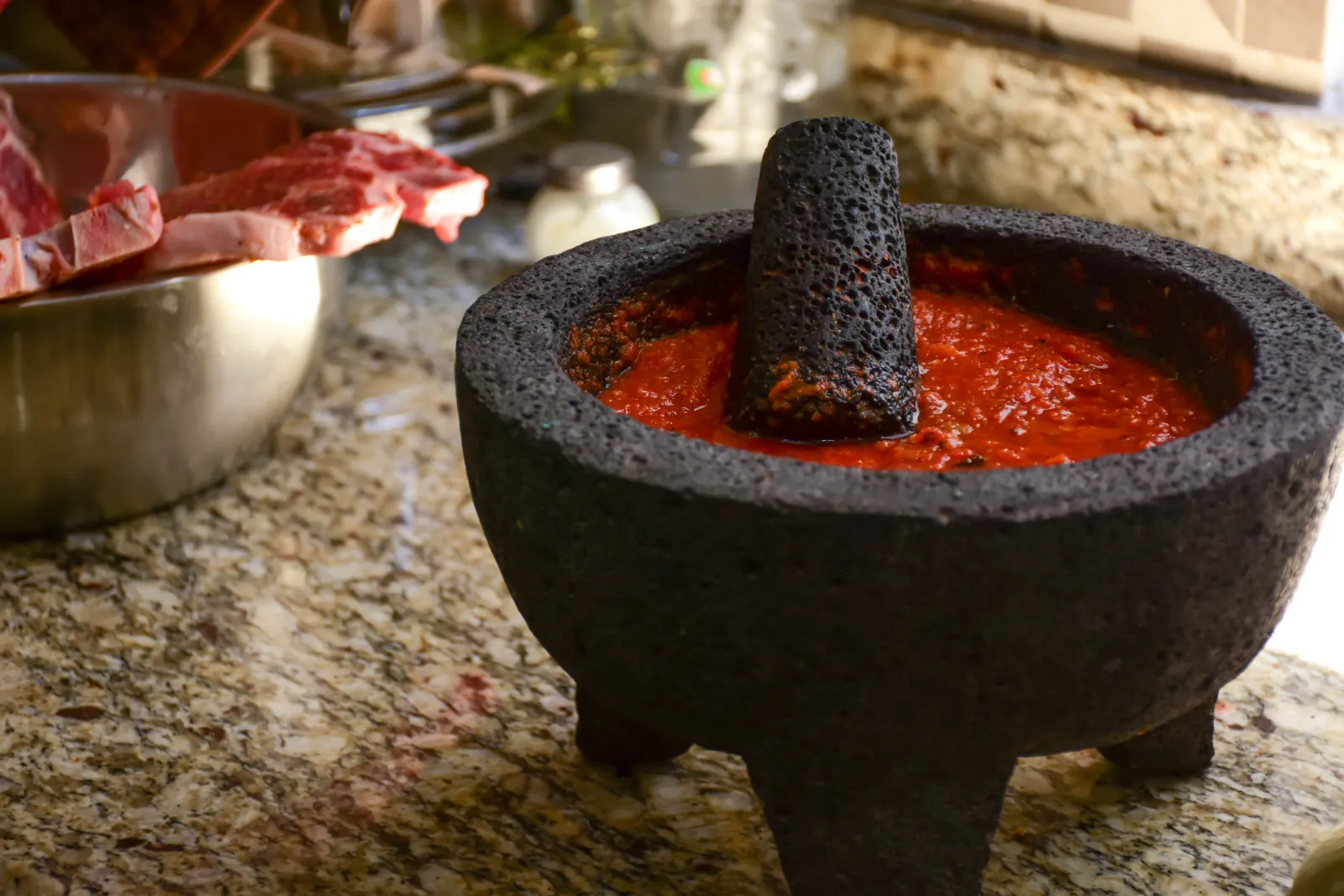

Ask for the hot salsa at a Mexican taco stand and there’s a good chance it’s made from chiles de árbol (CHEE-leh deh AHR-bol), small, thin, bright red dried chiles whose name means “tree chile”. This version is the simplest form: the chiles toasted on a dry skillet and ground with charred tomatillos, garlic and salt, nothing else. No onion, no tomato, no vinegar. It’s tart, toasty and properly hot, and the one thing that decides how hot is the number of chiles you put in, which is why this recipe gives you a count for every heat level.
What is chile de árbol salsa, and how hot does it get?
How do you make chile de árbol salsa? Char 14 oz (400 g) of tomatillos and 2 unpeeled garlic cloves on a dry skillet for about 10 minutes, then toast 15 dried chiles de árbol for 20 to 30 seconds per side over medium-low heat without letting them burn. Grind the chiles with salt to flakes, add the garlic, then crush in the tomatillos in a molcajete or pulse in a blender. 35 minutes for 12 servings.
Chiles de árbol run 15,000 to 30,000 Scoville heat units, while a jalapeño sits at 2,500 to 5,000. Each dried chile weighs about 0.5 g (0.02 oz) (about 50 to the ounce), so 15 of them come to roughly 8 g.
That makes a rough heat estimate possible. If the chile makes up about 2% of the salsa by weight, the salsa carries roughly 1/50 of the chile’s heat. It’s a back-of-the-envelope sum, since every bag of chiles is different, but it lets you place the salsa next to bottles you already know.
By that sum, the 15-chile version sits at roughly 320 to 630 SHU, below Valentina’s regular hot sauce (900 SHU) and well below original Tabasco (2,500 to 5,000). It still tastes hot, because you spoon it on rather than shaking out drops. In my kitchen, for 14 oz (400 g) of tomatillos:
- 5 chiles (about 3 g) → mild, 2 out of 5. The chile flavor is there; almost anyone can eat it.
- 10 chiles (about 5 g) → medium, 3 out of 5.
- 15 chiles (about 8 g) → hot, 4 out of 5. This recipe, for using by the teaspoon.
- 25 chiles (about 13 g) → very hot, 5 out of 5.
How much chile different versions use
Home versions vary a lot in how much chile they use per weight of tomatillo or tomato, which is why “a handful of chiles” in one recipe can be twice as hot as in another.
How it differs from the other red salsas
My taqueria-style red salsa uses tomatoes and tomatillos, onion, 12 chiles for about 21 oz (600 g), and is blended and simmered in oil, so it’s redder, sweeter and smoother. Salsa macha is a different thing again, an oil packed with fried chiles, garlic, peanuts and sesame, used as a condiment. This one has more chile per ounce than the taqueria salsa, no cooking after grinding, and a coarse texture.
Ingredients, and what to buy in the US and UK
The recipe card has the exact amounts. To scale by weight, my ratio is 2 g of chile, just under 4 chiles, and 1 g of salt for every 3½ oz (100 g) of tomatillos.
Tomatillos (Physalis philadelphica) look like small green tomatoes in a papery husk but are a different plant. They’re tart, and their pectin thickens the salsa as it cools. A medium one weighs about 34 g (1.2 oz), so 14 oz is 10 to 12. Pick firm ones that fill their husks.
| Ingredient | US | UK | Swap, and what changes |
|---|---|---|---|
| Dried chiles de árbol | Hispanic aisle of most large supermarkets, Mexican grocers | Online, Mexican food specialists | Whole dried cayenne chiles, 7 or 8 instead of 15; they run 30,000 to 50,000 SHU for most varieties |
| Fresh tomatillos | Produce section | Rare fresh | Canned whole tomatillos, drained; Ocado listed La Costeña 794 g (28 oz) at £3.95 in October 2026. Already cooked and salted, so skip the charring and halve the salt; less smoky |
| Crushed red pepper flakes | Spice aisle | Supermarket chilli flakes | Emergency only, about 4 g toasted for 15 seconds; they can’t toast evenly and leave the salsa gritty |
Seeds or no seeds? Food science writer Harold McGee explained on the Gastropod podcast that most of a chile’s capsaicin sits in the placenta, the pale strip the seeds hang from; the seeds are hot mostly because they touch it. In a dried árbol, that strip is thin and stays put when you shake the seeds out. So seeding helps a little, but five fewer chiles helps much more. I seed them only when I want a cleaner texture.
Equipment. A cast-iron skillet or comal about 10 inches (26 cm) across, tongs, and a stone molcajete (a Mexican mortar). No molcajete? A blender on pulse, or a large mortar; a small spice mortar won’t hold 14 oz of tomatillos. A nonstick pan works but chars less, and shouldn’t be heated empty on high.
Step by step, with the cues to watch for
35 minutes on the clock, about 20 hands-on. Husk the tomatillos while the pan heats, and don’t put the chiles on until everything else is off and the heat is down.
- Tomatillos are done when they’re olive green, blackened on both sides and slumped. Take them off before they split and leak onto the pan.
- Garlic is done when it’s soft with golden spots on the skin. A fully black skin often means a bitter clove; peel and check.
- Chiles are done when bright red turns a shade darker, they puff a little and the kitchen smells toasty. Smoke or black patches mean they’ve burnt.
- Chiles in the molcajete should crack into flakes within about 3 minutes. If they bend instead of snapping, give them 10 more seconds on the skillet.
- Finished salsa is chunky, with 3 to 5 mm (about ⅛ inch) pieces of tomatillo and red flakes all through, thick but spoonable.
Molcajete or blender
Use the molcajete for a taco night: no water, red flakes against the green, and heat that hits in bursts. The order matters; dry and hard things first, juicy ones last. The coarse salt works like sandpaper on the chiles, the garlic paste holds them, and the tomatillos go in two at a time, pressed more than turned. Tip everything in at once and the tomatillo juice floats the chiles so they never break. It’s about 13 minutes of grinding.
Use the blender when you’re short on time or feeding a crowd: 1 to 2 minutes, smoother, paler and a little foamy at first, settling after 10 minutes. For a fully smooth salsa with no flakes, soak the toasted chiles in hot water for 30 minutes before blending.
Who this recipe is for
- First time → start with 10 chiles and taste before adding more; you can always grind in another.
- Cooking for kids → set aside 3 or 4 charred tomatillos with a little garlic and salt before the chiles go in. It makes a tart, mild green salsa.
- Feeding 20 → two batches, roughly 27 oz (760 g): 1¾ lb (800 g) tomatillos, 30 chiles, 4 garlic cloves and 9 g salt, blended in loads no more than two-thirds full.
Why it turns bitter, and other ways it goes wrong
- Bitter → a burnt chile, nearly always. One spoils the whole batch. Medium-low heat, half a minute a side at most, and bin any that blacken.
- Watery → tomatillos that burst on the skillet, or too much water in the blender. Let it stand 10 minutes; the pectin thickens it.
- Too sour → small or under-charred tomatillos. One more roasted garlic clove rounds it out.
- Much hotter than expected → chiles vary from bag to bag. Grind 10 first, taste on a piece of tomatillo, then add.
- Too hot to eat → char about 4 oz (120 g) more tomatillos and crush them in. The heat drops without the salsa going thin.
Handling the chiles. Capsaicin stays on your fingers after breaking open dried chiles. Wear gloves or wash well with soap before touching your eyes or a child’s face. Toasting throws off a pungent smoke, so run the extractor fan.
Allergens. No gluten, dairy, egg, nuts, sesame or fish. It’s vegan.
Fried, in oil, with tomatoes, and how long each one keeps
- Fried salsa → heat 2 tablespoons (28 g) of oil over medium, fry the peeled garlic for 1 to 2 minutes until pale gold and lift it out, fry the chiles for 10 to 15 seconds until they puff, then grind or blend everything with the charred tomatillos and the oil. Redder, glossier and more toasted, at about 35 kcal per serving.
- Boiled → simmer the tomatillos in water to cover for 8 to 10 minutes over medium until olive green, adding the untoasted chiles for the last 5. Drain and grind with 1 raw peeled garlic clove and the salt. Tarter, looser, no smoke.
- With tomatoes → 7 oz (200 g) tomatillos and 7 oz (200 g) Roma tomatoes, both charred. Redder and sweeter; for the full taqueria version with onion, see the red salsa linked above.
- Oil only, no tomatillos → chiles and garlic fried in oil and ground is, in practice, salsa macha without the nuts and seeds.
Why garlic in oil goes in the fridge. Garlic is a low-acid food, and oil shuts out oxygen, which is the environment where Clostridium botulinum can produce botulism toxin. That’s why homemade raw garlic in oil should be refrigerated and used within 4 days, or frozen. A fried-garlic chile oil, salsa macha style, keeps 1 month in the fridge and 2 months in the freezer. Shop-bought garlic oils can sit in the cupboard because they’re acidified: after botulism outbreaks linked to garlic in oil, those products have carried acidifying agents since 1989. Homemade versions aren’t formulated that way.
Tomatillo salsa in the fridge. Treat it like any cooked leftover: no more than 2 hours at room temperature, and 3 to 4 days sealed at 40°F (4°C) or below. Use a clean spoon each time.
Freezer. In ½-cup (120 ml) portions or ice-cube trays, 3 to 4 months for best quality. It weeps a little water when thawed; stir it back in or bring it to a boil for 2 minutes.
Reheating. Not needed, it’s served warm or cold. To spoon it hot over eggs, bring it to a boil in a small pan, stirring, which takes it well past 165°F (74°C).
Make ahead. The whole salsa can be made the day before; the heat evens out overnight. Or char the tomatillos and garlic the day before and toast and grind the chiles on the day, so they still smell freshly toasted.
What it costs to make
At advertised US supermarket prices on October 9, 2026 (tomatillos $0.99/lb, garlic $5.99/lb), the fresh produce for one batch comes to about $0.95, roughly 8 cents a serving. I won’t put a number on the dried chiles de árbol; a small bag covers several batches.
At Mexico City’s Central de Abasto on the same date, the most common wholesale prices put the whole batch, chiles included, at 8.21 pesos. The chiles cost nearly 11 times as much per kilo as the tomatillos (175 pesos against 16), but at 8 g they add only 1.40 pesos.
Yield. About 13 oz (380 g), a little over 1½ cups, or 12 servings of 2 tablespoons. I allow 2 tablespoons per person when it’s the only hot salsa on the table, so one batch covers 4 to 6 people generously and 12 at a stretch.
How to serve it, 1 to 2 teaspoons per taco
Warm or cold, in the molcajete in the middle of the table, with a spoon so everyone takes 1 to 2 teaspoons (5 to 10 ml) per taco. It’s at home on carnitas tacos, where it trades places with the milder tomatillo salsa verde, and on tacos al pastor when there’s already something gentler on the table. A teaspoon wakes up huevos rancheros or a split Colombian cheese arepa, and a bowl of pico de gallo alongside barely registers on the heat scale, which balances it.
Chile de árbol salsa FAQ
How many chiles de árbol do I need for salsa? For 14 oz (400 g) of tomatillos: 5 for mild, 10 for medium, 15 for hot and 25 for very hot. This recipe uses 15, a generous ¼ oz.
How hot is chile de árbol salsa? The chiles rate 15,000 to 30,000 SHU, and with 15 in 14 oz of tomatillos a rough dilution sum puts the salsa at about 320 to 630 SHU, though you eat it by the spoonful.
Why is my chile de árbol salsa bitter? A burnt chile, or garlic with fully blackened skin. Toast the chiles last, over medium-low, and pull them within half a minute per side.
Do you remove the seeds from chiles de árbol? You can, but most of the heat is in the placenta, the pale inner strip, not the seeds. Use fewer chiles if you want less heat.
Do I need to soak chiles de árbol? Not for a molcajete; toasted chiles grind straight to flakes. Soak them in hot water for 30 minutes only if you want a smooth blended salsa.
How long does chile de árbol salsa last? The tomatillo version, 3 to 4 days in the fridge at 40°F (4°C) or below and 3 to 4 months frozen. The oil version with fried garlic keeps a month in the fridge; with raw garlic, only 4 days.
Can chile de árbol salsa in oil be kept at room temperature? Not homemade. Unacidified garlic in oil is where botulism toxin can form; commercial versions are formulated differently.
What can I use instead of chiles de árbol in the UK? Whole dried cayenne chiles, about half the number because they’re hotter. Chilli flakes only in an emergency.
Nutrition per serving
Per serving of 2 tablespoons (about 1.1 oz / 32 g), calculated ingredient by ingredient with the quantities in this recipe, salt included. The chile de árbol is counted as sun-dried hot chile pepper:
- Calories: 14 kcal
- Protein: 0 g (0.4 g)
- Carbohydrates: 3 g
- Fat: 0 g (0.4 g)
- Fiber: 1 g
- Sugars: 2 g
- Sodium: 146 mg
It’s almost all tomatillo, at 32 kcal per 100 g (3½ oz). The number worth watching is sodium: with ½ teaspoon of fine salt (3 g) instead of ¾ it drops to about 98 mg per serving. The fried version adds about 21 kcal per serving from the oil.
Where I grew up in Venezuela, the heat on the table came from a jar of pickled ají, and in Colombia it’s a cilantro ají, so the molcajete sat on my counter as decoration for months. What finally got me using it was counting chiles instead of tipping them in by eye. I now write on the bag how many went into the last batch and how it turned out, because no two bags are the same. Josnaisis.