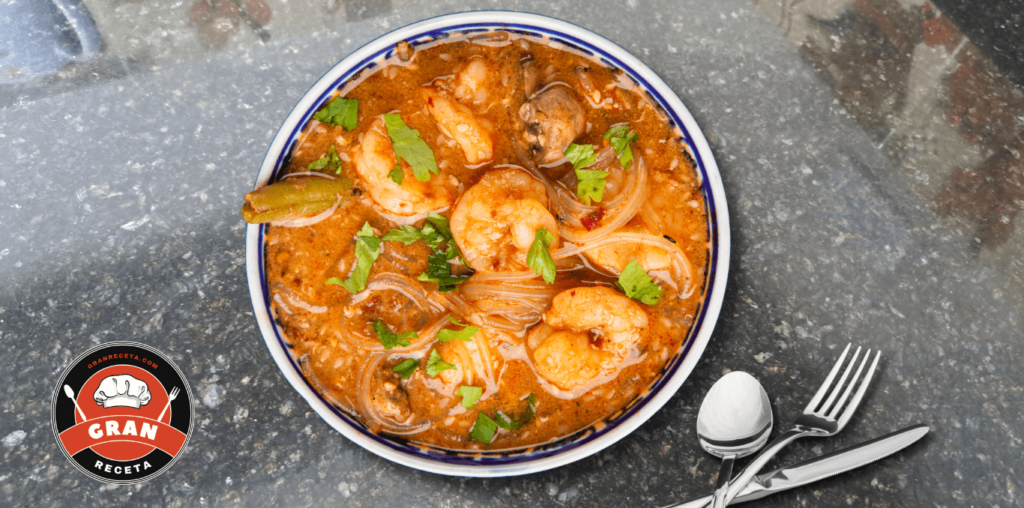
In Cartagena every cook will tell you to add the shellfish at the end. Few tell you that the end is 4 minutes long, that it has an order, and that a shrimp goes from tender to rubbery in about 30 seconds. This is cazuela de mariscos as it is made in Cartagena, on Colombia’s Caribbean coast: a stock built from shrimp shells, a sofrito, coconut milk and cream, and then four minutes of paying attention. Four servings, 45 minutes, 36 g of protein a bowl.
How do you make Colombian seafood stew? Simmer shrimp shells into a quick stock, cook a sofrito of onion, pepper and tomato, then add the stock, coconut milk and cream and reduce 10 minutes. With the heat at its lowest, add fish, mussels, shrimp and squid in that order over 4 minutes. 45 minutes for 4 servings.
What a cazuela is, and where it comes from on the plate
Cazuela means the earthenware dish it is cooked and served in, and on the Colombian Caribbean it is what a coastal restaurant brings out when a table orders seafood without deciding which one. It is rich rather than spicy: no chili at all, colored orange by annatto rather than paprika or saffron, and thickened by reduction instead of a roux.
You will meet it in Cartagena and Santa Marta with a wedge of lime and a scoop of coconut rice, and often with a whole fried plantain leaning against the bowl. One bowl is a meal at about 515 calories.
The order the shellfish goes in
Each item has its own clock and they are not close. Cubed fish wants 4 minutes, mussels 3, shrimp 2, and squid a bare 90 seconds. Put them all in together and either the fish is raw or the squid is rubber; there is no middle setting.
So they go in backwards, longest first: fish, then mussels a minute later, shrimp half a minute after that, squid last. All four finish at once. It is easier to do than to read, and it is the only part of the recipe that needs a clock.
Why the sauce must never boil
Coconut milk and heavy cream are both emulsions, and a boil breaks both: the fat separates and you get a grainy sauce under a slick of oil. At about 185 °F, when the surface shivers but does not bubble, the shellfish cooks just as fast and the sauce stays whole.
That is why the sauce is reduced first and the seafood added afterwards, over low heat. If it needs to be thicker, thicken it before, with a teaspoon of cornstarch slaked in cold stock, never by turning the heat up at the end.
The shrimp-shell stock
The shells from 10 oz of shrimp, fried 3 minutes and simmered 15 in 2 cups of water, give a stock no bouillon cube can match. It is what makes the dish taste of the sea rather than of cream with seafood in it, and it costs nothing, because those shells were headed for the bin.
If you buy shrimp already peeled, ask for the shells or buy a few extra shell-on ones just for the stock. Fish frames or heads do the same job in 20 minutes, and most fish counters hand them over for free.
Shopping for it in a US market
Frozen is fine and often better, since most shrimp sold “fresh” at a counter was frozen anyway. Thaw overnight in the fridge, never in warm water, and pat everything dry: the water it releases would thin the sauce you just spent 10 minutes reducing.
One label trap is worth flagging. Cream of coconut, the Coco López type of can, is heavily sweetened and belongs in a piña colada; what this needs is unsweetened canned coconut milk, full fat, the kind that separates into cream and water in the can. Coconut beverage in a carton is far too thin.
How to tell each one is done
Shrimp tell you with their shape: properly cooked they hold an open C, and when they curl into a tight O they have gone. Squid tells you by sound, squeaking between the teeth. Fish tells you by falling into threads instead of breaking into flakes.
Mussels are the easy ones: they open when they are done, and any that stay shut after 3 minutes go in the bin rather than in the bowl.
Who this recipe is for
- If you use frozen seafood → thaw in the fridge and dry it well; the water it sheds thins the sauce
- If you cannot find mussels → clams in the same time, or simply more shrimp
- If you want it lighter → swap the cream for ⅔ cup more stock, which brings the bowl from about 515 to about 420 calories
- If you are cooking for 8 → double everything except the sauce, which goes up by half, since it should coat the seafood rather than drown it
- If you are serving guests → make the sauce a day ahead and do the last 4 minutes once everyone is seated
Cazuela, chowder and coconut curry
If you know chowder, the dairy will feel familiar and the coconut will not. If you know Thai curries, the coconut will feel familiar and the absence of chili will surprise you. The cazuela sits between them, and what it has that neither has is that shellfish stock.
It is also thickened differently. A chowder leans on a roux or crushed crackers, a curry is not thickened at all, and this one relies on 10 minutes of reduction with a teaspoon of cornstarch as insurance.
Make ahead, storage and reheating
The sauce is the part that can wait. It keeps 2 days in the fridge and improves, which makes this a genuinely good dinner-party dish: reduce the sauce in the afternoon, and cook the seafood in 4 minutes when people sit down.
A finished stew keeps 1 day and no more, and it should be reheated gently, below a simmer. The shellfish will be one notch firmer than it was; that is unavoidable. Freezing does not work at all, since the sauce splits on thawing.
What goes wrong
Boiling after the cream goes in. The sauce splits and does not come back.
All the seafood at once. One of the four is guaranteed to suffer; the order exists for that reason.
Throwing away the shells. The cheapest flavor in the dish and the most noticeable.
Wet frozen seafood. It sheds water and undoes 10 minutes of reduction.
Salting early. Shrimp and the shell stock bring their own sodium; salt at the end, after tasting.
Variations
With lobster or large prawns. Two per bowl on top, added 30 seconds before the shrimp. The restaurant version.
Coconut only, no dairy. Cleaner tasting and more coastal; take the coconut milk up to 1⅔ cups and cut the stock.
With rice in the bowl. Half a cup of cooked rice stirred in 2 minutes before the seafood turns it into a one-dish meal.
With ají dulce. Three or four of the mild Caribbean peppers in the sofrito, aromatic without any heat.
What to serve with it
The classic pairing is Colombian coconut rice with its caramelized titoté, whose sweetness plays against the sauce, or plain white rice if you want something neutral. Two Colombian patacones a person, about 280 calories, work as both a starter and a scoop; Caribbean tostones, pressed thinner and dipped in garlic water, do the same job with more crunch.
For a full coastal menu, arroz de lisa is the rice dish of the same coast, Colombian fried calamari goes first as the fried course, the river counterpart of this pot is viudo de pescado, which steams a whole fish over the vegetables, and Colombian mote de queso is better saved for another day, since two creamy dishes in a row is too much. To drink, cold beer or Colombian aguapanela with lime.
Frequently asked questions
Why did my sauce split? It boiled after the cream or coconut milk went in. From that point the heat stays at its lowest, around 185 °F.
Can I use frozen seafood? Yes, and most of it was frozen at some point anyway. Thaw in the fridge and dry it before it goes in.
How long does the seafood cook? Four minutes in total, added longest first: the fish, then mussels a minute later, shrimp after another half minute, squid last.
Can I make it ahead? The sauce, yes, up to 2 days. The seafood goes in at the last moment.
Which fish works best? A firm white one that holds its shape in cubes, such as cod, halibut or tilapia. Oily fish takes over the sauce.
Nutrition
Per bowl, a quarter of the pot, calculated with the USDA database for the shrimp, squid, fish, coconut milk and cream:
- Calories: 515 kcal
- Protein: 36 g
- Carbohydrates: 10 g
- Fat: 37 g, of which 21 g saturated
- Fiber: 1 g
- Sodium: 780 mg
The seafood brings nearly all the protein and almost none of the fat: according to the USDA, raw shrimp carries 1.01 g of fat against 13.61 g of protein per 100 g. The fat is the coconut milk, at 21.33 g per 100 g, and the heavy cream, at 36.08 g, which together account for about 85 % of it. Replacing the cream with stock takes the bowl down to roughly 420 calories with the protein untouched.
The cazuela I grew up with in Venezuela leaned on tomato and had no coconut in it at all, so the first one I ate in Cartagena tasted like a different dish wearing the same name. What convinced me was the shell stock: my mother always simmered shrimp heads for rice, and seeing the same habit turned toward a sauce made it obvious this was the same cooking arriving by another road. Josnaisis.