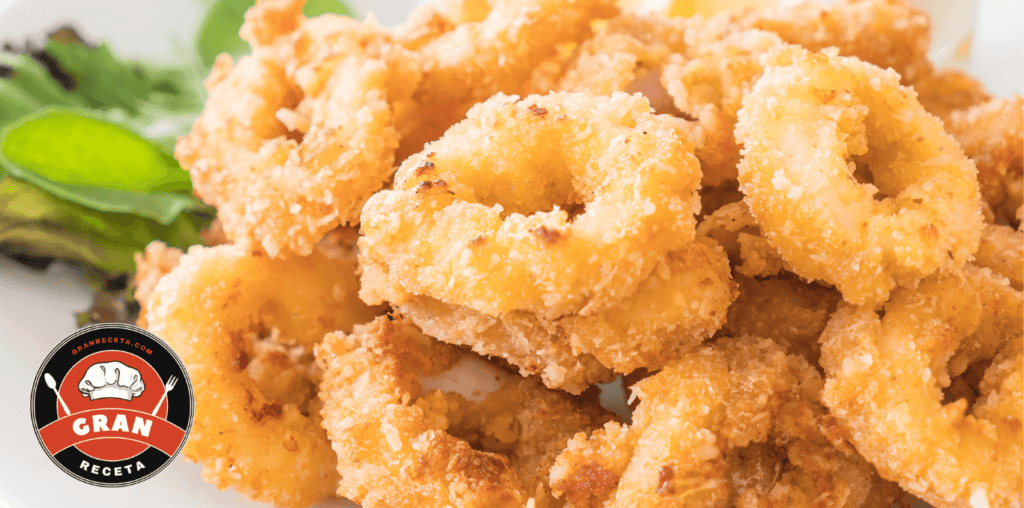

Restaurant calamari is not better squid, it is better timing: squid crosses from tender to rubbery in about 30 seconds. The difference between the plate you order out and the one you fry at home is a thermometer and a timer, not a secret batter. This is chicharrón de calamar, how the Colombian Caribbean coast fries it: a flour-and-cornstarch coating with a cold beer step, fried in small batches and eaten standing up in the kitchen. Four servings in twenty-five minutes.
How do you make crispy fried calamari? Cut the squid into ⅜-inch rings and press it dry. Dredge in flour and cornstarch, then in egg beaten with cold beer, then back in the dry mix. Fry at 365 °F in batches of five or six for 90 seconds each and drain on a wire rack. 25 minutes for 4 servings.
What chicharrón de calamar is
On the Colombian coast, from Cartagena down to Buenaventura on the Pacific side, fried seafood is sold from a tray rather than a plate. Chicharrón de calamar is the squid version, cut small, coated thin and fried fast, and it shares that tray with plantain and fritters rather than arriving with a dipping sauce in a ramekin.
The name is the giveaway. Chicharrón in Colombia means something fried until it crackles, so the coating is meant to be thin and shattering, not the thick craggy jacket of a US restaurant basket. It carries lemon and a garlic sauce, and it is eaten within 10 minutes of leaving the oil.
Why squid turns rubbery, and the two windows that work
Squid muscle is mostly fiber and collagen, which leaves it two good states with a long bad stretch between them. According to Harold McGee’s On Food and Cooking, squid is tender with under 2 minutes of high heat or with more than 30 minutes of slow cooking, the time collagen needs to turn to gelatin. In between, the fibers have already tightened while the collagen has not yet given, and that is the rubber band most people blame on the fishmonger.
This recipe lives in the first window. The 90 seconds are enough for the coating to color and the squid to go from translucent to just opaque, and every extra half minute costs texture. If you would rather braise it, the clock changes completely and it wants a good forty minutes in sauce.
The oil temperature, and why small batches matter
Below 340 °F the coating takes so long to seal that it drinks oil while it cooks, which is where heavy, greasy calamari comes from. Above 400 °F it colors before the inside is hot. The working band is 355 to 375 °F.
Getting there is easy; staying there is the work. Each batch of cold squid pulls the oil down, and five or six pieces is about all a home pot absorbs without dropping under 340 °F. That is why the squid goes in five at a time, in a minute and a half per round, rather than all at once in one comfortable batch.
What goes wrong and how to read it
Four of the five common failures come back to the same two causes, a pan that was too full or oil that was too cool. They are all fixable on the next batch, which is the advantage of frying in fives: you get four more chances in the same 7 minutes.
The one that is not fixable is the rubbery one. Once the fibers have contracted there is no resting, no sauce and no reheating that softens them again, so when you are unsure whether to pull a batch or give it another half minute, pull it. Residual heat finishes the job on the rack.
Buying squid in the US and the UK
Most supermarket squid is frozen, cleaned and sold as tubes, or as tubes and tentacles together, in 1 lb bags. That is the right thing to buy for this recipe and it is what I use most of the year. Thaw it overnight in the fridge, never in warm water, and expect it to give up a lot of liquid, which is why the drying step matters more with frozen squid than with fresh.
Two things worth knowing at the counter. Pre-cut rings cost far more than whole tubes for the same squid, and in Colombian wholesale markets that gap runs from about 23 % to 152 % according to the DANE’s SIPSA bulletin for the week of September 12 to 18, 2026, so cutting your own is worth the four minutes anywhere. And calamari steaks, the flat pounded ones, are a different product entirely: they come from large squid and they are built for a quick sear, not for rings.
Who this recipe is for
- If it is your first time frying squid → fry one test piece and cut it open, so you learn your oil before you commit five batches
- If your last batch was chewy → drop to 90 seconds and pull it even when the color looks light, because it keeps browning on the rack
- If you have no thermometer → a drop of batter should rise and bubble within 2 seconds, neither instantly nor slowly
- If you are cooking for 8 → double the mixes but not the pot; that is 10 batches, with half a minute of recovery between them
- If you skip alcohol → very cold club soda does the same job, since what lightens the coating is the gas and the chill
Why cornstarch and cold beer
Cornstarch has no gluten, so used in equal weight with the flour it gives a layer that stays thin and shatters instead of turning leathery. Flour on its own builds a gluten network that holds moisture and goes limp a few minutes out of the oil.
The beer does two jobs at once. Its gas expands into bubbles inside the coating as it fries, and its alcohol evaporates at a lower temperature than water, so the crust dries faster. Straight from the fridge it holds more gas than at room temperature, which is why the wet mix gets stirred together right before dredging rather than 10 minutes ahead.
Three coatings, and how long each one holds
If the calamari has to travel from stove to table across a room, or sit while people find their seats, the semolina dredge is the sturdier choice and gives that gritty restaurant crust. This beer batter is the lightest of the three and the one that tastes least of coating, at the cost of a shorter window.
Buttermilk gives the thickest jacket and the shortest crispness, which is why it is usually paired with a dip that hides the point. None of the three changes the squid’s own limit: whatever the coating, 2 minutes is the ceiling.
Make ahead, storage and reheating
Fried calamari is a last-minute dish, but two parts can wait. The squid can be cut and dried up to 4 hours ahead and kept covered in the fridge, and the dry mix can be measured out the day before. The wet mix cannot: it goes flat.
Leftovers keep 2 days in the fridge and come back best in a 400 °F oven or air fryer for 4 minutes, straight from cold, on a rack. Microwaving turns the coating to paste. The tentacles reheat better than the rings, which dry out faster.
What to serve it with
On the coast this goes on a tray of fried things rather than a plate of its own — the inland version of that tray is a fritanga platter — next to Colombian patacones with hogao and a Colombian egg arepa, with Colombian empanadas if the table is bigger. They all fry in the same oil, in that order, with the calamari last because it is the first to lose its crunch, about 10 minutes in.
As a starter it works ahead of a big spoon dish, and Colombian sancocho is the usual one, fried first and soup after. If the calamari is the main event instead, the coastal side is Colombian coconut rice, whose caramelized sweetness cuts the fried coating the way it does with fried fish, and cold beer or lemonade rather than wine.
Frequently asked questions
How long do you fry calamari? Ninety seconds at 365 °F, in batches of five or six pieces. Two minutes is the limit; past that it turns rubbery.
Can I use frozen squid? Yes, and most supermarket squid is. Thaw it overnight in the fridge and press it very dry, since it releases a lot of water as it thaws.
Why does my coating fall off? Usually surface moisture on the squid, or a skipped first dry dredge, which is the layer the wet mix needs to grip.
Does this work in an air fryer? Not with this coating. A wet batter needs hot oil all around it to set; in moving air it dries out before it can form a crust.
How long does it stay crisp? About 10 minutes on a wire rack. It is a dish you eat in the kitchen while the next batch goes in.
Nutrition
Per serving, a quarter of the recipe, calculated with the USDA database counting all of the coating and roughly 1.8 oz of oil absorbed across the five batches:
- Calories: 390 kcal
- Protein: 27 g
- Carbohydrates: 31 g
- Fat: 16 g, of which 3 g saturated
- Fiber: 1 g
- Sodium: 520 mg
Squid itself is one of the leanest things in the seafood case. Per USDA, raw squid runs 92 calories with 15.58 g of protein and 1.38 g of fat per 100 g, and fried squid measures 175 calories per 100 g, so the coating and the oil are doing all the work. How hot the oil was is what decides whether a serving stays near four hundred calories or climbs well past five hundred.
The first time I fried calamari at home I left it in for five minutes because it still looked raw to me, and I produced a perfect batch of erasers. In Venezuela we mostly ate squid stewed or in garlic, never battered like this, and it took me a while to accept that the doneness is not something you look at, it is something you time. Now I set the phone for 90 seconds and I do not argue with it. Josnaisis.