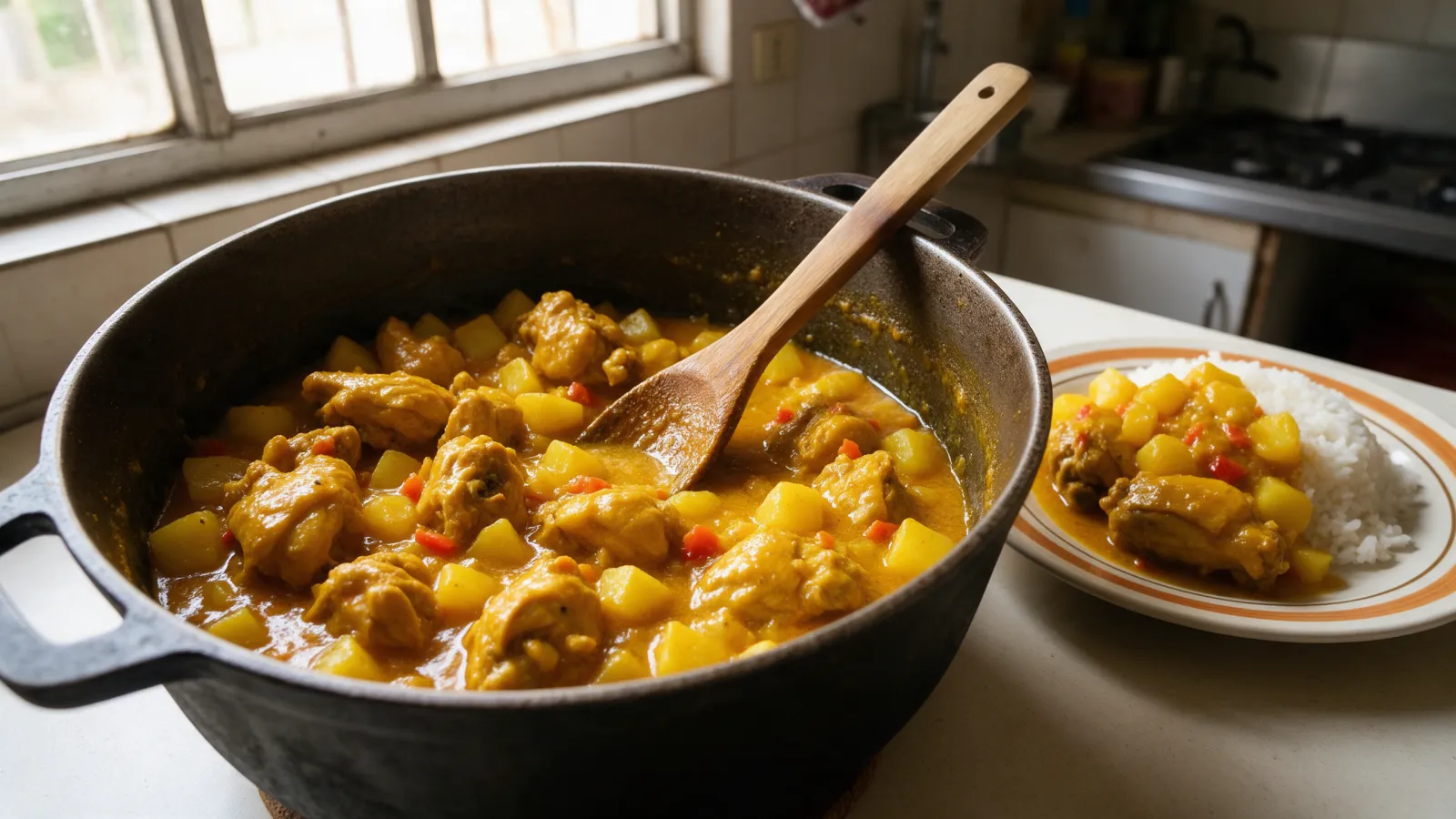

If you know Trinidad curry chicken, Venezuelan talkari will surprise you: it uses roughly a third of the curry powder, about 2 tsp for every 2 lb (900 g) of chicken. Talkari (tal-kah-REE, also spelled tarkarí) is a curry-scented stew from eastern Venezuela, mostly Sucre state and the Paria Peninsula, the stretch of coast that faces Trinidad across the Gulf of Paria, and the dish came over from there. The classic is made with goat, and hen is common too. At home I make it with chicken thighs, a sofrito of onion, sweet peppers and tomato, and potatoes, and it is on the table in 95 minutes. Below you’ll find which chicken pieces work, how much curry to use, what to buy instead of ají dulce in a US or UK store, the safe temperature, storage and what it costs.
How do you make Venezuelan chicken curry?
How do you make Venezuelan chicken curry (talkari)? Season bone-in chicken with lime, garlic, curry powder and salt, brown it in two batches, then build a sofrito of onion, bell pepper, ají dulce, garlic and tomato in the same pot with the rest of the curry and a little cumin. Return the chicken with 1 cup (240 ml) of water, simmer covered 20 minutes, add potatoes for 20 more and reduce the sauce uncovered. 95 minutes for 6 servings.
It is closer to a chicken stew than to an Indian or Caribbean curry. The curry powder sits in the background, behind the sweet peppers and tomato, and gives the sauce a golden tint and a warm smell. There is no chili heat, no coconut milk in the base recipe and no long ingredient list.
Is it worth making, and who is it for?
Make it if you like braised chicken and want something different from your usual rotation without a special shopping trip. Apart from the ají dulce, which has an easy swap, everything is at a regular supermarket.
Good for a Sunday lunch for 6, or a pot that feeds you for a few days, since it tastes better the next day. It also scales to a crowd without changing the cooking time.
Maybe not for anyone who dislikes curry, because even a small amount is noticeable, or anyone expecting the heat and depth of a Trinidad or Indian curry.
Time. 95 minutes total, about 50 of them hands-on and 40 with the lid on, plus marinating time in the fridge: 30 minutes is enough, overnight is better.
Difficulty, easy. The two things to watch are frying the curry powder for 1 minute without burning it and adding the potatoes halfway, not at the start.
Shopping in the US and UK, and what to buy instead
Chicken
Buy bone-in thighs and drumsticks and pull off the skin. They stay juicy through 40 minutes of simmering and the bones give the sauce body. It’s the same reasoning as in my Colombian stewed chicken: thigh meat has the collagen that turns to gelatin in a braise, and breast doesn’t. Plan on 250 g (about ½ lb) of bone-in chicken per person.
- A whole cut-up chicken works with the same timing; the breast pieces come out a little drier.
- Breast only goes in with the potatoes, in large chunks, for 20 minutes.
- Boneless thighs need 25 minutes in total, so add the potatoes right away.
- A stewing hen is the more traditional choice after goat. Braise it 75 minutes covered, as in the Colombian stewed hen, before the potatoes.
Ají dulce and the other swaps
Ají dulce is a small, wrinkled pepper with a floral smell and no heat. It’s the same species as the habanero and looks a lot like one, which is the trap: a habanero or Scotch bonnet is not a substitute. In the US you’ll find ají dulce fresh or frozen in Latin groceries, especially Puerto Rican and Dominican ones, where it may be labeled ají gustoso; Cuban shops call it ají cachucha. In the UK it’s rare.
- Mini sweet peppers (US) or mini peppers (UK), 60 g (2 oz), are the closest swap.
- More red bell pepper works too. The stew loses some perfume, not its character.
- Curry powder. A standard mild yellow curry powder. A hot Madras blend adds real heat: use half. Check the label if you cook for someone with allergies, because some blends contain mustard or wheat flour.
- Potatoes. A waxy or all-purpose potato that holds its shape: Yukon Gold or red potatoes in the US, Charlotte or Maris Peer in the UK.
- Tomatoes. Out of season, a 400 g (14 oz) can of chopped tomatoes does the same job.
Equipment
A heavy 5- to 6-quart (5-6 liter) pot with a lid, a Dutch oven being ideal, and an instant-read thermometer, the only reliable way to know the chicken reached 165°F (74°C).
How much curry powder goes into talkari
1 tbsp (6 g) for 3.3 lb (1.5 kg) of bone-in chicken: 1 tsp in the seasoning and 2 tsp in the sofrito. Venezuelan goat talkari uses the same tablespoon for 4½ lb (2 kg) of meat, and the big party pots stretch it over 9 lb (4 kg). Trinidad curry chicken goes the other way, from 2 tbsp for about 2½ lb (1.1 kg) up to ¼ cup for 3 lb (1.4 kg).
If you want it stronger, go up to 2 tbsp and stop there. At 3 tbsp it stops being talkari and becomes a Caribbean curry. Whatever the amount, the curry powder gets 1 minute in the hot sofrito before the tomatoes: raw spices taste dusty, and a couple of minutes over high heat makes them bitter.
The cooking-day plan
Two stages: 10 minutes to season the chicken, which can happen the night before, and 85 minutes on the day.
How to know each step is right.
- Browning → golden, not gray, on the side touching the pot. Lots of liquid means the pot was crowded.
- Sofrito → onion translucent at 5 minutes, peppers soft at 10.
- Curry → after 1 minute it smells strong and the oil turns yellow. If it darkens or smells scorched, lower the heat and add the tomatoes right away.
- Tomatoes → collapsed after 4 minutes, with the browned bits scraped off the bottom.
- Done → potatoes tender to a fork, chicken at 165°F (74°C) or above in the thickest part.
- Sauce → after 5 minutes uncovered it coats a spoon.
Make-ahead
- The night before, season the chicken. Raw marinated chicken keeps up to 2 days, covered in the fridge.
- Chop the sofrito vegetables ahead and keep them in a sealed container.
- Cook the whole stew a day early. The curry mellows and the sauce thickens overnight. Get it into the fridge within 2 hours of cooking.
Cooking for 3, 6, 12 or 20
| Serves | Bone-in chicken | Potatoes | Curry powder | Water | Pot |
|---|---|---|---|---|---|
| 3 | 750 g (1.65 lb) | 300 g (10½ oz) | ½ tbsp | 120 ml (½ cup) | 3-4 qt |
| 6 | 1.5 kg (3.3 lb) | 600 g (1.3 lb) | 1 tbsp | 240 ml (1 cup) | 5-6 qt |
| 12 | 3 kg (6.6 lb) | 1.2 kg (2.6 lb) | 2 tbsp | 480 ml (2 cups) | 10 qt |
| 20 | 5 kg (11 lb) | 2 kg (4.4 lb) | 3 tbsp + 1 tsp | 800 ml (3⅓ cups) | 16 qt, or two 8-qt pots |
The simmering time stays the same at any size, because it depends on the size of each piece, not the weight in the pot. What grows is the browning (for 12 people work in 4 batches, for 20 in 6 or 7) and the wait for a big pot to boil.
Pressure cooker or Instant Pot
With chicken thighs it isn’t worth it. Do the math: the potatoes still need 20 minutes uncovered afterwards, and before that the pot spends about 10 minutes coming up to pressure, 10 at high pressure and 10 on natural release. That lands you at the same time as the stovetop. On the stove, goat needs about 2 hours and a hen 75 minutes, and that’s where a pressure cooker pays off.
What goes wrong, food safety and allergens
- Rinsing raw chicken → skip it. Water spreads bacteria around the sink and counter. Dry the chicken with paper towels; the lime goes in the seasoning.
- Burnt curry powder → a bitter sauce with no fix. Medium heat, tomatoes ready next to the stove.
- Potatoes in from the start → after 40 minutes they fall apart and cloud the sauce.
- Crowded pot → the chicken steams instead of browning. Two batches of 5 minutes.
- Thin sauce → 5 minutes uncovered over medium heat. No flour.
Safe temperature. Chicken must reach 165°F (74°C) in the thickest part. After 40 minutes of simmering, thighs are well past that, and they’re better for it: around 185°F (85°C) their collagen has turned to gelatin. The raw seasoning juices are fine to add to the pot because they boil for 40 minutes; never use them as a sauce uncooked.
Heat level, 1 out of 5. Mild curry powder gives a little warmth and ají dulce gives none. My son eats it happily, especially mashed into rice; for a first try with kids, start with ½ tbsp of curry powder.
Allergens. No gluten, dairy, egg or nuts in the recipe itself. Mustard and wheat can hide in curry powder blends, so read the label.
Versions worth knowing
- Short on time → boneless thighs, 25 minutes of simmering with the potatoes from the start. About 80 minutes in total, with the 30-minute marinade on top.
- For a party of 20 → 5 kg (11 lb) chicken and 3 tbsp + 1 tsp curry powder, made the day before.
- With coconut milk → some versions from eastern Venezuela add it. Use ½ cup (120 ml) water instead of 1 cup and add one 13.5 oz (400 ml) can of coconut milk with the potatoes, over low heat, without a hard boil: held above about 176°F (80°C), coconut milk splits.
- With red wine → the goat versions from Sucre and Falcón use 2 cups of wine for 9 lb (4 kg) of meat. For 3.3 lb (1.5 kg) of chicken that’s ¾ cup (180 ml), reduced 15 minutes uncovered before the potatoes.
- With eggplant → 600 g (1.3 lb) cubed eggplant instead of the potatoes, or half and half.
- With goat → the original. It needs about 2 hours to turn tender, and the fat trimmed off first, as in my Venezuelan goat in coconut milk.
- Meatless → 2 cups cooked chickpeas, the potatoes and an eggplant, 25 minutes in the same sauce. A different dish, same sofrito.
What it costs
At US average prices, bone-in chicken legs were $1.74 a pound in September 2026. The 3.3 lb (1.5 kg) in this recipe come to $5.75, and with potatoes, tomatoes, onions, a bell pepper, mini sweet peppers, garlic and a lime, the pot totals $11.94, about $1.99 a serving, before oil and spices.
What drives the cost. The chicken, at 48% of the total. Oil, curry powder and dried spices aren’t in the total because a jar lasts for many pots.
Yield. 1.5 kg (3.3 lb) of bone-in chicken gives about 1.1 kg (2.5 lb) of raw meat, roughly 190 g (6½ oz) per plate. With rice and plantains that’s 6 full plates; as part of a bigger spread, 8.
Serving, leftovers and storage
What it tastes like. Chicken that comes off the bone with a fork, soft potatoes that drink up the sauce, and a thick red-gold sauce that is sweet from onion and peppers with the curry in the background. It smells of curry when you lift the lid and tastes more of sofrito than of curry.
How it’s served. In Sucre it comes with white rice and plantain. For 6, cook 1½ cups of rice with 3 cups of water, the 1:2 ratio from my Colombian white rice. For plantain, Venezuelan fried sweet plantains fried at 350°F (175°C) are my choice; their sweetness works well against the curry.
Fridge. Cool it in shallow containers and refrigerate within 2 hours. It keeps 3 to 4 days at 40°F (4°C) or below.
Freezer. 2 to 3 months for best quality, ideally without the potatoes, which go mealy after thawing. Set aside the portion you plan to freeze before adding them. Thaw overnight in the fridge.
Reheating. Covered, over low heat, stirring, until it simmers and reaches 165°F (74°C), about 10 minutes. Add 3 or 4 tablespoons of water if the sauce has tightened. In the microwave, cover it and stir halfway.
Frequently asked questions
What is talkari? A Venezuelan curry-scented stew from the east of the country, mainly Sucre state: meat braised in an onion, pepper, ají dulce and tomato sofrito with curry powder and potatoes. Goat is the classic; hen and chicken are common.
Is it talkari or tarkari? Both. Tarkarí is the most common name in eastern Venezuela, and you’ll also see talkarí and talcarí.
How is it different from Trinidad curry chicken? It uses roughly a third to a quarter of the curry powder, no hot pepper and no green seasoning, and it starts from a tomato sofrito. It tastes like a stew with curry, not a curry.
How much curry powder do I need? 1 tbsp (6 g) for 3.3 lb (1.5 kg) of bone-in chicken, 2 tbsp at most.
What can I use instead of ají dulce? Mini sweet peppers, or extra red bell pepper. Never a habanero or Scotch bonnet.
Does it have coconut milk? Not the base recipe. Some versions add a 13.5 oz (400 ml) can with the potatoes.
Is it spicy? No. Mild curry powder is warm, not hot, and ají dulce has no heat.
How long does it keep? 3 to 4 days in the fridge and 2 to 3 months in the freezer, best without the potatoes.
Nutrition
Per serving (one sixth of the pot, about 190 g / 6½ oz of chicken with potatoes and sauce, rice not included), worked out ingredient by ingredient from this recipe, counting 1.1 kg of meat from 1.5 kg of bone-in chicken:
- Calories: 414 kcal
- Protein: 40 g
- Carbohydrates: 29 g
- Fat: 15 g, of which 3 g saturated
- Fiber: 5 g
- Sugars: 6 g
- Sodium: 775 mg
The chicken accounts for 225 of the 414 calories and the potatoes for 77. Without the added salt, sodium would be about 194 mg per serving.
Growing up in Venezuela, curry was something we put on goat, and chicken got the plain sofrito-and-potato treatment. The first time I made chicken talkari here in Colombia, I used goat quantities of curry and it tasted like a different dish. One tablespoon, fried for a minute in the sofrito, keeps it tasting like a home-style stew with something extra in the air. These days Dylan asks for it with fried sweet plantains on the side. Josnaisis.