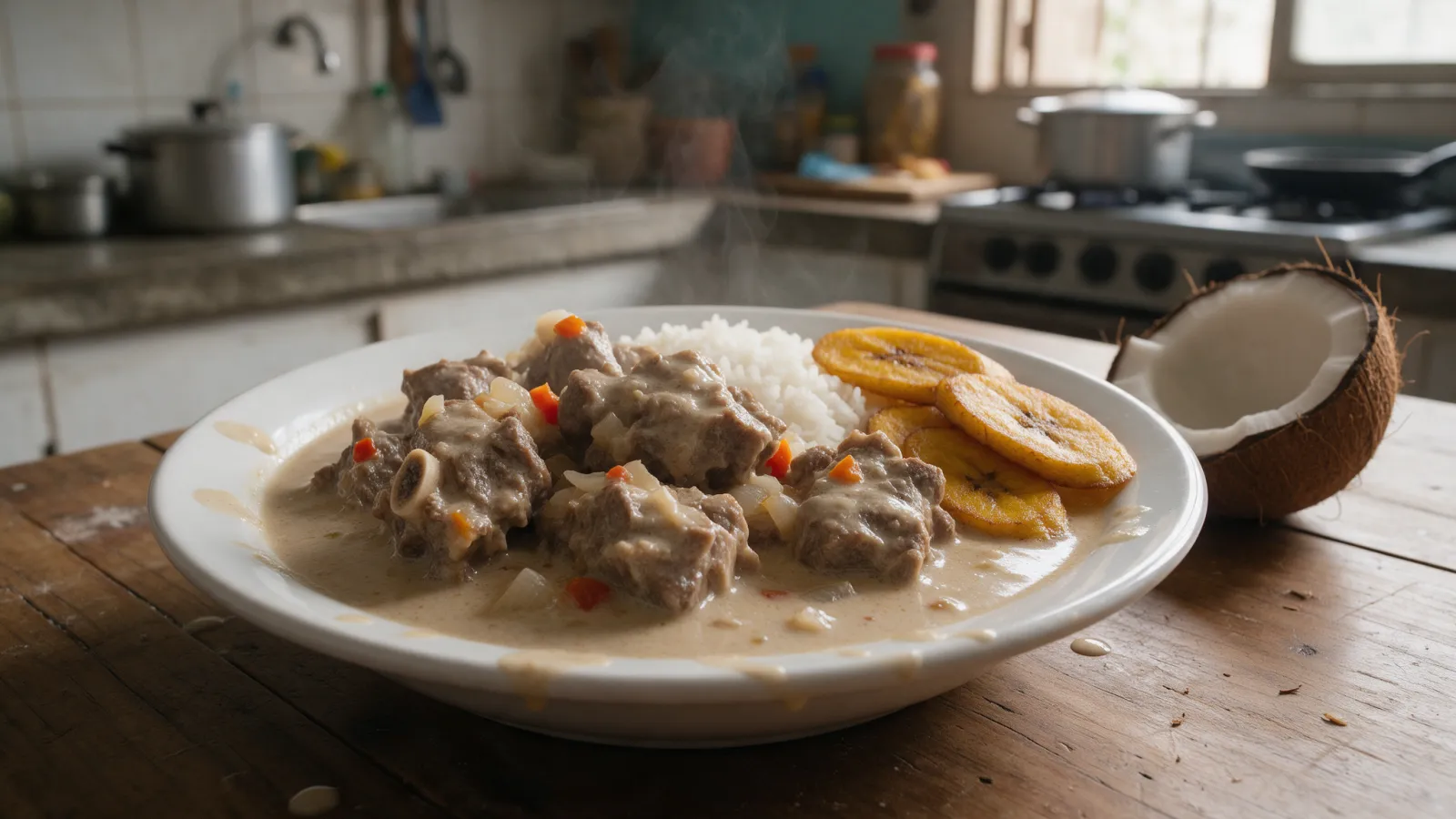

Goat is a very lean red meat, with 2.3 g of fat per 100 g raw against 21.5 g for lamb shoulder, and that is exactly why chivo en coco works: the meat brings the deep flavor and a can of coconut milk brings the richness it lacks. Chivo en coco is goat stewed with garlic, cumin, sweet peppers and annatto, then finished in coconut milk, and it is cooked in western Venezuela (Falcón, Lara, Yaracuy and Zulia) and in Sucre state in the east. If you have never cooked goat, the two things to get right are trimming the fat, which is where the strong smell lives, and adding the coconut milk at the end so it doesn’t split.
How do you make Venezuelan goat in coconut milk?
How do you make chivo en coco? Trim the goat of fat, rub it with lime, rinse, and season it with garlic, cumin and salt the night before. Brown it in annatto oil, cook a sofrito of onion, bell pepper, ají dulce and tomato, then simmer the goat covered in water for 100 minutes, until it pulls from the bone. Reduce the broth, stir in coconut milk and cook 20 minutes on low. 200 minutes for 8 servings.
Is it worth making, and who is it for?
It’s worth it if you like lamb or beef stew and want something with more character. Think of a braise where the meat falls off the bone into an orange, spoon-coating sauce that tastes of coconut first and cumin and garlic second. It isn’t spicy: ají dulce is a sweet pepper.
Good for a weekend lunch, or a gathering of 8 to 20, since the pot looks after itself for most of the afternoon and the stew is better the next day.
Maybe not for someone who dislikes gamey meat. Even trimmed, goat tastes like goat; make it with lamb shoulder for them. It’s also not a weeknight dish at 3 hours 20 minutes on the clock, though only about 62 minutes of that are hands-on.
Difficulty: medium. Nothing here is technically hard. Trim properly and keep the coconut milk away from a hard boil, and it comes out right.
Buying goat in the US and UK, and what to use instead
Which cut to ask for
Ask for bone-in goat shoulder, leg or ribs, cut into 2-inch (5 cm) pieces, often sold simply as goat stew meat. The bone gives body to the broth, which later becomes half the sauce. Meat from adult goats is almost always stewed because it’s tough, while kid can be cooked like lamb.
If you have a choice, pick meat from a female or a younger animal. The branched-chain fatty acids behind the goaty smell (methyl- and ethyl-octanoic acid) sit in the fat and run higher in males than in females.
Out of 4.4 lb (2 kg) bone-in, expect about 3.3 lb (1.5 kg) of meat once bone and trimmed fat are gone; bone alone is 21 to 24% of a goat carcass.
Where to find it
- US: halal butchers, and Caribbean, Mexican, West African and South Asian grocers. In South Asian and Caribbean shops, mutton often means goat, so ask. In the week of October 9, 2026, goat only showed up in grocery ads in the Northeast and Southeast.
- UK: halal and Caribbean butchers are the reliable source; I wouldn’t count on finding it at a supermarket.
- Frozen is fine. Thaw it in the fridge, or in cold water in a sealed bag, changing the water every 30 minutes, and cook it right away if you use the water method.
Lamb, mutton or kid
- Lamb shoulder is the easy swap and gives a milder dish. It has 21.5 g of fat per 100 g raw, about nine times as much as goat, so skim the broth before the coconut milk goes in. Unskimmed, each serving gains about 291 calories and 36 g of fat.
- Mutton (adult sheep) comes closest to goat’s intensity. Treat it like goat: trim, then cook long.
- Kid (young goat, cabrito) is tender and mild. Start checking at 60 minutes, because it shreds if it goes too long.
- Beef stew meat works, at 4.5 g of fat per 100 g, but you’ve made beef in coconut milk, which is a different dish.
Coconut milk, ají dulce and annatto at a US or UK store
| In the recipe | What it is | US / UK swap | What changes |
|---|---|---|---|
| Full-fat coconut milk | about 21 g fat per 100 g | any full-fat can; one with guar gum holds together better | light coconut milk gives a thin sauce |
| Ají dulce | small sweet pepper, no heat | mini sweet peppers, or more red bell pepper | a little less perfume |
| Onoto | annatto seeds | achiote seeds in the Latin aisle, or 1 tsp sweet paprika | color only, flavor barely |
| Cebollín | green onion | green onions / spring onions | nothing |
The guar gum point is the reverse of the advice for Colombian coconut rice, where you want the fat to separate. In a stew you don’t, and the stabilizer helps.
Getting rid of the strong goat smell
- Trim the fat and the white membrane. That’s where the smell compounds are. It takes 10 minutes with a sharp knife and does more than anything else on this list.
- Rub with lime for 5 minutes and rinse. Almost every Venezuelan recipe does this. I treat it as cleaning the surface; it won’t fix fat you left on.
- Season and refrigerate, overnight or for at least 2 hours. Always marinate in the fridge, never on the counter.
- For an older male that smells strong, I blanch it: 5 minutes in boiling water, drain, rinse, then season.
The cooking-day plan
Twenty minutes the night before and about three hours on the day. Seasoning ahead means you start cooking with clean, salted meat and only chopping left to do.
What to look for at each stage
- Annatto oil, 3 to 5 minutes: deep red. If the seeds turn black, the oil is bitter; start over.
- Browning: the side touching the pot comes out brown, not gray. A lot of liquid means the pot was too cool or too crowded.
- Sofrito: onion translucent at 8 minutes, tomato collapsed 4 minutes later.
- Goat: a fork goes in without resistance and the meat lets go of the bone with a gentle push.
- Sauce: after 20 minutes with the coconut milk, it coats the spoon and looks smooth, with no yellow beads of oil.
Why coconut milk splits, and the temperatures that matter
Coconut milk is an emulsion of fat and water. Held above roughly 176°F (80°C), its proteins stop holding it together and the fat pools on top over white curds. That’s why the goat gets tender in water here and the coconut milk only goes in for the last 20 minutes. If you cook the goat in coconut milk from the start, as some versions do, you need to stir it constantly for an hour and a half.
Three rules: room-temperature coconut milk, because cold milk hitting a hot pot can split from the shock; low heat, with bubbles only at the edge; and no acid at the end, so the lime goes on the table. If it splits anyway, take the pot off the heat and stir in a slurry of a tablespoon of cornstarch in two of water, a little at a time. It usually comes back.
Is it safe? Whole cuts of goat need 145°F (63°C) plus a 3-minute rest. A stew that simmers for 100 minutes is far past that; the thermometer matters when you reheat.
Stovetop, pressure cooker or lamb shoulder
Stovetop: 100 minutes covered after browning. In Venezuelan kitchens it usually takes 90 to 100 minutes; an older animal can need 150.
Instant Pot or stovetop pressure cooker: after the sofrito, add the goat and only 2 cups (500 ml) of water, since nothing evaporates. Cook 35 minutes at high pressure with a 15-minute natural release. Bone-in goat curries for electric pressure cookers use 25 to 40 minutes, so test with a fork and add 5 minutes if needed. Then switch to sauté on low, add the coconut milk and cook 20 minutes with the lid off.
Curry version: plenty of Venezuelan cooks add ½ tsp curry powder to the sofrito. I use it in place of 1 of the 2 tsp of cumin.
Lighter version: use 1 can of coconut milk and 1⅔ cups (400 ml) more broth. The sauce is paler, and each serving drops about 93 calories.
How it compares with asado negro and fish in coconut sauce
Venezuelan asado negro is the other long Sunday braise: a single piece of beef blackened in papelón caramel and cooked with wine for 165 minutes. Colombian fish in coconut sauce uses the same low-heat coconut milk, but the fish cooks in it for under 10 minutes. Chivo en coco sits between them, with the long braise of one and the coconut sauce of the other.
Cooking for 4, 8 or 20
| Serves | Bone-in goat | Coconut milk | Water | Pot |
|---|---|---|---|---|
| 4 | 1 kg (2.2 lb) | 1 can (400 ml) | 600 ml (2½ cups) | 4 qt (4 L) |
| 8 | 2 kg (4.4 lb) | 2 cans (800 ml) | 1.2 L (5 cups) | 6 qt (6 L) |
| 20 | 5 kg (11 lb) | 5 cans (2 L) | 3 L (12½ cups) | 16 qt (15 L), or two 8-quart pots |
Allow 9 oz (250 g) of bone-in goat per person. The simmering time doesn’t change when you scale up, because it depends on the size of each piece, not the total weight. Browning takes longer, about 8 batches for 20, and a big pot takes longer to come to a boil; in mine, about 20 extra minutes. For a party, I cook the whole thing the day before.
What goes wrong
- It smells strong: the fat stayed on. Trim raw; there’s no fix once it’s in the pot.
- The meat is tough: not enough time, or it boiled hard. Low heat, lid on, 15-minute rounds until it leaves the bone.
- The sauce split: the coconut milk boiled or went in cold. See the rules above.
- The sauce is watery: the broth wasn’t reduced before the coconut milk.
- It’s greasy: lamb, or fatty goat, needs skimming with a ladle before the coconut milk.
Heat: none. Kids: depends how they feel about strong flavors; shredded off the bone, it goes down easier. Allergens: coconut. It contains no gluten, dairy, eggs or nuts. In the UK, coconut is not one of the 14 allergens that must be declared, but coconut allergy exists, so mention it if you’re cooking for guests.
What it costs
Fresh goat stew meat averaged $5.15 a pound nationally in grocery ads on October 9, 2026. The 4.4 lb in this recipe comes to $22.71, and with the vegetables, limes and herbs the pot totals $30.19, or $3.77 a serving.
Goat is 75% of the bill, and that’s an advertised sale price, so a butcher counter may charge more. Coconut milk, oil and spices aren’t counted because their price swings so much by brand. For 20, multiply by 2.5: about $75 before the coconut milk. UK goat prices vary too much by butcher, so I’m not giving one here.
Yield: 4.4 lb bone-in gives about 3.3 lb (1.5 kg) of raw meat, or about 5 oz (140 g) of cooked meat per serving with sauce. With rice and Venezuelan fried sweet plantains that’s 8 full plates, or 10 as part of a spread.
Serving, make-ahead and storage
How it’s served: with Colombian white rice to soak up the sauce, plus tostones or boiled cassava and a green salad. Leftovers, shredded off the bone with a little sauce, make a good filling for a Venezuelan patacón maracucho, the plantain sandwich from Zulia.
Make ahead: cool the stew in shallow containers and get it into the fridge within 2 hours. Next day the fat sets on top and lifts off with a spoon if you want it gone.
Fridge: 3 to 4 days at 40°F (4°C) or below. Raw goat cut up for stew is best cooked within 1 to 2 days; larger cuts keep 3 to 5.
Freezer: 2 to 3 months for best quality, in flat bags or containers. Thaw in the fridge for 24 hours. The sauce may look separated after thawing; stir as it warms and it comes back together.
Reheating: covered, over low heat, stirring, until it reaches 165°F (74°C) in the center, about 10 to 15 minutes. Add 3 or 4 tablespoons of water if the sauce has thickened. High heat will split the coconut milk.
Frequently asked questions
What does goat in coconut milk taste like? Like a rich beef or lamb stew with a stronger, earthier meat flavor, in a sweet-savory coconut sauce with cumin and garlic. It isn’t spicy.
How do you get rid of the goaty smell? Trim all visible fat and membrane while the meat is raw, rub with lime and rinse, then season and refrigerate. For an older male, blanch the pieces for 5 minutes and discard the water.
How long does goat take to get tender? About 100 minutes at a gentle simmer for 2-inch pieces, up to 150 for an older animal. In an Instant Pot, a 15-minute natural release after 35 minutes at high pressure.
Can I use lamb instead of goat? Yes. Lamb shoulder is milder and softens sooner, from about 75 minutes, but carries about nine times the fat, so skim before adding the coconut milk.
Why did my coconut milk curdle? It boiled too hard for too long, or went into a hot pot straight from the fridge. Add it last, at room temperature, over low heat.
Can I freeze it? Yes, for 2 to 3 months. Stir well when reheating.
Where is chivo en coco from? Western Venezuela (Falcón, Lara, Yaracuy and Zulia) and Sucre state in the east, where it’s a dish for christenings and weddings.
Nutrition
Per serving (1/8 of the recipe, about 5 oz / 140 g cooked meat with sauce, no sides), calculated ingredient by ingredient using this recipe’s amounts and 3.3 lb (1.5 kg) of trimmed meat from the 4.4 lb bone-in:
- Calories: 474
- Protein: 42 g
- Carbohydrates: 11 g
- Fat: 30 g, of which 20 g saturated
- Fiber: 2 g
- Sugars: 4 g
- Sodium: 755 mg
Coconut milk accounts for 39% of the calories and 91% of the saturated fat. The sugar figure leaves out the canned coconut milk, so it runs a little low. Without the added salt, sodium would be about 174 mg.
For years I thought the smell of goat was just part of the deal. The first time I made chivo en coco in Colombia I tried lime, vinegar and everything else in the cupboard, and it still smelled. What fixed it was a knife and ten patient minutes taking off the fat before seasoning. Now the lime is only for cleaning, and the coconut milk waits until the end. Josnaisis.