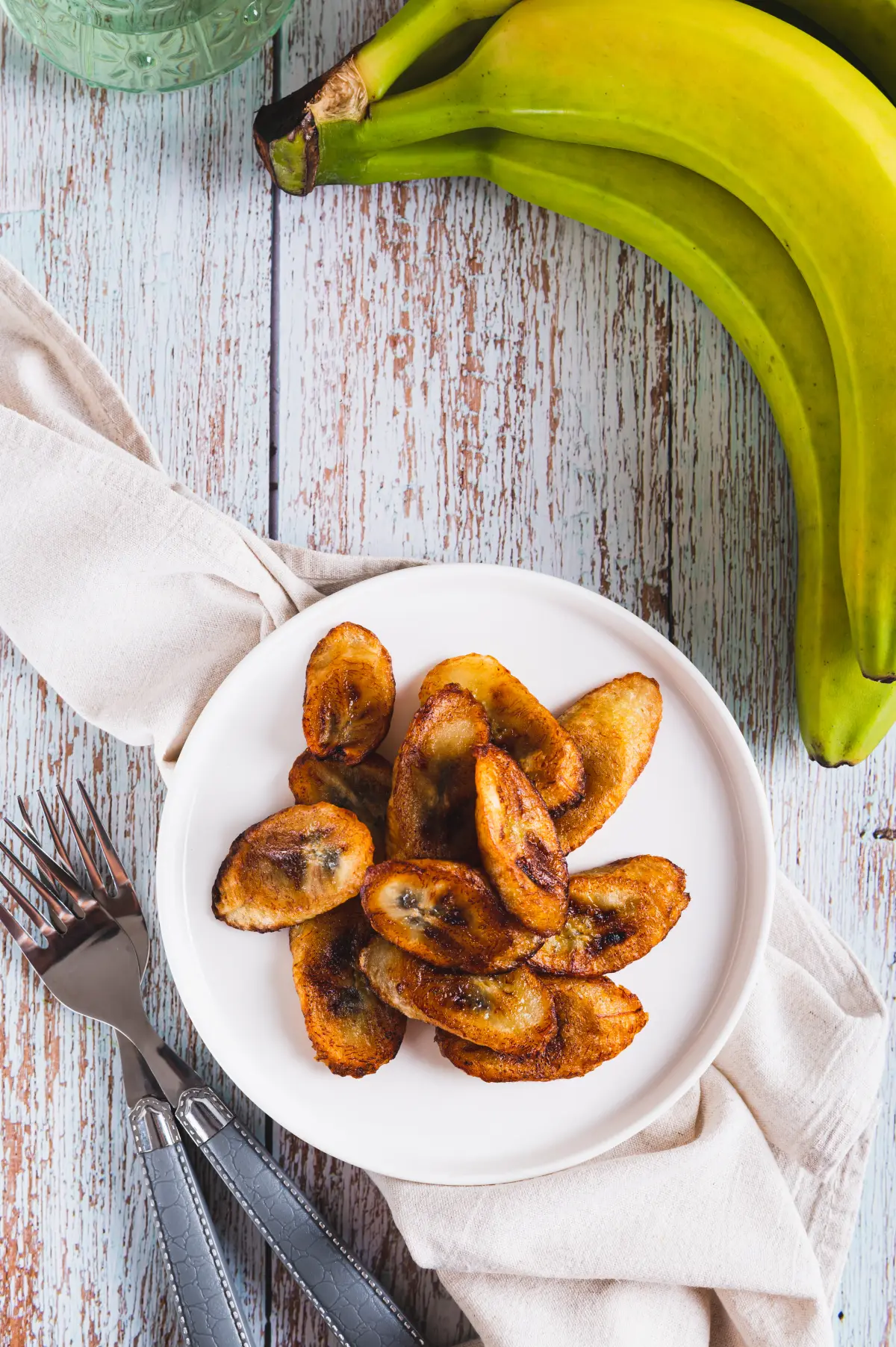

Tajadas (tah-HAH-dahs) are ripe plantains sliced long and fried once, and in Venezuela they sit beside almost every home-cooked lunch. They are sweet but not a dessert: the sugar in a black-skinned plantain browns in hot oil into a dark, sticky edge, while the inside goes soft and creamy, and that sweetness is meant to sit next to salty beans, rice and braised beef. If you have eaten Cuban or Puerto Rican maduros, you already know the idea. What follows is how I make them: the ripeness I wait for, the cut, the oil temperature, what makes them greasy, and how to do them in an air fryer or oven when frying is not an option.
What are tajadas, and are they worth making?
How do you make fried sweet plantains? Peel very ripe plantains with mostly black skins, cut them on a steep diagonal into 1 cm (⅜ inch) slices and fry them in small batches in oil at 350°F (175°C), 2-3 minutes per side, until the edges turn mahogany. Drain on a rack and serve hot. Ready in 30 minutes for 4 servings.
They are worth it whenever plantains on your counter have gone black. Three ingredients, half an hour, and almost nothing can go wrong once you get the ripeness and the oil right.
Fried ripe plantain slices are called tajadas in Venezuela, Honduras and central Colombia, and they appear in most typical Venezuelan meals, starting with pabellón criollo. They are maduros or amarillos in Cuba, Puerto Rico and the Dominican Republic, dodo in Nigeria and its neighbours, and one trap: in Nicaragua, tajadas are made from green plantain.
Who they suit. Anyone cooking a Latin American or Caribbean plate with rice and beans, kids, and gluten-free and dairy-free tables, since they are only plantain and oil.
Who they may not suit. Anyone who will not deep-fry at home. The air fryer and oven versions below work, but they do not get the same caramel edge. And if all you have is green plantain, make tostones instead.
Time and effort. 30 minutes, nearly all of it at the stove. Easy.
How ripe should plantains be for frying?
More black than yellow, with no sunken spots, and still firm when you squeeze. It should give like a ripe avocado, not like a water balloon.
Cooks split on this. Some want very ripe, black plantains that yield to gentle pressure; others prefer yellow with black spots, because mostly black fruit can fall apart in the oil. I land between the two. That difference is sugar: green plantain has 2.3 g per 100 g, ripe raw plantain 17.5 g, and it is the sugar that browns.
- Green → hard, starchy, not sweet. Tostones, not tajadas.
- Plain yellow → firm but bland, browns poorly. Wait 2-3 days.
- Yellow with black spots → works, a little less sweet.
- Mostly black, still firm → the one you want.
- Black and very soft, leaking or smelling fermented → too far for slicing. Use it for Venezuelan mandocas or mash it.
On my counter a plain yellow plantain needs 2-3 days to get spotty and 4-6 days to blacken, a little less in a paper bag. The fridge darkens the skin without ripening the fruit.
Not a banana. A banana has too little starch and turns to mush in hot oil. In the US and UK, plantains are sold near the bananas in most large supermarkets and in Latin, Caribbean, African and Asian grocers. In the week of October 9, 2026 they were advertised in the US at an average of $0.88 a pound, and Tesco lists them at £0.75 each.
What you need
Three plantains at 1 kg (2.2 lb) unpeeled, 750 ml (3 cups) of oil and salt if you want it. The rest is equipment.
- Oil. Any neutral oil that handles 355°F (180°C) without smoking: vegetable, sunflower, corn, canola. Extra virgin olive oil fights the plantain flavour.
- Pan. A deep 24 cm (9½-inch) skillet or a heavy pot, so 3 cups of oil sit about 2 cm (¾ inch) deep, enough to cover a 1 cm (⅜ inch) slice. Never fill it more than halfway.
- Thermometer. An instant-read or clip-on fry thermometer. Without one, use a test slice.
- Wire rack over a tray. I drain them on a rack because very ripe slices stick to paper towels.
The 30-minute plan
Put the oil on before you peel, because it needs 8-10 minutes to reach 350°F (175°C), which is about how long it takes to peel and slice three plantains. Then three batches of about 6 minutes. If the tajadas go with a bigger meal, fry them last, when everything else is on the table.
How to cut plantains for tajadas
On a steep diagonal, 1 cm (⅜ inch) thick, all the same. The usual range is 1 cm slices on the bias up to half an inch. Thinner slices dry out; thicker ones stay hard in the middle. Even thickness matters more than the exact number. With short plantains, I cut lengthwise slabs of the same thickness.
To peel, cut off both ends, run the knife lengthwise through the skin only and push the peel off with your thumb. A ripe plantain peels like a banana.
Oil temperature for frying plantains
350°F (175°C) is the most common frying temperature, and some cooks go up to about 180°C (355°F); anything from 325-350°F (160-180°C) works. At 375°F (190°C), the heat some Nigerian dodo recipes use, a very ripe plantain darkens in seconds. Two to three minutes on the first side and a little less on the second is the usual window, sometimes as little as 2 minutes and 1 minute.
Signs it is going right.
- Slices go in → steady, vigorous bubbling around each one.
- After 2 minutes → the underside is golden and the edges mahogany. Turn once.
- Out of the oil → golden on both sides, dark but not black at the edges, and soft when pressed.
- Between batches → back to 350°F (175°C), about 3-4 minutes on the heat.
Scaling for 4 to 20
| Serves | Ripe plantains | Weight unpeeled | Skillet batches | Best method |
|---|---|---|---|---|
| 4 | 3 | 1 kg (2.2 lb) | 3 | skillet |
| 6 | 4-5 | 1.5 kg (3.3 lb) | 4-5 | skillet |
| 12 | 9 | 3 kg (6.6 lb) | 9, about 55 min | oven, 2 sheet pans, or two skillets |
| 20 | 15 | 5 kg (11 lb) | 15, over 90 min | oven, 3-4 sheet pans in 2 rounds |
The same 3 cups of oil do every batch; top it up if it drops below 1.5 cm (½ inch).
Why fried plantains turn out greasy, and other mistakes
Greasy slices come from cool oil. If the oil is cold, the tajadas absorb more fat. Crowding the pan is the usual way the oil gets cold.
- Greasy → oil below temperature or too many slices at once. Batches of 8-10, let the oil recover, pat the slices dry first and drain on a rack.
- Black outside, firm inside → oil above 365°F (185°C) or slices too thick. Lower the heat and cut 1 cm (⅜ inch).
- Pale and starchy → the plantain was plain yellow. No sugar, no caramel. Wait for black skins.
- Breaking apart → fruit too soft, or pierced when turning. Use firm plantains and turn with a slotted spoon.
- Stuck to the paper → very ripe slices do that. Use a rack.
- Spitting oil → wet slices. Dry them and slide them in from close to the surface.
Spice level. None. Allergens. Plantain and oil only: no gluten, dairy, egg or nuts, unless the oil was used before for breaded food.
Skillet, air fryer or oven
- Air fryer. Brush the slices with 1 tablespoon of oil in total, lay them in one layer and cook at 400°F (200°C) for 7 minutes, flip, then 5-9 minutes more until golden and soft. In total it runs 12-16 minutes at 400°F; my basket takes one plantain per batch. Oil the basket well, because ripe plantain sticks.
- Oven. On an oiled parchment-lined sheet pan, one layer, brushed with 1 tablespoon of oil, at 400°F (200°C): 12 minutes, flip, 6-10 minutes more. Half-inch diagonal slices of black-skinned plantain need 12 and then 6 minutes. This is the method for a crowd.
- Lighter. Either of those: about 240 kcal and 4 g of fat per serving, against 323 kcal and 10 g fried.
- With cheese. Grate a salty white cheese over the hot slices; feta or cotija are the easy US and UK stand-ins for Venezuelan queso blanco. The Venezuelan yo-yo is two tajadas sandwiching soft white cheese, dipped in egg and fried again.
- Sweeter. Some Venezuelan cooks fry them in butter with honey or sugar. With properly ripe plantains I do not need it.
- Baked into something. Venezuelan plantain cake layers these same slices with cheese, cane sugar syrup and egg.
Make ahead, storing and reheating
Tajadas are best within minutes of leaving the oil. What you can do ahead is limited.
- Up to 1 hour ahead → peel and slice, cover and refrigerate. The cut surface darkens slightly.
- Up to 30 minutes ahead → fry and hold on a rack in a 200°F (95°C) oven.
- Leftovers → into a closed container within 2 hours, and eat within 3-4 days, like any cooked leftovers.
- Reheating → air fryer at 350°F (175°C) for 3-5 minutes, or a dry skillet over medium heat, 2 minutes a side, to 165°F (74°C) in the centre, as with any leftovers. The microwave works but leaves them soft.
- Freezing → some cooks freeze them for up to 3 months. I do not: thawed tajadas weep water and lose their edge. If you want tajadas later in the week, keep the plantains, not the fried slices.
How much do tajadas cost?
At $0.88 a pound (US average, week of October 9, 2026), 1 kg (2.2 lb) of plantains costs $1.94, about 49 cents a serving. The oil is the wild card and I leave it out, but strain and reuse it, because the oil in the pan is worth more than the plantains. In Bogotá, at Corabastos wholesale prices for September 12-18, 2026, the plantains plus the 39 g (1.4 oz) of oil they absorb come to 3,368 Colombian pesos for four.
What to serve with tajadas, 4 classic plates
The classic plate is pabellón criollo: shredded beef, Venezuelan black beans, white rice and tajadas side by side. They also go next to Venezuelan asado negro, a plain bowl of Colombian white rice with beans, or on the giant Colombian bandeja paisa. With grated white cheese, they are an afternoon snack in my house.
Fried sweet plantain questions
Are tajadas the same as maduros? Yes, both are ripe plantain fried once. Tajadas is the Venezuelan and Colombian name and usually means long diagonal slices.
What is the difference between tajadas and tostones? Tajadas use ripe plantain fried once. Tostones use green plantain, smashed and fried twice.
What temperature should the oil be? 350°F (175°C), anywhere from 340°F to 355°F (170-180°C), for 2-3 minutes per side.
Why are my fried plantains greasy? The oil was too cool, usually because the pan was crowded. Fry about 8-10 slices at a time in a 9½-inch pan and let the oil recover.
Can I use yellow plantains? Yellow with black spots, yes, though they are less sweet. Plain yellow ones stay pale and starchy.
Can you make tajadas in an air fryer? Yes. 400°F (200°C), a tablespoon of oil brushed on, 12-16 minutes, flipped halfway.
Can I use bananas? No. They turn to mush in the oil.
How do you reheat fried plantains? Air fryer at 350°F (175°C) for 3-5 minutes, or a dry skillet, until hot in the centre.
Nutrition per serving
Per serving (a quarter of the recipe, about 137 g / 4.8 oz of fried slices), calculated for fried ripe plantain, including the oil absorbed, with no salt:
- Calories: 323 kcal
- Protein: 2 g
- Carbohydrates: 56 g
- Fat: 10 g, 2 g saturated
- Fiber: 4 g
- Sugars: 30 g
- Sodium: 8 mg
Almost all the fat is frying oil, about 39 g (1.4 oz) across the batch; raw plantain brings less than 3 g. The 30 g of sugar is the plantain’s own. Baked or air-fried, a serving is about 80 kcal and 6 g of fat lighter, at roughly 240 kcal.
When I moved to Colombia I kept buying yellow plantains labelled ripe and getting pale, starchy tajadas, until I started buying them a week early and leaving them on top of the fridge. Black skin on a plantain is not a sign that you waited too long. It is the whole recipe. Josnaisis.