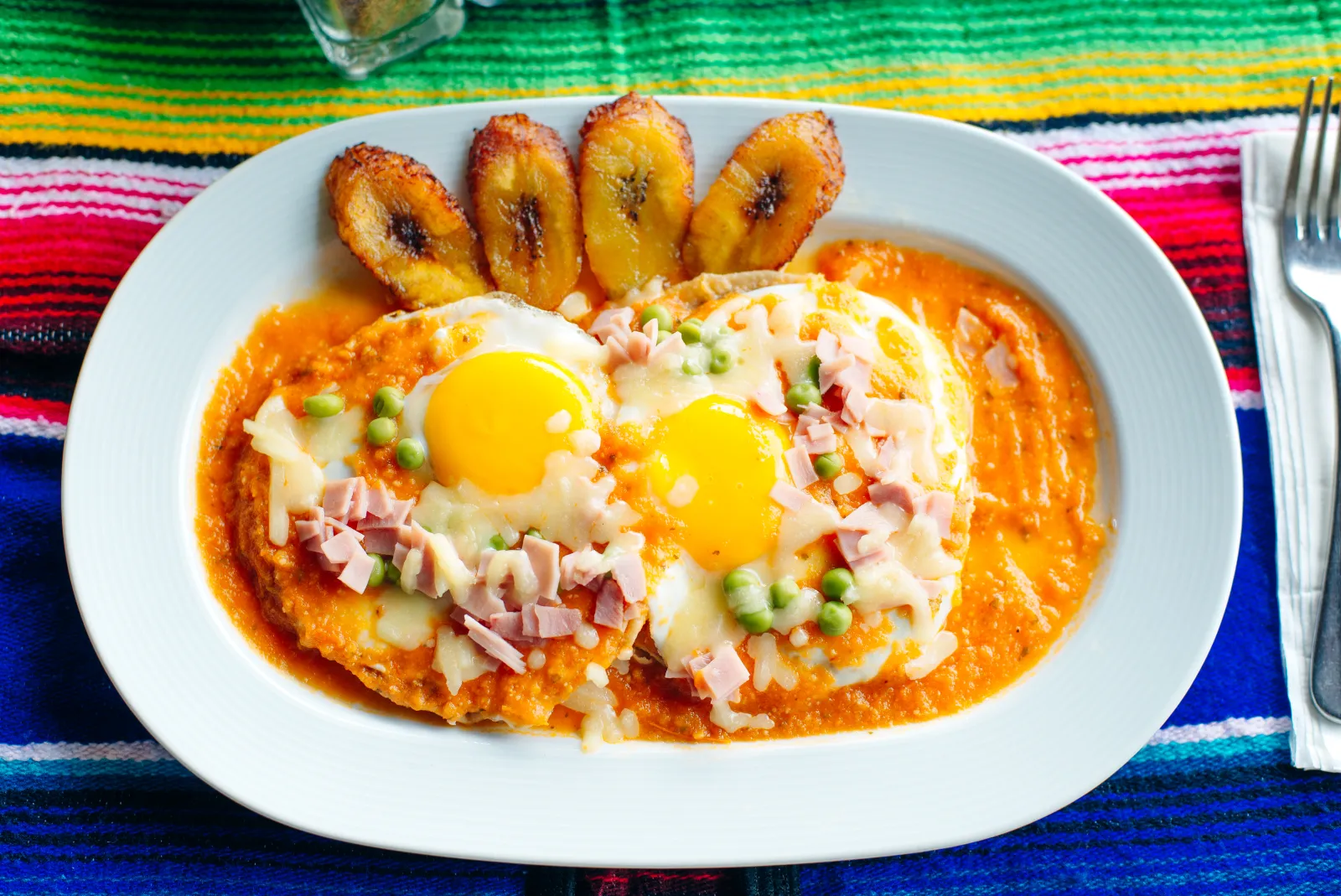

Huevos motuleños (WAY-vohs moh-too-LEN-yohs) are the big breakfast of Yucatán, the peninsula on Mexico’s Caribbean side: fried corn tortillas spread with black beans, fried eggs on top, a tomato sauce with diced ham and peas spooned around them, and slices of fried sweet plantain on the side. They take their name from Motul, a town north of Mérida, where the dish is usually credited to a cook named Jorge Siqueff around 1921, though another account places it in the port of Telchac. None of the parts is hard. The trick is getting six hot components onto the plate at the same moment, and that comes down to cooking them in the right order.
What makes huevos motuleños different from huevos rancheros?
How do you make huevos motuleños? Char 600 g (1⅓ lb) of tomatoes, a garlic clove and a habanero in a dry skillet, blend the tomatoes and simmer them with onion, the whole habanero, 120 g (a scant cup) of peas and 140 g (5 oz) of ham for 12 minutes. Fry a sliced ripe plantain, then 8 corn tortillas, spread them with black beans, top with 8 eggs fried covered for 3 minutes, and spoon the sauce around the yolks. Ready in 45 minutes for 4 servings.
Three things. The sauce is made from charred tomatoes with a whole habanero simmered in it, rather than a blended tomato and serrano salsa. The tortillas are fried firm, not just softened in oil. And the plate carries far more: black beans, ham, peas, plantain and often cheese. Huevos rancheros take about 30 minutes for 4 and come to about 450 kcal a plate; huevos divorciados with red and green salsa take 40 minutes and about 570 kcal. Motuleños need 45 minutes and land around 750 kcal, which makes them a brunch that doubles as lunch.
Who it’s for. Anyone feeding 4 on a slow weekend morning, or 8 to 10 if the sauce and beans are made the day before. Who might skip it. Anyone with 15 minutes, since it uses three skillets and two saucepans, and vegetarians, unless the ham goes (see the versions below).
Time and effort. 45 minutes, about 30 hands-on; about 25 minutes on the day if the sauce and beans are ready. Difficulty, medium: no single step is tricky, but the order matters.
Ingredients, and where to find them outside Mexico
Quantities on the recipe card make four plates, each with a pair of tortillas and a pair of eggs.
Plantain. Plantains look like oversized bananas but are starchier, and they’re only sweet once the skin turns almost black. US supermarkets stock them near the bananas; in the UK, look in Caribbean and African grocers and the world-food aisle of larger supermarkets. A green or yellow plantain fries pale and starchy, so buy a few days ahead if needed. A regular banana is no substitute: it collapses in hot oil.
Habanero. One of the hottest chiles you’ll find in a grocery store, with a fruity smell. Here it goes in whole and unbroken, so it scents the sauce without making it fierce. In the UK, a Scotch bonnet is a close cousin with similar heat. If you can only find dried habanero, skip it and serve hot sauce at the table.
Black refried beans. US stores sell them canned. In the UK, mash a can of drained black beans with a few spoonfuls of their liquid and warm them with a little oil: looser, but right in flavor. Yucatecan cooks often use frijol colado, beans blended and pushed through a sieve for a silky, almost pourable texture.
Cheese. Optional. In Motul’s market stalls the dish comes without any; in Mérida, grated queso de bola is common, and that cheese is simply Edam, sold under that name in both countries. Crumbled queso fresco is milder.
Ham and peas. Plain cooked ham from the deli counter, diced, and ordinary frozen peas (garden peas in the UK).
Equipment. A dry cast-iron skillet for charring, a blender, two small saucepans, a 20 cm (8 in) skillet for frying and a 26 cm (10 in) nonstick skillet with a lid for the eggs. No lid? A dinner plate on top does the same job.
The tomato-habanero sauce, charred, not boiled
In Yucatán the charred tomato and habanero sauce is called chiltomate, and it’s what this dish wears. I char the tomatoes for 12 minutes in a dry pan until the skins blister black, because the scorched skin gives a smoky sweetness that boiled tomatoes never get. Then they’re pulsed, not puréed, and fried with the onion. The peas and ham join for the final 4 minutes of a 12-minute simmer, so they heat through in the sauce. You end up with about 600 ml (2½ cups), roughly ⅔ cup per plate.
How hot is it? With the habanero whole and unbroken, I’d call it 1 out of 5: warm and fragrant. Prick it with a fork and it climbs to about 3. Blend it in and most people won’t finish the plate. For the heat-lovers, do what they do in Motul and put a charred habanero on the side.
Planning the morning, for 4 plates or 10
The order that keeps everything hot:
- Sauce first. On the lowest heat, it holds as long as you need.
- Beans while the sauce simmers. They hold on low too.
- Plantain next. Freshly fried, it’s fine for 15 minutes, longer in a low oven.
- Tortillas right before the eggs, with the beans spread on while they’re still hot.
- Eggs last, in batches of 4. They’re the only part that won’t wait.
| People | Eggs | Tortillas | Tomatoes | Habanero | Ham | Peas | Refried beans | Plantain | Cheese |
|---|---|---|---|---|---|---|---|---|---|
| 2 | 4 | 4 | 300 g (⅔ lb) | 1 | 70 g (2½ oz) | 60 g (½ cup) | 180 g (¾ cup) | ½ | 30 g (1 oz) |
| 4 | 8 | 8 | 600 g (1⅓ lb) | 1 | 140 g (5 oz) | 120 g (1 cup) | 360 g (1½ cups) | 1 | 60 g (2 oz) |
| 10 | 20 | 20 | 1.5 kg (3⅓ lb) | 2 | 350 g (12 oz) | 300 g (2¼ cups) | 900 g (3¾ cups) | 2 or 3 | 150 g (5 oz) |
For 10, use 150 g (5 oz) onion and 2 or 3 garlic cloves. The frying oil stays at 150 ml (⅔ cup), topped up when it drops below about 5 mm (¼ in).
Ten hot plates at once
- The day before, make the sauce without the ham and peas, and the beans. Refrigerate each within 2 hours.
- 45 minutes before, heat the oven to its lowest setting, about 200°F (95°C), with the plates inside. Bring the sauce to a boil, add the ham and peas and keep it on low; the same for the beans.
- 35 minutes before, fry the plantain in 3 batches and hold it on a tray in the oven.
- 20 minutes before, fry all 20 tortillas and hold them on a rack in the oven without beans, so they stay crisp. Spread the beans as you plate.
- Eggs in two 26 cm (10 in) skillets at once: batches of 8, 3 minutes each, three batches in about 12 minutes. One person fries, one plates, and every batch sends 4 plates to the table.
While you serve, the sauce and beans should stay above 140°F (60°C); a lid and the lowest flame do it.
Runny yolks, mistakes, kids and allergens
Egg timing. In a nonstick pan over medium heat, with ½ tbsp oil per 4 eggs and the lid on, a large egg goes like this in my kitchen: 3 minutes, whites set and yolk runny; 4, jammy; 5 to 6, firm. The lid steams the white around the yolk so the bottom doesn’t burn before the top sets.
Are runny yolks safe? The cautious advice is to cook eggs until both white and yolk are firm, especially for infants, young children, older adults, pregnant women and anyone with a weakened immune system. For them, 5 to 6 minutes covered, or pasteurized shell eggs, sold labeled as such in US stores. Keep raw eggs in their carton at 40°F (4°C) or below and use them within 3 weeks.
Common mistakes.
- Cold eggs on the plate → they were fried first. Eggs last, 4 at a time.
- Tortillas shatter → left in the oil until fully browned. 20 to 30 seconds a side; pull them when the edge crisps.
- Soggy tortillas → runny beans or plates assembled too early. Thick beans, build at the last minute.
- Sauce too hot → the habanero split while stirring. Stir gently, or tie it in a scrap of cheesecloth.
- Pale, greasy plantain → underripe fruit or oil that wasn’t hot. Nearly black skin, 350°F (175°C) oil.
Kids usually like it: sweet plantain, salty ham and barely any heat. Give them firm yolks. Allergens: egg and milk (cheese). Corn tortillas contain no wheat, but some processed hams contain added starches, so check the label for a coeliac guest, and use oil that hasn’t fried anything breaded. Canned refried beans can contain lard.
Which version should you make?
- Short on time → sauce and beans from the day before; about 25 minutes on the morning.
- Vegetarian → drop the ham and use beans made with oil. You lose salt and protein; a little extra cheese helps.
- Lighter → no plantain and no cheese: about 600 kcal a plate, 150 fewer.
- More Yucatecan → strained black beans, blended, sieved and simmered with epazote until thick; about 10 minutes more.
- Uncharred sauce → simmer the tomatoes for 10 minutes instead of charring them. Brighter, more acidic, less smoky.
- Something sweeter on the side → fry an extra plantain the Venezuelan way, in thick diagonal fried sweet plantain slices, and pass them around.
What it costs
At US prices, the ingredients I could price come to about $7.05 for 4 plates, $1.76 each. Tomatoes and ham are more than half of that.
Eggs ($2.272 a dozen large), tomatoes ($1.977 a pound), boneless ham ($5.382 a pound) and dried beans ($1.630 a pound) are national average prices for August. The beans are counted dry: the blog’s refried beans recipe gets about 1 cup of refried beans from 83 g (3 oz) of dried. Onion and garlic are advertised supermarket prices from October 9, and the plantain was $0.58 each at Walmart. Tortillas, peas, cheese, habanero and oil aren’t counted. In Mexico, at early-October wholesale prices in Mérida and Mexico City, the same plates come to about 11.72 pesos each before the ham.
What drives the cost. The ham, nearly a quarter of the bill. Leave it out and the plate drops to about $1.35.
Serving, storing and reheating
Two bean-spread tortillas per plate, an egg on each, the sauce with its ham and peas around the yolks, cheese on top and plantain alongside. In Motul they come with crusty white rolls for mopping up the sauce and black coffee; a mug of café de olla, coffee simmered with cinnamon and piloncillo, works too. If this sends you further into Yucatecan cooking, the slow-roasted cochinita pibil is the obvious next step.
Fridge. Sauce (better without the ham and peas) and beans keep 3 to 4 days, in separate containers. Fried plantain keeps as long but loses its crisp edge. Fried eggs don’t keep. Cooked food shouldn’t sit out for more than 2 hours, or 1 hour above 90°F (32°C).
Freezer. Sauce and beans, 3 to 4 months in 1-cup (250 ml) tubs. Fried tortillas go hard and stale.
Reheating. Sauce and beans in a pan until bubbling, which takes them past the 165°F (74°C) leftovers need, with a splash of water if they’ve thickened. Plantain, 5 minutes in a 350°F (180°C) oven or a dry skillet. Tortillas and eggs, always fresh.
Frequently asked questions
What are huevos motuleños? A breakfast from Yucatán, Mexico: fried corn tortillas spread with black beans, topped with fried eggs and a tomato-habanero sauce with ham and peas, served with fried plantain and often cheese. About 45 minutes for 4.
Where does the name come from? From Motul, a town in northern Yucatán. The usual story credits a local cook, Jorge Siqueff, around 1921; another places the dish in Telchac Puerto.
What’s the difference between huevos motuleños and huevos rancheros? Rancheros have a tomato and serrano salsa over oil-softened tortillas. Motuleños add black beans, ham, peas and fried plantain, fry the tortillas firm and use a charred tomato sauce with a whole habanero.
Are huevos motuleños spicy? Only mildly, if the habanero stays whole: it perfumes the sauce. Break or blend it and the heat climbs fast.
Can I make them ahead? The sauce and beans, yes, up to 3 or 4 days. The plantain can be fried 30 minutes ahead and held in a 200°F (95°C) oven. Tortillas and eggs have to be cooked right before serving.
What can I use instead of plantain? Nothing that behaves the same. A sweet banana falls apart in the oil. If there’s no plantain, leave it out and add a little extra cheese.
What’s a substitute for habanero in the UK? A Scotch bonnet, used whole the same way. It’s about as hot.
Are runny yolks safe? The cautious advice is firm yolks for infants, young children, older adults, pregnant women and anyone with weakened immunity. For those guests, use pasteurized eggs or keep the lid on until the yolk sets solid.
How many calories are in huevos motuleños? About 750 kcal for a full plate of 2 eggs, 2 tortillas, beans, sauce with ham and peas, plantain and cheese; about 600 without the plantain and cheese.
Nutrition
Per plate of 2 eggs and 2 fried tortillas, 90 g (⅓ cup) canned refried beans, about 150 ml (⅔ cup) of sauce with 35 g (1¼ oz) ham and 30 g (¼ cup) peas, a quarter of the fried plantain and 15 g (½ oz) queso fresco, calculated ingredient by ingredient for this recipe, counting about 5 g of absorbed oil per tortilla and all the oil in the sauce and eggs:
- Calories: 750 kcal
- Protein: 32 g
- Carbohydrates: 68 g
- Fat: 40 g, of which 8 g saturated
- Fiber: 12 g
- Sugars: 18 g
- Sodium: 1,360 mg
The oil in the sauce, tortillas and eggs is about 150 kcal a plate, the plantain about 105 and the cheese 45. The ham accounts for about 285 mg of the sodium, the canned beans 335 mg and the recipe’s salt about 435 mg; with unsalted homemade beans and no salt on the whites, it drops below 900 mg.
The first time I read the list of what goes on this plate, I laughed, because it’s almost a Venezuelan pabellón a caballo: black beans, sweet fried plantain and a fried egg on top. What Yucatán adds is the smoky tomato, the habanero you smell before you taste, and the ham and peas. What it taught me was patience. I used to fry the eggs first. Now they’re the last thing I touch, and nothing reaches the table cold. Josnaisis.