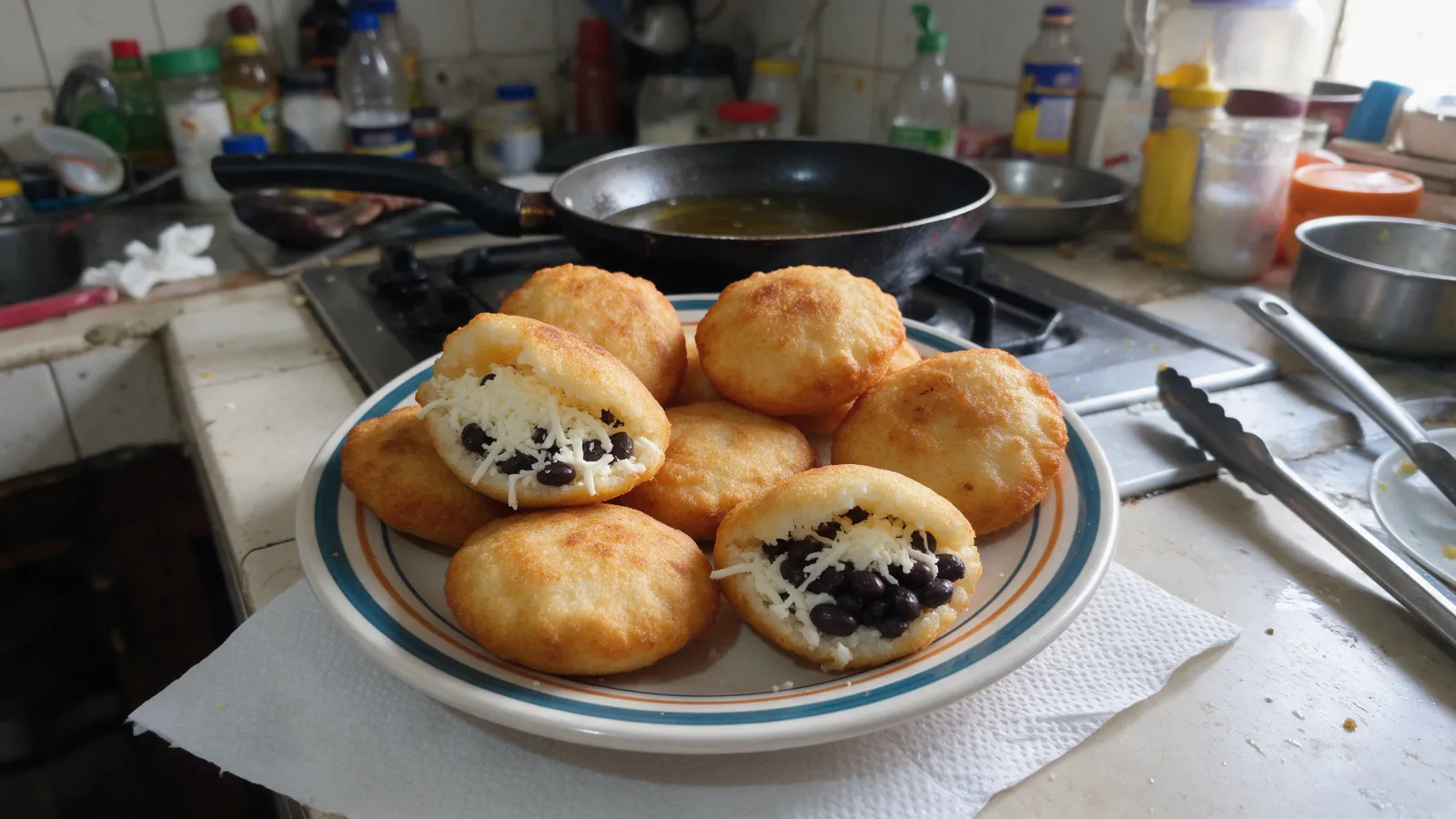

A Venezuelan fried arepa (ah-REH-pah) is a corn cake thin enough to balloon in hot oil. The disc goes in flat, and within a minute steam from the water in the dough lifts the top away from the bottom, so it comes out as a crisp, golden shell with a pocket inside, ready to split and fill like a small pita. It uses the same precooked corn flour, water and salt as any arepa, and nothing else. What makes it puff is a disc about a quarter inch thick, oil at the right heat, and one move most recipes leave out: spooning hot oil over the top the moment it goes in.
What fried arepas are and when they are worth making
How do you make Venezuelan fried arepas? Knead 300 g (2½ cups) masarepa with 420 ml (1¾ cups) warm water and salt, rest the dough 5 minutes and press 12 discs 4 in (10 cm) across and a generous ¼ in (7 mm) thick. Fry them three at a time at 350°F (175°C), basting the tops until they puff, 4 to 5 minutes per batch, then slit and stuff. Ready in 50 minutes for 6 servings of 2 arepas.
Arepas are the everyday corn bread of Venezuela and Colombia, made from a flour of corn that has been cooked, dried and ground, so it turns into dough with nothing but water. Most are cooked on a griddle. The fried version is thinner and lighter, and it is the quick one: a thick Venezuelan griddle arepa of ¾ in (2 cm) needs about 25 minutes between griddle and oven, while a fried one is done in 4 or 5.
Make them for a weekend breakfast where everyone fills their own, or when there is shredded beef or chicken left over from yesterday. Made small, they are party food. Skip them if you would rather not deep-fry at home: the air fryer version is good, but it does not puff, so you split it with a knife. Each arepa takes up about 5 g of oil in my kitchen, which is little, but more than a dry-griddled one.
Plan on 50 minutes, about 35 of them hands-on. It is an easy recipe; pressing the discs evenly and basting without splashing are the only things that take a batch to learn.
Ingredients and US or UK substitutes
The recipe card has the exact amounts for 12 arepas. Three things decide whether they work: the flour, the water and the oil.
Masarepa, not cornmeal or masa harina
Look for bags labeled masarepa, harina de maíz precocida or Harina P.A.N., white or yellow. The yellow one gives a deeper gold and a stronger corn taste. In the US it is in the Latin aisle of most large supermarkets; in the UK, in the world-food aisle of bigger stores, Latin American shops, or online. Cornmeal, polenta and Mexican masa harina are not substitutes here.
How much water, and why it matters
I use 1.4 ml of water per gram of flour: 420 ml for 300 g, or 1¾ cups for about 2½ cups. That is a softer dough than you would use for a thick griddle arepa, and it needs to be. The disc is pressed thin, so a dry dough splits at the edge, and the water in the dough is exactly what turns into the steam that puffs it. The dough should feel like soft modeling clay. Brands absorb differently, so keep 2 tablespoons of water handy and add them one at a time if a pressed ball cracks.
Warm water, around 105°F (40°C), hydrates the flour within the 5-minute rest. No sugar, no wheat flour, no baking powder: these arepas brown on their own and stay gluten-free.
The oil
A neutral oil that handles frying: soybean, sunflower or canola (rapeseed in the UK). One litre (4 cups) in a deep 10-inch (24 cm) skillet gives the ¾ to 1 in (2 to 3 cm) of depth the arepas need to float, so you can baste the tops. A clip-on or instant-read thermometer takes the guesswork out.
Cheese and fillings in a US or UK store
Venezuelans stuff fried arepas with grated salty white cheese, the hard queso llanero or queso de año. In the US, queso fresco or cotija from the Latin dairy case is closest; in the UK, feta crumbled fine. For the classic pelúa, shredded beef with yellow cheese, a mild cheddar or gouda grated coarse stands in for Venezuelan queso amarillo.
| Filling | What goes in | Per arepa |
|---|---|---|
| White cheese | Queso fresco, cotija or feta, grated | 30 g (1 oz) |
| Dominó | Thick black beans and grated white cheese | 25 g + 20 g |
| Pelúa | Shredded beef and grated mild cheddar | 40 g + 15 g |
| Perico | Eggs scrambled with onion, tomato and pepper | 50 g (scant ¼ cup) |
| Reina pepiada | Chicken, avocado and mayonnaise | 50 g (scant ¼ cup) |
The beef for a pelúa is the same as in my Colombian shredded beef, and the beans for a dominó are Venezuelan black beans cooked down until thick, so they do not soak the crust. For perico, scramble the eggs the way I do in huevos pericos. The chicken and avocado filling has its own page, the reina pepiada arepa, built on a thick griddle arepa that holds a heavier, cold filling.
Equipment
A deep skillet or wide pot, a thermometer, a large spoon for basting, a slotted spoon or spider, a wire rack or paper towels, and a zip-top freezer bag cut open along the sides for pressing. A tortilla press works too. Without a thermometer, drop in a pea of dough: at 350°F (175°C) it floats up fizzing in 2 to 3 seconds.
Game plan and make-ahead
Mix the dough, and while it rests, set out the plastic, a plate and the filling. Put the oil on soon after you start pressing; it is hot by the time the last disc is done. Fry, drain, split and fill while they are hot.
The night before. Make the filling: cooked beef, chicken and beans keep 3 to 4 days in the fridge. The dough keeps up to 24 hours wrapped tightly in plastic. Take it out 20 minutes ahead and knead in 1 to 2 tablespoons of water, because precooked corn dough stiffens in the cold.
Freezing raw discs
This is the make-ahead I use most. Press the discs, lay them on a parchment-lined tray without touching, and freeze for 1 to 2 hours until hard. Stack them in a freezer bag with parchment between them and press the air out. I use them within 3 months; after that the edges dry and crack. Fry straight from frozen at 340°F (170°C) for 6 to 7 minutes in total, flipping halfway, so the center heats through before the crust darkens. Wipe off any frost first, because ice makes the oil spit. They puff a little less than fresh ones, but they still open.
Scaling up for a crowd
Two arepas per person is breakfast; three make a meal. For 20 people, make 40: 1 kg (2.2 lb) masarepa, 1.4 litres (6 cups) water and 20 g (1 tablespoon plus ½ teaspoon) salt, plus 1.2 kg (2⅔ lb) grated cheese if every arepa gets cheese. In one skillet that is about 14 batches and close to 80 minutes at the stove; with two skillets going, 40. Or fry them ahead and reheat at 355°F (180°C) for 5 to 6 minutes just before serving. For party bites, use 30 g (1 oz) balls pressed to 2¾ in (7 cm): you get 24, and they fry in 3 minutes.
How to get them to puff, and how to split them
Puffing is steam. In hot oil the surface of the disc sets within seconds, the water in the middle boils, and if both faces have already sealed, the steam has nowhere to go but between them. Three things make that happen together: a thin, even disc, an edge without cracks, and heat on both sides at once. The arepa floats in ¾ in (2 cm) of oil with its top in the air, so basting the top for the first 20 to 30 seconds is what heats it at the same time as the bottom. Around 30 to 40 seconds in, the top lifts like a cushion.
A disc thicker than ⅜ in (1 cm) puffs late or not at all, because the crust closes before the center boils. One thinner than 3/16 in (5 mm) dries out before it fills with steam and fries up like a cracker. If one puffs and then collapses, it had a crack at the edge.
Want them flat instead? For an arepa to eat whole with butter, press a dent in the center with your finger before frying. The steam escapes there and the arepa stays flat and crisp.
Splitting. Give them 1 minute out of the oil, just long enough to hold one in a towel. With a small serrated knife, cut along the edge about two thirds of the way round, pointing the opening away from you: a puff of steam comes out. Open the pocket with your fingers and fill it while it is hot. You can scoop out the soft layer inside with a teaspoon for more room; I leave it, because it soaks up the filling.
Mistakes, kids and allergens
- They did not puff → disc too thick, oil too cool or a cracked edge. Press to 7 mm (a generous ¼ in), check the oil and smooth the edge.
- Only half puffed → the tops were not basted in the first 20 to 30 seconds.
- Greasy → oil below 330°F (165°C), or more than 3 discs in a 10-inch skillet.
- Brown outside, raw inside → oil above 365°F (185°C), or discs over ⅜ in (1 cm).
- Discs crack when pressed → the dough needs water or rest. Add water a tablespoon at a time and give it 5 covered minutes.
- Oil spits when they go in → water drops or frost on the disc. Pat it dry and slide it in from the edge of the pan.
- They tear when split → cut too hot or with a blunt knife. Wait a minute; use a serrated knife.
Spice level, 0 out of 5. Heat goes on the table, in hot sauce or a spicy guasacaca.
Kids love the cheese ones and are good at pressing discs between the plastic sheets; leave the frying to an adult. The steam inside burns, so split them yourself and wait 2 to 3 minutes before handing one over.
Allergens. The dough is gluten-free, as long as the flour is; some brands warn of traces on the label. Cheese fillings contain dairy, perico contains egg, and reina pepiada contains egg in the mayonnaise. No nuts.
Air fryer, shallow-fry and griddle versions
- Air fryer → brush each disc with ½ teaspoon oil, 400°F (200°C) for 12 minutes, flipping halfway. They do not puff, because hot air cannot set both faces at once the way oil does. You get a flat, crisp, matte arepa that you split with a knife. Good, but a different thing.
- Shallow-fried → 1 tablespoon oil per batch over medium heat, 4 minutes per side. Sometimes they dome a little, but they do not go hollow.
- Dry griddle or cast-iron pan → 4 minutes per side over medium heat. A thin toasted arepa, firm and good for splitting with a knife.
- Yellow corn flour → same recipe, more color and corn flavor.
How fried arepas compare with their relatives
| Fried arepa | Sweet arepitas | Venezuelan griddle arepa | Colombian egg arepa | |
|---|---|---|---|---|
| Dough | Masarepa, water, salt | Masarepa, cane sugar, anise, some wheat | Masarepa, water, salt, oil | Yellow masarepa, water, salt, sugar |
| Size | 4 in (10 cm), ¼ in (7 mm) | 3 in (8 cm), 3/16 in (5 mm) | 4 in (10 cm), ¾ in (2 cm) | 5 in (12 cm), ⅜ in (1 cm) |
| Cooked | Fried at 350°F (175°C) | Fried at 350°F (175°C) | Griddle, then oven | Fried twice at 350-360°F (175-180°C) |
| Inside | Hollow pocket for any filling | Hollow, eaten with cheese | Soft crumb, split open | A whole egg, cooked in the pocket |
Venezuelan sweet arepitas puff the same way but are a sweet snack with anise. For a cheese-in-the-dough griddle arepa, see the Colombian cheese arepas. Fold the same dough into a half-moon around a filling and you have Venezuelan empanadas.
What a batch costs
The arepas themselves cost very little; the filling is what you pay for. In Bogotá, at wholesale prices in mid-September 2026, the 300 g of corn flour came to about 1,374 Colombian pesos and the absorbed oil to about 469, against 8,910 pesos for 360 g of salty costeño cheese: the cheese was 83% of the batch.
In the US, at the September 2026 average price of $6.133 per pound, 360 g (12¾ oz) of cheddar costs about $4.87, roughly $0.41 per arepa. Masarepa and oil add little on top. The rest of the litre of frying oil can be strained and used again.
Serving, storing and reheating
Taste and texture. Toasted corn, a thin crust that shatters when you bite it, and a soft layer inside. Straight from the oil they crackle; after 15 to 20 minutes they soften and turn tender. Good either way, but fry them as people eat if you can.
How to serve. Hot, split and stuffed, with coffee or juice and something to spoon inside: guasacaca, garlic sauce or hot sauce. In place of bread, next to a soup or stew. For a Venezuelan breakfast table, put them beside cachapas, the sweet corn pancakes folded over soft cheese.
Fridge. Unfilled fried arepas, like any cooked leftovers: no more than 2 hours at room temperature, then 3 to 4 days at 40°F (4°C) or below, in a closed container lined with paper towel. Store fillings separately.
Freezer. Fried and cooled, frozen on a tray for 1 hour and then bagged, they keep good quality for 3 to 4 months.
Reheating. Oven or air fryer at 355°F (180°C) for 5 to 6 minutes (8 from frozen), until hot in the center, 165°F (74°C). A covered dry skillet works too, 2 minutes per side. The microwave makes the crust rubbery.
Venezuelan fried arepas FAQ
Why didn’t my arepas puff? Usually the disc was too thick: above ⅜ in (1 cm) the middle cannot boil in time. Then cool oil, or a crack at the edge where the steam leaked.
What temperature should the oil be? 350°F (175°C), three at a time in a 10-inch skillet. Below 330°F (165°C) they soak up oil; above 365°F (185°C) they brown before they cook through.
How long do you fry arepas? About 4½ minutes in all at 350°F (175°C), turning once when the first side is golden and the arepa has puffed. Discs straight from the freezer need a couple of minutes longer at a slightly lower heat.
Can I use regular cornmeal? No. It is not precooked, so it will not form a dough with water. You need masarepa, such as Harina P.A.N.
Why do some recipes poke a hole in the middle? To stop them puffing. Do it if you want a flat arepa to eat whole; skip it if you are going to stuff them.
Can I make fried arepas in an air fryer? Yes, brushed with a little oil, at 400°F (200°C) for 12 minutes, flipping halfway. They stay flat and crisp and need a knife to split.
Can I freeze arepa dough? Freeze pressed raw discs rather than the lump of dough. Once they are hard on the tray, bag them with parchment in between and fry them without thawing; the freezer section above has the times.
What do you stuff fried arepas with? Grated salty white cheese, black beans and cheese, shredded beef with yellow cheese, perico eggs, or chicken and avocado. About 30 g (1 oz) cheese or 50 g (a scant ¼ cup) filling per arepa.
Are fried arepas gluten-free? The dough is, since it is only precooked corn flour, water and salt. Check the flour label and the filling if you cook for someone with celiac disease.
Nutrition per serving
Per serving of 2 unfilled arepas (a sixth of the batch), calculated ingredient by ingredient for the amounts in this recipe. I used degermed white cornmeal for the precooked flour and counted about 60 g (¼ cup) of absorbed oil for the whole batch, 5 g per arepa, which is my estimate for well-drained arepas fried at 350°F (175°C).
- Calories: 273 kcal (about 137 per arepa)
- Protein: 4 g
- Carbohydrates: 40 g
- Fat: 11 g, of which 1 g saturated
- Fiber: 2 g
- Sugars: 1 g
- Sodium: 391 mg
Of the 137 kcal in each arepa, about 93 come from the flour and 44 from the oil. Stuffing each one with 30 g (1 oz) of white cheese adds about 93 kcal, 6 g protein and 211 mg sodium.
In Colombia, where I live now, most people cook their arepas on a griddle, so the first time Dylan watched me fry a batch he thought something had gone wrong when the discs blew up in the pan. My son Dylan now does the splitting, serrated knife in hand and me next to him, and his rule is that the cheese goes in until the arepa will not close. A thin disc, hot oil and a spoonful of oil over the top: that is all a fried arepa asks for. Josnaisis.