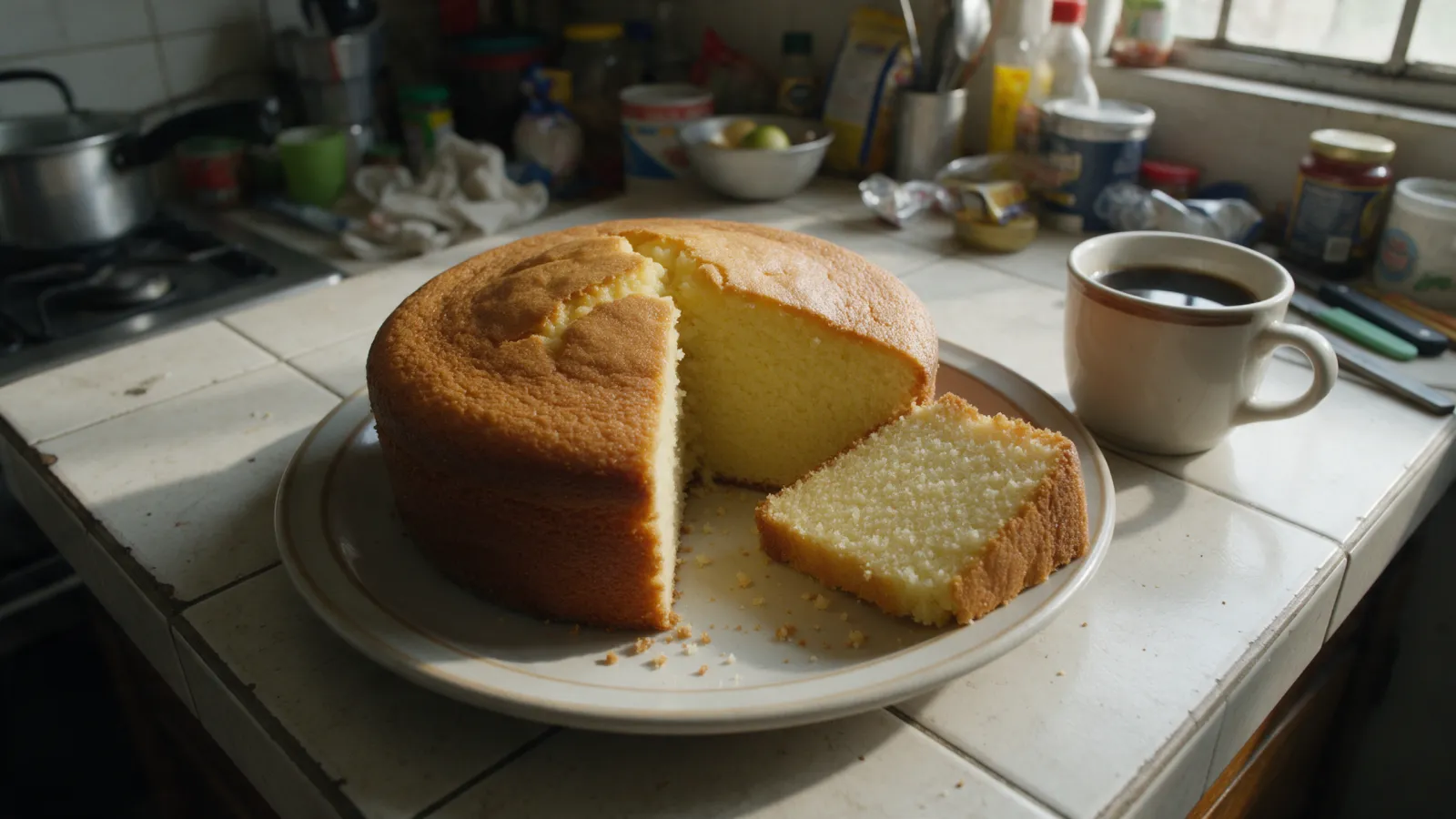

Ask for a slice of ponqué (pohn-KEH) in Bogotá and you get pound cake: the name is the Spanish ear’s version of the English words, and the cake follows the old English rule of a pound each of butter, sugar, flour and eggs. What makes the Colombian homemade one worth knowing is how it’s eaten. It’s the plain golden loaf that turns up at afternoon onces, sliced thick with hot chocolate or coffee, and it isn’t iced, filled or soaked. If you’ve baked an American pound cake, you already know most of this; the details below are the ones that separate a tall, tender loaf from one that sinks with a wet stripe through it.
How to make Colombian pound cake, and is it worth it
How do you make Colombian pound cake? Cream 250 g (8.8 oz) of butter at 65-67°F (18-19°C) with 250 g (1¼ cups) of sugar for 5 minutes, beat in 5 room-temperature eggs one at a time, then fold in 250 g (2 cups) of flour with 1 tsp baking powder, alternating with ¼ cup of milk. Bake in a 9 x 5-inch loaf pan at 325°F (160°C) until the center reads 205-210°F (96-99°C). Ready in 100 minutes for 10 servings.
It’s worth it if you own a stand or hand mixer and can plan an hour ahead. The work itself is 25 minutes; the oven does 75. Add the hour the butter spends warming and another hour of cooling, and from fridge to first slice you’re looking at about 3¾ hours on the clock.
Who it’s for. Anyone who likes a dense, buttery cake that holds a clean slice, travels well and gets better overnight. It makes a good make-ahead gift.
Who might skip it. If you want a light, airy layer cake, this isn’t it. And at 23 g of fat a slice, it isn’t a light dessert either.
Difficulty, honestly easy. Two temperatures decide everything: the butter going in and the center coming out. Get those right and it works the first time.
What makes a ponqué different from mantecada, panqué and sponge cake
In Colombia, ponqué means the plain butter loaf. Its close cousin, Colombian mantecada, swaps part of the flour for fine cornmeal and bakes as a flat sheet at 350°F (180°C), cut into 15 squares. In Mexico the same loaf is called panqué. A sponge cake is a different animal: it gets its lift from whipped eggs and has an open, dry crumb that drinks liquid, which is why tres leches cake is built on a whipped-egg sponge that soaks up 900 ml (3¾ cups) of milk. A pound cake’s buttery crumb would let that milk pool on top.
The ponqué negro, the dark wedding cake, is a separate recipe altogether: fruit macerated for weeks in sweet wine, burnt panela syrup for color and a long, very slow bake of around 3 hours. If that’s what you’re after, Venezuelan black cake is the closest thing on this site, baked at 300°F (150°C).
Ingredients, ratios and US or UK swaps
The ratio is the recipe. Here’s how this loaf compares with the original pound-of-each formula.
| Old pound-of-each cake | This loaf | |
|---|---|---|
| Butter | 1 lb (454 g) | 8.8 oz (250 g) |
| Sugar | 1 lb (454 g) | 8.8 oz (250 g), 1¼ cups |
| Flour | 1 lb (454 g) | 8.8 oz (250 g), 2 cups |
| Eggs | 9 large (about 1 lb) | 5 large (8.8 oz / 250 g) |
| Leavening | none | 1 tsp baking powder |
| Liquid | none | ¼ cup (60 ml) milk |
| Pan | 10-inch tube or two loaf pans | one 9 x 5-inch (23 x 13 cm) loaf |
The original formula has no baking powder at all and rises only on creamed air and steam. I add 1 teaspoon as insurance against an under-creamed batter and ¼ cup of milk to make the batter easier to fold. More baking powder doesn’t make it lighter; it makes it rise fast and fall.
Weigh the flour if you can. Two cups scooped straight from the bag can carry a lot more than 250 g, and extra flour is the most common reason a pound cake comes out dry and heavy. No scale? Spoon the flour into the cup and level it with a knife.
Swaps for a US or UK kitchen
| You need | US | UK | What changes |
|---|---|---|---|
| All-purpose flour | all-purpose | plain flour | nothing |
| Finer crumb | cake flour, same weight | stick with plain flour | softer, more tender slice |
| Granulated sugar | granulated | caster sugar | caster creams a little faster |
| Unsalted butter | unsalted sticks | unsalted block | with salted butter, skip the salt |
| Baking powder | any double-acting | any baking powder | nothing |
| 9 x 5-inch loaf pan | standard | 2 lb loaf tin, but measure it | smaller pans overflow |
Butter-for-margarine works and costs less, but you lose the one flavor this cake is about. Brown sugar or grated panela makes a darker, moister, heavier cake; good, but a different one.
Pan size matters more than people expect. In an 8½ x 4½-inch (22 x 11 cm) pan, hold back about 3½-5 oz (100-150 g) of batter and bake it as two cupcakes, or it spills over.
The key technique, creaming butter at the right temperature
A pound cake rises mostly on the air you beat into the butter, so this is the step you can’t shortcut. At 65-67°F (18-19°C) the butter bends without snapping, and 5 minutes on medium speed lets the sugar crystals cut thousands of tiny air pockets into it. Colder butter won’t hold air. Warmer butter, or creaming far past 5 minutes, turns greasy and leaves a gummy streak near the bottom of the baked cake that looks raw even when it isn’t.
The eggs need to be warm too. A cold egg firms up the butter and breaks the emulsion. If it happens, beat in a couple of spoonfuls of the flour mixture and it comes back together. Forgot to take them out? Ten to 15 minutes in a bowl of warm, not hot, water.
Baking low and checking doneness
Pound cake bakes at 325°F (160°C), lower than most cakes, because it’s a tall, heavy batter in a narrow pan. At 350°F (180°C) the crust darkens before the center sets.
Use a thermometer if you have one. The center is done at 205-210°F (96-99°C), measured beside the crack, not in it. Without one, push a long skewer into the middle: clean or with moist crumbs is done, wet batter is not. Start checking at 65 minutes. The crack that opens along the top while it bakes is normal and may look damp even when the cake is fully baked.
Other pans. These times are mine, and the thermometer always has the final word:
| Pan | Batter | Slices | At 325°F (160°C) |
|---|---|---|---|
| 9 x 5 in (23 x 13 cm) loaf | full recipe | 10 | 65-75 min |
| 8 x 4 in (20 x 10 cm) loaf | half recipe | 6-7 | 45-55 min |
| 9-10 in (22-24 cm) bundt or ring | full recipe | 12 | 50-60 min |
| Two 9 x 5 in loaves | double recipe | 20 | 65-75 min |
| 10 in (25 cm) tube pan | double recipe | 16-20 | 70-85 min |
For 4-6 people, make half: 125 g (4.4 oz) each of butter, sugar and flour, and 125 g of beaten egg (beat 3 and weigh). Feeding a crowd of up to 20? Double it into two loaf pans side by side on the middle rack, not touching.
Before you bake, problems and how to prevent them
- Sunken middle → nearly always an underbaked center that couldn’t hold its own weight as it cooled. Opening the door early or adding extra baking powder does it too.
- Gummy streak → butter too soft or creamed too long. It’s edible, just heavy.
- Dry → too much flour or too long in the oven. Brush warm slices with a light sugar syrup, or toast them in butter in a skillet.
- Dense and short → cold butter or eggs, a short creaming, or a curdled batter.
- Stuck to the pan → no parchment. Butter, line with a sling, and unmold after 10 minutes.
Allergens. Wheat (gluten), egg and dairy. No nuts unless you add them. I haven’t tested a gluten-free version enough to give you amounts.
Raw batter. Don’t taste it: raw cake batter isn’t safe to eat because of the raw egg and uncooked flour.
Variations worth making
- Orange ponqué → rub the zest of 1 orange into the sugar before creaming and use ¼ cup (60 ml) orange juice instead of the milk. More fragrant and a touch moister.
- Marble → stir 15 g (about 3 tbsp) unsweetened cocoa and 1 tbsp milk into a third of the batter, about 12 oz (350 g). Alternate spoonfuls in the pan and run a knife through once in a zigzag.
- With raisins or candied fruit → 3½ oz (100 g) tossed in 1 tbsp of flour so they don’t sink, folded in at the end.
- Lighter crumb → separate the eggs, cream the yolks with the butter and fold in the whites beaten to stiff peaks. It’s how pound cakes without baking powder get their lift.
- No mixer → a wooden spoon and 8-10 minutes of creaming. It rises a little less.
Make ahead and freeze
Bake it the day before. Wrapped in plastic once fully cool, the moisture evens out overnight and the slices cut cleaner. Don’t leave unbaked batter in the fridge: the butter sets hard and the baking powder weakens.
- Counter → wrapped or airtight, 3-4 days. It’s the best place for it; the fridge hardens the butter and dries the crumb.
- Fridge → only in very hot or humid weather, well wrapped, up to 1 week. Give it 20 minutes out before eating.
- Freezer → at 0°F (-18°C) it stays safe indefinitely; quality is what fades. I wrap slices one by one, bag them, and use them within 6 months.
- Thawing → wrapped, about 1 hour for slices and 3-4 hours for a whole loaf. To warm a slice, 10-15 seconds in the microwave or a minute in a buttered skillet.
What it costs in the US
At average US retail prices in August 2026, the main ingredients come to about $4.10 a loaf, or $0.41 a slice, and butter is 54 % of that.
The math: butter at $4.02 a pound (8.8 oz, $2.22), large eggs at $2.27 a dozen (5, $0.95), sugar at $1.02 a pound (8.8 oz, $0.56), flour at $0.55 a pound (8.8 oz, $0.30) and whole milk at $4.23 a gallon (¼ cup, $0.07). Baking powder, salt and vanilla aren’t counted. Margarine brings the cost down, but butter is the flavor.
What to serve it with
In Colombia, ponqué is an onces cake: a mid-afternoon slice with Colombian hot chocolate with cheese melting in the cup, or with a glass of Colombian kumis, the tangy fermented milk. For dessert, a spoonful of arequipe, Colombian dulce de leche, on a warm slice is hard to beat, and after a big bowl of ajiaco on a Sunday, a thin slice with coffee is all anyone wants. If you like snack cakes but want something moister with less butter, Colombian banana cake is made with oil and very ripe bananas and bakes at 350°F (180°C) in 35-40 minutes.
Colombian pound cake FAQ
Why is it called ponqué? It’s the Spanish pronunciation of “pound cake”, named for the old formula of a pound each of butter, sugar, flour and eggs.
What is the pound cake ratio? Equal weights of butter, sugar, flour and egg. For one 9 x 5-inch loaf, 250 g (8.8 oz) of each, which is 5 large eggs.
What temperature do you bake pound cake at, and for how long? 325°F (160°C) for 65-75 minutes in a 9 x 5-inch loaf pan, until the center reads 205-210°F (96-99°C).
Why did my pound cake sink in the middle? Usually an underbaked center. Opening the oven early or too much baking powder can also do it.
Why is there a gummy streak at the bottom of my pound cake? The butter was too soft or creamed too long. Start at 65-67°F (18-19°C) and cream for 5 minutes, no more.
Is the crack on top of a pound cake normal? Yes. The crust sets before the center finishes rising, and the center splits it open.
Can I make pound cake without baking powder? Yes, the traditional way: a full 5-minute creaming plus egg whites beaten stiff and folded in. It’s slightly denser.
How long does pound cake last? 3-4 days wrapped at room temperature, up to a week in the fridge, and up to 6 months frozen in slices.
Nutrition per slice
Per slice (one tenth of the loaf), worked out ingredient by ingredient from this recipe:
- Calories: 408 kcal
- Protein: 6 g
- Carbohydrates: 45 g
- Fat: 23 g, of which 14 g saturated
- Fiber: 1 g
- Sugars: 25 g
- Sodium: 194 mg
Nearly all the fat comes from the butter, 203 g of the loaf’s 231 g. Slice it thinner and get a dozen pieces, and each one drops to about 340 kcal.
Growing up in Venezuela, the cakes I knew were tall birthday cakes under meringue, and pound cake was something that came wrapped in plastic. My first homemade ponqué in Bogotá went in at 350°F like any other cake and came out nearly black outside with a wet band at the bottom. Low oven, thermometer beside the crack: that fixed it for good, and the day-old slices, toasted in butter, are what Dylan asks for at breakfast. Josnaisis.