
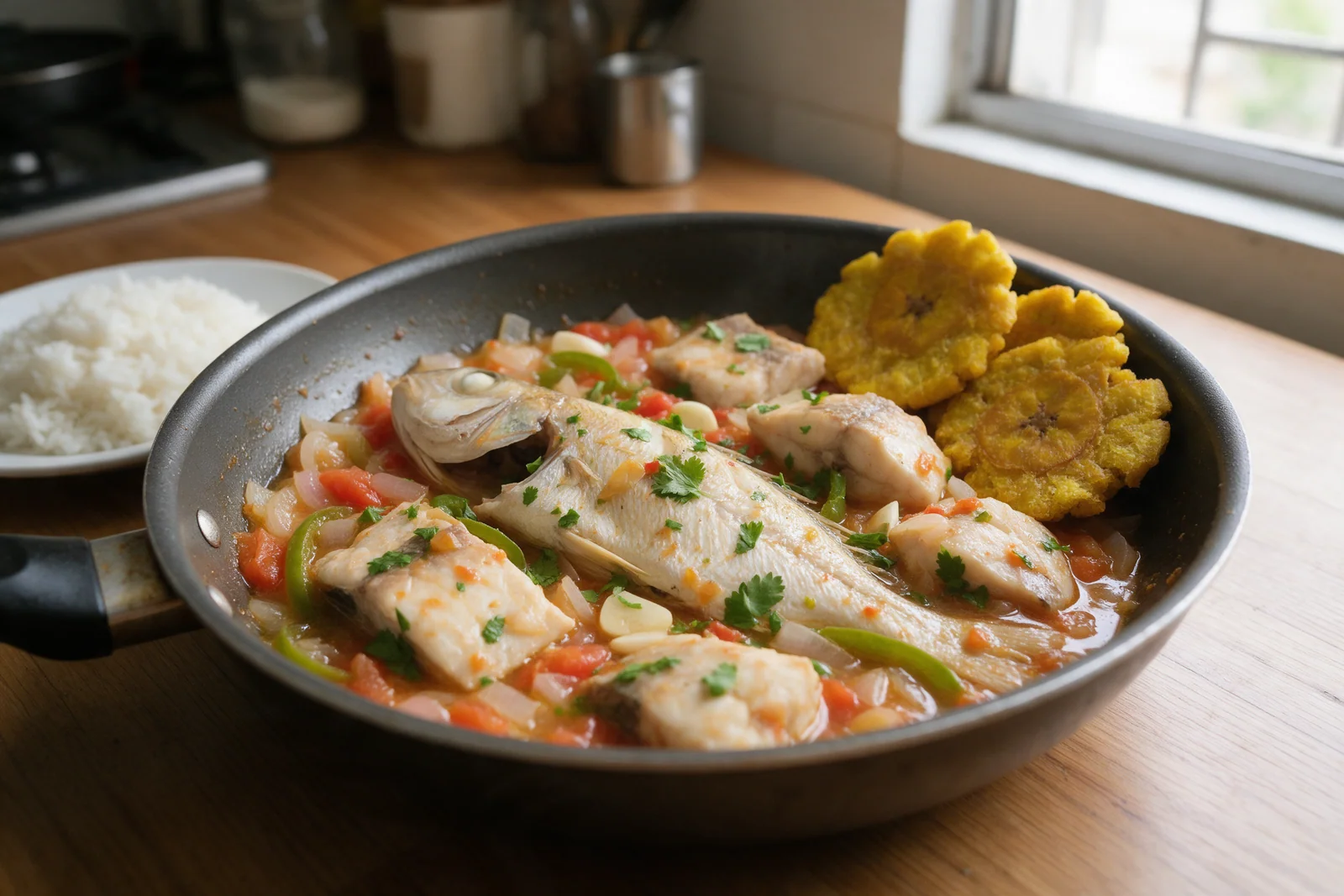

Pescado sudado (pes-KAH-doh soo-DAH-doh) is everyday Colombian home cooking and a Lent and Holy Week regular: thick fish steaks laid on sliced potatoes in a tomato, onion and bell pepper sauce, then covered so they cook in their own steam. The name means “sweated fish.” There is very little liquid, so the result is a moist piece of fish with a short, bright sauce to spoon over rice, not a soup. Below is which fish to buy in a US or UK store, how long each cut takes, how to tell it’s cooked at the bone without breaking it apart, and how to reheat leftovers so they stay juicy.
What is pescado sudado?
How do you make Colombian pescado sudado? Marinate 2¼ lb (1 kg) of bone-in fish steaks with salt, garlic and lime. Cook onion, bell pepper and tomato into a thick sauce, top with 14 oz (400 g) of sliced potatoes and 1 cup (250 ml) of water, and simmer covered for 15 minutes. Set the fish on top, cover and cook 10 to 12 minutes over low heat, without stirring, until it reaches 145°F (63°C) at the bone. Ready in 65 minutes for 4 servings.
The sauce base is hogao, the cooked tomato and onion sauce Colombians put on almost everything. What changes from region to region is the fish and what goes in the pot with it: potato, cassava, plantain or yam. The cooking method is the same one behind Colombian sudado de pollo, with fish instead of chicken and far less time on the stove.
How it differs from other Latin fish stews. A Colombian fish sancocho is a soup served in a bowl with plenty of broth. In the river fish stew from the Magdalena, known as viudo, the fish steams on top of root vegetables and the broth is served on the side in a cup. The Venezuelan fish soup called hervido is a clear broth made from the head, with no tomato sauce at all. Sudado is a main course on a plate.
Is it worth making? If you want a weeknight fish dinner that’s hard to dry out and happy to sit for a few minutes, yes. It’s easy, it isn’t spicy, and nearly all of the stove time is hands-off. It isn’t the dish for crisp skin or a golden crust.
Which fish to buy, and how long each cut takes
Look for firm, white fish, ideally steaks with the bone in. The backbone holds each piece together and flavors the sauce. Thin boneless fillets work, but they need gentle handling.
| Fish | US | UK | How it behaves |
|---|---|---|---|
| Catfish steaks | catfish | not common | firm, almost boneless; closest to Colombian bagre, a little softer |
| Snapper | red snapper | red snapper (fishmonger) | firm, good flavor, steaks or whole |
| Sea bass | sea bass, snook | sea bass | firm and delicate, pricier |
| Cod or hake steaks | cod | cod or hake steaks | tender, big flakes; don’t move them |
| King mackerel | king mackerel | rarely sold | very firm, stronger flavor |
| Whole tilapia | tilapia | tilapia | mild, overcooks fast |
Cook by thickness, not weight:
- Bone-in steaks, 1 to 1¼ in (2.5 to 3 cm) → 10 to 12 minutes, covered, over low heat.
- Boneless fillets, ⅝ in (1.5 cm) → 6 to 8 minutes, laid on potatoes that are already tender.
- Whole tilapia or snapper, 12 to 14 oz (350 to 400 g) → 15 to 20 minutes, with two or three diagonal cuts to the bone on each side. Four whole fish need two pans or one very wide one, because they must sit in a single layer.
Frozen is fine. Thaw it overnight in the fridge and pat it very dry; frozen fish releases water that thins the sauce.
Ingredients and supermarket swaps
Everything is in the recipe card above. These are the ingredients that might send you looking:
- Scallions stand in for Colombian cebolla larga, a long green onion with a thick white base. In the UK, spring onions.
- Ground annatto (achiote) is mostly for the orange color. In the US, look in the Latin aisle; a sazón seasoning packet with annatto works, but it adds salt, so cut the ½ tsp of salt in the sauce. In the UK, use ¼ tsp sweet paprika.
- Potatoes: in Colombia, a floury potato that softens and thickens the sauce a little. Yukon Gold in the US or Maris Piper in the UK do the same; red-skinned potatoes hold their shape better.
- Tools: a wide 11 to 12 in (28 to 30 cm) pot with a tight lid, so four steaks fit in one layer, and a wide spatula. An instant-read thermometer takes the guesswork out. If your lid is loose, lay a sheet of foil, or a banana leaf if you can find one in the freezer section, under it to trap the steam.
How much liquid. 1 cup (250 ml) of water for 2¼ lb (1 kg) of fish with 14 oz (400 g) of potatoes. The rule I go by: the liquid should come no more than halfway up the fish. Cover it completely and you’re poaching, and the outside falls apart before the center is done. Without potatoes, ½ cup (125 ml) is enough.
How to tell it’s done at the bone
The flesh against the backbone is the last part to cook, so that’s where you check.
- With a thermometer → 145°F (63°C) in the thickest part, beside the bone but not touching it.
- Without one → slide a knife in next to the backbone and ease the flesh apart. It should be white and opaque all the way to the bone and lift off it easily. If it looks pink, glossy or translucent there, cover again and give it 2 to 3 minutes more.
- Overcooked → the flesh falls into dry shreds and the steak breaks when you lift it. Take it off the heat as soon as it’s ready; the 3-minute covered rest settles it.
The finished sauce should be loose but not watery and just cover the bottom of the pot. If it’s thin, lift out the fish, boil the sauce uncovered for 3 to 4 minutes and put the fish back.
Troubleshooting
| Problem | Why | Fix |
|---|---|---|
| Fish breaks apart | soft fish, thin cut, stirring, hard boil | steaks at least 1 in (2.5 cm), low heat, never stir, serve with a wide spatula |
| Raw at the bone | steaks over 1¼ in (3 cm), fish straight from the fridge, loose lid | take the fish out of the fridge when you start the sauce; check by the bone |
| Sticks to the pot | fish touching the bottom, liquid boiled away | always on the potatoes; add ¼ cup (60 ml) water if the bottom looks dry |
| Thin, bland sauce | too much water, wet thawed fish, sauce base not cooked down | reduce the sauce with the fish out |
| Mushy surface | more than 30 minutes in lime juice | marinate 20 minutes, no longer |
Fish is the only major allergen. It isn’t spicy and kids tend to like it; just flake their portion off the bone and check for pin bones.
Make ahead, double it, change it
Make ahead. Cook the sauce base the day before and refrigerate it. On the day, warm it in the pot, add the potatoes and water, then the freshly marinated fish.
For 8. Double everything and use two pots, or one wide enough for 8 steaks in a single layer. Stacked fish cooks unevenly: the bottom layer overcooks while the top stays raw.
Coconut version. On Colombia’s Caribbean coast it’s made with coconut milk in place of the water: use 1 cup (250 ml) of canned coconut milk and keep the heat low so it doesn’t split. For a thicker, richer coconut sauce, make Colombian fish in coconut sauce instead.
With cassava or plantain. Swap the potatoes for 14 oz (400 g) of cassava chunks, which take longer to soften, so don’t add the fish until a knife slides in easily. Or add 1 ripe plantain, cut into 4, with the potatoes.
Cost. The fish is nearly all of it. Snapper and sea bass are the expensive choices; catfish and tilapia cost much less and taste great in this sauce.
What to serve with pescado sudado
Serve each 9 oz (250 g) steak with its potatoes and plenty of sauce next to Colombian white rice to soak it up. At home I add crispy patacones or fried ripe plantain, a tomato and onion salad with lime, and a few slices of avocado. If you’d rather have your fish crunchy and without sauce, Colombian fried mojarra is the other classic Holy Week fish.
Storing and reheating
- Fridge → within 2 hours of cooking, into a covered container with the sauce over the fish. It keeps 3 to 4 days at 40°F (4°C) or below; the sauce stops it drying out.
- Freezer → cooked fish can be frozen for 4 to 6 months, though the potatoes turn a bit grainy. I freeze the sauce base on its own and cook the fish fresh. Thaw in the fridge.
- Reheat → in a covered pan over low heat with 2 to 3 tbsp water if the sauce has thickened, until the center reaches 165°F (74°C), about 6 to 8 minutes. In the microwave, covered, at half power in 1-minute bursts; full power makes the fish rubbery.
FAQ
Do you fry the fish first? No. It goes in raw and cooks in the steam of the sauce. Browning it first gives a crust and a darker sauce, but the fish breaks more easily when you move it.
Can I use tilapia or swai fillets? Yes, but they’re very soft. Lay them on potatoes that are already tender, cook 6 to 8 minutes covered and serve straight from the pot. Swai (basa) is the most fragile.
Is it the same as Peruvian sudado de pescado? No. The Peruvian dish is seasoned with ají amarillo or ají panca chili paste and red onion, and some versions add chicha de jora (corn beer) or beer. The Colombian one uses a mild tomato, onion and bell pepper sauce with no chili.
How many calories are in pescado sudado? About 380 kcal a plate with potatoes and sauce, before rice: 37 g protein, 30 g carbohydrate, 13 g fat (2 g saturated), 5 g fiber, 7 g sugars and 690 mg sodium. I worked it out using catfish and about 7 oz (200 g) of clean flesh per 9 oz (250 g) steak once the bone and skin are off.
I only learned to make pescado sudado after I moved to Colombia, and my first try was with thin basa fillets, stirred like a beef stew, and it ended up as threads in the tomato. Now I buy thick bone-in steaks, set them on the potatoes and leave the lid alone until the flesh is white at the bone. Josnaisis.