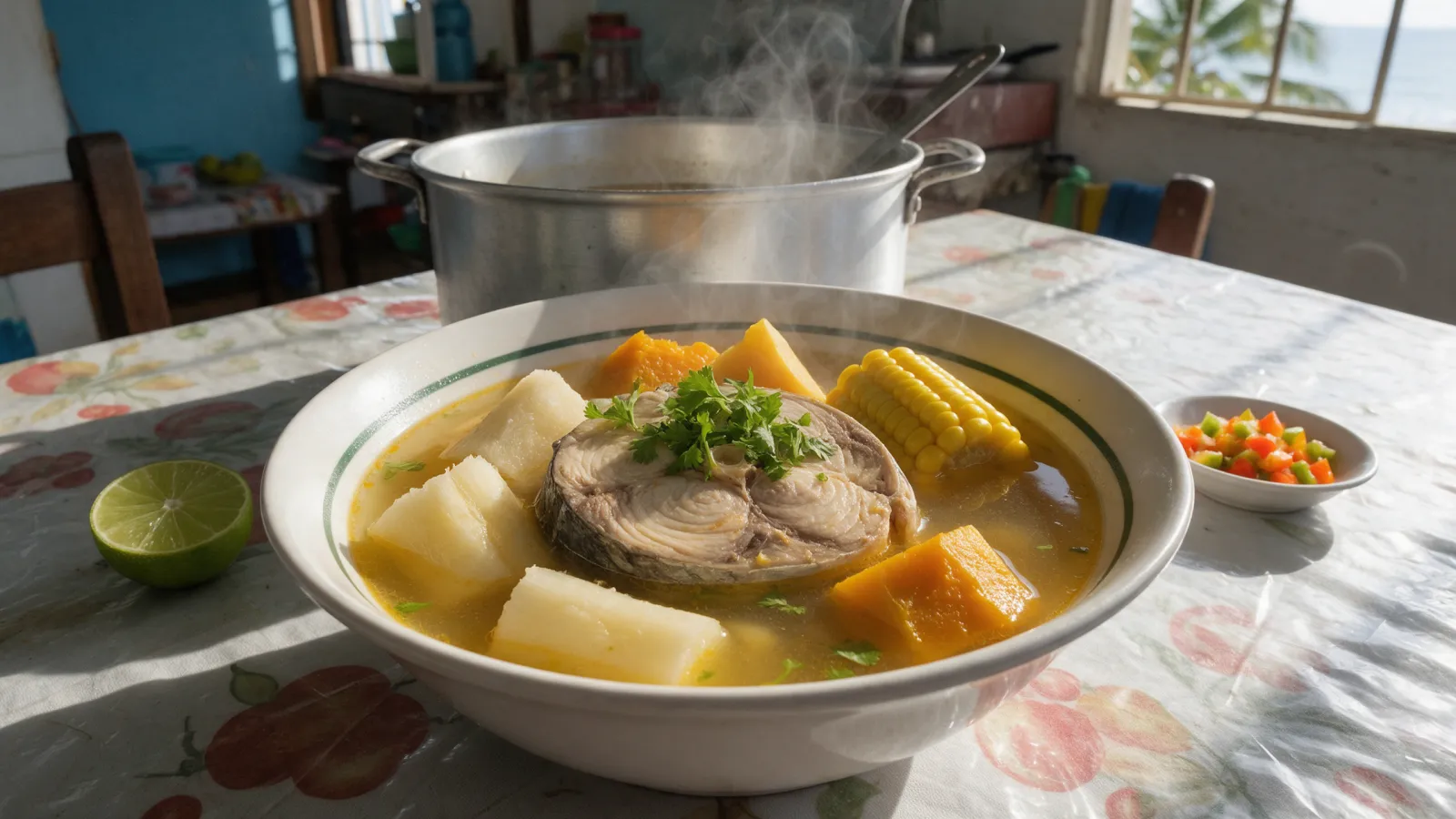

Hervido de pescado (ehr-VEE-doh deh pehs-KAH-doh) is the fish soup of eastern Venezuela, the coast of Anzoátegui and Sucre and Margarita Island. There’s no sofrito and no coconut. The flavor comes from simmering a fish head for half an hour with leek, garlic and ají dulce, a fragrant pepper with no heat. Starchy roots cook in that strained stock, and thick bone-in steaks of snapper go in only for the last 12 minutes, which is the difference between steaks that hold together and a pot of fish threads.
What is Venezuelan fish soup, and is it the same as fish sancocho?
How do you make Venezuelan fish soup (hervido de pescado)? Simmer a fish head and backbone for 30 minutes in 2.5 liters (10½ cups) of water with leek, ají dulce peppers and garlic, then strain. Cook cassava and yam in that stock for 10 minutes, add malanga, squash and boiled green plantain for 15, then lay in bone-in fish steaks, covered and below a boil, for 12 minutes, to 145°F (63°C). 100 minutes for 6 servings.
In Venezuela, hervido and sancocho are two names for the same soup, and on the eastern coast the fish version is sold more often as sancocho de pescado. It’s made with sea fish, whatever is in season, and red snapper, grouper and jack are the most common. A bowl holds one fish steak, a piece of each root and plenty of broth, and with avocado and cassava bread on the side it’s a full meal at 458 kcal.
It is not the same as Colombian fish sancocho, which starts from a sofrito and ends with coconut milk. If you know the Colombian fish sancocho with coconut on this site, this one is lighter and clearer, and it tastes more of the fish.
Is it worth making?
Make it when you can get a whole fish and want a light one-pot meal: 33 g of protein and very little fat per bowl. It also scales well for a crowd.
Maybe not if bones bother you, since the steaks are bone-in and the head goes in the pot. On a weeknight it’s only realistic with the stock made the day before.
Time. 100 minutes total, about 40 of them hands-on. The roots get peeled while the head simmers.
Difficulty, medium. The technique is easy. The order of the pot is what takes care.
Shopping in the US and UK
The fish
You want a firm, white-fleshed sea fish, bought whole so you get bone-in steaks and a head for the stock. Ask the fishmonger to cut it into 1¼ in (3 cm) steaks and give you the head and backbone.
- Red snapper is the classic. In the UK it is sold at fishmongers, often frozen; whole sea bream is a good stand-in.
- Grouper, mero in Venezuela, is the firmest of all. UK cooks can use hake or cod steaks on the bone, which flake larger.
- King or Spanish mackerel, carite, is oilier and stronger. It gives a richer broth and about 465 kcal a bowl instead of 458.
- Jack (UK horse mackerel or scad) is small, bony and cheap, best cooked whole.
Skip skinless fillets. Without a bone they’re cooked in 3 or 4 minutes and shred before the soup is ready.
The roots, and where to find them
| Venezuelan name | What it is | US | UK | If you can’t find it |
|---|---|---|---|---|
| Ocumo | starchy tuber, turns creamy | malanga or yautía, Latin markets | eddoes or malanga, Caribbean and African grocers | a floury potato |
| Ñame | true yam, firm white flesh | ñame or white yam, Latin markets | white or puna yam, African shops | more cassava |
| Yuca | cassava | fresh or frozen in many supermarkets | world-food aisles, fresh or frozen | no swap needed |
| Auyama | West Indian pumpkin | calabaza, or butternut squash | butternut squash | butternut squash |
| Topocho | small cooking banana | a green plantain | a green plantain | a green plantain |
The orange “yam” in American supermarkets is a sweet potato. It sweetens the broth and collapses, so leave it out.
Ají dulce
Small, fragrant and not hot. Look for it frozen in US Latin markets. In the UK it’s rare; use a small red bell pepper and half a cubanelle. Never confuse it with a habanero, which looks almost identical and is very hot. Taste a sliver raw if you’re unsure.
Equipment
A wide 6- to 8-quart (6- to 8-liter) pot with a lid, so the steaks fit in one layer, a small pan for the plantain, a fine strainer and a ladle. An instant-read thermometer settles any doubt about the fish.
The fish-head stock
This is what makes the soup Venezuelan. In restaurants on the eastern coast, six in ten of the places that serve it treat the head as essential for flavor. Pull out the gills first, because they make the stock bitter and cloudy. Start the head and backbone in cold water, skim the foam for the first 10 minutes, then keep it at a bare tremble for 30 minutes. In my kitchen, a longer simmer gives no extra flavor, only more loose bones to strain out.
Strain through a fine sieve. The cheek meat is the best on the fish: pick it out, check it for bones, and add it back at the end.
Timeline and make-ahead plan
| Minute | What happens | How long | Done when |
|---|---|---|---|
| 0 | rinse the head, salt the steaks | 15 min | steaks in the fridge |
| 15 | head and aromatics into cold water | 40 min | clear, golden stock |
| 30 | plantain boils in its own pan | 20 min | tender, drained |
| 55 | strain the stock | 5 min | a little over 2 liters (8½ cups) |
| 60 | cassava and yam | 37 min to the end | cassava splits in the center |
| 70 | malanga, squash, plantain, onion, peppers | 27 min to the end | knife slides in, pieces whole |
| 85 | fish steaks, covered, below a boil | 12 min | 145°F (63°C) at the center |
| 97 | cilantro, rest | 3 min | salt adjusted |
Why the plantain cooks separately. Boiled in the soup, it releases a gray tint that darkens the broth. Twenty minutes in its own pan and it goes in already soft with the malanga.
Make ahead. Make the stock the day before, strain it, cool it fast and refrigerate. On the day it’s about 45 minutes from cold stock to the table. Peel the roots on the day, since peeled malanga and cassava darken overnight. Raw fish keeps 1 to 2 days in the fridge.
Feeding a crowd
| Servings | Whole fish | Peeled roots | Water | Pot |
|---|---|---|---|---|
| 6 | 1.6 kg (3½ lb) | 1.65 kg (3⅔ lb) | 2.5 liters (10½ cups) | 6-8 quarts |
| 12 | 3.2 kg (7 lb) | 3.3 kg (7¼ lb) | 5 liters (5¼ quarts) | 12 quarts, or two of 8 |
| 20 | 5.3 kg (11¾ lb) | 5.5 kg (12 lb) | 8.3 liters (8¾ quarts) | two 10-12 quart pots |
The stock scales in one big pot, but the steaks must cook in a single layer, so split the broth and roots between two wide pots for the last stage. The fish still takes 12 minutes in each.
Cooking the fish without breaking it
Three rules. The steaks go in last, onto roots that are nearly done. Once they’re in, the pot stays covered over medium-low heat, trembling and never at a rolling boil. And no spoon: swirl the pot instead. The fish is safe at 145°F (63°C) in the center of the thickest steak, away from the bone; without a thermometer, the flesh should be opaque and flake easily with a fork.
What goes wrong, and how to fix it
- The fish fell apart → it boiled hard, got stirred, or was a fillet. Use bone-in steaks, keep the lid on and move the pot, not the fish.
- Bitter stock → the gills were left in. Always remove them, and don’t simmer past 30 minutes.
- Gray broth → the plantain cooked in the soup. Give it its own pan.
- Bones in the bowl → the stock wasn’t strained finely enough. Use a fine sieve and check the head meat before returning it.
- Cassava still hard at minute 85 → an old, fibrous root. Lift it out, cook the fish, and put it back at the end.
- Strong fishy taste → the fish wasn’t fresh, or the lime wasn’t rinsed off. Fresh fish smells mild, like the sea, never of ammonia.
Heat, 0 out of 5. Ají dulce has no heat. In eastern Venezuela, hot sauce and half a lime go on the table without asking.
Kids usually like the broth and the plantain. Flake their fish for them and check for bones, especially with jack.
Allergens. Fish. No gluten, dairy, eggs or nuts; with cassava bread or corn arepas the whole meal is gluten-free.
Versions
- Short on time → make the stock the day before; on the day it’s about 45 minutes, 20 hands-on.
- Lighter → skip the cassava and add 400 g (14 oz) more squash: about 370 kcal a bowl, with an oranger broth.
- With corn → 2 ears of corn, each cut in 3, go in with the cassava. It’s sweeter, about 515 kcal a bowl, and less typical of the east, but plenty of homes add it.
- Fried steaks → some cooks fry the steaks golden first and add them only for the last 5 minutes. The broth tastes less of fish and the steak more.
- Pressure cooker → no need. The stock gains nothing under pressure and the fish should never go in one.
If what you’re after is a slow Sunday pot with beef, the Venezuelan beef hervido uses the same roots but runs the clock the other way: the beef simmers alone for 105 minutes before any vegetable goes in.
How it compares
The viudo de pescado, Colombia’s river fish stew, is the closest in technique: river fish steamed 13 minutes on top of the roots, served with hogao and the broth in a cup, 380 kcal. The Colombian coconut sancocho comes in at 749 kcal. The Venezuelan pot is the only one built on a fish-head stock.
What it costs
In the US, supermarket ads for the week of October 9, 2026 averaged $0.88 per lb for green plantains, $1.09 per lb for butternut squash, $1.22 per lb for white onions and $0.97 a bunch for cilantro. With the garlic and 3 limes, the produce I can price comes to about $4.45 for the pot. Fish, cassava, yam and malanga are most of the bill and vary too much by store for me to give a figure.
In Colombia, where I live, the same pot made with frozen whole Spanish mackerel (sierra) cost 38,580 pesos at Cartagena’s Bazurto market in mid-September 2026, and the fish was 86 % of it. Whatever the country, the fish is the bill: with whole red snapper from Santa Marta the pot more than doubled, to 89,245 pesos.
Yield. 6 deep bowls as a main course, or 10 to 12 cups of 250 ml (1 cup) of broth as a starter.
Serving and storing
Serving. One steak per deep bowl, a piece of each root, broth to cover. In eastern Venezuela it almost always comes with sliced avocado and cassava bread, sometimes arepas or white rice. Venezuelan guasacaca, a pourable avocado sauce, works when there’s no ripe avocado to slice, and a cold papelón con limón is the drink. For more fish from the same coast, Venezuelan cazón guisado is the shredded fish filling of Margarita’s empanadas.
Fridge. Refrigerate within 2 hours, in shallow containers, at 40°F (4°C) or below: 3 to 4 days. To hold the pot for late guests, keep it covered above 140°F (60°C).
Freezer. 2 to 3 months for best quality. I freeze the broth with the fish flaked off the bone and cook fresh roots when reheating, because thawed malanga turns gummy and cassava spongy.
Reheating. Covered over medium-low heat, without stirring the steaks, to 165°F (74°C). High heat breaks the fish.
FAQ
What is the best fish for Venezuelan fish soup? A firm sea fish bought whole and cut into bone-in steaks 1¼ in (3 cm) thick: red snapper, grouper, king mackerel or jack.
Do I really need the fish head? It makes the stock. If your fish comes already cut, buy a head or two separately, and pull the gills.
How long does the fish cook? 12 minutes, covered, over medium-low heat and below a boil, to 145°F (63°C) at the center.
What can I use instead of malanga? Yautía or eddoes. Failing that, a floury potato, which is less creamy.
Is ñame the same as a yam? It’s a true yam, with rough skin and firm white flesh. The orange “yam” in US supermarkets is a sweet potato and doesn’t work here.
Is Venezuelan fish soup spicy? No. Ají dulce is a sweet pepper; hot sauce goes on the table.
Can you freeze it? Yes, 2 to 3 months, best as broth with the fish flaked off the bone and fresh roots added when reheating.
Nutrition
Per bowl, one-sixth of the pot with fish, roots and broth, no sides, calculated ingredient by ingredient from the quantities above, using snapper and counting 850 g (1⅞ lb) of flesh in the 1 kg (2.2 lb) of steaks. The stock vegetables are strained out and not counted, nor is the little the head gives off:
- Calories: 458 kcal
- Protein: 33 g
- Carbohydrates: 76 g
- Fat: 3 g, of which 1 g saturated
- Fiber: 6 g
- Sugars: 5 g
- Sodium: 897 mg
The fish provides 142 of the 458 kcal and nearly all the protein. Salt accounts for 775 of the 897 mg of sodium, so if you’re watching it, start with 1 tsp in the pot and adjust at the end.
Snapper is expensive where I live in Colombia, so I usually make this with sierra, a cousin of carite, and I never skip the head: I buy it separately at the market for far less than the fish. The trick that took me longest was getting the plantain out of the big pot. Since it cooks on its own, my broth comes out as clear as the one I grew up with. Josnaisis.