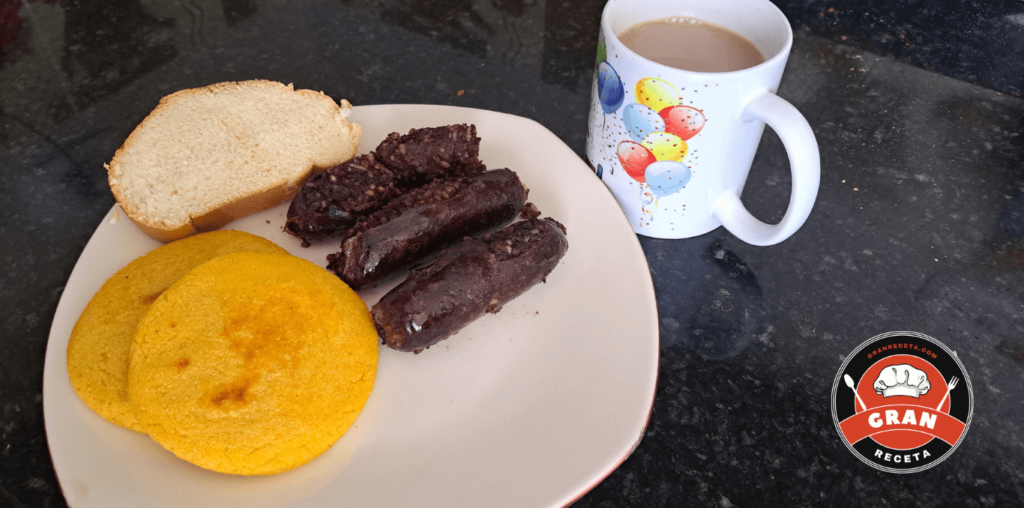
Two things burst a blood sausage, and both are under your control: a casing packed past 3 quarters full, and water that boils. The filling contains rice, which goes on absorbing and swelling inside the casing, so you fill to three quarters and hold the water between 176 and 185 °F for the whole 45 minutes. Get that right and 1 quart of blood gives 20 servings of Colombian morcilla, dark, herb-flecked and far lighter than its European relatives.
How do you make Colombian blood sausage? Clean and soak the casings 12 hours with lime. Mix pork blood with half-cooked rice, peas, scallions, mint, pennyroyal and cilantro, fill the casings loosely and tie every 6 inches. Prick each one and poach 45 minutes at 176-185 °F. 160 minutes on filling day, for 20 servings.
The water that never boils
This is the rule that decides whether a batch survives. Between 176 and 185 °F the blood sets evenly and the casing contracts slowly without tearing. At 203 °F the casing tightens and the first splits appear, and at a rolling boil it bursts and the filling ends up in the pot.
The visual cue is the same as for any delicate poach: the surface shivers and steams but no large bubble rises. Before they go in, each sausage is pricked 4 or 5 times with a needle, giving the steam inside a controlled way out.
They are done at 45 minutes, and the test is to prick one: clear liquid means it has set, blood means it needs longer.
Sourcing blood and casings in the US
Fresh pork blood is a special-order item at most full-service butchers and a regular one at Asian and Latin markets, sold by the quart and sometimes frozen. Order it for the day you plan to cook, stir in the vinegar as soon as you get home, and keep it cold: blood is a fresh product and this is not a recipe to stretch across two days.
Natural hog casings come packed in salt, sold in bags or by the hank. They need rinsing inside and out and at least 2 hours of soaking; the 12-hour lime soak in this recipe is what Colombian households do with casings bought whole from the butcher, and it is still worth 2 hours even with the cleaned commercial kind.
The filling, and the rice mistake
The most common error is not with the blood but with the rice. It goes in half-cooked, about 10 minutes, because inside the casing it keeps drawing liquid from the blood and finishes there. Fully cooked, the filling compacts into a paste when sliced.
The herbs are the other distinguishing feature. Mint, pennyroyal and cilantro are what separate Colombian morcilla from a Spanish or British one: just 2 oz against a filling of nearly 4 lb, but visible in every slice as green flecks. Outside Colombia, plain fresh mint is the sensible substitute for pennyroyal, which is hard to buy as a culinary herb and should never be approached through its essential oil.
Colombia, Burgos and black pudding
People are often surprised that Burgos and Bogotá agree on rice: Spain’s most famous blood sausage is built on it too. British black pudding takes the other road, with oats or barley and cubes of pork fat.
Where the Colombian one parts company is fat and herbs. It carries almost none of the first and a lot of the second, which is why it comes in at around 190 calories per 100 g against roughly 350 for Burgos and 375 for black pudding.
Why the casing is only three quarters full
Rice swells. A filling that looks loose when raw is tight 20 minutes into the poach, and a casing packed to the brim has nowhere to give. Three quarters is the working proportion, and tying every 6 inches gives each link its own margin.
There is one test worth doing before any of it goes into a casing: fry a spoonful of the mix and taste it. That is where salt gets adjusted, and salt is the one thing you cannot fix once everything is sealed inside.
Who this recipe is for
- If you buy cleaned casings → still give them 2 hours in water with lime before filling
- If you cannot find pennyroyal → double the mint; it is not identical, but it is the closest safe option
- If you have no sausage stuffer → a plastic bottle cut in half makes a serviceable funnel
- If one bursts → scoop the filling, roll it into balls and poach them 20 minutes wrapped in plastic film
- If you want a smaller batch → half works the same, but blood does not keep: use it the day you buy it
Make ahead, storage and reheating
Poached and cooled, they keep 4 days refrigerated, within the 3 to 4 day window the USDA gives cooked dishes, and 3 months frozen. Freeze them whole rather than sliced.
To serve, most Colombian households poach them first and then fry slices for 3 minutes in a hot dry pan, which crisps the edges. That second step is also the best way to bring back a sausage that has been in the fridge.
What goes wrong
Letting the water boil. The casing tightens and bursts; keep it at 176-185 °F for the full 45 minutes.
Overfilling the casing. The rice swells and there is no room; three quarters full.
Using fully cooked rice. The filling slices like paste.
Skipping the casing soak. The smell cannot be corrected later with any amount of herbs.
Not tasting for salt. A fried spoonful beforehand solves the only thing that cannot be fixed afterwards.
Variations
Antioquia style. More rice and less blood, giving a lighter, looser filling.
Boyacá style. More peas and more herbs, sometimes with onion in place of scallion.
With potato. 3.5 oz of cooked diced potato in the filling, which softens it.
Fried. Poached and then given 3 minutes in a hot pan, which is how it is served on a fritanga platter.
What to serve with it
Morcilla is one of the pieces of a Colombian fritanga platter, alongside chorizo, pork ribs and small potatoes, sliced about ¾ inch thick. It is also eaten on its own with lime and a fresh chili sauce, or with 2 Colombian patacones a person alongside.
For a table of homemade sausages it pairs naturally with grilled chorizo, and the drink is cold Colombian aguapanela with lime. After something this rich, a spoon dish like Colombian sancocho belongs the next day rather than the same one, and Colombian stewed chicken is the lighter way to use the same afternoon.
Frequently asked questions
Why do blood sausages burst? Boiling water or an overfilled casing. Keep the water at 176-185 °F and fill to three quarters.
Where do I buy pork blood? Asian and Latin markets, or by special order from a butcher. Mix in vinegar when you get it and use it the same day.
Can I use leftover rice? Only if it is still firm. Soft, fully cooked rice turns the filling to paste.
What is pennyroyal here? A mint-family herb used in Boyacá cooking. Outside Colombia, use ordinary fresh mint instead.
How long do they keep? Four days refrigerated and 3 months frozen, always poached first.
Nutrition
Per serving of about 3.5 oz, one twentieth of the batch, calculated with the USDA database:
- Calories: 190 kcal
- Protein: 10 g
- Carbohydrates: 16 g
- Fat: 9 g, of which 3 g saturated
- Fiber: 1 g
- Sodium: 520 mg
Commercial blood sausage, according to the USDA, carries 379 calories and 34.5 g of fat per 100 g, well above this one, because the Colombian version leans on rice and vegetables rather than pork fat. That is also where the 16 g of carbohydrate come from, a figure that would be near zero in a European blood sausage.
The first time I helped make morcilla was on a farm in Boyacá and I got the casings, which is the job nobody wants. What surprised me was not that but the sheer amount of fresh herbs going into the bowl: I had never seen a blood sausage that was green inside. Now, when I make it, I chop twice the mint that batch had. Josnaisis.