
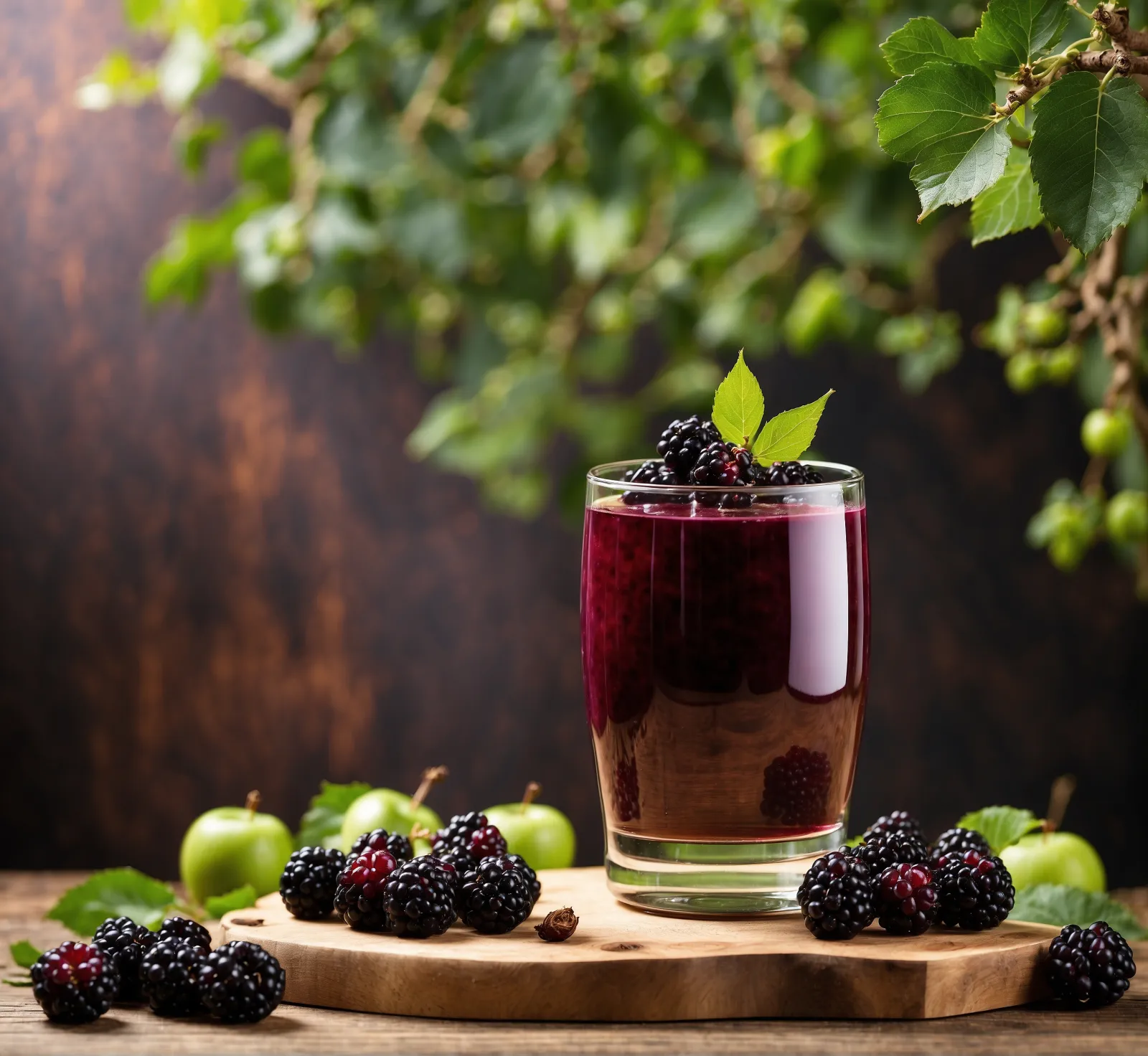

Ask for jugo de mora with lunch anywhere in Colombia and you get a glass of something wine-red and sharply tart, made from a blackberry most Americans and Brits have never tasted. The berry is mora de Castilla, a long, glossy Andean species that is far more sour than the blackberries in a US or UK supermarket. You can make the real thing with frozen mora pulp from a Latin grocery, or get close with ordinary blackberries, a little less sugar and a squeeze of lime. Either way, it takes 10 minutes and one patient minute at the sieve.
What is jugo de mora, and who is it for?
How do you make Colombian blackberry juice? Rinse the berries, blend them for 30 seconds with a third of the water, then strain and press the pulp hard through a fine sieve. Stir in the rest of the cold water and the sugar. For 1 liter (about 1 quart), use 300 g (10.5 oz) mora, 750 ml (3 cups) water and 60 g (⅓ cup) sugar. Ready in 10 minutes for 4 servings.
Jugo de mora (HOO-go deh MOH-rah) is simply blackberry juice, blended and strained, served cold with almost any Colombian lunch. Mora de Castilla is Rubus glaucus, a bramble of the Andean highlands that grows at about 1,500 to 3,100 m (4,900 to 10,200 ft). The berries are small, about 0.1 to 0.18 oz (3 to 5 g) each, and turn from red to a deep, shiny purple as they ripen. Colombians drink it two ways: in water, which is tart and refreshing, or in milk (jugo de mora en leche), which is creamy and turns a soft lilac.
Who will love it. Anyone who likes tart drinks, cranberry juice or lemonade. It is cheap, fast and works for a crowd, because the strained base keeps overnight.
Who might not. If you dislike sour drinks, start with the milk version. If you have no fine sieve, wait until you do: unstrained mora is full of hard little seeds.
Mora de Castilla vs supermarket blackberries
They are cousins, not the same fruit. The blackberries sold in US and UK supermarkets are cultivated varieties bred to be sweet and firm. Mora de Castilla is sourer and less sugary, and that changes the recipe.
Fresh-market blackberries grown in Arkansas have measured 1.09 to 1.32 g of acid per 100 g of fruit and 8.2 to 11.9 °Brix of sugar. Mora de Castilla from three towns in Colombia’s coffee region came in at 1.73 to 2.82 g of acid and only 5.3 to 8.3 °Brix. Up to twice the sourness and noticeably less sugar: a supermarket blackberry juice made with the Colombian sugar ratio tastes flat and sweet next to the real thing.
How to compensate. With supermarket blackberries, fresh or frozen, use the same 300 g (10.5 oz) per liter, cut the sugar to 45 g (3½ tbsp) and add 1 tbsp (15 ml) fresh lime juice. That’s my own adjustment after making both side by side, and it brings the glass much closer to what you’d drink in Bogotá.
Where to find mora in the US and UK
| What you find | Where | What changes |
|---|---|---|
| Goya frozen Blackberry Pulp (labeled mora), 14 oz (396 g) | frozen aisle of Latin grocers and larger US chains with a Latin section | the real fruit, seedless; same 300 g (10.5 oz) per liter, about three-quarters of a pack |
| Generic frozen mora pulp | Latin grocers in US and UK cities | same as above; check the label for added sugar |
| Fresh or frozen supermarket blackberries | any US or UK supermarket | sweeter and less tart; use 45 g (3½ tbsp) sugar and 1 tbsp lime |
| Fresh mora de Castilla | rarely outside the Andes | the reference |
Frozen pulp goes into the blender half-frozen, straight from the bag after 10 minutes on the counter. Because it is already seedless, straining takes seconds.
Step by step, and why the sieve matters more than the blender
Ten minutes, all hands-on: 2 minutes rinsing, 1 blending, 3 straining, 2 sweetening, 2 pouring.
Rinse just before, never before storing
Berries have no skin to protect them. Rinse them in a colander under a gentle stream of cold water right before you blend, not when you get home: moisture in the fridge softens them and brings on mold. No soaking, which waters them down, and no soap.
Blend briefly, press hard
Blend with just 250 ml (1 cup) of the water, for 30 seconds. Less water means the fruit breaks down faster and strains more easily. Run the blender for over a minute and, in my experience, the seeds shatter into a fine grit that slips through the mesh.
Then press: 2 to 3 minutes against the mesh with the back of a spoon for every 300 g (10.5 oz) of berries, scraping the underside, where the thickest pulp clings. You’re done when what’s left is a dry, dark paste of seeds. If it’s still wet and red, keep going: that’s flavor you’re throwing away.
Who this recipe is for
- If you’ve never tasted mora → start with frozen mora pulp and the water version.
- If you only have supermarket blackberries → 45 g (3½ tbsp) sugar and 1 tbsp lime per liter.
- If you’re making it for kids → the milk version, which softens the sourness.
- If you’d rather use less refined sugar → swap in the same weight of panela or piloncillo, dissolved in the blending water.
- If you’re feeding a crowd → strain the base the night before (see below).
Making it with milk without curdling
Jugo de mora en leche can split, and the numbers show why. Ripe mora sits at pH 2.67 to 2.98, fresh milk around pH 6.6, and casein, the main milk protein, clumps once the pH drops to 4.6. The more fruit and the longer they sit together, the closer the mix gets.
The order fixes it:
- Blend the berries with only 150 ml (⅔ cup) water and the 60 g (⅓ cup) sugar, then strain.
- Stir that base into 600 ml (2½ cups) whole milk straight from the fridge, at 40°F (4°C) or colder.
- Serve right away.
Cold milk is slower to curdle than warm, and with the sugar already dissolved there’s no need to keep the blender running once the milk goes in. Made this way, mine has never split in the first 15 minutes. If fine curds do appear after a while on the table, it’s still safe to drink; a 5-second blitz smooths it out.
Lilac is not curdled. The pigments in mora, anthocyanins, are red in acid and shift toward purple and blue as acidity drops, so the juice turns from wine-red to lilac the moment it meets milk. That’s normal. Curdled looks different: small white flecks and a thin, pale liquid separating out.
Mistakes that ruin blackberry juice
- Watery and pink → too little fruit. 300 g (10.5 oz) per liter.
- Gritty → blended too long. 30 seconds, then a fine sieve.
- Flat and sweet → supermarket berries with full sugar. Cut to 45 g (3½ tbsp) and add lime.
- Weak berry flavor → the pulp wasn’t pressed. Give it 2 to 3 minutes.
- Split milk → warm milk, too much water or too long on the table. Cold milk, concentrated base, serve at once.
- Moldy berries after 2 days → washed before storing. Rinse only right before using.
Make-ahead, freezing and party batches
Night before. Blend and strain the berries with the first 250 ml (1 cup) water and refrigerate that base, unsweetened and undiluted, for up to 24 hours. At serving time, add sugar, cold water and ice.
Freezer. Whole berries, pulp or strained base freeze in flat 300 g (10.5 oz) bags, one per liter. At 0°F (−18°C) they stay safe indefinitely; for best flavor I use them within 3 months. Frozen berries go straight into the blender and make the juice colder.
Fresh berries. Ripe mora keeps only 3 to 5 days at room temperature, and mold is what ends it. I store mine unwashed in the fridge in their container and use them within 2 or 3 days.
For a crowd. The ratio never changes: 300 g (10.5 oz) fruit, 750 ml (3 cups) water and 60 g (⅓ cup) sugar per liter. For 4 to 6 people, make 1.5 liters (about 1½ quarts): 450 g (1 lb) fruit, 1.1 liters (4½ cups) water and 90 g (scant ½ cup) sugar. For 12 to 20 people I plan a glass and a half each on a hot afternoon: 30 glasses is 7.5 liters (about 2 gallons), from 2.25 kg (5 lb) fruit, 5.6 liters (about 6 quarts) water and 450 g (1 lb, about 2¼ cups) sugar. Blend and strain the fruit with 1.9 liters (2 quarts) of the water the night before, then sweeten and top up with the remaining 3.7 liters (about 4 quarts) as you serve. The milk version isn’t made ahead: mix it 1 liter at a time.
What a pitcher costs in the US
With Goya mora pulp at $3.69 for a 14 oz (396 g) pack at one supermarket chain, the 300 g (10.5 oz) in a liter costs about $2.80, and the sugar, at the August 2026 national average of $1.024 a pound, $0.14. That’s about $2.93 a liter, or 73 cents a glass. With supermarket berries at 2023 average prices, a liter comes to about $3.21 with frozen blackberries at $4.71 a pound and $4.62 with fresh ones at $6.83, not counting the lime. The milk version adds about $0.67 for 600 ml (2½ cups) of whole milk at $4.229 a gallon. The fruit is almost all of the cost.
Yield. 1 liter makes 4 glasses of 250 ml (8.5 oz) or 3 tall ones of 330 ml (11 oz).
What to serve with it
In Colombia this is a lunch juice, one 250 to 350 ml (8.5 to 12 oz) glass per person. I pour it next to a bowl of Colombian ajiaco, the chicken and potato soup from Bogotá or a bandeja paisa platter, where the acidity cuts through all that richness. For a two-juice table, pair it with creamy, low-acid Colombian soursop juice. If you like tart drinks, mora has two close relatives on the site: Colombian lulo juice and Colombian passion fruit juice, both made with the same cold-milk method. In Cali, mora also turns up as syrup over shaved ice in a Colombian cholado, and the fruit-in-the-glass cousin is lulada from Cali. For a warm drink sweetened the same way, try aguapanela with lime.
Colombian blackberry juice FAQ
What is mora de Castilla? An Andean blackberry, Rubus glaucus, grown in the highlands at 1,500 to 3,100 m (4,900 to 10,200 ft). It’s longer, glossier and much more sour than supermarket blackberries.
Can I use regular blackberries for jugo de mora? Yes. Use the same 300 g (10.5 oz) per liter, but cut the sugar to 45 g (3½ tbsp) and add 1 tbsp lime juice, because supermarket berries are sweeter and less tart.
Why does blackberry juice curdle milk? Milk’s casein clumps at pH 4.6, and mora sits far below that, at about 2.7 to 3.0. Cold milk, a concentrated sweetened base and serving immediately prevent it.
Why does the juice turn purple or lilac in milk? The berry’s anthocyanin pigments are red in acid and shift toward purple as acidity drops. It isn’t curdling.
Do you have to strain it? For juice, yes: the seeds are hard and plentiful. Unstrained, it keeps more fiber but feels gritty.
How long does it keep in the fridge? The water version up to 24 hours, covered, at 40°F (4°C) or colder, though it darkens. The milk version is for drinking right away, and milk shouldn’t sit out more than 2 hours.
Can I freeze blackberries for juice? Yes, whole or as pulp, in 300 g (10.5 oz) bags. Blend them straight from frozen.
Nutrition per glass
Per 250 ml (8.5 oz) glass of the water version, a quarter of the recipe, calculated from the recipe weights (fresh blackberries and granulated sugar):
- Calories: 90 kcal
- Protein: 1 g
- Carbohydrates: 22 g
- Fat: 0 g
- Sugars: 19 g, 15 g of it added
- Sodium: 1 mg
I don’t give a fiber number: whole berries have plenty, but much of it stays with the seeds in the sieve. Unsweetened, a glass has 32 kcal. With whole milk, a glass carries 6 g protein, 5 g fat, 30 g carbohydrates and 26 g sugars, for about 185 kcal. Per 100 g of fruit, mora de Castilla carries roughly 22 to 39 mg of vitamin C, depending on where it’s grown.
The first time I made the milk version in Colombia, it went lilac in the pitcher and I nearly poured it down the sink, sure it had spoiled. Now I know the color is the berry and the curds are the clock. Serve it cold and fast. Josnaisis.