
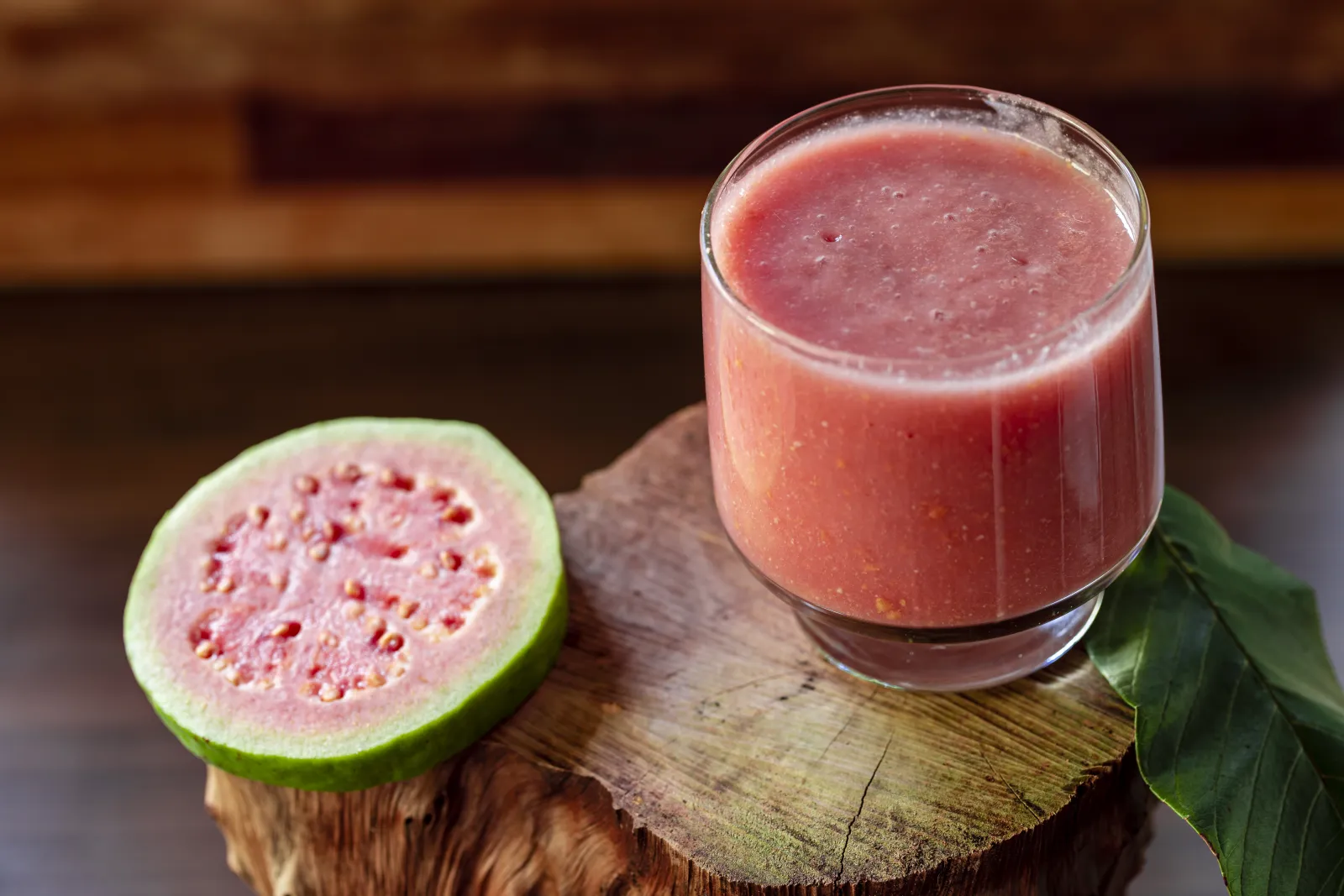

Of all the fruit juices Colombians blend with milk, guava is the one you don’t have to rush to the table. That surprises anyone who has watched passion fruit or blackberry juice curdle a glass of milk. Guava doesn’t, at least not cold, because it carries a fraction of the acid of those fruits. What it does ask for is a sharp eye before the blender and patience at the sieve: the seeds are rock-hard and the puree is thick enough to sit in the strainer if you let it.
What is Colombian guava juice, and who is it for?
How do you make homemade guava juice? Trim and quarter ripe guavas without peeling them, check the flesh, then blend 20 to 30 seconds with a third of the water and the sugar. Press the puree through a fine sieve and stir in the rest of the cold water. For 1 liter (about 1 quart), use 350 g (12 oz) guava, 750 ml (3 cups) water and 60 g (⅓ cup) sugar. Ready in 10 minutes for 4 servings.
Jugo de guayaba (HOO-goh deh gwah-YAH-bah) is fresh guava blended with water or milk, strained and sweetened. In Colombia it is made with the guayaba pera, an oval guava of about 120 g (4 oz) with thin green skin that turns yellow as it ripens and deep pink flesh. It is not the canned nectar sold in the juice aisle in the US or the guava juice drinks in UK supermarkets: those are a different, much sweeter product, as the table further down shows.
It suits a weekday lunch, a hot afternoon or a party, since the strained base can be made the day before. It is less of a fit if you want something sharp and thirst-quenching, or if the strong perfume of ripe guava isn’t your thing. Expect 10 minutes, all of it hands-on, and no real difficulty.
Which guavas to buy, and how to tell they’re ripe
Look for pink-fleshed guavas if you can find them; that is what gives the juice its color and perfume. In the US, most fresh guavas in stores come from Mexico year-round, and Florida adds its own crop from about August to October, in both pink and white varieties. White guavas make a paler, milder juice. In the UK, fresh guavas turn up mostly in South Asian grocers, where they are sold as amrood.
A ripe guava has yellow-green to yellow skin, gives slightly when you press it with your thumb and smells sweet from a foot away. Hard green ones need a couple of days on the counter, three at most. Once ripe, they last about 3 days at room temperature before going soft and spotty, so I move them to the fridge as soon as they smell ready and use them within 2 or 3 more days. Skip any that are wrinkled, have sunken soft patches or smell fermented.
Fresh guava, frozen pulp or canned nectar
- Frozen guava pulp is the swap I use outside Colombia. Goya sells it as Guava Pulp in 396 g (14 oz) packs, with no added sugar, in Latin grocers and in big supermarket chains with a Latin aisle; in the UK, look in the freezer of Latin American shops in larger cities. Use 300 g (10.5 oz) per liter, about three-quarters of a pack, because it has no skin or seeds. Blend it half-thawed and the straining takes a minute.
- Canned guava nectar (Kern’s, Goya and others in the US) is about 80 % water and added sugar, with only 18 to 20 % fruit. Rubicon Still Guava, the common UK juice drink, lists 18 % guava purée plus sugar and sweeteners. Both are fine poured over ice, but they are not this juice and don’t work as a base for it.
Ingredients and tools for 1 quart
For 1 liter, about 1 quart, 4 glasses of 250 ml (1 cup):
- 350 g (12 oz) ripe guavas, about 3 medium pink guavas. Fewer guavas give a pale, watery juice; much more fruit and the puree barely strains.
- 750 ml (3 cups) very cold water.
- 60 g (⅓ cup) granulated sugar. Panela, the unrefined cane sugar sold in blocks in Latin shops, works at the same weight, grated fine; it turns the juice brick-colored with a molasses note. Dark brown sugar is the nearest supermarket stand-in. If you happen to have Colombian aguapanela chilled in the fridge, use it for part of the water and taste before adding more sugar.
- Ice.
Tools: a blender, a fine-mesh sieve and a 1.5-liter (1½-quart) pitcher. No blender? Mash very ripe quarters with a potato masher in a bowl with the 250 ml (1 cup) water for 2 to 3 minutes and strain the same way; you get less juice and a lighter color. No fine sieve? Line a regular one with a clean cotton cloth or use a nut-milk bag.
How to make guava juice, step by step
Quarter and check before blending
In Colombia, fruit flies are the most common pest of guava trees. The female lays her eggs inside the flesh and leaves no visible hole, so a guava can look perfect and still have larvae inside. Trim both ends, cut each fruit into quarters and look: dark tunnels, watery patches or a tiny white larva mean that quarter goes in the bin. The rest of the fruit is fine. Leave the skin on; it is thin and blends with the flesh, and whatever doesn’t pass stays in the sieve.
Blend short, press long
Blend the quarters with just 250 ml (1 cup) of water and the sugar for 20 to 30 seconds. Guava seeds are hard as gravel. Run the blender longer and it cracks them into a grit that slips through the mesh and makes the juice cloudy and scratchy.
Then press. Guava puree is thick, and if you just pour it into the sieve, half of it stays there. Push it through with the back of a spoon in circles for about 3 minutes, scraping the underside of the sieve where the thickest pulp collects. You are done when only seeds with a thin film of pulp remain. Strained juice is pink, opaque and free of black specks, and leaves a light coating on the side of the pitcher when you swirl it.
Who this recipe is for
- Anyone with guavas going soft on the counter.
- Parents looking for a fruit juice kids actually drink, especially the milk version.
- Hosts who want a pitcher drink that can be prepped the day before.
- Anyone who finds passion fruit or lulo juice too sour.
Guava juice with milk, and why it doesn’t curdle
Casein, the main protein in milk, clumps when the mix drops to pH 4.6, while fresh milk sits around pH 6.6. Guava pulp isn’t especially high in pH (4.6 at most, 3.9 in sourer fruit), but what decides curdling is how much acid the fruit brings, and guava brings very little.
To make it, blend the 350 g (12 oz) guava with 150 ml (⅔ cup) water and the sugar, strain, then stir that base into 600 ml (2½ cups) whole milk straight from the fridge, at 40°F (4°C) or below. In my kitchen it stays smooth in the pitcher through a whole lunch, which I can’t say for my Colombian blackberry juice or passion fruit juice made with milk. Tamarillo juice, the Colombian tree tomato drink, is the other low-acid one that holds up in milk. I strain before adding the milk only because the puree passes the mesh faster without foam; you can also blend the guava straight into the milk and strain after. Heat is another story: hot milk curdles faster, so cooked guava drinks need more care. Skim milk gives a thinner glass, and almond or oat drinks work and come out lighter.
Mistakes that make guava juice gritty or flat
- Gritty or scratchy → the blender ran too long. 20 to 30 seconds and a fine sieve.
- Pale and watery → not enough fruit. 350 g (12 oz) per liter.
- Tastes green or slightly bitter → underripe guavas. Wait until they smell sweet and give under your thumb.
- Most of it stuck in the sieve → the puree wasn’t pressed. Give it 3 minutes with a spoon.
- A larva in the blender → the fruit wasn’t checked. Always quarter first.
- Settles and thickens in the pitcher → that is the pulp. Stir before pouring.
It has no heat at all. In water it contains none of the major allergens; the milk version contains dairy.
Make-ahead, freezing and party batches
Day before. Blend and strain the guavas with the 250 ml (1 cup) of water, no sugar, and keep that base covered in the fridge for up to 24 hours. At serving time, add cold water, sugar and ice.
Fridge. Juice made with water keeps up to 24 hours in a covered pitcher at 40°F (4°C) or below; the pulp settles and the aroma fades, so stir it and make it for the day. The milk version goes back in the fridge as soon as it is poured and gets drunk the same day, since perishable food shouldn’t sit out more than 2 hours.
Freezer. Checked guava quarters, pulp or strained unsweetened base freeze in flat 350 g (12 oz) bags, one per liter. At 0°F (−18°C) they are safe indefinitely; for flavor I use them within 3 months and blend them straight from frozen. I don’t freeze the diluted juice, which separates when it thaws.
For a crowd. The ratio per liter never changes. For 4 to 6 people, make 1.5 liters (about 1½ quarts): 525 g (1 lb 2 oz) guava, 1.1 liters (4⅔ cups) water and 90 g (½ cup) sugar. For 12 to 20 people I count a glass and a half each, so 30 glasses or 7.5 liters (2 gallons): 2.6 kg (5¾ lb) guava, about 22 guavas, 5.6 liters (6 quarts) water and 450 g (2¼ cups) sugar. Make the concentrated base the night before with 1.9 liters (2 quarts) of the water, strained in batches, and top it up with the remaining 3.75 liters (4 quarts) of water plus sugar and ice, one liter at a time, as you serve.
What a pitcher costs, and the calories per glass
With Goya guava pulp at $2.69 for 14 oz at one US supermarket chain (other stores charge up to about $3.49), the 300 g (10.5 oz) for a liter costs $2.04. The sugar, at the US average retail price for August 2026, adds 14 cents. That is about $2.18 per liter, or 55 cents a glass. Made with milk, the 600 ml (2½ cups) of whole milk adds 67 cents at the August 2026 average, for about $2.85.
A cup (240 ml) of canned guava nectar runs about 158 kcal, more than the homemade juice with its full 60 g of sugar per liter.
What to serve it with
Guava juice goes with almost any Colombian lunch; with a heavy plate like bandeja paisa I pour the water version, which doesn’t fill you up. For a two-pitcher table, pair it with the equally creamy Colombian soursop juice or with blackberry for those who want something tart. Extra ripe guavas? 1 kg (2.2 lb) makes a Colombian guava roll to eat with fresh cheese, and guava paste is also what fills the Colombian guava roscón.
Guava juice FAQ
Do you peel guava before making juice? No. Wash it, trim the ends and blend it with the skin on; whatever doesn’t pass stays in the sieve with the seeds.
Can you blend guava seeds? Briefly, yes. Blend only 20 to 30 seconds so the seeds stay whole, then strain them out. Longer blending cracks them into grit.
Does guava juice curdle milk? Cold, almost never. Per 100 g, guava carries just 0.6 to 1 g of acid, far less than passion fruit or blackberries, so cold milk stays smooth. Hot milk can curdle.
How many guavas do I need for 1 liter of juice? About 3 medium guavas, 350 g (12 oz), with 750 ml (3 cups) water and 60 g (⅓ cup) sugar. With frozen pulp, 300 g (10.5 oz).
Is guava juice the same as guava nectar? No. Nectar is about 18 to 20 % fruit with sugar added. Homemade juice is mostly fruit and water, sweetened to taste.
How long does homemade guava juice last? Up to 24 hours covered in the fridge for the water version; the milk version, the same day and always chilled.
Can you freeze guava for juice? Yes. Freeze checked quarters or pulp in 350 g (12 oz) bags and blend from frozen. Use within 3 months for the best flavor.
How do I make guava juice without a blender? Mash very ripe quarters with a potato masher in 1 cup of water for 2 to 3 minutes and press through a sieve. You get less juice, but it works.
Nutrition per glass
Per 250 ml (1 cup) glass of the water version, a quarter of the recipe, calculated from the recipe weights (fresh guava and granulated sugar):
- Calories: 118 kcal
- Protein: 2 g
- Carbohydrates: 28 g
- Fat: 1 g
- Sugars: 23 g in total (15 g of it from the added sugar)
- Sodium: 2 mg
Per 100 g, whole guava has 5.4 g of fiber, but much of it stays in the sieve with the seeds, so I don’t give a fiber figure. Without sugar a glass is 60 kcal; made with whole milk it is 212 kcal, with 7 g protein, 6 g fat, 35 g carbohydrates and 31 g sugars. Guava is one of the richest fruits in vitamin C, 228 mg per 100 g, so the fruit in each glass, about 87 g (3 oz), carries around 200 mg before straining; some of it stays in the sieve.
Back in Venezuela we had a guava tree, and juice was what happened when it dropped more fruit than we could eat. In Colombia I learned to quarter every guava before it goes in the blender, the hard way, with the first pitcher I made for Dylan. Check the fruit, press the sieve, and the rest takes care of itself. Josnaisis.