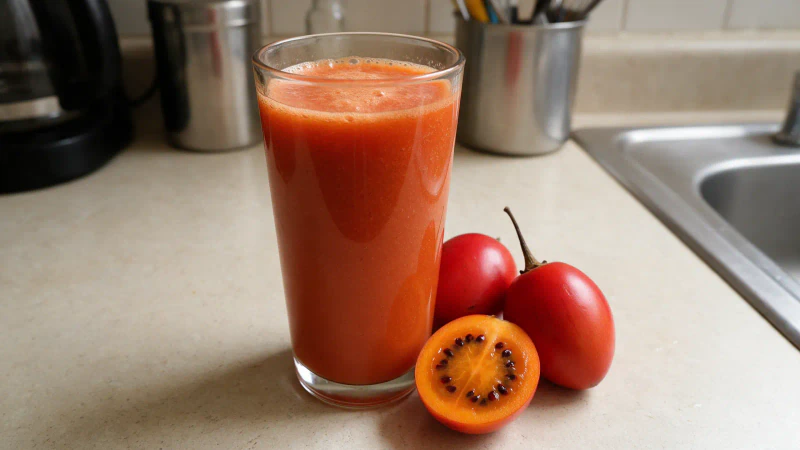
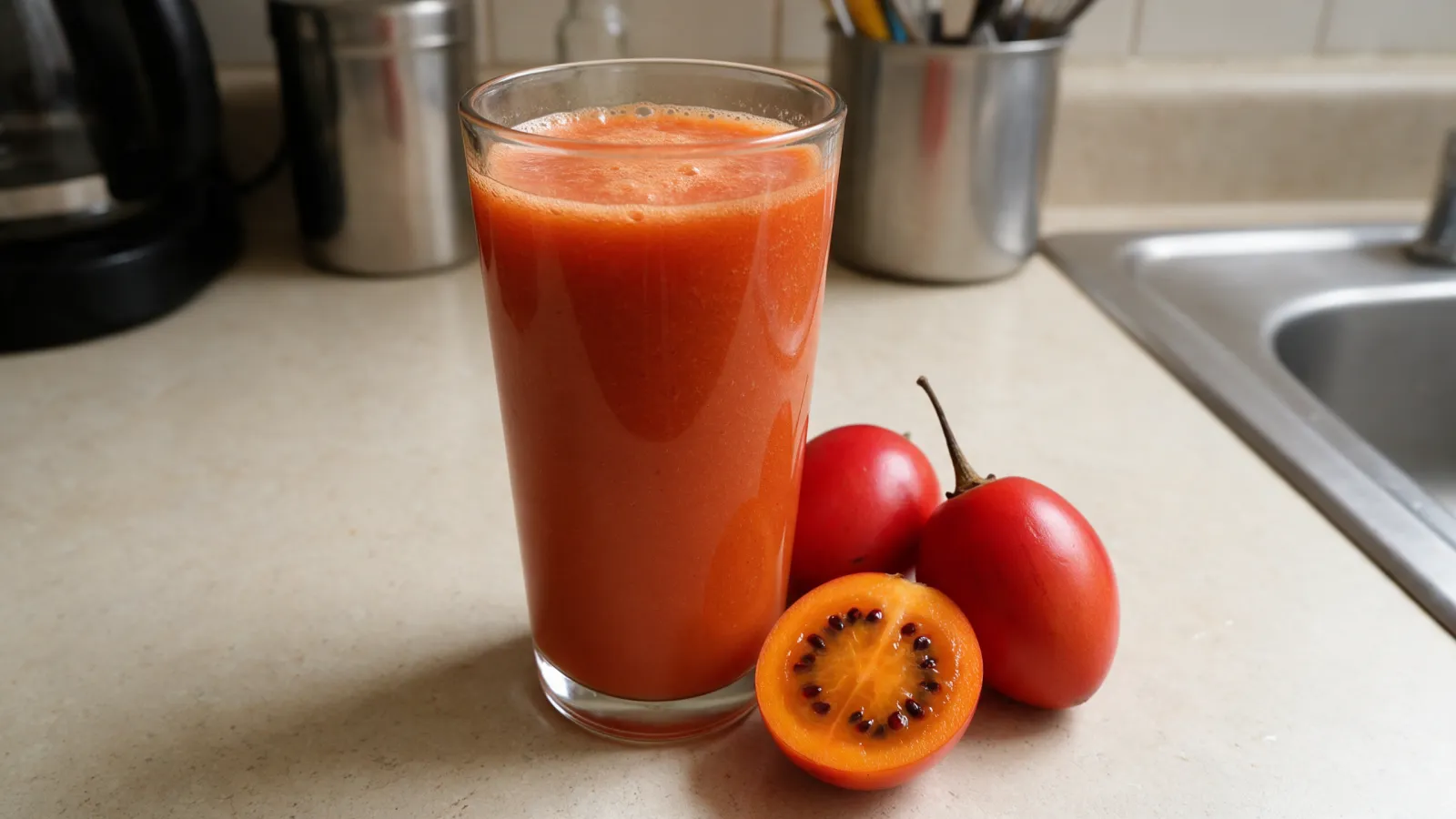

In Colombia the tamarillo goes by tomate de árbol, tree tomato, and it’s one of the everyday lunch juices, blended with water or milk and strained. The fruit looks like a glossy red egg and tastes somewhere between a tart plum and a tomato. The only trick is the skin, which is bitter: blanch the fruit for 2 minutes, slip the skins off, and the rest is a blender and a sieve. Twenty minutes, most of it waiting for water to boil.
What is tamarillo juice, and who is it for?
How do you make tamarillo juice? Blanch the tamarillos in boiling water for 2 minutes, cool them in cold water and peel. Blend the flesh for 30 seconds with a third of the water, strain and press through a fine sieve, then stir in the rest of the cold water and the sugar. For 1 liter (about 1 quart), use 400 g (14 oz) fruit, 750 ml (3 cups) water and 60 g (⅓ cup) sugar. Ready in 20 minutes for 4 servings.
The tamarillo (Solanum betaceum) is an Andean fruit from the same family as tomatoes and potatoes. It’s egg-shaped, about 1½ to 4 in (4 to 10 cm) long, red, orange or yellow outside, with orange flesh and black seeds wrapped in purple jelly. The English name was coined in New Zealand in the 1960s, and the fresh tamarillos in US specialty stores often come from there. Jugo de tomate de árbol (HOO-go deh toh-MAH-teh deh AR-bol) is the Colombian juice made from it.
Who will love it. Anyone who likes tart, not-too-sweet drinks, or wants a fruit juice that goes with savory food. It’s a lunch drink, not a dessert.
Who might not. If you avoid nightshades, skip it: tamarillo is one. And if you want something candy-sweet, the red fruit will feel sharp; gold tamarillos are milder.
Is tamarillo skin bitter, and how do you peel it?
Yes. The skin, and the thin layer of flesh just beneath it, taste bitter, and sugar doesn’t cover it up. Blend even part of the skin into the pitcher and you’ll taste it. That’s why I always peel first.
The easiest way to peel is the same as for tomatoes:
- Score a shallow cross in the pointed end, through the skin only.
- Blanch in water at a rolling boil for 2 minutes.
- Cool in a bowl of cold water for 1 minute.
- Peel from the cross. The skin comes off in long strips.
You’ll see blanching times from 30 seconds to several minutes. With ripe fruit, 2 minutes works for me every time, and a stubborn patch gets one more minute. Longer than that and, in my experience, the outer flesh starts to soften and taste cooked. You can also peel raw with a paring knife, but you lose more flesh and it’s easy to leave slivers of skin behind.
Twenty minutes, ten of them hands-on: 2 minutes rinsing and scoring, 8 heating water, 2 blanching, 1 cooling, 3 peeling, 1 blending, 2 straining and 1 to sweeten. Put the water on before you rinse the fruit and you’ll be done in 18.
Fresh tamarillos, frozen pulp or gold tamarillos
Fresh tamarillos in the US mostly come from New Zealand, and specialty produce suppliers list them from about April to September. Pick fruit that’s fragrant, feels heavy and gives slightly when pressed. Ripe ones keep in the fridge for about a week in my kitchen. Size varies a lot by variety, from under 1½ oz (40 g) to over 5 oz (150 g), so weigh them: a medium red one is about 3½ oz (100 g).
Frozen tamarillo pulp is the easy route. Goya sells a 14 oz (396 g) pack, labeled Tamarillo Pulp, with tamarillo and ascorbic acid as the only ingredients and no added sugar, in the frozen aisle of Latin grocers and bigger US chains with a Latin section. In the UK, look for frozen tamarillo or tomate de árbol pulp in Latin American shops. It’s already peeled, so you skip the blanch and the juice takes 10 minutes. Use 330 g (11.5 oz) per liter, a little over three-quarters of the pack, which is what 400 g (14 oz) of whole fruit leaves once peeled. Blend it half-thawed, and strain anyway in case it has seeds.
Gold or yellow tamarillos are sweeter and less sour than red. Use the same weight, but taste before adding all the sugar. The juice comes out paler.
Ingredients and tools for 1 quart
- 400 g (14 oz) ripe red tamarillos, about 4 medium, or 330 g (11.5 oz) frozen pulp.
- 750 ml (3 cups) very cold water, plus 1.5 liters (6 cups) for blanching.
- 60 g (⅓ cup) sugar. Panela or piloncillo at the same weight gives a darker juice with a molasses note; dissolve it in the blending water first, since it won’t dissolve in cold water.
- Tools: a 2-quart pot, a slotted spoon, a bowl of cold water, a blender, a fine-mesh sieve and a 1½-quart pitcher. No blender? Mash the peeled flesh with a fork in the 1 cup (250 ml) of water for 2 minutes and strain as usual; the juice comes out a little lighter.
Blend briefly, then press
Blend the peeled flesh with just 1 cup (250 ml) of the water for 30 seconds. The seeds are small and soft, and I’ve never found them bitter the way the skin is, but blend too long and they turn the juice cloudy and speckled. Then press the pulp against the sieve for 2 minutes, scraping underneath, until little more than black seeds and their jelly is left.
You can tell it went right when the skins came off in strips, the strained juice is a clear orange-red with no black specks or red flecks of skin, and it tastes tart and fruity with no bitter finish.
Who this recipe is for
- If you’ve never had tamarillo → start with frozen pulp and the water version.
- If you’re short on time → frozen pulp: no blanching, 10 minutes.
- If you’re making it for kids → the milk version, which softens the tartness.
- If you’d rather use less refined sugar → the same weight of panela or piloncillo.
- If you’re feeding a crowd → peel and strain the night before (see below).
Tamarillo juice with milk, and why it doesn’t curdle
Milk curdles when its main protein, casein, clumps at pH 4.6. Fresh milk sits around pH 6.6. Ripe Colombian tamarillos have measured pH 3.84 to 4.36, which is much less acidic than Andean blackberries or lulo, both below 3.
In practice, tamarillo juice made with cold milk sits in my pitcher through a whole lunch without a single curd, which I can’t say for blackberry. I still follow the same order: blend the flesh with only 150 ml (⅔ cup) water and the sugar, strain, then stir that base into 600 ml (2½ cups) whole milk straight from the fridge, at 40°F (4°C) or colder. The thick pulp strains better on its own than mixed with milk, which foams. It turns a soft pink. Skim milk makes it thinner; almond or oat drinks work and give a lighter juice.
Mistakes that ruin tamarillo juice
- Bitter → skin or stem went into the blender. Blanch, peel completely, pull the stem.
- Tastes cooked → blanched too long. 2 minutes, then straight into cold water.
- Pale and watery → not enough fruit. 400 g (14 oz) per liter.
- Cloudy with black specks → blended too long or a coarse sieve. 30 seconds and a fine mesh.
- Harsh and sour → underripe fruit. Wait until it’s fragrant and gives when pressed.
- The skin won’t budge → the water wasn’t at a full boil, or you skipped the cross. One more minute.
Make-ahead, freezing and party batches
Night before. Blanch, peel, blend with the first 1 cup (250 ml) water and strain. Refrigerate that base, unsweetened and undiluted, for up to 24 hours. At serving time, add sugar, cold water and ice.
Freezer. Peeled fruit, pulp or strained base freezes in flat bags, 400 g (14 oz) of fruit per bag, one bag per liter. At 0°F (−18°C) it stays safe indefinitely; for flavor I use it within 3 months, blended straight from frozen. I don’t freeze finished juice, which separates when thawed.
In the fridge. The water version keeps up to 24 hours, covered, at 40°F (4°C) or colder; it settles, so stir before pouring. The milk version is for the same day and goes back in the fridge between glasses, since milk shouldn’t sit out more than 2 hours.
For a crowd. The ratio stays the same: 400 g (14 oz) fruit, 750 ml (3 cups) water and 60 g (⅓ cup) sugar per liter. For 4 to 6 people, make 1.5 liters (about 1½ quarts): 600 g (1⅓ lb) fruit, about 6 medium, 1.1 liters (4½ cups) water and 90 g (scant ½ cup) sugar. For 12 to 20 people I plan a glass and a half each: 30 glasses is 7.5 liters (about 2 gallons), from 3 kg (6½ lb) fruit, about 30 medium, 5.6 liters (about 6 quarts) water and 450 g (1 lb, about 2¼ cups) sugar. Blanch in batches of 8 to 10 so the water keeps boiling, and keep ice in the cold-water bowl. Blend and strain with 1.9 liters (2 quarts) of the water the night before, then sweeten and top up with the remaining 3.75 liters (about 4 quarts) as you serve.
What a pitcher costs, and the calories per glass
With Goya tamarillo pulp at $3.59 for a 14 oz (396 g) pack at one supermarket chain, the 330 g (11.5 oz) in a liter costs about $2.99, and the sugar, at the August 2026 national average of $1.024 a pound, $0.14. That’s about $3.13 a liter, or 78 cents a glass. At another store of the same chain the pack was $4.29, which puts the liter at $3.71. The milk version adds about $0.67 for 600 ml (2½ cups) of whole milk at $4.229 a gallon.
Yield. 1 liter makes 4 glasses of 250 ml (8.5 oz) or 3 tall ones of 330 ml (11 oz).
Calories. A glass of the water version has about 93 kcal, 58 of them from the sugar. Without sugar it’s about 35 kcal, but very tart; with half the sugar, 30 g (2½ tbsp) per liter, about 64 kcal. The milk version comes to about 187 kcal.
What to serve with it
In Colombia this is a lunch juice, one 250 to 350 ml (8.5 to 12 oz) glass per person. I pour it next to Colombian ajiaco, the chicken and potato soup from Bogotá, a bandeja paisa platter or Colombian breaded chicken, where the sharpness cuts through the richness. For more of the same family, try Colombian blackberry juice, Colombian lulo juice and Colombian passion fruit juice, all more acidic, or the mild Colombian-style guava juice. For a hot drink sweetened with the same panela, there’s aguapanela with lime.
Tamarillo juice FAQ
What does tamarillo juice taste like? Tart and fruity, with a faint tomato note, somewhere between a plum and a tomato. In milk it’s milder and creamy.
Do you have to peel tamarillos for juice? Yes. The skin and the flesh just under it are bitter. Blanch 2 minutes, cool in cold water and the skins slip off.
Are tamarillo seeds edible? Yes. They’re small and soft, and people eat them along with the flesh when they scoop a tamarillo raw. For juice I strain them out for a smooth glass.
Can I use frozen tamarillo pulp? Yes, 330 g (11.5 oz) per liter, with no blanching or peeling. Goya sells it in 14 oz packs.
Does tamarillo juice curdle milk? Rarely. Tamarillo’s pH is around 4, much less acidic than blackberry or lulo, and with cold milk it holds through a meal.
Is tree tomato the same as tamarillo? Yes. Tree tomato and tomate de árbol are older names; tamarillo is the name New Zealand gave it.
How long does tamarillo juice keep? The water version up to 24 hours, covered, at 40°F (4°C) or colder. The milk version the same day, kept cold.
Nutrition per glass
Per 250 ml (8.5 oz) glass of the water version, a quarter of the recipe, calculated from the peeled flesh of 100 g (3.5 oz) of fruit and the recipe’s sugar:
- Calories: 93 kcal
- Protein: 2 g
- Carbohydrates: 21 g
- Fat: 0 g
- Sugars: 18 g, 15 g of it added
- Sodium: 1 mg
I don’t give a fiber number, since part of it stays with the seeds in the sieve. With whole milk, a glass carries 7 g protein, 5 g fat, 29 g carbohydrates and 26 g sugars. Red tamarillos carry roughly 19 to 42 mg of vitamin C per 100 g (3.5 oz) of fruit, depending on the crop.
The first tamarillo juice I made in Colombia went into the blender skin and all, because nobody told me otherwise, and I poured the whole bitter pitcher out. These days the water heats while I rinse the fruit, and peeling four blanched tamarillos takes less time than straining. My son Dylan asks for the milk one. Josnaisis.