
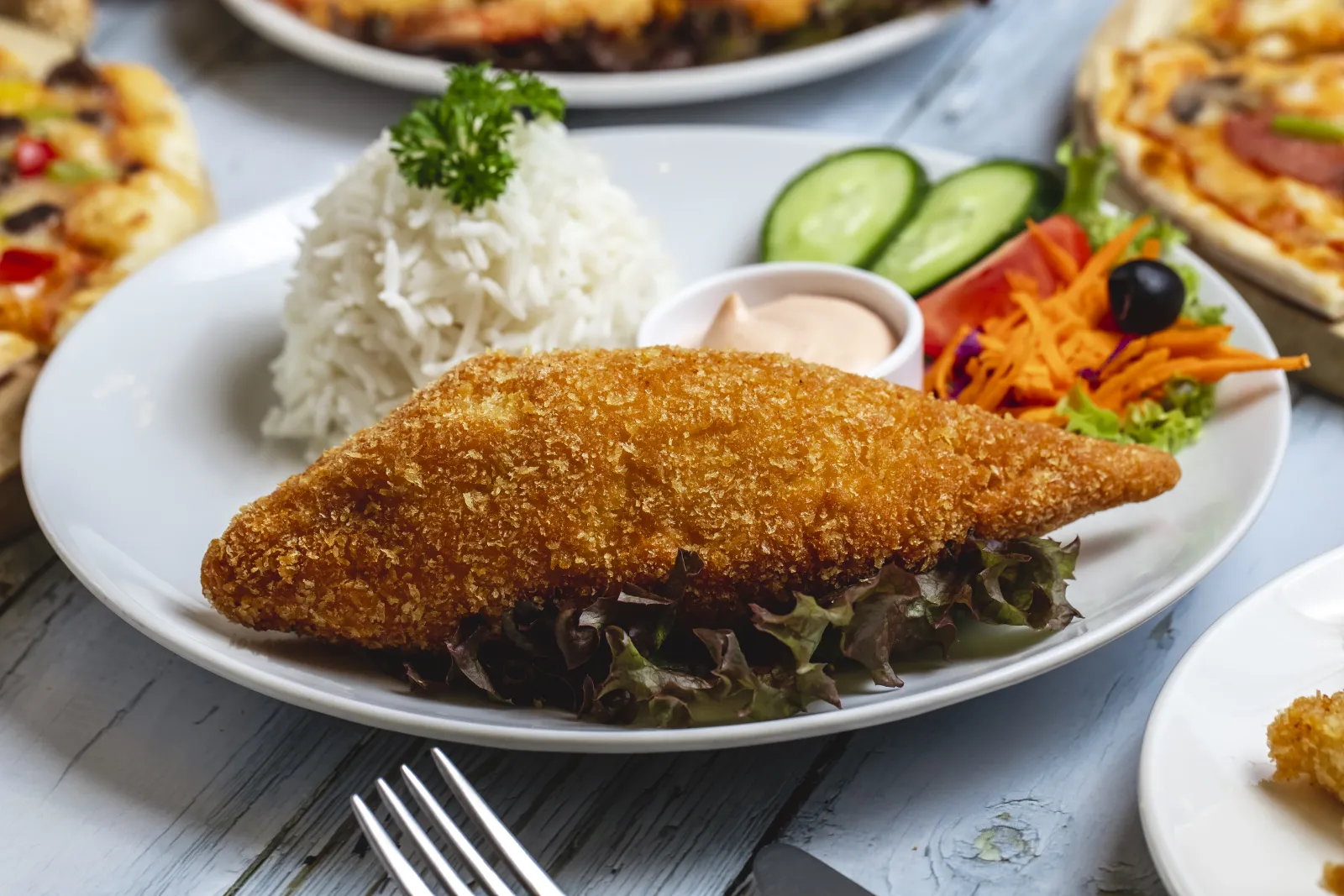

Pollo apanado (poh-yoh ah-pah-NAH-doh) is what you get when a Colombian cook makes chicken cutlets: breast meat sliced thin, rubbed with garlic and cumin, coated in flour, egg and fine breadcrumbs, and shallow-fried until golden. It turns up on the set lunch menus of Colombian diners next to rice, salad and a fried plantain or potato, and in home kitchens it is the weeknight dish kids ask for. The cumin is what makes it Colombian rather than generic, and the method below is built around one number, ¼ inch, because a cutlet of even thickness cooks through in the same 3 minutes per side the crust needs to brown.
What is Colombian breaded chicken, and who is it for?
How do you make Colombian breaded chicken? Butterfly boneless chicken breasts into cutlets, pound them to ¼ inch (6 mm) and season with garlic, cumin, salt and pepper for 30 minutes. Pat dry, coat in flour, egg and fine breadcrumbs, chill 10 minutes, then fry in ⅜ inch (1 cm) of oil at 350°F (175°C) for about 3 minutes per side, to 165°F (74°C) inside. Ready in 80 minutes for 4 servings.
If you know chicken schnitzel or chicken Milanese, you already know the shape. The Colombian version differs in the seasoning, which goes straight on the meat instead of into the crumbs, and in the plate: never pasta or potato salad, always rice. In Venezuela, where I grew up, the same thing is called milanesa de pollo, and in Mexico it is pechuga empanizada.
Why make it. It costs little, uses supermarket ingredients, and the leftovers make the best next-day sandwich. A chicken breast has under 3 g of fat per 100 g, and the crust is what keeps that lean meat from drying out.
Who it suits. Busy weeknights if you season the night before, lunchboxes, picky eaters, and crowds of 10-20 if you switch to the oven.
Who might skip it. Anyone who won’t shallow-fry at home (though the oven and air fryer versions below are solid), and anyone gluten-free unless you swap the flour and crumbs.
Real time. 80 minutes start to finish, about 35 of them hands-on. Seasoned ahead, the day-of work drops to 50 minutes.
Difficulty, honestly easy. Chicken breast pounds out without tearing. The only thing that needs attention is oil temperature.
What you need, from the cut to the coating
For 4 servings: 700 g (1½ lb) boneless chicken breast, 2 eggs, 70 g (½ cup) flour, 120 g (1 heaping cup) fine breadcrumbs and 600 ml (2½ cups) oil. The seasoning is garlic, cumin, salt and pepper. Exact amounts are in the recipe card.
Buying the chicken in the US and UK
- US. Packs labeled thin-sliced chicken breast or chicken cutlets are already butterflied and only need a few taps with the mallet. Whole breasts work too; a 350 g (12 oz) half gives two cutlets.
- UK. Look for chicken breast fillets and butterfly them yourself, or ask the butcher for escalopes.
- Thighs instead. Boneless, skinless thighs are juicier and more forgiving, but they are harder to pound to an even thickness.
How thin to pound, and how to do it without tearing
The target is ¼ inch (6 mm) everywhere. A breast half is thick at one end and thin at the tip, and if you fry it that way the tip dries out while the thick end is still raw. Butterfly first, then pound only the thick part, inside an open zip-top bag, with the flat side of the mallet. The textured side shreds the surface, and the breading peels off wherever the meat is torn. If the meat is hard to slice, 15 minutes in the freezer firms it up.
Breadcrumbs, panko or crackers
Fine plain dry breadcrumbs give the smooth, deep-golden crust you see in Colombia. Panko works, but it fries up harder, spikier and paler. Crushed saltines are the best pantry swap: brittle and a little saltier, so leave the ¼ tsp salt out of the flour. In the UK, cream crackers crushed fine do the same job.
Equipment, and what to use instead
A 28 cm (11 in) skillet, a long sharp knife, a meat mallet, three shallow dishes, tongs, a wire rack and an instant-read thermometer. No mallet? Use a heavy pan or rolling pin. No rack? Lean the cutlets on their edges against a plate. The thermometer has no substitute.
Your make-ahead plan and how to tell each step is right
The night before. Butterfly, pound and season the cutlets and keep them covered in the fridge for up to 24 hours. Marinated poultry keeps up to 2 days in the fridge, but I stop at one. Rice can be cooked the day before too.
On the day. Rice on the stove, plantains peeled. Fry the plantains first in the same oil so it stays clean, and keep them in a 200°F (90°C) oven. Then the chicken.
Cues to watch for.
- Pounded → even ¼ inch (6 mm) from tip to edge.
- Floured → looks dusted, not white.
- Oil ready → a crumb sizzles immediately and rises; if it sits still on the bottom, wait; if the oil smokes, it is too hot.
- First side → after about 3 minutes the edges are deep golden and the bubbling calms down.
- Done → 165°F (74°C) with the thermometer pushed in sideways through the thickest part. Without one, cut there: the meat should be opaque white all the way through, with clear juices.
Scaling for a crowd
Per person: 175 g (6 oz) chicken, half an egg, 17.5 g (2 tbsp) flour and 30 g (¼ cup) breadcrumbs. A 28 cm (11 in) skillet holds 2 cutlets, and each batch takes about 8 minutes including the oil’s recovery.
| Servings | Chicken | Eggs | Flour | Breadcrumbs | One skillet |
|---|---|---|---|---|---|
| 4 | 700 g (1½ lb) | 2 | 70 g (½ cup) | 120 g (1 cup) | 2 batches, ~16 min |
| 10 | 1.75 kg (3.9 lb) | 5 | 175 g (1⅓ cups) | 300 g (2¾ cups) | 5 batches, ~40 min |
| 20 | 3.5 kg (7.7 lb) | 10 | 350 g (2¾ cups) | 600 g (5½ cups) | bake instead |
For 20, I bake: 8 cutlets per round on 2 rack-lined sheet pans, about 12 minutes each round. Swap in fresh oil after every 8 cutlets if you do fry, because burnt crumbs turn the next batch dark and bitter.
Before you start, oil temperature, the 165°F rule and common mistakes
Why these numbers. Thin chicken cutlets fry well between 350°F and 375°F (175-190°C) in 2 to 4 minutes a side. Starting at 350°F (175°C) leaves room for the drop when cold meat goes in without scorching the crumbs. 165°F (74°C) is the safe minimum for all chicken, measured in the thickest part, and unlike pork there is no resting period that makes a lower reading acceptable. Color is not a reliable test.
Why the breading falls off
- Wet meat. Seasoning juices turn to steam and push the crust away. Pat dry before the flour.
- Too much flour. The egg sticks to loose flour instead of the chicken. Shake until it is barely visible.
- No rest. 10 minutes in the fridge lets the egg hydrate the crumbs so they set.
- Torn surface. Textured mallets and over-pounding rip the meat. Flat side, outward strokes.
- Cool oil. Below 325°F (160°C) the crumbs soak up oil instead of sealing.
- Too much handling. Every extra flip or poke loosens the crust. One flip, tongs on the edge.
Other mistakes. Dry chicken comes from uneven cutlets or cooking past 165°F (74°C). A burnt crust with a raw center means oil above 375°F (190°C) or a thick cutlet. A greasy crust means a crowded pan. A soggy bottom means paper towels instead of a rack.
Heat, kids and allergens. No chili heat at all; Colombian ají goes on the table for anyone who wants it. Kids love it, especially cut into strips before breading (2 to 3 minutes per side, checked at 165°F). Main allergens are gluten and egg; no dairy or nuts.
Oven or air fryer? Choosing your version
- Shallow-fried (the original). Best crust: even, deep golden, crisp. About 395 kcal per cutlet.
- Oven, for crowds. Toast the breadcrumbs first in a skillet with 1 tbsp oil until light gold, or they stay pale. Bread the cutlets, set them on a wire rack over a sheet pan, spray with oil and bake at 425°F (220°C) for 10 to 12 minutes, flipping halfway, to 165°F (74°C).
- Air fryer, for one or two. Preheat to 400°F (200°C), spray the breaded cutlets on both sides, cook in a single layer 5 minutes, flip, spray, and cook 3 to 5 minutes more, to 165°F (74°C). Crisp but drier. With about 6 g of oil instead of 30 g for the batch, each cutlet drops to roughly 340 kcal.
- Short on time. Buy thin-sliced breasts and season for 15 minutes.
- Chicken fingers. Strips 2 cm (¾ in) wide, same coating, 2 to 3 minutes per side.
Freezing raw breaded cutlets
This is the biggest time-saver in the whole recipe. Bread the cutlets, freeze them apart on a tray for 2 hours, then bag them with parchment between layers. I use them within 3 months. Fry straight from frozen at 350°F (175°C), adding 1 to 2 minutes per side, and check for 165°F (74°C): frozen chicken takes roughly half again as long to cook. Already-fried cutlets can be frozen too, but the crust never fully comes back.
How much it costs in the US
At US city average retail prices for August 2026, dinner for 4 with rice and lime comes to about $8.69, or $2.17 a plate.
Boneless chicken breast is about 74% of the bill at $4.17 a pound. Breadcrumbs, oil and plantains aren’t in the total; the oil is the next biggest cost, so strain it once it cools and reuse it for frying plantains the next day.
Serving, storing and reheating
Taste and texture. A fine, crackly crust that stays on when you cut, juicy breast underneath, and an earthy cumin-garlic flavor. Lime squeezed at the table adds the acidity the seasoning leaves out.
The Colombian plate. Colombian white rice, a tomato and onion salad, and fried potatoes or Colombian patacones. Salsa rosada, the pink ketchup-mayo sauce, is the usual dip, and Colombian ají picante brings the heat. To drink, lulo juice or a glass of tamarillo juice made with water or milk. If you like this, the pork version from Cali, chuleta valluna, uses the same breading with lime in the marinade.
Fridge. Cooked leftovers keep 3 to 4 days at 40°F (4°C) or below and shouldn’t sit out for more than 2 hours. Store them in one layer so the crust doesn’t steam.
Reheating without losing the crunch. Oven or air fryer at 350°F (180°C) for 5 to 8 minutes on a rack, to 165°F (74°C) in the center. The microwave turns the crust soft for good.
Colombian breaded chicken FAQ
What is pollo apanado? Colombian breaded chicken: thin chicken breast cutlets seasoned with garlic, cumin and salt, coated in flour, egg and breadcrumbs, and fried. It is served with rice, salad and plantain or potato.
Is pollo apanado the same as chicken Milanese? Same technique, different seasoning and sides. The Colombian version seasons the meat with cumin and garlic and is served with rice and lime.
How long do you fry breaded chicken cutlets? About 3 minutes per side for ¼ inch (6 mm) cutlets in oil at 350°F (175°C), until 165°F (74°C) inside.
Why does the breading fall off my chicken? Wet meat, too much flour, torn meat from pounding, oil below 325°F (160°C), or flipping more than once. Pat dry, shake off flour, chill 10 minutes, fry hot, flip once.
Can I make it in the air fryer? Yes: 400°F (200°C), sprayed with oil, 5 minutes, flip, then 3 to 5 minutes more. It is drier than fried and about 55 kcal lighter per cutlet.
Can I bake breaded chicken cutlets instead of frying? Yes. Toast the crumbs first, bake on a rack at 425°F (220°C) for 10 to 12 minutes, flipping halfway, to 165°F (74°C).
Can you freeze breaded chicken before cooking? Yes. Freeze on a tray, then bag. Fry from frozen at 350°F (175°C), 1 to 2 extra minutes per side, to 165°F (74°C).
Panko or breadcrumbs for Colombian breaded chicken? Fine plain breadcrumbs for the classic smooth crust. Panko gives a harder, spikier, paler coating.
Nutrition per cutlet
Per serving (one cutlet from 175 g / 6 oz raw breast, without sides), worked out from the recipe weights: 700 g chicken breast, the coating that actually sticks (25 g flour, 60 g egg, 70 g breadcrumbs), 30 g absorbed oil, the garlic, cumin and 7.5 g of salt. The absorbed oil is my own estimate for thin cutlets fried in ⅜ inch (1 cm) of oil.
- Calories: 395 kcal
- Protein: 45 g
- Carbohydrates: 18 g
- Fat: 15 g (2 g saturated)
- Fiber: 1 g
- Sugars: 1 g
- Sodium: 960 mg
Baked or air-fried, it is about 340 kcal and 9 g fat. With saltines the numbers barely move, but sodium rises to about 990 mg. Most of the sodium is the salt in the seasoning; halve it and you land near 670 mg.
The milanesa I grew up with in Venezuela was a whole breast pounded by hand, thick on one side and paper-thin on the other, and nobody minded. In Colombia, cooking for Dylan, I kept finding the dry tip left on his plate, so I started butterflying every breast. Same thickness, same 3 minutes a side, and the plate comes back clean. Josnaisis.