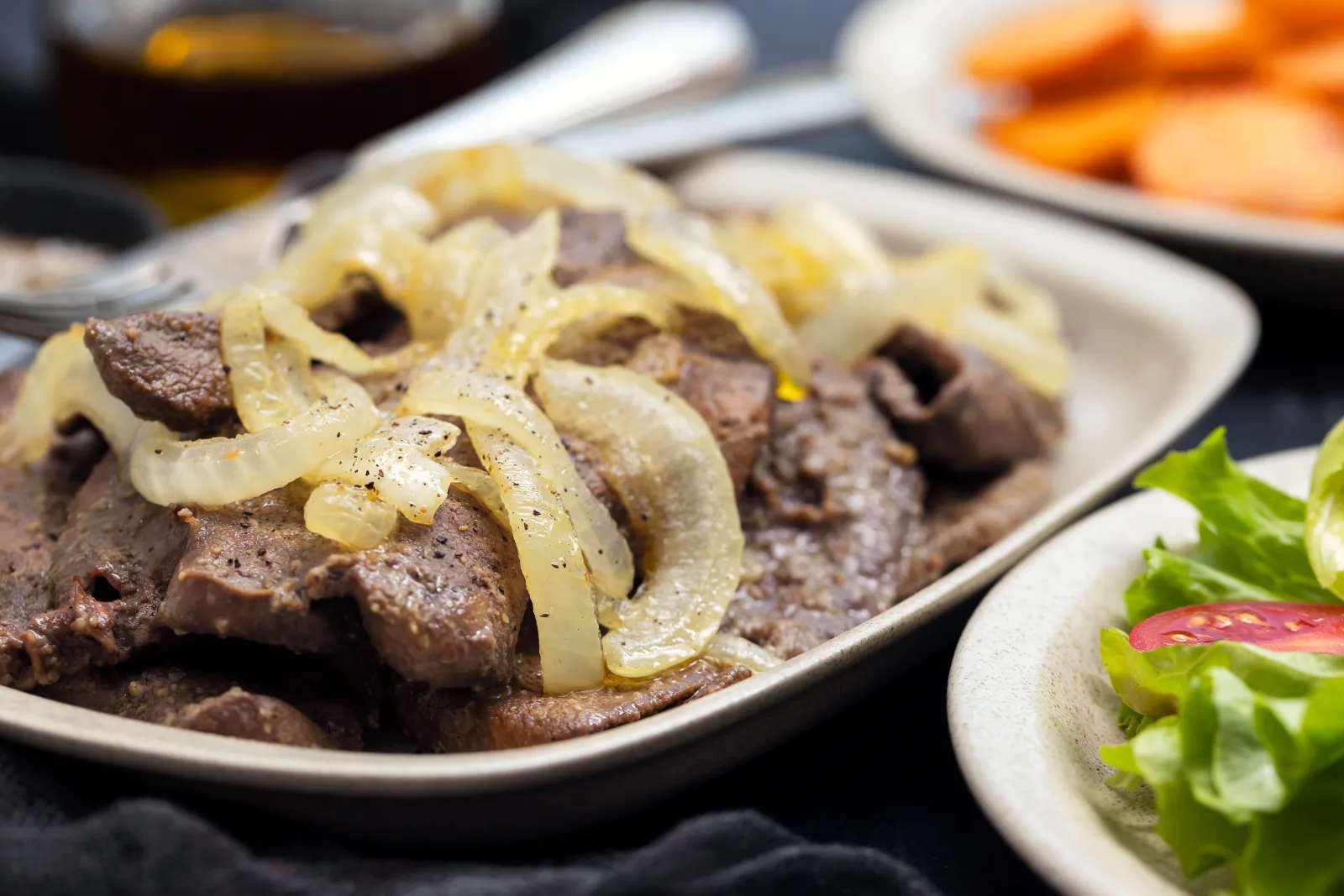

Hígado encebollado is liver and onions as it’s cooked in Colombian homes: beef liver cut thin, seared fast, and buried under a pile of onions softened with tomato and cumin, then eaten over white rice with fried sweet plantains. If you grew up with the gravy version and remember it as shoe leather, the culprit was almost certainly the clock. A quarter-inch slice needs 2 minutes a side, and that is the whole secret.
What is Latin-style liver and onions, and who is it for?
How do you make liver and onions that stay tender? Peel off the membrane, cut beef liver into ¼-inch (6-7 mm) slices and season with garlic, cumin and pepper. Cook the onions and tomato separately for 15 minutes, then sear the liver in a hot skillet 2 minutes per side in two batches and toss it with the onions for just 1 minute. 40 minutes for 4 servings.
Compared with the British or Southern US plate, the Latin version skips the flour and the gravy. The sauce is the onion itself, cooked with tomato until it collapses, plus a splash of water to lift the browned bits from the pan. It’s an everyday lunch in Colombia, and close cousins turn up in Mexico, the Dominican Republic, Ecuador and Spain, sometimes with vinegar or wine.
Why bother. It’s cheap beef, about $1.64 a plate in the US, it’s quick (the liver is in the pan for 8 minutes), and one 150 g (5.3 oz) raw portion carries about 7.4 mg of iron, 41% of the 18 mg Daily Value.
Who it suits. Liver eaters who want it tender, and anyone after a 40-minute weeknight plate that goes over rice.
Who should skip it. Pregnant women, because of the vitamin A (numbers below), and anyone who dislikes the mineral taste: onions soften it, they don’t hide it. It’s also a poor make-ahead dish, since reheated liver never matches fresh.
Time and difficulty. 40 minutes, about 28 of them hands-on. Easy, with one demanding stretch: the last 10 minutes.
Beef, calf’s or chicken liver, which to buy
Buy beef liver for this dish. It’s the cheapest per pound, its firm texture stands up to a hot skillet, and its stronger taste is what the onions are there to balance.
- Calf’s liver (veal liver) is the mildest and most tender, and the easy swap in the UK, where calf’s and lamb’s liver are the ones to ask a butcher for. Same 2 minutes a side, a little less if it’s sliced thinner. It has more than twice the vitamin A of beef liver.
- Chicken liver makes a different, creamier dish and must reach 165°F (74°C) in the center. Use whole livers and give them longer than a thin slice.
Where to find beef liver in the US. Sliced, in trays, at Latin supermarkets and many big chains, sometimes labeled hígado de res; fresh sliced beef liver ran about $2.49-2.86/lb in October 2026, and frozen calf’s liver about $3.68/lb. Thaw frozen liver overnight in the fridge, never on the counter.
How to pick it. Deep red, even color, shiny and moist, with no green spots or sour smell.
Does soaking liver in milk actually work?
It’s the most repeated liver trick in English, and it’s worth separating what it does from what it doesn’t. A 30-minute soak in 1 cup (250 ml) of milk in the fridge makes the flavor a bit milder to my taste. It does not make liver tender, and it can’t rescue a slice that’s been overcooked: texture is decided in the pan.
| Trick | Time | What it changes | What it doesn’t |
|---|---|---|---|
| Milk soak | 30 min, in the fridge | Flavor a little milder, to my taste | Doesn’t tenderize; adds milk as an allergen |
| Lime or vinegar marinade (Colombian style) | 10-30 min, in the fridge | Adds a sour note that Colombians like | Doesn’t tenderize; dry well before searing |
| Flour dredge | 3 tbsp (25 g) | Thicker crust, slightly thicker sauce | Adds gluten; doesn’t fix overcooking |
| Thin slicing | ¼ inch (6-7 mm) | The real tenderizer: center reaches done before the outside toughens | — |
With fresh, well-trimmed liver, none of the first three is needed. I make it plain and keep the milk for when the liver smells stronger than I’d like.
Ingredients and US/UK swaps
The recipe card has the exact amounts: 1⅓ lb (600 g) liver and the same weight of onions, which is the ratio that gives you enough onion sauce for the rice.
- White onions → yellow onions work the same; red onions come out sweeter and darker.
- Round tomatoes → any ripe slicing tomato, or 2 canned plum tomatoes, drained. Skip the tomato and you’ll need more water at the end, or the dish is dry.
- Cumin → it’s the Colombian touch. Leave it out and you’re closer to the British plate.
- Vegetable oil → canola or sunflower. I keep butter out of the liver pan, where the heat is high; if you want its taste, add 1 tablespoon to the onions only.
- Salt at the end → I salt the liver once it’s back with the onions. I haven’t seen salt toughen it (time does that), but this way I control the seasoning better, since the onions already have theirs.
Equipment. An 11-inch (28 cm) cast-iron or heavy nonstick skillet, a sharp knife and paper towels. In a smaller pan, cook the liver in 3 batches: crowded slices steam gray instead of browning. An instant-read thermometer helps the first time, so you learn what 160°F (71°C) looks like.
Game plan, timing and how to tell it’s done
Make ahead. Cook the onions and tomato up to a day early and refrigerate them covered; reheat in the skillet for 3 minutes before the liver goes in. You can also trim and slice the liver the day before, as long as it’s cooked within 1-2 days of buying it. The searing is the one step that never moves.
How to peel the membrane. Liver comes wrapped in a thin, see-through skin that shrinks with heat and makes the slices curl and the edges chewy. Lift it at a corner with a knife tip, grab it with a paper towel so it doesn’t slip, and pull back slowly. If the liver is already sliced, the membrane is only around the rim: 3 or 4 small nicks per slice stop the curling.
Signs you’re on track.
- The pan → the slice sizzles the moment it touches the oil. If it doesn’t, wait.
- First side → after 2 minutes it releases on its own with a golden crust.
- Done → pressed with a finger it gives like the fleshy base of your thumb, the juice it releases is no longer red, and the center is very pale pink to light tan, never red.
- Overdone → gray all the way through, firm, with a wrinkled surface.
Cooking for a crowd. Allow 5.3 oz (150 g) raw liver per person and the same weight of onion: 2⅔ lb (1.2 kg) for 8, 4 lb (1.8 kg) for 12, 6⅔ lb (3 kg) for 20. An 11-inch skillet takes about 10 oz (300 g) of liver per batch, so for 12 or more, cook the onions the day before in a wide pot and sear in two skillets or on a griddle, moving the liver into the hot onions as it comes off. Twenty people is 10 batches, about 40 minutes of searing.
Why liver turns tough, and other things to know
Liver is very lean, about 3.6 g of fat per 3.5 oz (100 g), so nothing cushions it once it goes past done. Thickness sets the clock: at ¼ inch (6-7 mm) it’s 2 minutes a side; at ½ inch (1 cm) or more the outside overcooks before the center gets there. Smothering it under the onions for 10 minutes, the way many home cooks do, leaves it firm and grainy.
Mistakes and fixes.
- Tough → overcooked or too thick. Slice thinner rather than cooking longer.
- Curls up → membrane left on. Peel it, or nick the edges.
- Gray, no crust → cold pan or overcrowded. One layer, medium-high heat.
- Bitter → usually a thick vein or a green trace of bile. Trim both.
- Onions raw or scorched → heat too high. Medium, 12 minutes, stir every 2-3.
Safe doneness. Beef organ meats should reach 160°F (71°C) in the center. A quarter-inch slice gets there in the 4 minutes of searing; rare, red-centered liver isn’t recommended.
Vitamin A and pregnancy. A 150 g (5.3 oz) raw portion of beef liver holds about 7,450 µg of vitamin A, two and a half times the 3,000 µg daily upper limit for adults. Excess vitamin A is linked to birth defects, so the standard advice is that pregnant women avoid liver and liver products such as pâté, and that other adults eat liver no more than once a week.
Kids. The taste is strong, and a small portion already goes well past a child’s daily vitamin A limit (600 µg at ages 1-3, 900 µg at 4-8), so it’s an occasional dish, not a weekly habit.
Heat level, 0 out of 5. Cumin and pepper only; hot sauce goes on the table.
Allergens. No gluten, dairy, egg, nuts or fish in the base recipe. Milk comes in with the soak, gluten with a flour dredge.
Versions worth knowing
- Short on time → onions made the day before; dinner is 15 minutes.
- Milder → the 30-minute milk soak, or calf’s liver.
- Colombian lime marinade → 2 tablespoons lime juice with the garlic and cumin, 20 minutes in the fridge; pat dry before searing.
- Dredged → 3 tablespoons (25 g) all-purpose flour before searing, for a thicker crust. Adds gluten.
- Lighter → 1 tablespoon of oil instead of 3 in a nonstick pan, about 60 kcal less per plate.
- For a party → see the crowd plan above. Don’t sear an hour early to keep it warm; it overcooks.
What liver and onions cost for 4 in the US
Pricing the four main ingredients at October 2026 supermarket prices (and tomatoes at the August 2026 national average), the skillet comes to $6.56, or about $1.64 a plate, with the liver at 58% of the total.
Yield. 4 plates with about 4 oz (115 g) of cooked liver each and a generous layer of onions; with rice and plantains, a full meal. In Colombia the same recipe comes to about 14,400 pesos, with the liver at 19,800 pesos a kilo in October 2026.
Serving, storing and reheating
How it’s served. Liver on the plate, onions over the top, next to Colombian white rice and fried sweet plantains or patacones. A tomato-and-onion salad with lime or a glass of lulo juice cuts the richness.
If you’re warming to organ meats, Colombian beef tongue in sauce is the other one worth trying, and Colombian chicken giblet soup times chicken liver differently. For the same onion-and-tomato treatment on a regular cut, there’s Colombian carne en bistec.
Fridge. Raw liver, 1-2 days at 40°F (4°C) or below. The cooked dish, 3-4 days, refrigerated within 2 hours of cooking.
Freezer. Raw liver keeps best quality 3-4 months at 0°F (-18°C). The cooked dish freezes for 2-3 months, though the onions turn watery and the liver firmer.
Reheating. Leftovers need to reach 165°F (74°C), which firms the liver no matter what. What works best for me: slice it into strips, warm the onions first with 2 tablespoons of water, then add the strips, covered, over medium heat, stirring until steaming. In the microwave, covered, in 1-minute bursts.
Liver and onions FAQ
How long do you cook liver so it isn’t tough? For ¼-inch (6-7 mm) slices, 2 minutes per side over medium-high heat, to 160°F (71°C) in the center. Longer is what toughens it.
Why do you soak liver in milk? For a milder taste. It doesn’t make it more tender, and fresh, well-trimmed liver doesn’t need it.
Should liver be pink in the middle? Very pale at most, never red. Beef liver should reach 160°F (71°C), which a thin slice does in 4 minutes without going tough.
What’s the difference between calf’s liver and beef liver? Calf’s liver comes from a young animal: milder, more tender and pricier, with more than twice the vitamin A. Beef liver is stronger and cheaper.
How do you get the membrane off liver? Lift a corner with a knife tip and pull it back with a paper towel. On pre-sliced liver, nick the edges instead.
Is liver and onions healthy? It’s high in protein, iron and vitamin B12, but one plate has about 7,450 µg of vitamin A, so once a week is the usual limit, and none in pregnancy.
Can you freeze liver and onions? Yes, 2-3 months, though the onions get watery. Freezing raw liver (3-4 months) and cooking it fresh gives a better result.
Can I make it with chicken livers? Yes, whole, cooked to 165°F (74°C). The result is creamier and milder than beef.
Nutrition per serving
Per serving (a quarter of the recipe: 5.3 oz / 150 g raw liver, 150 g onion, 60 g tomato, no rice or sides), calculated ingredient by ingredient with all the oil and salt counted:
- Calories: 371 kcal
- Protein: 33 g
- Carbohydrates: 23 g
- Fat: 16 g, including 3 g saturated
- Fiber: 3 g
- Sugars: 8 g, almost all from the onions
- Sodium: 695 mg
The oil accounts for about 93 kcal per plate and the salt for 581 mg of the sodium; with ½ teaspoon of salt in total, sodium drops to about 405 mg. Beyond the card, each plate brings about 7.4 mg iron, roughly 89 µg vitamin B12, around 412 mg cholesterol and the 7,450 µg of vitamin A that set the once-a-week limit.
For years I cooked liver the way I’d always seen it done, covered with the onions until it was “properly cooked”, and for years it came out tough. Pulling it from the pan after 4 minutes, center still pale, felt wrong the first time, and it was the first time it came out tender. Now the onions get their own turn in the skillet and the liver goes in last, when everyone is already sitting down. Josnaisis.