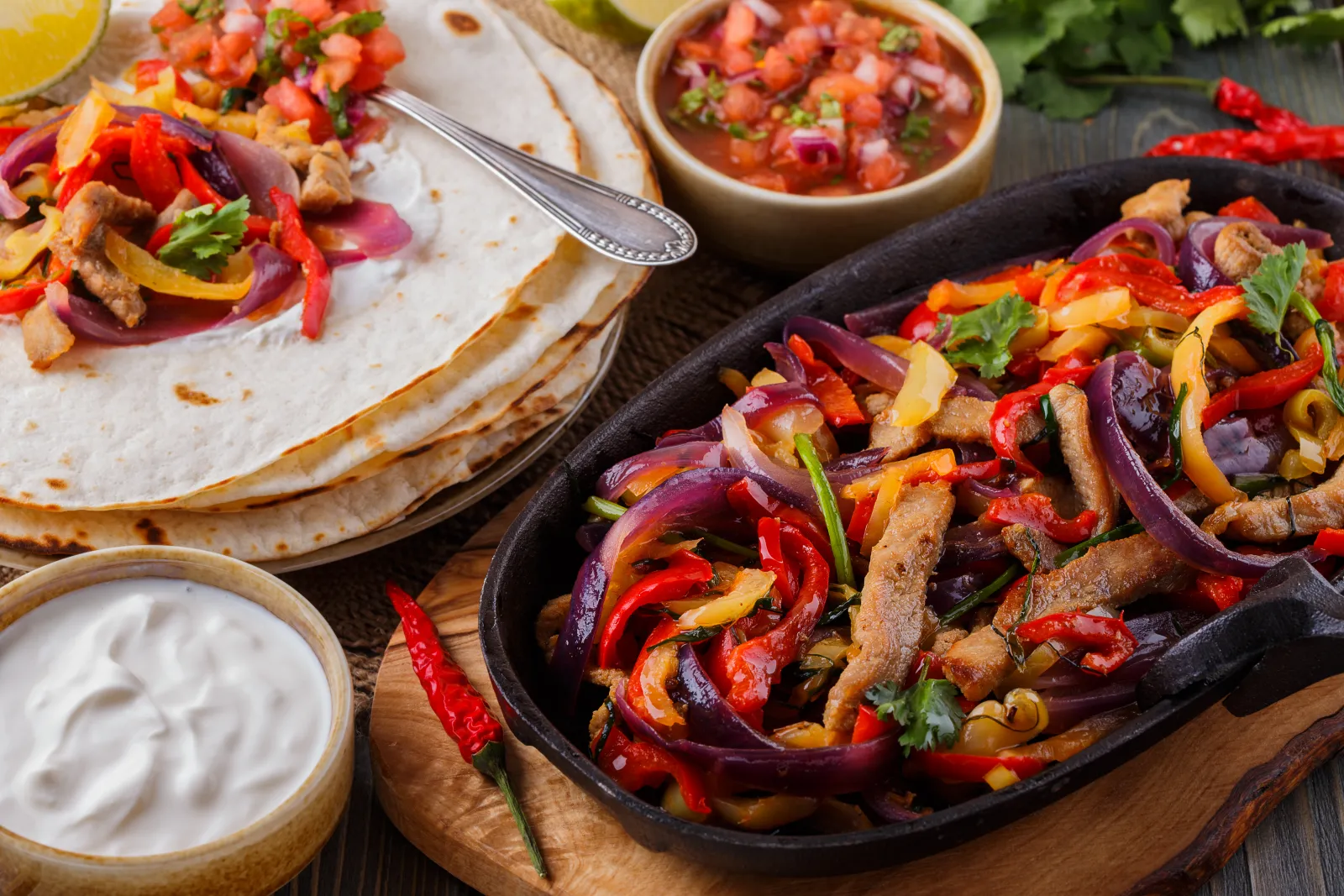

Fajitas are Tex-Mex, the food of the Texas–Mexico border rather than of interior Mexico: strips of grilled meat with charred peppers and onions, brought to the table hot so everyone builds their own flour tortilla. The original was beef skirt steak, cooked by ranch hands in South and West Texas, and the name comes from faja, Spanish for belt, after the long, narrow shape of the cut. It reached a wider public from 1969, at Texas fairs and restaurants, and chicken came later, once fajitas meant the dish rather than the cut. A good home version needs no seasoning packet and no restaurant platter, just a timer on the lime and a very hot cast-iron pan.
What are chicken fajitas, and who are they for?
How do you make chicken fajitas at home? Marinate 1.5 lb (700 g) of boneless thighs for 30 minutes to 4 hours in lime, oil, garlic, chili powder, cumin and smoked paprika, pat dry and sear them whole in cast iron, 5 to 6 minutes per side, to 165°F (74°C). Char peppers and onion in the same pan, slice the chicken against the grain and serve in warm flour tortillas. Ready in 75 minutes for 4 servings.
Worth it if you want a one-pan dinner where everyone assembles their own plate, from ingredients any US or UK supermarket stocks. The homemade seasoning tastes more of cumin and lime than a packet, and you control the salt.
Maybe not for you if your kitchen has no extractor fan and smoke is a deal-breaker. A skillet at medium-high always gives off some; the sheet-pan version below gives off almost none.
Time, honestly. 75 minutes on the clock, about 55 of them hands-on: 10 for the marinade, 30 in the fridge while you slice the vegetables, and roughly 30 at the stove.
Difficulty, easy. Nothing here is delicate. The two things that take discipline are leaving the chicken alone while it browns and not over-marinating it in lime.
Thighs or breasts for fajitas, and why I cook them whole
I use boneless, skinless thighs. Raw thighs carry about 4.1 g of fat per 3.5 oz (100 g), breast about 2.6 g, so thighs forgive a couple of extra minutes over high heat and stay juicy. Breast works too, as long as you butterfly it to an even ¾ in (2 cm) and take it off right at 165°F (74°C); past that it turns dry and stringy.
Both go into the pan whole and get sliced after resting. A whole piece builds a crust before it releases its juices. Raw strips crowd the pan, dump water and steam instead of browning, which is how fajitas turn grey.
If you buy in the UK, thighs are sold as boneless chicken thigh fillets; in the US, as boneless skinless thighs.
The fajita seasoning, made from your spice drawer
A packet of fajita seasoning is mostly chili powder, cumin, paprika, garlic, oregano and salt, often with starch or sugar. Those six from the jar, plus lime and oil, are the whole marinade.
| What the recipe uses | US | UK | What changes if you swap |
|---|---|---|---|
| Mild chili powder | American chili powder blend (chili, cumin, garlic, oregano) | Read the label: if it is pure hot chilli, use 1 tsp sweet paprika plus a pinch of it | Pure hot chilli makes the dish much spicier |
| Smoked paprika | Smoked paprika | Smoked paprika, sometimes labeled pimentón de la Vera | Sweet paprika works but loses the grilled taste |
| Mexican oregano | Latin aisle or spice section | Online or world-food shops | Mediterranean oregano is fine, a little more minty |
| Lime | Limes | Limes | Lemon works, sharper and less floral |
| Neutral oil | Canola or avocado | Sunflower or rapeseed | Extra-virgin olive oil smokes sooner at this heat |
| Sour cream | Sour cream or Mexican crema | Soured cream or crème fraîche | Crème fraîche is richer and less tangy |
Three colors of pepper are not just for the photo. Green brings a slight bitterness that cuts through the richness of the thighs, while red and yellow are sweeter. A white onion holds up to high heat better than a red one, which goes soft sooner. In the UK, bell peppers are simply peppers, and cilantro is coriander.
Use 8 in (20 cm) flour tortillas. Store-bought soft-taco size is fine; if you make your own, the homemade flour tortillas come out exactly that size. Corn tortillas make the dish gluten-free but tear more easily under a juicy filling.
No cast iron?
Use the heaviest stainless-steel or carbon-steel pan you have. It holds less heat, so cook the chicken in two batches and expect a little less browning. A nonstick pan is not built for this much heat for this long.
How long to marinate chicken for fajitas with lime
30 minutes to 4 hours in the fridge when the marinade has lime juice in it. Half an hour is enough for the spices to color and season the surface; they don’t travel much deeper the longer you wait.
Leave it overnight, or anywhere past the 6-hour mark, and the acid starts changing the proteins on the outside as the chicken picks up a soft, mealy layer that won’t brown well. That is why I stop at 4. For an overnight marinade, leave the juice out: oil, garlic, spices and salt can sit on raw chicken in the fridge for up to 2 days, and you squeeze the lime over it when you cook.
Always marinate in the fridge, never on the counter, and throw out the marinade left in the bag: it has been sitting on raw chicken.
How to cook chicken fajitas in a cast-iron skillet
Most of the 75 minutes is waiting on the marinade. The cooking itself is about 30 minutes, and it runs in this order.
Cues that each stage is right.
- Pan ready → a drop of water skitters and disappears in 1 to 2 seconds. If it sits and dances for a long time, give the pan another minute; if it smokes before the oil goes in, nudge the heat down.
- First side → the thigh lets go of the pan on its own at 5 to 6 minutes. If it sticks, it isn’t ready.
- Doneness → 165°F (74°C) in the thickest part, thighs or breasts. Without a thermometer, cut into the thickest piece: clear juices and no glossy pink.
- Vegetables → charred edges, a few near-black tips, and strips that bend but still have bite.
Sizzle without setting off the smoke alarm
Home fajita smoke comes from three places: wet marinade dripping onto the iron, where garlic and spices scorch in seconds; an oil with a low smoke point; and a pan held on maximum heat for too long. So the chicken is drained and patted dry, the oil is canola, sunflower or avocado, the burner stays at medium-high, and the extractor fan goes on when the pan does.
The restaurant sizzle is something else: the fajitas go onto a very hot cast-iron platter and get a splash of liquid on the way out of the kitchen. At home, combine the chicken and vegetables in the hot skillet, kill the heat, add 2 tbsp (30 ml) water and a squeeze of lime and carry the pan to the table on a board. Steam makes the noise and the smell, and water doesn’t burn, so there’s no smoke.
Slicing against the grain
After the 5-minute rest, look for the fine lines running across the meat and cut perpendicular to them into ½ in (1 cm) strips. Short fibers mean tender bites. Thigh muscle changes direction within one piece, so turn it halfway through if you need to. Breast fibers run lengthwise, and with beef it matters even more: skirt steak cut with the grain chews like gum.
Mistakes that make fajitas soggy, grey or smoky
- Lime overnight → mealy surface. Lime only for the last 4 hours, or at the end.
- Wet chicken into the pan → smoke, burnt spices and steamed meat. Drain and pat dry.
- A crowded pan → the temperature crashes and everything stews. Two batches.
- Flipping too early → the crust stays stuck to the iron. It releases when it is ready.
- Cutting strips before cooking → more lost juice, less browning.
- Peppers cooked too long → limp and watery. High heat, 6 to 8 minutes, done.
- Breast without a thermometer → overcooked in a minute. Pull it right at 165°F (74°C).
Food safety. Chicken has to reach 165°F (74°C) in the center. Wash the board and knife after the raw chicken and before the vegetables. Don’t leave fajitas or sour cream out more than 2 hours, or 1 hour above 90°F (32°C).
Spice level, 1 out of 5 with a mild chili powder. Add a sliced jalapeño to the peppers for more.
Kids usually love building their own. Some small children pick out green pepper; make it with red and yellow only.
Allergens. Gluten in flour tortillas and dairy in sour cream. Check the labels on chili powder blends and packaged tortillas if you cook for someone with allergies. No egg or nuts in the chicken, vegetables or spices.
Which version to make, skillet, sheet pan, grill or beef
- Short on time → a 15-minute marinade and breast cut into ½ in (1 cm) cutlets, 3 minutes per side. About 55 minutes total.
- Spicier → 1 or 2 sliced jalapeños with the vegetables, or a minced chipotle in adobo in the marinade.
- Gluten-free → corn tortillas and a chili powder labeled gluten-free.
- Lighter → breast instead of thigh, 1 tbsp less oil, and three corn tortillas in place of two flour ones.
- Vegetarian → thick strips of portobello or zucchini in the same marinade for 30 minutes, 5 to 6 minutes in the pan.
Sheet-pan chicken fajitas for a crowd
Past 4 people, a skillet means five or six batches. Switch to sheet pans:
- Buy 175 g (6 oz) of chicken and 2 tortillas per person, and multiply everything else with it.
- Slice the chicken into ½ to ¾ in (13-20 mm) strips first, the opposite of the skillet method, so it cooks in the same time as the vegetables.
- One large rimmed sheet pan per 1.5 lb (700 g) of chicken, everything in a single layer.
- Roast at 425°F (220°C) for 15 to 20 minutes, tossing halfway, then broil 2 to 3 minutes to char the edges. Check for 165°F (74°C). UK readers: broil means the oven grill.
For 12, that is 2.1 kg (4.6 lb) of chicken, 9 peppers, 3 onions, 24 tortillas and three times the marinade; for 20, 3.5 kg (7.7 lb), 15 peppers, 5 onions, 40 tortillas and five times the marinade. I run two pans at a time and put the next two in while people eat the first round.
Beef fajitas, and which cut to buy
The original fajita is skirt steak; flank steak is leaner and works too. Use the same marinade, and with beef the lime can stay on longer, up to 8 hours. Sear it whole over maximum heat, 3 to 4 minutes per side for skirt and 5 to 6 for flank, pull it at 140°F (61°C) in the center and let it rest 5 minutes, which carries it to the 145°F (63°C) safe minimum for steak. Slice thinner than chicken, always against the grain. The cut and the timing are covered in detail in the Mexican carne asada.
What chicken fajitas cost in the US
In October 2026 the recipe for 4 with thighs comes to about $13.36, or $3.34 a serving: boneless thighs at $3.72/lb at Walmart, a red bell pepper at $1.19 and a green one at $0.86 (I count the yellow at the red price), limes at $0.50 each, white onion at $1.22/lb, garlic for 12 cents and a 10-pack of soft-taco flour tortillas at $2.78. Chicken is 43 % of the total. With boneless breast, which averaged $4.17/lb in August, it rises to about $14.06. Oil, salt and spices are left out.
Sides add up. The guacamole on this site costs about $4.39 for 6 and the pico de gallo about $4.47. Three green peppers instead of mixed colors save about 66 cents, at the cost of a more bitter pan. For the UK I don’t have reliable prices for every ingredient, so no figure.
Make ahead, meal prep, storing and reheating
- The night before → chicken in the lime-free marinade, in the fridge; peppers and onion sliced, in a sealed container.
- Freezer packs → raw chicken in the lime-free marinade, flat in freezer bags. I use them within 3 months and thaw overnight in the fridge.
- Meal prep → cook on Sunday, split chicken and vegetables into 4 containers, keep tortillas and salsas separate. Good through day four, in a tortilla or over rice and beans as a bowl.
- Leftovers → 3 to 4 days in the fridge, sealed, tortillas apart. The cooked filling freezes for up to 3 months, though the peppers come out softer.
- Reheat in a skillet over medium-high with 1 tbsp water, 3 to 4 minutes, stirring, until hot through to 165°F (74°C). In the microwave, covered at half power, stirring halfway; full power dries the edges. Warm tortillas separately, 20 to 30 seconds per side.
What to serve with chicken fajitas
Guacamole, pico de gallo, sour cream and lime wedges on the table, then the sides: Mexican refried beans and Mexican red rice make it a full plate for 5. For heat, a spoonful of red taco salsa.
Chicken fajitas FAQ
What cut of chicken is best for fajitas? Boneless, skinless thighs. They take high heat without drying out. Breast works if you butterfly it to ¾ in (2 cm) and stop at 165°F (74°C).
How long should I marinate chicken for fajitas? Between half an hour and 4 hours when there is lime juice in it. Without lime, up to 2 days in the fridge.
Can you marinate chicken in lime juice overnight? I don’t. Overnight in lime, the surface turns soft and mealy. Marinate without the juice and add it when you cook.
What is in homemade fajita seasoning? Mild chili powder, ground cumin, smoked paprika, garlic, dried oregano and salt. The marinade adds lime and oil.
How do restaurants make fajitas sizzle? A very hot cast-iron platter and a splash of liquid just before serving. At home: hot skillet, heat off, 2 tbsp water and a squeeze of lime, straight to the table.
Why are my fajitas soggy? The pan wasn’t hot enough, it was crowded, or the chicken went in wet. Pat dry, cook in batches and keep the vegetables over high heat.
How much chicken per person for fajitas? About 175 g (6 oz) of boneless chicken and 2 tortillas. For 12 people, 2.1 kg (4.6 lb); for 20, 3.5 kg (7.7 lb).
Can I make chicken fajitas in the oven? Yes. Strips of chicken and vegetables in one layer at 425°F (220°C) for 15 to 20 minutes, then 2 to 3 minutes under the broiler.
What beef is used for fajitas? Skirt steak is the original; flank works too. Pull it at 140°F (61°C) and rest it to 145°F (63°C).
How do you reheat fajitas without drying them out? In a skillet over medium-high with a spoonful of water until it reaches 165°F (74°C), or covered in the microwave at half power.
Are chicken fajitas gluten-free? The filling is, if your chili powder is. Flour tortillas are not; use corn tortillas.
Nutrition per serving
Per serving (¼ of the recipe with thighs: about 175 g / 6 oz raw chicken, vegetables and 2 flour tortillas of 49 g, without guacamole, pico de gallo or sour cream), calculated ingredient by ingredient and counting all the oil:
- Calories: 681 kcal
- Protein: 44 g
- Carbohydrates: 61 g
- Sugars: 7 g
- Fat: 29 g, of which 4 g saturated
- Fiber: 6 g
- Sodium: 1518 mg
The two packaged tortillas account for about 291 kcal and nearly half the sodium; the filling alone is about 390 kcal. Made with breast, the calories barely move, with 27 g of fat and 49 g of protein.
My weeknight chicken growing up in Venezuela was stewed, never seared, and the first fajitas I made in Colombia went into a crowded nonstick pan and came out pale and wet. A cast-iron skillet, a towel to pat the chicken dry and two batches fixed it. These days the tortillas are on the table before Dylan hears the sizzle. Josnaisis.