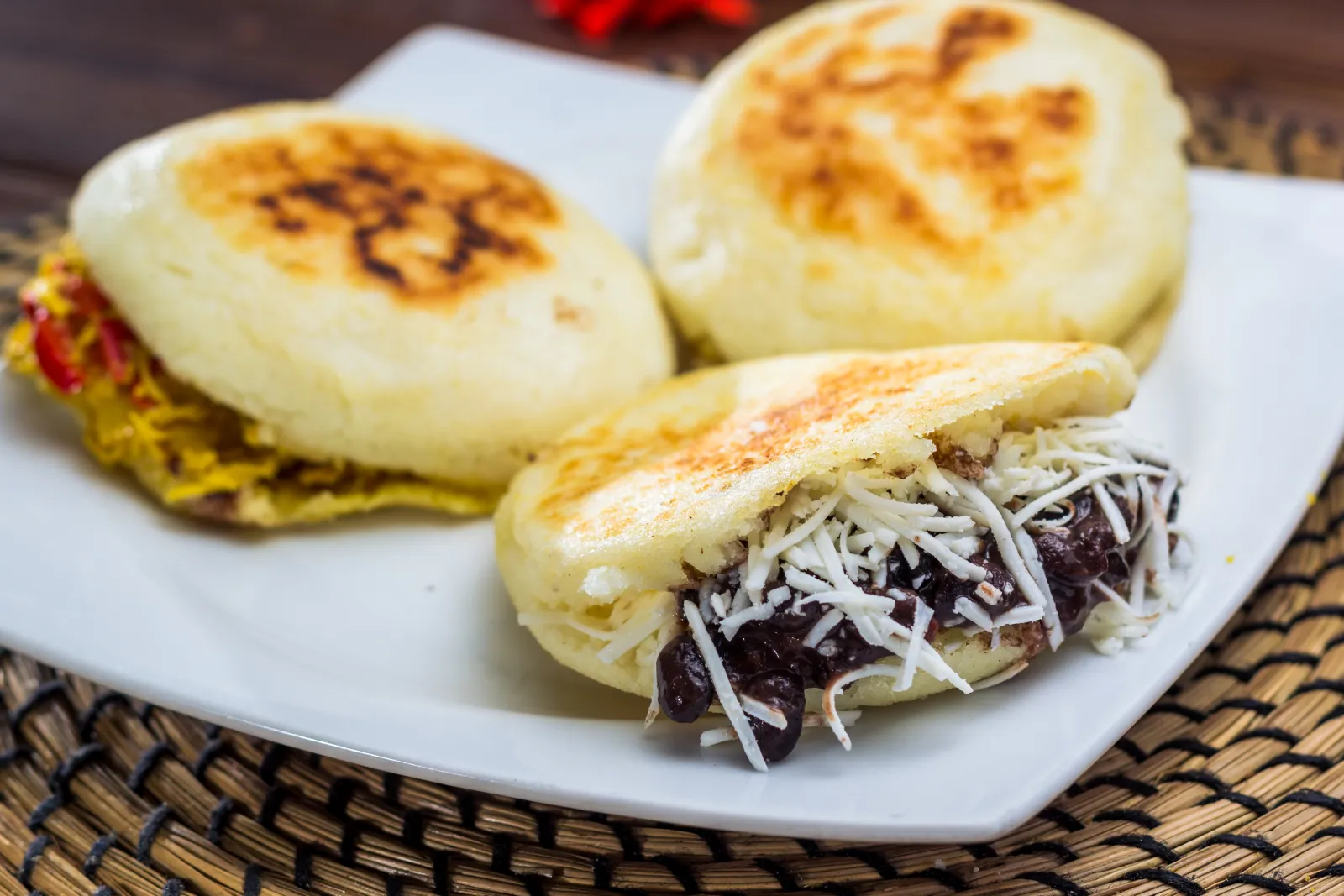

An arepa (ah-REH-pah) is a round corn cake from Venezuela and Colombia, made from nothing but a special corn flour, water and salt. The Venezuelan kind is thick, about ¾ inch (2 cm), with a thin toasted crust and a soft middle, and you eat it the way you’d eat a pita: split open along the side and stuffed with black beans and cheese, scrambled eggs, shredded beef or chicken salad. I’m Venezuelan, I’ve lived in Colombia for years, and this is the arepa I make most mornings. Below is the dough ratio I use, the one test that tells you it’s cooked inside, and what to do if all you can find is masa harina.
What are arepas, and who are they for
How do you make arepas? Dissolve 10 g (2 tsp) of salt in 650 ml (2¾ cups) of warm water, add 500 g (3½ cups) of pre-cooked corn flour such as P.A.N., knead 2 to 3 minutes and rest 5. Shape 8 discs of 5 oz (145 g), ¾ inch (2 cm) thick, sear them 5 minutes a side on a griddle and bake 15 minutes at 350°F (180°C), until they sound hollow when tapped. 50 minutes for 8 servings.
Arepas are everyday bread in Venezuela, not a special-occasion dish. For generations the dough was made from corn that had to be soaked, hulled and pounded by hand. Since 1960, when Empresas Polar launched P.A.N., most homes use bagged pre-cooked flour, and the dough is ready in 8 minutes with no yeast and no rising.
They’re a good fit if you want a gluten-free bread you can make from scratch on a weekday, a breakfast that lets everyone build their own, or a brunch for a crowd, since nearly everything can be done the day before. They’re not the right recipe if you want something thin and crisp to eat plain; for that, look at the Venezuelan fried arepas that puff up in the oil, which are only ¼ inch (7 mm) thick.
Time and effort. 50 minutes, about 30 of them hands-on, for 8 arepas. Difficulty is easy. The two things that go wrong are a dough that’s too dry, which you fix a spoonful of water at a time, and pulling arepas from the oven before they’re cooked in the middle.
The one ingredient that matters, pre-cooked corn flour
You need pre-cooked corn flour, and nothing else will do. It’s corn that has been cooked, dried and ground, which is why it turns into a dough with warm water alone. On a shelf it goes by several names: P.A.N. (the Venezuelan brand), masarepa (Goya’s name for it), harina precocida, or brands like Juana and Donarepa. Confusingly, the US bag of P.A.N. says “pre-cooked white corn meal.” That’s the right product; the words “pre-cooked” are what matter.
Why masa harina doesn’t work. Masa harina, the flour for Mexican tortillas, is made from corn treated with lime (nixtamalized). It’s a fine product, just a different one, and the dough it makes isn’t an arepa dough. Why cornmeal doesn’t work. Ordinary cornmeal and polenta are raw corn. The starch hasn’t been cooked, so it won’t absorb warm water and bind; the patty falls apart.
Where to buy it.
- In the US, P.A.N., Juana and Donarepa are in the Latin or international aisle of Walmart and most large supermarkets, and Goya Masarepa sits with the Goya products. Bags are usually 2.2 lb (1 kg), and P.A.N. also comes in 5 lb (2.27 kg) bags.
- In the UK, look in Latin American grocers or order online; P.A.N. comes in 1 kg bags.
- White or yellow? White is the everyday arepa. Yellow takes the same amount of water and gives a more golden, slightly sweeter arepa.
Ingredients and tools, with US and metric measures
| Ingredient | Metric | US | Why |
|---|---|---|---|
| Pre-cooked white corn flour | 500 g | about 3½ cups | the whole structure |
| Warm water, 104°F (40°C) | 650 ml | 2¾ cups | 1.3 ml per gram of flour |
| Fine salt | 10 g | 2 tsp | flavor; dissolve it in the water first |
| Oil for the dough (optional) | 15 ml | 1 tbsp | slightly softer crumb |
| Oil for the griddle | 10 ml | 2 tsp | stops the first batch sticking |
Weighing the flour is more reliable than cups, because a cup of corn flour can hold more or less depending on how you scoop it. That’s also why bag instructions in cups make a softer dough than my ratio; both work if you adjust by feel.
Tools. A budare is the traditional round iron griddle, but a cast-iron or heavy nonstick skillet of 10 inches (26 cm) holds 4 arepas of 4 inches (10 cm) just as well. You also need a mixing bowl, an oven and a serrated knife for splitting.
How to make arepas, step by step
Getting the dough right
I use 1.3 ml of water for every gram of flour: 650 ml (2¾ cups) for 500 g. That’s a firm dough that holds a ¾-inch (2 cm) patty without slumping. Keep 3 to 4 tablespoons of the water back, because flours absorb differently from brand to brand and with the humidity in your kitchen.
Warm water, around 104°F (40°C), comfortable to hold a finger in, hydrates the flour faster than cold. The salt goes into the water before the flour so it’s evenly spread.
Then the only test that counts: press a ball flat between your palms. Cracks at the edge mean it needs water. Sticky hands mean it needs flour. When it’s right, it feels like soft modeling clay and the edge of the disc stays smooth.
Why they finish in the oven, and the hollow knock
A ¾-inch (2 cm) arepa is too thick to cook through on the griddle. Over medium heat the crust browns in 5 minutes a side; turn the heat up to hurry it and the outside burns while the middle stays raw. Fifteen minutes on the rack of a 350°F (180°C) oven cooks the inside gently and the arepa puffs a little.
To check, take one out and knock on it with a knuckle. A hollow sound, dry and empty, means it’s done. A dull thud means the center is still damp; give it 3 to 4 more minutes. Split one if you’re unsure: raw dough sticks to the knife.
What to look for at each stage.
| Stage | What you want |
|---|---|
| Dough, after 5 min | a flattened ball doesn’t crack at the edge |
| Disc | 4 in (10 cm) wide, ⅝ to ¾ in (1.5 to 2 cm) thick, smooth edge |
| Griddle, 5 min a side | releases on its own, toasted spots |
| Oven, 15 min | slightly puffed, sounds hollow |
No oven, or using an air fryer
- Skillet only → medium-low heat, 8 to 10 minutes a side, with a lid over the pan for the last 5 so the steam helps cook the middle. The crust comes out thicker and harder.
- Air fryer → brush with oil, 400°F (200°C) for 16 minutes, flipping at 8. Three or four fit in a basket.
- Oven only → for a big batch, on a lined sheet pan at 400°F (200°C) for 25 minutes, flipping halfway. You lose the griddle spots but bake 16 at once.
Mistakes that ruin arepas
- Cracked edges → the dough is too dry. Add water a tablespoon at a time and smooth the edges with wet fingers. A crack is where moisture escapes, and the arepa dries out.
- Raw, pasty middle → griddle only, on high heat. Medium heat, 5 minutes a side, then 15 in the oven.
- Stuck to the pan → the pan wasn’t hot, or you flipped too early. It lets go by itself when the crust has formed.
- Hard as a rock → too long in the oven or too little water. More than 20 minutes at 350°F (180°C) dries them out.
- Tastes of nothing → not enough salt. 10 g (2 tsp) per 500 g of flour makes an arepa that tastes good on its own.
- Tears when you split it → it was cold, or the knife was straight-edged. Split it hot, with a serrated knife, through the side.
Spice level, 0 out of 5. Arepas aren’t spicy; heat, if you want it, comes from the filling or a sauce.
Kids. Nearly always a hit. They’re mild, hand-held and work with simple fillings like grated cheese or butter. Let a split arepa cool for a couple of minutes first, because the steam inside is hot.
Allergens. The arepa itself is corn, water and salt: no gluten, egg, dairy or nuts. If you’re cooking for someone with celiac disease, check that the bag says gluten-free, as most pre-cooked corn flours do. Allergens come in with the fillings, dairy in cheese and egg in scrambled eggs and mayonnaise.
Thick or thin, and what to stuff them with
The same flour makes very different arepas, and thickness is most of the difference.
The Venezuelan arepa is the thick one you split and stuff. Colombian arepas are usually thinner, ⅜ to ⅝ inch (1 to 1.5 cm), cooked in a skillet and eaten whole, often with cheese worked into the dough, like my Colombian cheese arepas. On the Caribbean coast of Colombia there’s also the arepa de huevo, fried with a whole egg inside.
The classic Venezuelan fillings, with what I’d use from a US or UK supermarket:
| Name | What’s inside | Supermarket swap |
|---|---|---|
| Dominó | Venezuelan black beans and grated hard white cheese | feta or cotija for the white cheese |
| Perico | eggs scrambled with tomato and onion, like huevos pericos | none needed |
| Pelúa | shredded beef and coarsely grated yellow cheese | mild cheddar or gouda |
| Catira | shredded chicken and yellow cheese | rotisserie chicken, mild cheddar |
| Reina pepiada | chicken, avocado and mayo, 4-3-1 by weight; see the reina pepiada arepa | rotisserie chicken works |
| Rumbera | roast pork and cheese | leftover pork shoulder |
I count on about 3½ oz (100 g) of filling per 5 oz (145 g) arepa; a reina pepiada takes more, around 5 oz (150 g). An ounce (30 g) of grated cheese is already breakfast.
How many arepas per bag, and cooking for a crowd
A 2.2 lb (1 kg) bag makes about 5.2 lb (2.35 kg) of dough, which is:
- 16 stuffing-size arepas of 5 oz (145 g)
- 23 breakfast arepas of 3½ oz (100 g)
- 39 party-size arepitas of 2 oz (60 g), about 2½ inches (6 cm) across
For breakfast I plan on 1½ arepas per adult and 1 per child.
Scaling. Nothing changes but the amounts: per 1 kg (2.2 lb) of flour, 1.3 liters (5½ cups) of warm water and 20 g (4 tsp) of salt.
My plan for 20. The night before, I make the dough in two 1 kg batches and sear every arepa on the griddle, 5 minutes a side, then cool them and bag them in the fridge. In the morning the oven goes to 350°F (180°C) and they bake for 20 minutes on two sheet pans while I warm the fillings. They stay hot for about 20 minutes in the switched-off oven with the door closed. Searing 30 arepas on one griddle is 8 batches of 10 minutes, which is exactly why I do it the day before, or use two pans at once.
What arepas cost
The arepa is the cheap part; the filling is the bill. In Bogotá, at wholesale prices in mid-September 2026, 8 plain arepas cost about 2,470 Colombian pesos, around 309 pesos each. Add an ounce (30 g) of cheese to each and the cheese becomes 71 % of the total.
In the US, at September 2026 average prices, cheddar was $6.133 a pound, so 8½ oz (240 g) for 8 arepas costs about $3.25, roughly 41 cents per arepa. A dozen large eggs averaged $2.27, under 20 cents an egg for perico. I don’t give a figure for the corn flour because prices vary too much by store and pack size.
Storing, freezing and reheating
Fridge. Cooked arepas can sit out 2 hours at most; in a sealed bag in the fridge they keep 3 to 4 days at 40°F (4°C) or below. Store them unfilled and keep the filling separate.
Freezing raw discs. Shape them, separate with parchment and freeze flat on a tray for 1 to 2 hours, then bag them. They keep well for about a month. Thaw overnight in the fridge and cook as if fresh; straight from frozen, the crust browns before the middle thaws.
Freezing cooked arepas. Seared and baked, cooled and bagged, also about a month in my experience. At 0°F (−18°C) they stay safe much longer, but they dry out after that.
Reheating. Oven at 350°F (180°C) for 10 to 12 minutes from the fridge or 20 from frozen, or an air fryer at 350°F (180°C) for 6 minutes. The microwave turns the crust soft and rubbery. Hot fillings like beans or shredded beef should reach 165°F (74°C) before they go in.
Arepa questions people ask
What is the ratio of water to flour for arepas? I use 1.3 ml of warm water per gram of pre-cooked corn flour: 650 ml (2¾ cups) for 500 g (3½ cups), with 2 tsp of salt. Hold back a few tablespoons and add them if the edges crack.
Can I use masa harina or cornmeal instead of masarepa? No. Masa harina is lime-treated corn for tortillas and cornmeal is raw corn; neither makes an arepa dough. You need pre-cooked corn flour such as P.A.N. or Goya Masarepa.
How do I know when arepas are done? Knock on one: a hollow sound means the inside is cooked. A ¾-inch (2 cm) arepa needs 5 minutes a side on the griddle and 15 minutes at 350°F (180°C).
Why are my arepas cracking? The dough is too dry or didn’t rest for 5 minutes. Add water a tablespoon at a time and smooth the edges with wet fingers.
Can I make arepas without an oven? Yes. Cook them in a skillet over medium-low heat, 8 to 10 minutes a side, with a lid for the last 5, or in an air fryer at 400°F (200°C) for 16 minutes.
How many arepas does a bag of P.A.N. make? A 2.2 lb (1 kg) bag makes about 16 stuffing-size arepas, 23 breakfast-size or 39 small party arepitas.
Can you freeze arepa dough? Freeze shaped raw discs separated by parchment for about a month, then thaw overnight in the fridge before cooking.
Are arepas gluten-free? Yes, they’re corn, water and salt. Check that the flour bag is labelled gluten-free if you’re cooking for someone with celiac disease.
Nutrition per arepa
Per 5 oz (145 g) arepa, unfilled, worked out from the quantities in this recipe (62.5 g of flour per arepa, all the oil and the full 10 g of salt):
- Calories: 257 kcal
- Protein: 4 g
- Carbohydrates: 50 g
- Fat: 4 g, mostly from the oil
- Fiber: 2 g
- Sugars: 1 g
- Sodium: 489 mg
An ounce (30 g) of hard white cheese adds about 93 kcal and 211 mg of sodium. Skipping the optional oil in the dough saves about 15 kcal per arepa.
In Venezuela I made arepa dough by eye and never measured the water. I only started measuring in Colombia, after switching brands of flour and getting a tray of cracked arepas, and it taught me that the number is a starting point and the flattened ball between my palms is the real test. The other thing I never skip is the knuckle knock when they come out of the oven. My son Dylan has taken that job over; he likes hearing them sound hollow. Josnaisis.