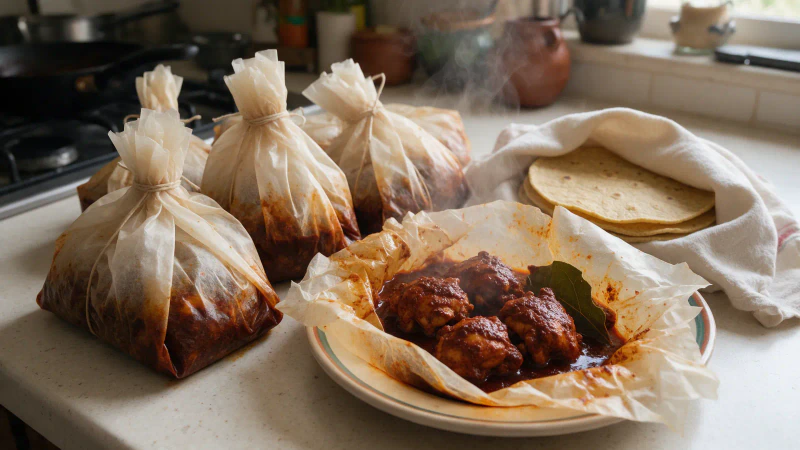
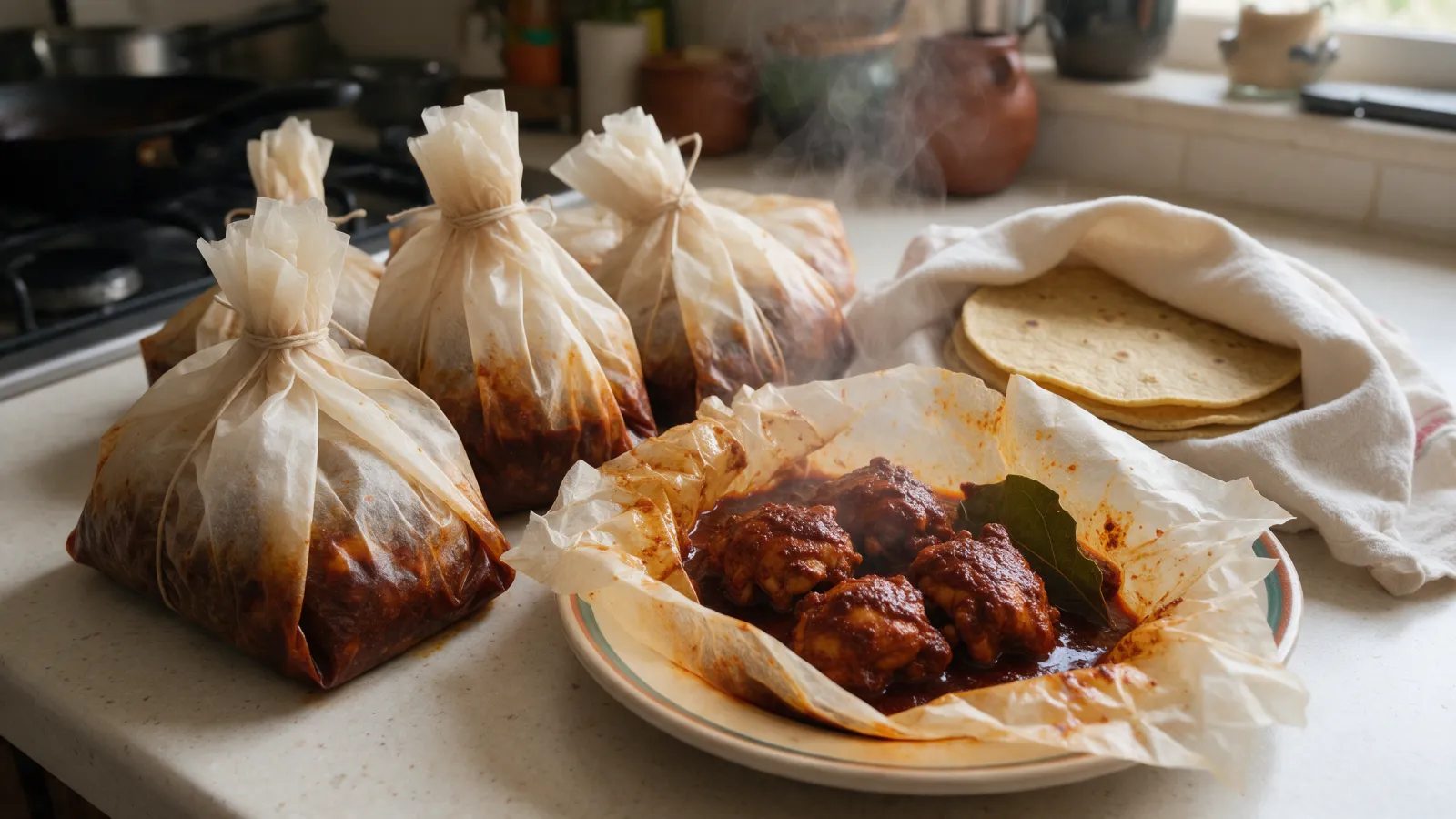

Mixiotes reach the table as 6 paper sacks tied with kitchen twine, one on each plate, and nobody has to serve anybody. Snip one open and a cloud of chile-scented steam comes out, followed by a chicken thigh and drumstick sitting in a brick-red sauce that soaked into the meat for hours. That is a mixiote (mee-shee-OH-teh): meat marinated in a dried-chile adobo, sealed in a parcel and steamed, a dish of central Mexico. The name belongs to the wrapper, not the filling. This version uses chicken, parchment and foil, a regular stockpot and a thermometer, and it scales from 6 to 30 people.
What are mixiotes, and who are they for?
How do you make chicken mixiotes? Blend 8 toasted guajillo and 3 ancho chiles with garlic, onion, vinegar and spices, marinate 2.1 kg (4.6 lb) of bone-in thighs and drumsticks in it for 4 hours, then tie each portion into a paper parcel with cactus strips, bay and avocado leaves. Steam 90 minutes, until the meat reads 165°F (74°C) by the bone. Ready in 400 minutes, about 55 of them hands-on, for 6 servings.
The word. In Nahuatl, metl is maguey (the agave plant) and xiotl is the thin film on its leaf. That film, peeled from the leaves of the pulque agave, was the original wrapper. Stripping it removes the leaf’s breathing pores and kills the plant, so home cooks in Mexico now mostly use a purpose-made mixiote paper, and cooks abroad use parchment.
Who will love it. Anyone who likes slow-cooked chicken with deep chile flavor and little heat, and any host who wants a main course that can be assembled the day before, steamed unattended and served in individual portions. It travels well, too: the parcel is its own container.
Who might not. If you want crisp skin, roast Mexican adobo chicken instead; steam doesn’t brown anything. If you decide at 6 pm what’s for dinner, this needs at least 4 hours of marinating first.
Real time. 400 minutes from dry chile to table, but only about 55 of that is work. With the marinade done the night before, dinner day is 20 minutes of wrapping plus 105 minutes of pot time.
Difficulty, honestly medium. No step is hard. The two things that take a little practice are tying a parcel that doesn’t leak and keeping the steamer from boiling dry.
Ingredients, substitutions and where to find them in the US and UK
The recipe card has the exact quantities: 4.6 lb (2.1 kg) of chicken, 11 dried chiles, ¼ cup (60 ml) vinegar, 3 cactus paddles and 6 wrappers for 6 parcels. Most of the list is ordinary supermarket shopping. These are the ingredients an anglo kitchen may need to hunt down or swap:
| Ingredient | What it is | Where to buy | If you can’t find it |
|---|---|---|---|
| Guajillo chile | long, smooth, dried red chile; fruity, mild | Hispanic aisle in large US supermarkets; online Mexican shops in the UK | dried New Mexico or California chiles, a lighter, less sweet adobo |
| Ancho chile | dried poblano; wrinkled, almost black, sweet with a raisin note | same as guajillo | pure ground ancho or guajillo (only chile on the label), not chili powder blend |
| Dried avocado leaves | anise-scented leaves sold for cooking | bags next to Mexican spices, or online | leave them out and keep the bay leaf |
| Nopales | cactus paddles | fresh in bags at Latin grocers in the US; in jars in the UK | 300 g (10.5 oz) zucchini (courgette) sticks, without the slight slipperiness of cactus |
| Mixiote paper | 31 cm (12 in) sheets made for the job | Mexican grocers | parchment (baking paper) with a foil jacket |
The chicken. Bone-in thighs and drumsticks, skinned. Dark meat stays moist through 90 minutes of steam, and the bone flavors the sauce. The skin comes off because steam won’t render or crisp it; it just floats as fat in the parcel. Breast dries out: if you must, use bone-in and check those parcels first.
Chile ratio. 8 guajillos to 3 anchos for 4.6 lb (2.1 kg) of chicken, a bit more chile per pound than an oven-roasted adobo, because here the marinade is also the sauce. For more heat, blend in one chile de árbol or a dried chipotle.
Mixiote paper vs parchment vs foil
The traditional maguey membrane gives a flavor no paper copies: its waxy fats melt into the meat as it steams. It’s also hard to source legally. In the Mexican state of Tlaxcala, for instance, authorities can declare closed seasons on harvesting it, and storing or transporting it without proof of legal origin is a fineable offense. If someone sells it to you, ask where it came from.
My choice outside Mexico is parchment against the meat and foil outside. Parchment doesn’t seal on its own, foil does, and the vinegar in the adobo never touches the metal. Foil alone works, though acid in direct contact with foil can leave a metallic taste. Frozen banana leaves, the same ones used for cochinita pibil, seal well when folded and add their own grassy aroma.
Equipment, and a steamer you can build
An 8 to 10 liter (8 to 10 quart) stockpot with a lid and a steamer rack, a heavy skillet, a blender, kitchen twine and an instant-read thermometer. No steamer rack? Scrunch three balls of foil in the bottom of the pot, set a heatproof plate upside down on them and keep the water below the plate. No thermometer? Pierce next to the bone: juices should run clear and the meat should come away by itself.
Make-ahead plan and timeline
400 minutes on the clock, about 55 of them hands-on. Skinning the chicken fits inside the chile soak, the 4 hours in the fridge are free time, and so are the 90 minutes of steaming, apart from listening for the coin.
- The night before → toast, soak and blend; coat the chicken and refrigerate it overnight. Cut the cactus and keep it covered.
- On the day → 20 minutes of wrapping and tying, then the pot. Cook rice and beans while it steams.
- For a party → tie the raw parcels the day before and refrigerate them on a sheet pan. Raw chicken keeps 1 to 2 days in the fridge counted from purchase, marinating time included.
Marinating, safely. At least 4 hours, ideally overnight, never more than 24, always in the fridge at 40°F (4°C) or below and in glass or plastic, not an aluminum dish. Under 4 hours the chicken tastes boiled inside; much longer and the vinegar turns the surface mealy. Don’t rinse raw chicken: it splashes bacteria around the sink. Pat it dry instead. Leftover marinade goes inside the parcels, where it cooks, never to the table raw.
How to tie mixiotes so they don’t leak
- Wrapper inside a bowl → the bowl holds the sauce while you build and gives you a round parcel that stands on its own.
- Leaves first, then chicken, then sauce → bay and avocado leaf underneath, chicken and cactus on top, about 5 tablespoons of adobo over everything.
- Gather and twist → lift the four corners and twist the paper two or three times right above the meat, like the neck of a sack. The less air inside, the less juice escapes.
- Two turns of twine, double knot → about 20 in (50 cm) of twine per parcel, with 1¼ in (3 cm) of paper above the knot to grab it by.
- Foil jacket for parchment → bring the foil up around the bundle and crimp it shut above the knot.
Steaming time, pressure cooker and doneness
90 minutes over medium-low, counted from when the water boils with the parcels in. Chicken is safe at 165°F (74°C) next to the bone. I still give it the full 90 minutes because I want more than safe: I want the thigh to let go of the bone, and that happens past about 175°F (80°C).
In a pressure cooker or Instant Pot, set the rack over 2 cups (500 ml) of water, stand the parcels on it clear of the water and cook 20 to 25 minutes at pressure, counted from when the valve starts releasing steam, then let it release naturally for 10 minutes. Check the middle parcel for 165°F (74°C). If they don’t fit upright without crowding, do two batches. The meat comes out tender; the sauce inside is a little thinner.
Always check the parcel in the middle of the pot. It heats last.
Mistakes that ruin mixiotes
- Bitter sauce → chiles toasted too long or soaking water in the blender. 20 to 30 seconds a side over medium heat, fresh water for blending.
- The parcel opened in the pot → loose knot or too much sauce. Twist before tying, double knot, no more than about 5 tablespoons of adobo.
- Water got inside → too much water in the pot or parcels lying down. 1.5 in (4 cm) below the rack, parcels standing.
- Scorched pot → the water boiled away. Keep the coin rattling and top up with boiling water, never cold, which stops the steam.
- Red outside, bland inside → short marinade or no slashes. 4 hours minimum and 2 cuts per piece.
- Watery sauce → slimy cactus or skin left on. Drain the cactus strips and skin the chicken.
Heat level, 1 out of 5. Guajillo and ancho without seeds and veins are mild. Kids usually love it, but open their parcel for them, the steam is scalding, and remove the bay leaf. Allergens: none of the major ones; corn tortillas are gluten-free if they’re 100 percent corn. Check labels on chile powders or canned chipotles if you use them.
Variations, from pork and lamb to a crowd of 30
- Short on time → pressure cooker, 20 to 25 minutes. The 4-hour marinade has no shortcut.
- Pork → shoulder or ribs in 2 in (5 cm) chunks with the same adobo. It takes much longer than chicken: pork is safe at 145°F (63°C) with a 3-minute rest, but it only shreds once the collagen melts, around 195-205°F (90-95°C). Steam until a fork pulls it apart.
- Lamb or mutton → with rabbit, the classic meats of central Mexico’s mixiotes. Leg or shoulder chunks, cooked by texture like the pork.
- Lighter → bone-in, skinless breast; check those parcels earlier.
- Vegetarian → large pieces of mushroom, cactus and ¾ in (2 cm) potato cubes in the same adobo, steamed until the potato is tender when pierced.
How it differs from its cousins. Beef barbacoa steams one big bundle of beef over water that catches its juices for consommé. Cochinita pibil swaps the chiles for achiote and sour orange and goes in the oven. Adobo chicken uses almost the same chile paste but roasts uncovered for crisp skin. A mixiote is one sealed parcel per person whose sauce never reduces. And if you’ve made green chicken tamales, the steamer pot, the coin and the water depth are identical; there’s just no masa to set.
Scaling mixiotes for 20 or 30 people
Plan one parcel per person, a thigh and a drumstick, about 12 oz (350 g) of bone-in chicken. Steaming time depends on how long heat takes to reach the middle parcel, not on the count: with a full pot, check that one and add 15 minutes if needed.
| Guests | Bone-in chicken | Guajillo / ancho | Vinegar | Cactus | Tortillas |
|---|---|---|---|---|---|
| 6 | 2.1 kg (4.6 lb) | 8 / 3 | 60 ml (¼ cup) | 300 g (10.5 oz) | 18 |
| 12 | 4.2 kg (9.3 lb) | 16 / 6 | 120 ml (½ cup) | 600 g (1.3 lb) | 36 |
| 20 | 7 kg (15.4 lb) | 27 / 10 | 200 ml (¾ cup + 1 tbsp) | 1 kg (2.2 lb) | 60 |
| 30 | 10.5 kg (23.1 lb) | 40 / 15 | 300 ml (1¼ cups) | 1.5 kg (3.3 lb) | 90 |
Feeding a crowd that size means a big tamale steamer or several tall pots running at once, and blending the adobo in batches. Tie the parcels the day before. Once cooked, hold them in the steamer on the lowest heat at 140°F (60°C) or above, and never more than 2 hours off the heat.
What mixiotes cost
In the US, with the August 2026 national average for bone-in chicken legs at $1.670 a pound, 4.6 lb of chicken costs $7.73. Add a $2.49 bag of nopales and the onion and garlic and the total is $10.68, about $1.78 per parcel, before chiles, which are sold by the bag and vary by store. For 20 guests the chicken alone is $25.77; for 30, $38.66.
What drives the price. The chicken, by far. Switching to breast pushes it up: the US average for boneless breast was about two and a half times the price of bone-in legs. In Mexico City wholesale markets in October 2026, the 11 chiles in this recipe cost under 15 pesos while the chicken cost 90.
Real yield. 6 two-piece parcels, a main course each with rice and beans. With one piece per parcel, the same 4.6 lb make 12 smaller mixiotes for a table with other dishes.
Serving, storing and reheating
What you’ll taste. Steam with dried chile and bay as the string comes off, meat that slides off the bone, a thick red sauce mixed with chicken juices and soft, slightly tart cactus. More savory and tangy than hot.
How to serve them. Closed, on the plate, with warm corn tortillas for making tacos at the table. Mexican red rice and frijoles de la olla on the side, and a bowl of tomatillo salsa verde for anyone who wants heat. Extra cactus? A cold nopales salad makes a good starter.
Fridge. No more than 2 hours at room temperature, then 3 to 4 days in the fridge at 40°F (4°C) or below. They keep fine in their closed parcels.
Freezer. Cooked parcels keep their quality 2 to 6 months. I freeze them cooled, still wrapped, each in its own bag, and thaw them overnight in the fridge.
Reheating. Steam the closed parcels 15 to 20 minutes, until 165°F (74°C) in the center. In the microwave, take off the foil, cover the plate and heat in 1-minute bursts, stirring between them. The oven dries them out if they open.
Mixiotes FAQ
What is a mixiote? A Mexican dish of meat marinated in dried-chile adobo, sealed in a parcel and steamed. The name comes from the film peeled off agave leaves that was the original wrapper; today it’s usually paper.
What can I use instead of mixiote paper? Parchment (baking paper) around the meat with a square of foil outside to seal it. Foil alone works, but the vinegar in the adobo can taste metallic where it touches.
How long do you steam chicken mixiotes? 90 minutes over medium-low heat for bone-in thighs and drumsticks, until 165°F (74°C) next to the bone. In a pressure cooker, let the pressure come down naturally for 10 minutes after 20 to 25 minutes at pressure.
Can I make mixiotes in an Instant Pot? Yes. Put the rack over 2 cups (500 ml) of water, stand the parcels on it, cook 20 to 25 minutes at pressure and release naturally for 10.
How long should the chicken marinate? Overnight in the fridge is ideal. Don’t go past a full day, and don’t go under 4 hours.
Are mixiotes spicy? Mildly. Guajillo and ancho with seeds and veins removed rate about 1 out of 5. Add a chile de árbol for more.
Can I make mixiotes ahead? Yes. Marinate the chicken the night before, or tie the raw parcels a day ahead and refrigerate them. Cooked parcels keep 3 to 4 days in the fridge and 2 to 6 months frozen.
How many mixiotes per person? One two-piece parcel, about 12 oz (350 g) of bone-in chicken. For 20 people, 15.4 lb (7 kg); for 30, 23.1 lb (10.5 kg).
Nutrition per mixiote
Per parcel (one skinless thigh and drumstick with its adobo and cactus, no tortillas), calculated ingredient by ingredient from this recipe’s quantities, counting about 1,340 g (3 lb) of edible meat in 2.1 kg (4.6 lb) of bone-in pieces:
- Calories: 338 kcal
- Protein: 47 g
- Carbohydrates: 14 g
- Fat: 10 g, 2 g saturated
- Fiber: 5 g
- Sodium: 1025 mg
Three corn tortillas add about 157 kcal. Cut the salt to 1 teaspoon and sodium falls to about 640 mg; the 2 teaspoons in the adobo account for nearly all of it.
Where I grew up in Venezuela, the parcel food was the hallaca, wrapped in banana leaf and tied with cotton string, and the first time I tied a mixiote my hands knew exactly what to do. What they didn’t know was how much steam waits inside. Now I twist the neck tight, steam them standing up and always open the middle one first, thermometer ready. Josnaisis.