
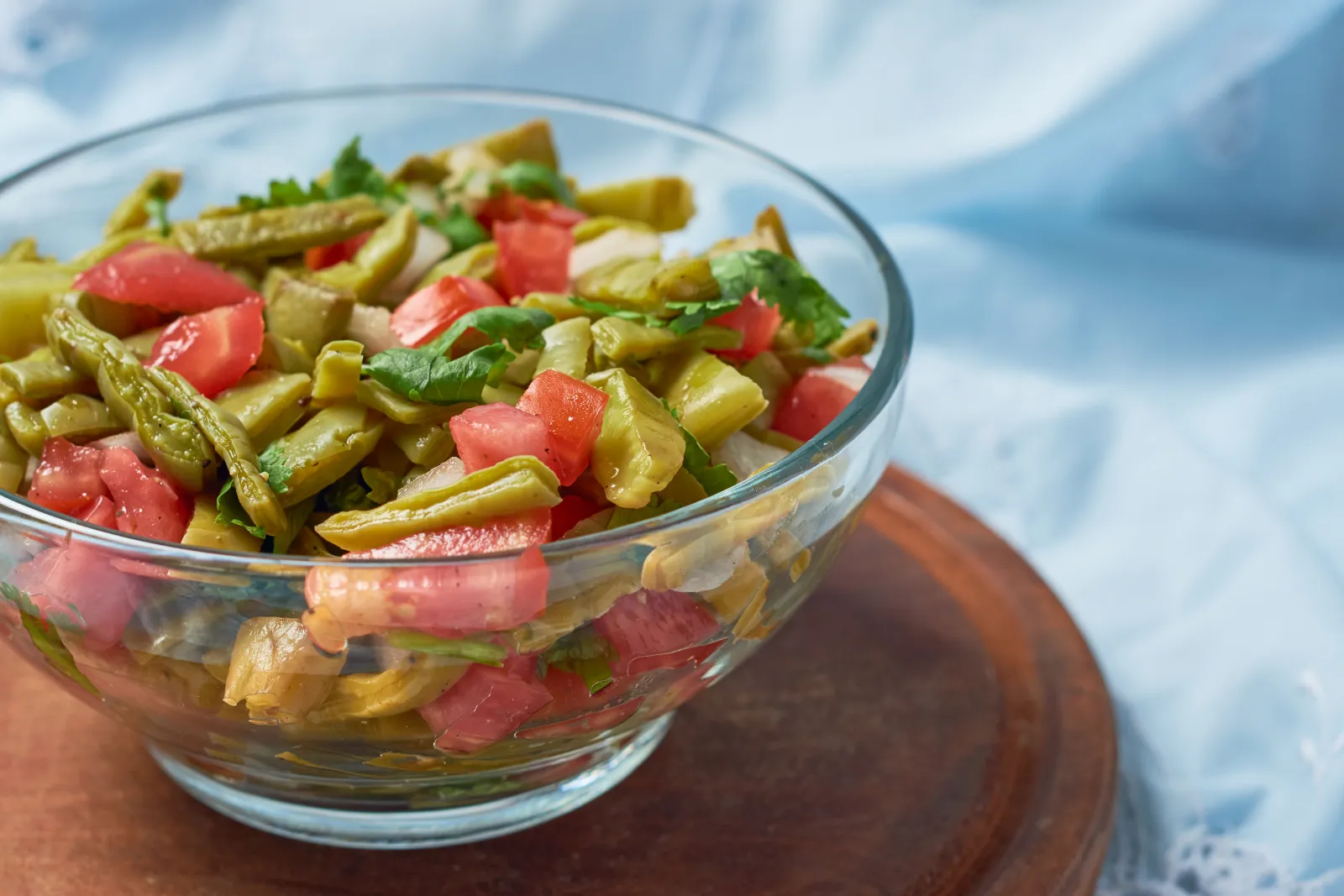

Nopales (noh-PAH-lehs) are the flat green paddles of the prickly pear cactus, Opuntia, and in Mexico they’re a vegetable like any other: sold by the hundred at wholesale markets, cut into strips and eaten in eggs, stews, tacos and this salad. Cooked, they taste a bit like green beans with a slightly tart edge. The catch is the slime. Cut a paddle and it releases a clear, okra-like gel, and most of what you’ll read about getting rid of it is folklore. Here’s the version that works, the evidence behind it, and what to do if your only option is a jar.
What is nopales salad, and how do you make it?
How do you make nopales salad? Scrape the spines off 500 g (1.1 lb) of cactus paddles, cut them into 1 cm (⅜ in) strips and simmer for 10 to 12 minutes in 1.5 liters (6 cups) of salted water until olive green. Rinse under cold water until they stop pulling threads, drain for 15 minutes, then toss with tomato, onion, serrano and cilantro in a lime, olive oil and oregano dressing, and top with queso fresco. Ready in 45 minutes for 4 servings.
Ensalada de nopales is a cold Mexican side salad, served with grilled meat, piled into tacos or spooned onto tostadas. It’s sharp, fresh and a little salty from the cheese, and it holds up on a buffet table far better than anything with lettuce.
Is it worth making? Yes, if you can get fresh paddles and want a vegetable side that can be made ahead. It’s less appealing if any slippery texture bothers you: even well-rinsed boiled cactus keeps a trace, and the grilled version later on is the one for you.
Time and effort. 45 minutes in total, about 28 hands-on. With the cactus cooked the day before, serving day takes 10 minutes. Difficulty, easy, though de-spining is slow the first time.
Buying and cleaning cactus paddles
You need 500 g (1.1 lb) of cleaned paddles, about 5 medium ones. Look for firm, bright green, young paddles 15 to 20 cm (6 to 8 in) long; the small ones, around 6 inches, are best, because large thick paddles are fibrous. Many US supermarkets with a Latin aisle sell them already de-spined, whole or cut, in 1 to 1.5 lb bags. If the pre-cut strips look thick, they came from old paddles.
The big spines are easy to see. The problem is the glochids, tiny barbed hairs that lodge in skin. The safe way is gloves, rinsing the paddle first, then scraping across it at an angle with a blunt knife until spines and glochids are gone, and finally removing each “eye” with the knife tip. Some cooks grip the paddle with tongs, trim the edge and the cut end, and scrape both faces. My way: a kitchen glove on the holding hand, the knife always moving from base to tip, and a thin stream of water running so the hairs wash off the board instead of ending up in your fingers.
Where to find nopales in the UK
Fresh paddles are rare in the UK. The practical route is jarred nopalitos from Mexican grocers or online, already cooked in brine, which brings its own problem: salt. Read the next section before you buy.
How to get rid of the slime, and what doesn’t work
The slime is mucilage, a soluble fiber the cactus releases when it’s cut and heated. There are three ways to handle it, and one popular trick to skip.
- Simmer in plenty of water, then rinse cold. The most common method in Mexico. The gel dissolves into the cooking water and a cold rinse carries off what clings. Boiled cactus can keep leaching a little as it sits, hence the 15-minute drain.
- Dry heat. Grilling whole paddles, or cooking the strips in a covered pan in their own juice and then uncovering until the liquid evaporates, drives the gel off instead of releasing it into water. Both methods virtually eliminate the stickiness.
- Acid. Cactus mucilage gets thinner in acidic conditions and much thicker in alkaline ones (pH 8 to 11), which is why the lime dressing helps.
- Skip the baking soda. It’s alkaline, which makes the gel thicker, not thinner. And table salt barely changes the viscosity, so the salt in the water seasons the cactus; it doesn’t remove the slime.
- Tomatillo husks in the pot are the trick everyone repeats. I’ve tried them and noticed no difference. Toss them in if you like; they won’t hurt.
Fresh or jarred, the sodium question
Jarred nopalitos skip the cleaning, simmering and draining, roughly 25 minutes of work. What you pay is sodium. The brand labels give 600 mg per 100 g (3.5 oz) drained for La Costeña, 915 mg for Goya and 1,080 mg for Herdez, against 20 mg for fresh cactus boiled without salt.
Swap 500 g (1.1 lb) of drained La Costeña into this recipe and a serving goes from about 470 mg of sodium to about 1,200 mg; with Herdez, about 1,800 mg, before whatever the rinse removes. If you use a jar, rinse the strips well under running water, drain them for 10 minutes, leave the salt out of the dressing and taste before adding any.
Ingredients and swaps for a US or UK kitchen
Everything else on the card is in a regular supermarket. Where it isn’t, here’s the closest swap and what changes.
| Ingredient | US | UK | What changes |
|---|---|---|---|
| Fresh nopales | Latin aisle, often pre-cleaned | Jarred nopalitos | Jar: softer, briny, 2.5 to 4 times the sodium per serving |
| Roma tomatoes | Any store | Plum or salad tomatoes | Salad tomatoes are wetter; seed them well |
| White onion | Any store | Brown onion soaked 5 minutes in cold water | Sharper raw; the cold soak softens it |
| Serrano chiles | Most stores | Green finger chillies or 1 jalapeño | Jalapeño is milder |
| Mexican oregano | Latin aisle | Mediterranean oregano, half the amount | Different aroma; half keeps it in balance |
| Queso fresco | Most stores | Mild feta soaked 10 minutes in cold water | Feta is saltier; the soak evens it out |
Equipment. A 3-quart (3-liter) pot, a large colander, a sharp knife plus a blunt one or a paring knife for scraping, tongs or a kitchen glove, and a big bowl. No colander? Spread the cooked strips on a clean tea towel; they drain just as fast.
Game plan, make-ahead and cooking for a crowd
45 minutes on the clock, about 28 of them hands-on. The chopping fits inside the simmer, and the dressing fits inside the drain.
How to tell each stage is right. A clean paddle feels smooth when you run a finger from base to tip. Cooked strips are olive green and bend without breaking; still bright green means 2 more minutes, falling apart means too long. Rinsed strips no longer form threads when you pull two apart. Ready-to-dress cactus is cold to the touch with no water pooling under the colander.
Make-ahead
Cook, rinse and drain the cactus the day before and refrigerate it at 40°F (4°C) or below, in a covered container lined with a paper towel. Spread cooked nopales out to cool quickly and completely before refrigerating, and they’ll keep for several days. Chopped onion and chile can be prepped ahead too. Leave the tomato, cilantro and dressing for the day itself.
Scaling from 4 to 20
| Servings | Cleaned cactus | Tomatoes | Onion | Serranos | Cilantro | Lime juice | Olive oil | Queso fresco |
|---|---|---|---|---|---|---|---|---|
| 4 | 500 g (1.1 lb) | 250 g (9 oz) | 80 g (2.8 oz) | 2 | 15 g (½ oz) | 30 ml (2 tbsp) | 15 ml (1 tbsp) | 80 g (2.8 oz) |
| 8 | 1 kg (2.2 lb) | 500 g (1.1 lb) | 160 g (5.6 oz) | 4 | 30 g (1 oz) | 60 ml (¼ cup) | 30 ml (2 tbsp) | 160 g (5.6 oz) |
| 12 | 1.5 kg (3.3 lb) | 750 g (1.65 lb) | 240 g (8.5 oz) | 6 | 45 g (1½ oz) | 90 ml (6 tbsp) | 45 ml (3 tbsp) | 240 g (8.5 oz) |
| 20 | 2.5 kg (5.5 lb) | 1.25 kg (2.75 lb) | 400 g (14 oz) | 10 | 75 g (2½ oz) | 150 ml (⅔ cup) | 75 ml (5 tbsp) | 400 g (14 oz) |
Oregano and dressing salt scale the same way: 1 tsp oregano and ½ tsp salt per 500 g (1.1 lb) of cactus. I never put more than 1 kg (2.2 lb) of cactus into 1.5 liters (6 cups) of water, because the water turns thick and slow to return to a boil. For 12, simmer in two batches of 750 g (1.65 lb) in 3 liters (3 quarts), changing the water between them.
Mistakes, heat level, kids, allergens and blood sugar
- Watery salad → the cactus was dressed warm or wet, or the tomatoes kept their seeds. Give it the full 15-minute drain.
- Slimy salad → no cold rinse, or undercooked. Olive green, then 2 to 3 minutes under the tap.
- Mushy cactus → over 15 minutes in the pot. Start checking at 10.
- A hair in your tongue → an eye was missed. Run a finger over both faces before slicing.
- Too salty → jarred cactus plus the full dressing salt. Dress it unsalted, then taste.
Heat level. Medium with 2 serranos spread through about 1 kg (2.2 lb) of salad. Without veins and seeds it drops a lot; with a single jalapeño it’s mild. For anyone who wants more, set out a bowl of chile de árbol salsa with roasted tomatillos on the side.
Kids. In my house the texture was the hurdle, not the flavor. Make their portion without chile and with extra cheese, and try the grilled version first, which is firmer.
Allergens. Milk, from the cheese. No gluten, egg or nuts. Without cheese, it’s vegan.
Nopales and blood sugar. There are studies, but small ones. One from 2014 gave 14 people with type 2 diabetes a high-carbohydrate breakfast with and without 300 g (10.6 oz) of steamed nopal; with the nopal, blood glucose rose less after the meal. It was a single-meal test in a handful of people, and a serving of this salad holds 125 g (4.4 oz) of cactus, under half that amount. Treat nopales as a good, high-fiber vegetable, not a treatment.
Boiled, grilled, sautéed or jarred, which to make
- No slime at all → grill the paddles whole. Brush with a little oil, salt them and cook on a grill, griddle or cast-iron pan over medium-high heat for about 4 minutes, until blotchy brown underneath, then turn and cook until completely limp; 2 or 3 fit at a time in a 30 cm (12 in) pan. Cool on a rack and slice. Firm, smoky and nearly slime-free, in about 50 minutes for 5 paddles.
- Stovetop, no water → strips in a saucepan with 1 tbsp oil, salt and sliced onion, 5 minutes covered and about 5 uncovered, until the liquid has evaporated and they start to sizzle. Spread on a plate to cool.
- In a hurry → jarred nopalitos, rinsed and drained 10 minutes, unsalted dressing: 15 minutes, softer and briny.
- Raw and crunchy → strips salted with coarse salt in a colander for 20 minutes, then rinsed thoroughly, the way cured-cactus salad is made. Crisper and tarter.
- Vegan → no cheese, plus half an avocado, about 70 g (2.5 oz), diced at the table: around 100 kcal a serving.
- Party size → the 12-serving batch, cactus cooked the day before, with cheese and cilantro in small bowls on the side so they don’t wilt in the dish.
What it costs in the US
Using advertised US supermarket prices for the week of October 9, a batch for 4 comes to about $5.41, $1.35 a serving, before cheese, oil and oregano. The bag of cleaned cactus is 46 % of that.
| Ingredient (serves 4) | Price |
|---|---|
| Cleaned nopales, 1-1.5 lb bag | $2.49 |
| Limes, 2 at $0.50 | $1.00 |
| Cilantro, 1 bunch | $0.97 |
| Roma tomatoes, 0.55 lb at $1.27/lb | $0.70 |
| White onion, 0.18 lb at $1.22/lb | $0.21 |
| Jalapeño in place of serrano, 0.03 lb at $1.45/lb | $0.04 |
| Total | $5.41 |
Serranos are priced as jalapeños, which are easier to find, and cilantro counts as a whole bunch because that’s how it’s sold. In Mexico City’s Central de Abasto, the same batch costs about 17.20 pesos at wholesale, with whole cactus paddles at 1.40 pesos each (October 9). Jarred nopalitos in the UK vary too much from shop to shop for me to give a figure.
Serving and storing
How it’s eaten. Cold or at room temperature, next to Mexican carne asada, folded into corn tortillas or piled on a tostada spread with beans. A pot of frijoles de la olla, a bowl of pico de gallo and some authentic Mexican guacamole turn it into a taco spread, and esquites bring the corn. At breakfast it sits well beside huevos a la mexicana.
Fridge. Dressed, it’s best the same day, because the tomato weeps and boiled cactus keeps releasing a little gel. Covered at 40°F (4°C) or below it keeps 3 to 4 days, the safe limit for leftovers, getting wetter each day. Undressed cooked cactus keeps better. A whole raw paddle lasts about a week in the fridge; once cut, cook it soon.
Out of the fridge. No more than 2 hours at room temperature, 1 hour above 90°F (32°C). At a cookout, nest the bowl in a larger one filled with ice.
Freezer. Not the salad: the tomato and onion collapse when thawed.
Reheating. It isn’t reheated. Straight from the fridge, let it stand covered for 15 minutes and refresh it with a squeeze of lime.
Frequently asked questions
What does nopales salad taste like? Bright and tart, with cactus that tastes like slightly tart green beans, juicy tomato, crunchy onion and salty cheese.
How do you get the slime out of nopales? Either rinse them hard under cold water after a generous simmer, until the strips stop pulling threads, or grill the paddles whole so the gel cooks off. The acid in the lime dressing finishes the job.
Do tomatillo husks really stop nopales from being slimy? There’s no evidence they do; I’ve tried them and noticed no difference.
How long do you boil nopales for salad? Until bright green turns olive green, which for strips 1 cm (⅜ in) wide takes 10 to 12 minutes once the water is back at a boil.
Can you eat nopales raw? Yes. Raw cured cactus salads salt the strips with coarse salt for 20 minutes and rinse them thoroughly. They stay crunchy and taste tarter.
Are jarred nopalitos healthy? They’re the same low-calorie vegetable, but brined: 600 to 1,080 mg of sodium per 100 g (3.5 oz) drained by brand label, against 20 mg for fresh. Rinse them and skip the salt in the dressing.
How long does nopales salad last in the fridge? Up to 4 days covered in the fridge, the end of the safe 3-to-4-day window for leftovers, though it’s at its best on day one.
Is nopales salad good for diabetes? A small study of 14 people with type 2 diabetes found 300 g (10.6 oz) of nopal eaten with a high-carbohydrate breakfast blunted the rise in blood sugar. It’s a promising vegetable, not a treatment.
How many calories are in nopales salad? About 132 kcal per 240 g (8.5 oz) serving with queso fresco and 1 tbsp olive oil for 4; about 72 without the cheese.
Nutrition per serving
Per serving (a quarter of the recipe, about 240 g / 8.5 oz), calculated ingredient by ingredient from the quantities above, using cactus boiled without salt and not counting the salt in the cooking water, which is drained away:
- Calories: 132 kcal
- Protein: 6 g
- Carbohydrates: 10 g
- Fat: 8 g, of which 3 g saturated
- Fiber: 4 g
- Sugars: 5 g
- Sodium: 470 mg
The cheese supplies 60 kcal per serving and the oil 30; the cactus itself only 19. About 290 mg of the sodium comes from the ½ tsp of dressing salt and 150 mg from the cheese, so dressing it unsalted brings a serving down to about 180 mg.
I never saw cactus on the table growing up in Venezuela, and I haven’t found fresh paddles at the markets I shop in Colombia, so my first nopales came out of a jar, and they were so salty I almost gave up on them. Rinsing the strips and dropping the salt from the dressing fixed that. With fresh paddles, my mistake was the opposite: I tossed them while still warm and served a salad floating in its own juice. These days the cactus gets cooked the night before, and the salad itself takes ten minutes. Josnaisis.