
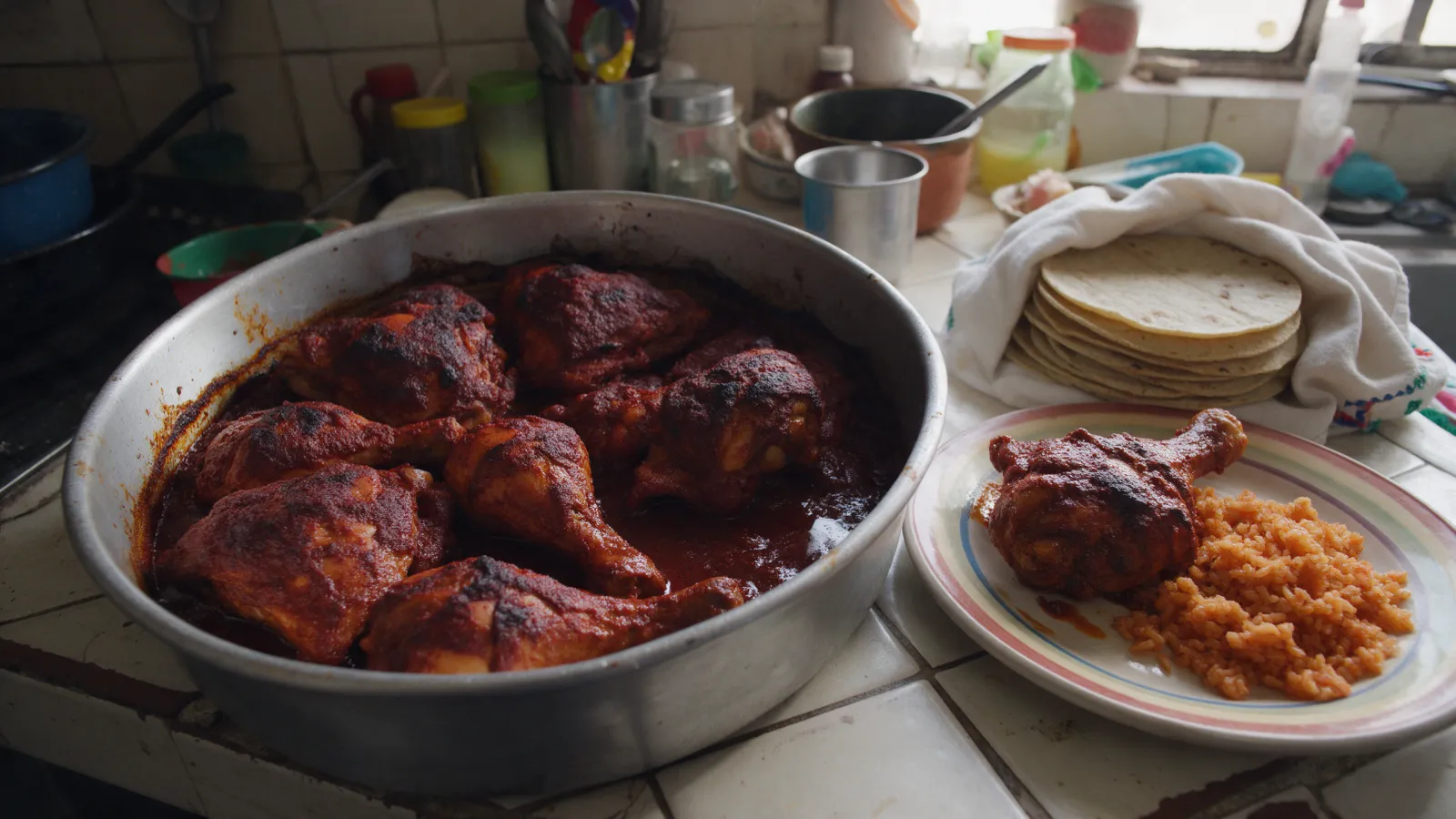

Adobo chicken can mean two very different dishes, and the better-known one in English is the Filipino braise of soy sauce and vinegar. This is the other one. Mexican adobo chicken, pollo adobado, is chicken coated in a thick red paste of dried guajillo and ancho chiles blended with garlic, vinegar and warm spices, left in the fridge for a few hours and roasted until the paste toasts onto the skin. It tastes of dried chile more than heat, it needs no special equipment beyond a blender, and once the chicken is marinated the oven does almost all the work.
What Mexican adobo chicken is, and how it differs from Filipino adobo
How do you make Mexican adobo chicken? Toast and soak 5 guajillo and 2 ancho chiles, blend them with garlic, onion, ¼ cup (60 ml) cider vinegar and spices, set ½ cup aside and rub the rest over 3 lb (1.4 kg) of bone-in thighs and drumsticks. Refrigerate 4 hours, roast at 400°F (200°C) for 25 minutes, brush with the reserved adobo and roast 15 to 20 minutes more, to 165°F (74°C). 325 minutes (40 hands-on, 4 hours marinating) for 4 servings.
In Mexico, adobo is a seasoning paste of dried chiles, vinegar, garlic, herbs and spices, used mostly on meat. Adobado simply means something marinated in it. The same word turns up in two other kitchens, and they are not the same dish:
| Mexican pollo adobado | Filipino chicken adobo | Spanish adobo | |
|---|---|---|---|
| Base | blended dried chiles, vinegar, garlic, spices | vinegar, soy sauce or salt, garlic, bay leaf, peppercorns | vinegar, salt, oregano, garlic, paprika |
| Chiles | guajillo, ancho, sometimes chipotle or pasilla | none | paprika, sweet or hot |
| Method | marinated, then roasted, grilled or braised | browned, then simmered in the vinegar until it reduces | marinated, then fried or roasted |
| Result | dark red, earthy, tangy | brown, sharp and salty | orange, garlicky |
The Filipino dish is a braise native to the Philippines that was given a Spanish name, and it uses no chiles, oregano or tomato. If you came here wanting soy sauce and bay leaves, this is a different recipe. If you came wanting the red, roasted kind you get at a Mexican family table, read on.
Is it worth making, and who it suits
Yes, if you can plan a few hours ahead. Hands-on time is about 40 minutes, most of it making the adobo. The rest is fridge and oven.
- Good for Sunday lunch with the chicken marinated on Saturday, a weeknight if you marinate after dinner the night before, or a crowd, because it scales by the sheet pan.
- Not ideal for a dinner decided at 6 pm: under 1 hour of marinating, the adobo stays on the surface.
- Heat level is mild, about 1 out of 5. Guajillo and ancho are flavor chiles, and with the seeds and veins removed the adobo is more savory than spicy.
- Difficulty is easy. The only steps needing attention are the 20 to 30 seconds of chile toasting and checking the temperature at the end.
What you need, from the chile aisle to the sheet pan
For 4 servings: 3 lb (1.4 kg) of bone-in chicken, 5 guajillos, 2 anchos, a quarter of an onion, 4 garlic cloves, ¼ cup (60 ml) cider vinegar, oil, salt and five dried spices. Exact amounts are in the recipe card.
Guajillo is a long, smooth, dark red dried chile with gentle heat; it gives the color and a tangy, fruity flavor. Ancho is a dried poblano, wrinkled and almost black, milder still, with a raisin-like sweetness that thickens the paste. Five to two for 3 lb of chicken works out to roughly one chile per 7 oz (200 g) of bone-in meat. Want it hotter? Add one chile de árbol to the blender.
Which chicken pieces, and what to ask for
Dark meat on the bone is the right cut here. Bone-in thighs and drumsticks carry enough fat and connective tissue to handle 40 to 45 minutes at 400°F (200°C) and stay juicy, and the pan juices are the best part of the dish. Breast dries out once it passes 165°F (74°C); if you prefer it, use boneless breast in the skillet version below. A whole chicken cut into 8 also works: pull the breast pieces about 10 minutes before the legs.
In the UK, “chicken thighs” and “drumsticks” are sold under those names; in Spanish-language shops in the US, ask for muslo (thigh) and pierna (drumstick).
No guajillos? Swaps and what they change
- US: guajillo and ancho sit in the Latin or international aisle of most large supermarkets and in every Mexican grocery. Dried New Mexico or California chiles are the closest stand-ins.
- UK: whole dried Mexican chiles are easiest to find online from specialist chile sellers.
- Pure chile powder: about ¼ cup (25 g) of pure ancho or guajillo powder replaces the 7 whole chiles, no toasting or soaking. Check that the label lists only chile. American “chili powder” is a blend with cumin, garlic and salt and gives a different, saltier result.
- Smoked paprika: 2 tablespoons plus a pinch of cayenne gives color and some depth, but the adobo will taste Spanish rather than Mexican.
- Canned chipotles in adobo: a smoky, much hotter sauce. One or two blended in add smoke; used as the whole base, the dish gets a lot spicier.
Equipment, and workarounds
A blender (an immersion blender in a tall jug works if you give the softened chiles a few extra minutes), a heavy skillet for toasting, a rimmed sheet pan and an instant-read thermometer. Without a thermometer, pierce the thickest part next to the bone: the juices should run clear with no pink, and the meat should pull from the bone. That is a weaker signal than a number, especially with large thighs.
How to plan it, and how to know it’s going right
The full recipe takes 325 minutes, but you only work for about 40. Do the adobo and the rub on day one, let the fridge work, and roast when you need it. With the chicken already marinated, the serving day looks like this:
Signs you’re on track:
- Toasted chile: smells sweet and toasty, blisters slightly, turns pliable as it cools. Smoke or black spots mean start again with that chile.
- Soaked chile: tears with no resistance after 15 minutes.
- Adobo: smooth, no visible skins, as thick as tomato paste thinned with a little water. If the blender stalls, add water a tablespoon at a time.
- Skin: brick red with dark, toasty edges, not burnt.
- Done: 165°F (74°C) in the thickest part without touching bone. I take thighs on to 175-185°F (80-85°C), where they turn more tender and slip off the bone.
How long to marinate, and why only in the fridge
At least 1 hour, ideally 4 to 12 hours, never more than 2 days. One hour colors and seasons the surface; from about 4 hours, the flavor reaches the bone. I stop at 24 hours, because past that the vinegar starts to make the outer layer of meat mealy.
Three food-safety rules:
- Marinate in the fridge at 40°F (4°C) or below, covered, in glass, ceramic or food-safe plastic. Never on the counter: bacteria multiply between 40 and 140°F (4 and 60°C).
- Marinade that touched raw chicken is not a sauce unless you bring it to a boil first. That is why ½ cup (120 ml) of clean adobo is set aside before the chicken goes in.
- Don’t rinse raw chicken. Washing splashes bacteria around the sink; pat it dry with paper towels instead.
Raw chicken should be cooked within 2 days of buying it, and the marinating time counts toward that.
Make ahead and scaling up
The adobo can be blended a day ahead and refrigerated, or frozen flat in a zip-top bag; I use frozen adobo within 3 months. The chicken can sit in it overnight, so on the day you only heat the oven.
Allow 12 oz (350 g) bone-in chicken per person, which is 2 pieces.
| People | Bone-in chicken | Pieces | Guajillos | Anchos | Cider vinegar | Sheet pans |
|---|---|---|---|---|---|---|
| 4 | 3 lb (1.4 kg) | 8 | 5 | 2 | ¼ cup (60 ml) | 1 |
| 6 | 4⅔ lb (2.1 kg) | 12 | 8 | 3 | 6 tbsp (90 ml) | 2 |
| 12 | 9¼ lb (4.2 kg) | 24 | 15 | 6 | ¾ cup (180 ml) | 3 |
| 20 | 15½ lb (7 kg) | 40 | 25 | 10 | 1¼ cups (300 ml) | 5 |
For a party of 20, blend the adobo in batches; most blenders take about a quarter of it at a time. A home oven fits two sheet pans at once; with both in, I swap racks halfway and add 5 to 10 minutes. For a buffet, keep finished pans covered in the oven at 140°F (60°C) or above, and don’t leave the chicken out more than 2 hours.
Before you start, mistakes, kids and allergens
Mistakes that cost the most, and the fix:
- Bitter adobo → over-toasted chiles or soaking water in the blender. Toast 20 to 30 seconds a side over medium heat and blend with fresh water.
- Gritty adobo → seeds and skins not blended out. Clean the chiles well, blend 2 full minutes, strain if your blender is weak.
- Black outside, raw inside → oven too hot or too much sugar in the paste. Stay at 400°F (200°C), middle rack, foil over the top if the edges race ahead.
- Dry meat → breast cooked as long as thighs. Pull breast at 165°F (74°C).
- Flavor only on the surface → too little time or no slashes. Two cuts per piece, 4 hours minimum for full flavor.
- Pale, steamed skin → crowded pan. Keep pieces ¾ in (2 cm) apart in one layer.
Kids. Most like it: it is mild and drumsticks are finger food. For a child who tolerates no heat at all, make their portion with ancho only and devein it carefully.
Allergens. None of the major ones: no gluten, dairy, egg, nuts or soy. If you use a commercial chile powder or canned chipotles, read the label for additives or wheat.
Oven, skillet or grill, and other versions
Oven is the method above, the easiest and the one that handles the most pieces. Two alternatives:
Skillet, with boneless meat. Use 1¾ lb (800 g) boneless thighs or breast cut into ⅝ in (1.5 cm) cutlets, in the same adobo. Scrape off the excess paste first, because it scorches on direct contact with the pan. Heat 1 tablespoon oil over medium, not high, and cook 5 to 6 minutes a side in batches of 4, to 165°F (74°C). Add the reserved adobo and ¼ cup (60 ml) water to the pan and bubble 2 minutes for a sauce. About 12 minutes of cooking.
Grill. Bone-in pieces burn over direct coals before they cook through, so set up two zones: heat on one side, none on the other. Cook the chicken over the cool side, lid down, at 350-375°F (175-190°C) for 40 to 45 minutes, turning and brushing with the reserved adobo halfway. Finish 2 to 3 minutes a side over direct heat to char the edges, to 165°F (74°C).
Other versions worth knowing:
- Short on time → boneless thighs, 1 hour in the adobo and the skillet.
- Lighter → skinless, boneless thighs: about 339 kcal a serving instead of 610 with skin.
- With potatoes → 1 lb (500 g) potato wedges under the chicken from the start, on the same pan; they pick up the red juices.
- Braised → brown the pieces, add the reserved adobo and 2 cups (500 ml) chicken stock and simmer covered on low 40 to 45 minutes, to 165°F (74°C).
- Vegetarian → the same adobo on cauliflower florets 1¼ in (3 cm) across, 25 minutes at 400°F (200°C) plus 3 to 5 more after glazing.
What it costs to make in the US
With August 2026 average US prices, the chicken, onion and garlic for 4 come to $5.42, about $1.36 a serving.
Bone-in chicken legs averaged $1.670 a pound, so 3 lb (1.4 kg) of thighs and drumsticks is $5.15, about 95 % of that total. Dried chiles, vinegar, spices and oil are not included: chile prices vary too much between a supermarket bag and a Mexican grocery to give one figure honestly. Boneless breast averaged $4.173 a pound, 2.5 times the price of bone-in legs, which is one more reason thighs are the right cut.
Yield. 8 bone-in pieces: 4 servings of 2 as a main, or 6 to 7 people with one large piece each alongside rice and beans.
What to expect, serving and leftovers
Flavor and texture. Crisp, slightly sticky, brick-red skin with dark edges, and juicy meat tasting of dried chile, garlic and vinegar. The heat is in the background. The juices left on the pan, mixed with the toasted adobo, are the sauce.
How to serve it. With Mexican red rice and refried beans, warm corn tortillas and something fresh and sharp: pico de gallo, sliced onion with lime, or guacamole. Shredded, it fills tacos and tortas.
For pork in a close cousin of this guajillo and ancho paste, Sinaloa chilorio simmers shoulder until it fries in its own fat, then cooks it nearly dry in chile and vinegar.
If you like this, try the homemade tacos al pastor, which use guajillo and ancho with achiote and pineapple, marinated 12 hours and seared in cast iron, or cochinita pibil, achiote and sour orange instead of chiles, also 12 hours in the fridge and baked at 325°F (160°C). For a braise, chicken in salsa verde is bone-in chicken and potatoes in tomatillo sauce, ready in 65 minutes.
Fridge. No more than 2 hours at room temperature, then 3 to 4 days covered at 40°F (4°C) or below.
Freezer. Cooked, it keeps best quality for 2 to 6 months. You can also freeze it raw in the adobo on the day you marinate; thaw it in the fridge overnight and the thawing doubles as marinating time.
Reheating. Covered with foil, with 2 tablespoons water in the dish, at 350°F (180°C) for 15 to 20 minutes, to 165°F (74°C); uncover for the last 5 so the skin dries. The microwave heats it fine but softens the skin.
Mexican adobo chicken FAQ
Is pollo adobado the same as chicken adobo? No. Pollo adobado is Mexican: chicken marinated in a dried-chile paste and roasted or grilled. Filipino chicken adobo is braised in vinegar and soy sauce and has no chiles.
How long should chicken marinate in adobo? Four to 12 hours in the fridge is ideal; 1 hour is the minimum and 2 days the safe maximum. I stop at 24 hours because the vinegar softens the surface.
What temperature do you bake adobo chicken at? 400°F (200°C) for 40 to 45 minutes for bone-in thighs and drumsticks, brushing at 25 minutes. It’s done at 165°F (74°C) in the thickest part.
Is Mexican adobo chicken spicy? Not very. With the seeds and veins removed, guajillo and ancho give a gentle warmth rather than real heat. A chile de árbol or chipotle raises it.
Can I use the leftover marinade as a sauce? Only if you boil it first. The easier route is to set aside clean adobo before the chicken goes in.
Is adobo sauce the same as chipotles in adobo? Not quite. Canned chipotles come packed in an adobo-style sauce, but it is smokier and much hotter than this guajillo and ancho paste.
What can I use instead of guajillo chiles? Dried New Mexico or California chiles, or ¼ cup (25 g) pure ancho powder. Smoked paprika with cayenne works in a pinch but tastes Spanish.
Can I use chicken breast? Yes. Cook boneless breast cutlets in a skillet over medium heat until they reach 165°F (74°C), about 10 to 12 minutes in total, and take them off right there.
Can I freeze adobo chicken? Yes, raw in its marinade or cooked. Cooked, it keeps best quality 2 to 6 months; thaw in the fridge and reheat to 165°F (74°C).
Nutrition per serving
Per serving of 2 pieces (about 9 oz / 262 g of raw meat and skin, plus a quarter of the adobo), counting all the skin and all the adobo:
- Calories: 610 kcal
- Protein: 48 g
- Carbohydrates: 14 g
- Fat: 40 g, including 10 g saturated
- Fiber: 5 g
- Sugars: 4 g
- Sodium: 1127 mg
Some of the skin’s fat renders onto the pan, so what you eat is a little lower. Made with 1¾ lb (800 g) skinless, boneless thighs, it drops to about 339 kcal and 13 g fat a serving. About 870 mg of the sodium comes from the salt in the adobo; cut it to 1 teaspoon and add an extra garlic clove if you are watching salt.
Back in Venezuela, Sunday chicken in my house was seasoned with garlic, cumin and onoto, so the first time I tasted a dried-chile adobo I was surprised that something so red could be so gentle. What took me longer was trusting the thermometer: with that dark color the chicken looks ready at 20 minutes and is still pink at the bone. Now I marinate it the night before, fill the little jar of clean adobo before I touch the raw meat, and don’t pull the pan until the thighs pass 175°F. Josnaisis.