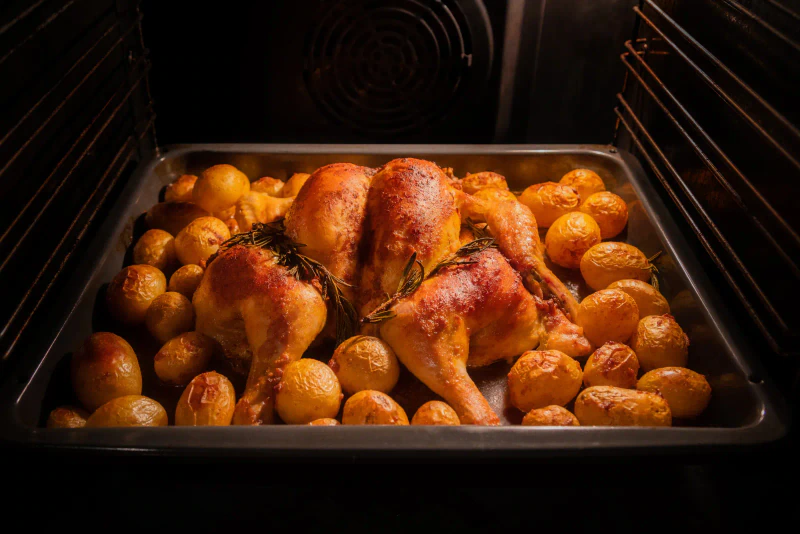
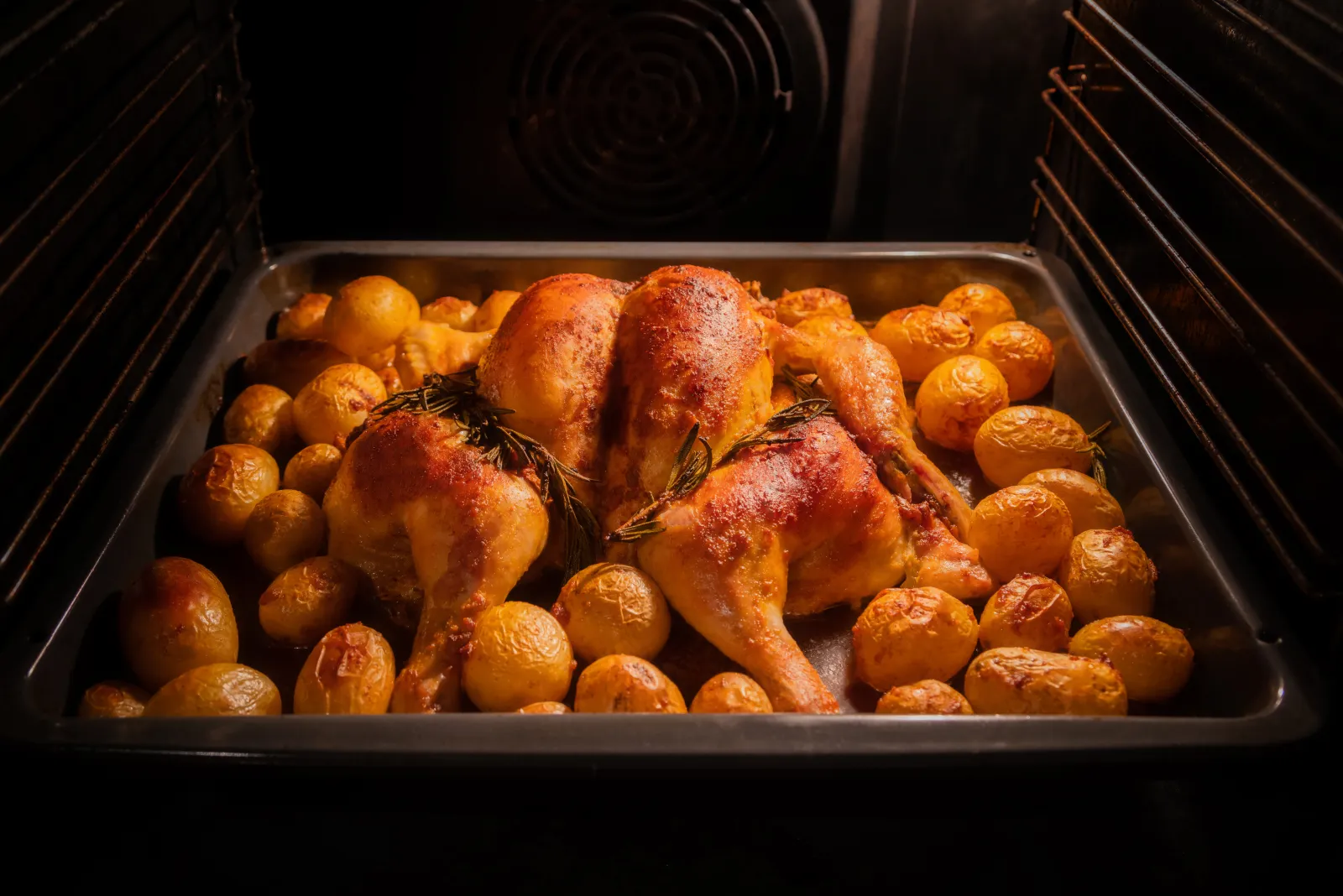

Latin roast chicken, the way it is made in Colombian and Venezuelan homes on a Sunday, is a whole bird rubbed with garlic, cumin, oregano and sour orange, roasted on a sheet pan with potatoes around it. The seasoning is close to a Cuban mojo of garlic, sour orange, cumin and oregano, and the move that matters most happens the night before: the marinade goes under the skin, the salt goes on early, and the chicken sits uncovered in the fridge so the skin dries out and crisps in a hot oven. This is my version, with exact weights, a minutes-per-pound guide and the one number that decides when it is done.
What is Latin roast chicken, and who is it for?
How do you make Latin roast chicken? Pat a 4 lb (1.8 kg) chicken dry, loosen the skin and rub a blended marinade of garlic, scallions, cumin, oregano and sour orange juice underneath, with 9 g of salt. Refrigerate it uncovered overnight, roast at 400°F (200°C), add potatoes after 25 minutes, and pull it at 165°F (74°C) in breast and thigh, about 85 minutes. Rest 15 minutes and carve. Ready in 850 minutes (30 hands-on, 12 hours in the fridge) for 4 servings.
In Spanish it is just pollo al horno, oven chicken. There is no single fixed recipe in Colombia or Venezuela; what the home versions share is the seasoning, garlic and ground cumin plus something sour, often a little annatto for color, and potatoes cooked in the same pan.
Who it suits. Anyone feeding 4 to 6 people from one pan, or 10 to 20 with two or more birds in batches. Leftovers turn into sandwiches, arepa fillings and stock.
Who it doesn’t. Cooks without an oven, or who need dinner in an hour with no planning. It still works with a 2-hour marinade, but the skin is less crisp and the flavor stays on the surface.
Real time. 850 minutes on paper, of which 720 are fridge time and 100 are oven and resting. Hands-on, about 30 minutes across two days, plus carving.
Difficulty, easy. No technique here is hard. Carving is explained step by step below, and an instant-read thermometer takes care of doneness.
Is it the same as Mexican adobo chicken? No. Mexican adobo chicken is bone-in thighs and drumsticks in a paste of dried guajillo and ancho chiles, roasted 40 to 45 minutes. This one is a whole bird with no chiles and no heat.
Ingredients, swaps and equipment
You need one 4 lb (1.8 kg) chicken, 2.2 lb (1 kg) of potatoes, an onion, garlic, scallions, sour orange or orange plus lime, cumin, oregano, pepper, oil and salt. Exact amounts are in the recipe card.
The chicken
A 3½ to 4½ lb (1.6 to 2 kg) bird roasts most evenly in a home oven, with breast and thighs reaching temperature at about the same time. Bigger roasters, 5½ lb (2.5 kg) and up, take longer and the breast tends to dry before the thighs are done. If the giblet bag is inside, pull it out and save it for stock.
Frozen? Thaw it in the fridge, never on the counter. A 4 lb (1.8 kg) bird needs about one full day, so count that day before the overnight marinade.
The mojo-style marinade, and why it goes under the skin
Six garlic cloves, two scallions, 2 teaspoons of ground cumin, oregano, black pepper and ½ cup (120 ml) of sour citrus, blended for 30 seconds. In Venezuela we call this an aliño; in Colombia, adobo. It tastes clearly of garlic and cumin without hiding the chicken.
It goes under the skin and inside the cavity, onto the meat. On top of the skin, citrus juice keeps the surface wet just when it needs to dry, and its sugar scorches before the chicken is cooked. The outside gets only salt, oil and, if you like, annatto.
No sour oranges? What to use instead
Sour orange, naranja agria, is sharp, slightly bitter and floral. In the US it shows up in Latin and Caribbean grocers, and bottled in the Latin aisle; in the UK, Seville oranges are the same fruit and appear in winter, roughly late December to February.
- Half orange juice, half lime juice, ¼ cup (60 ml) each. The closest match from any supermarket, slightly sweeter.
- Bottled sour orange, same amount. Taste for salt, since brands differ.
- Lime only, ⅓ cup (80 ml) lime with 3 tablespoons (40 ml) water. Very sharp; keep the marinade under 24 hours or the surface of the meat turns mealy.
- Orange juice only. Too sweet and not sour enough, and the skin darkens early. Add a tablespoon of white vinegar if it is all you have.
Annatto, salt and potatoes
Annatto (achiote) is for color only, turning the skin reddish gold. Look for ground annatto or achiote in the Latin or spice aisle; a teaspoon mixed into the oil is enough. Leave it out and the bird is simply golden.
Salt. The recipe uses 9 g, half a percent of the bird’s weight: 1½ teaspoons of fine table salt or 1 tablespoon of Diamond Crystal kosher salt. Other kosher salts are denser, so weigh it if you can.
Potatoes. Yukon Gold holds its shape and browns well; russets go fluffier inside. In the UK, any roasting potato such as Maris Piper works. Cut them into 2-inch (5 cm) chunks: smaller ones dry out in the 70 minutes they spend in the pan.
Equipment
A 12 x 16-inch (30 x 40 cm) rimmed sheet pan, foil and an instant-read thermometer, which does more for this recipe than any other tool. Without one, pierce where the thigh joins the body: the juices should run clear with no pink and the leg should wiggle loosely. That is a less reliable check, so for a whole bird a thermometer is worth having.
How long to roast a whole chicken, by the pound
At 400°F (200°C), plan on 20 to 23 minutes per pound, which is 45 to 50 minutes per kilo, for an unstuffed bird. That number is for planning. The chicken is done when it reaches temperature, not when the timer goes off.
| Oven | Conventional | Fan / convection | Gas mark |
|---|---|---|---|
| This recipe | 400°F (200°C) | 350°F (180°C) | 6 |
| Spatchcocked | 425°F (220°C) | 400°F (200°C) | 7 |
A very cold bird, a weak oven or opening the door often all add time. I start checking 15 minutes before the low end of the range.
Where to put the thermometer, and when it is done
165°F (74°C) is the safe internal temperature for chicken. Check it in three places: the thickest part of the breast, the inner thigh where it meets the body, and the wing joint, never touching bone, because bone reads hotter than the meat around it.
The thigh usually runs ahead of the breast. When the breast hits 165°F (74°C), the thigh is often at 175 to 185°F (80 to 85°C), which is where I like it: tender and pulling away from the bone. Sometimes the meat by the thigh bone looks pink even when it is fully cooked; trust the reading, not the color.
The plan, from the night before to the table
Hands-on time splits into 15 minutes the night before and 15 minutes on roast day. The night before, you dry, salt and season the bird. On the day, the oven does nearly everything.
Crispy skin, five habits
- Dry the bird with paper towels before seasoning, and don’t rinse it. Rinsing splashes bacteria around the sink and wets the skin.
- Marinade under the skin, not on it.
- Uncovered in the fridge, in a rimmed dish on the bottom shelf so nothing can drip onto other food.
- A hot oven, 400°F (200°C), with the bird uncovered. Foil only if it darkens early.
- Rest it loosely tented. Wrapped tight, it steams and the skin goes soft.
Marinate at least 2 hours, ideally 12, and never more than 2 days, always in the fridge. Buy the bird no more than 2 days ahead: raw chicken keeps 1 to 2 days in the fridge, marinating night included.
Why it rests for 15 minutes
Straight out of the oven, the juices are still moving. Carve right away and they end up on the board. After 15 minutes loosely tented, the meat settles and the bird is still hot. That is exactly the time the potatoes need to finish.
How to carve a roast chicken
With a large knife and a board with a juice groove, it takes me about ten minutes:
- Legs. Slice through the skin between leg and body, pull the leg outward until the joint pops, and cut through it.
- Thigh and drumstick. Skin side down, find the thin line of fat over the joint and cut along it; the knife slips through.
- Wings. Pull each wing out and cut through the joint at the body.
- Breasts. Cut down one side of the breastbone, then the other, keeping the knife against the ribs, and lift each breast off. Cut each in two or slice it.
You get 8 pieces plus the wings and a carcass for stock.
Make ahead
Everything except roasting. Peel and cut the potatoes the night before and keep them covered in cold water in the fridge; dry them well before oiling.
Feeding 10 to 20 people
Allow a quarter chicken and about 9 oz (250 g) of potatoes per person. The marinade and salt scale per bird.
| People | 4 lb (1.8 kg) chickens | Potatoes | Salt for the birds | Sheet pans | Oven rounds |
|---|---|---|---|---|---|
| 4 | 1 | 2.2 lb (1 kg) | 9 g | 1 | 1 |
| 8 | 2 | 4.4 lb (2 kg) | 18 g | 2 | 1 |
| 12 | 3 | 6.6 lb (3 kg) | 27 g | 3 | 2 |
| 20 | 5 | 11 lb (5 kg) | 45 g | 5 | 3 |
A home oven takes two chickens at once, one pan per rack. I swap the racks halfway and add 5 to 10 minutes. For 12 or 20, roast in rounds and let each round rest tented while the next one cooks. Cooked food should not sit out for more than 2 hours; to keep it hot, hold it at 140°F (60°C) or above.
Short on oven space? Spatchcocked birds, backbone cut out with kitchen shears and pressed flat, roast in 40 to 50 minutes at 425°F (220°C), so you fit two rounds in the time of one.
Mistakes to avoid, kids and allergens
- Pale, soft skin → marinade on top, the bird covered in the fridge, or a tight foil wrap while resting.
- Dry breast → roasting by the clock alone. Start checking at 70 minutes and pull at 165°F (74°C) in the breast.
- Raw potatoes or leathery ones → chunks too big or too small. Two inches (5 cm), into the pan after 25 minutes.
- Burnt breast skin → citrus on the skin or a rack set too high. Middle rack.
- Too salty → salt by eye. Weigh it: 9 g per 4 lb (1.8 kg) bird.
Heat level, 0 out of 5. Cumin and black pepper add aroma, not heat. For heat at the table, pass a bowl of Colombian ají picante.
Kids. Usually a hit: chicken and potatoes, no chile, drumsticks to hold.
Allergens. None of the major ones, no gluten, dairy, egg, nuts or soy unless the oil is soybean. Check the label of any store-bought seasoning blend.
Other ways to make it
- Short on time → spatchcock it, marinate 2 hours and roast at 425°F (220°C) for 40 to 50 minutes.
- No overnight rest → 2 hours of marinade minimum, dry the skin very well, and raise the oven to 425°F (220°C) for the last 10 minutes.
- Lighter → same recipe, skin left on the plate: about 564 kcal a serving instead of 920.
- With beer → some Colombian versions use beer in the marinade and the pan. I pour ½ cup (120 ml) into the pan halfway through for extra juices, never over the skin.
- Vegetarian → the same marinade on cauliflower florets, 1¼-inch (3 cm), in one layer, about 25 minutes at 400°F (200°C), turned halfway.
- No oven → a whole bird needs one. Cut into pieces, seasoned the same way and braised in a heavy pot with the potatoes, it becomes something close to Colombian stewed chicken, about 40 minutes covered over low heat.
What it costs in the US
At September 2026 US average prices, the whole pan comes to about $12.37, or $3.09 a serving.
| Ingredient | Amount | Average price | Cost |
|---|---|---|---|
| Whole chicken | 4 lb (1.8 kg) | $2.064/lb | $8.19 |
| Potatoes | 2.2 lb (1 kg) | $0.989/lb | $2.18 |
| Lemons, for the citrus | 5 oz (140 g) | $2.128/lb | $0.66 |
| Navel orange | 5 oz (150 g) | $1.723/lb | $0.57 |
| White onion | 7 oz (200 g) | $1.22/lb | $0.54 |
| Garlic | ⅔ oz (18 g) | $5.99/lb | $0.24 |
Oil, spices, scallions and salt are not counted. The chicken is two thirds of the total, so a sale on whole birds moves the price far more than anything else. A whole chicken also costs less per pound than boneless breast, and gives you a carcass for stock.
Yield. One 4 lb (1.8 kg) bird gives 8 pieces plus wings: 4 servings of two pieces, or 5 to 6 with Colombian white rice and a salad on the side.
Serving, leftovers and reheating
What you get. Crisp, golden skin, reddish if you used annatto, and meat that tastes of garlic, cumin and orange right to the bone. The thighs stay juicier than the breast. The potatoes brown underneath in the chicken fat, and the pan juices with the soft onion are the sauce.
How it is served. In Colombia, with the potatoes, white rice and a tomato and onion salad. In Venezuela, often with ensalada rusa, the Latin potato salad, and guasacaca, a tangy avocado sauce for dipping. If you want rice and chicken in one pot instead, that is Colombian arroz con pollo.
Leftovers. Shred them for reina pepiada arepas, chicken and avocado in a corn cake, and simmer the carcass with an onion and a carrot for stock.
Fridge. Cooked chicken goes into the fridge within 2 hours, at 40°F (4°C) or below, and keeps 3 to 4 days.
Freezer. Cooked chicken keeps its quality 2 to 6 months. Thaw it in the fridge.
Reheating. Oven at 350°F (180°C), in a dish with 2 tablespoons of water or pan juices, covered with foil, 15 to 20 minutes, to 165°F (74°C); uncover for the last 5 minutes to dry the skin. Potatoes reheat best in a skillet with a little oil. The microwave works, but the skin goes soft.
Latin roast chicken FAQ
How long do you roast a whole chicken at 400°F? About 20 to 23 minutes per pound: 80 to 90 minutes for a 4 lb (1.8 kg) bird. It is done at 165°F (74°C) in the breast and inner thigh.
Should I roast a chicken covered or uncovered? Uncovered, so the skin browns. Tent only the breast with foil if it darkens before the bird reaches 165°F (74°C).
Where do you put the thermometer in a whole chicken? In the thickest part of the breast, the inner thigh and the wing joint, not touching bone. All three should read at least 165°F (74°C).
How long should a whole chicken marinate? At least 2 hours, ideally overnight (12 hours), and never past 48 hours, always in the fridge.
What can I use instead of sour orange? Equal parts orange and lime juice, ¼ cup (60 ml) of each. Seville oranges in the UK and bottled sour orange in US Latin aisles also work.
Is this the same as Cuban mojo chicken? It is a close cousin. Both use garlic, sour orange, cumin and oregano; this version adds scallions and optional annatto, and puts the marinade under the skin of a whole bird.
How long should roast chicken rest? 15 minutes, loosely tented with foil, so the juices stay in the meat and the skin stays crisp.
Can the potatoes roast with the chicken from the start? Add them 25 minutes in, which gives them roughly an hour and ten minutes in the pan. If they go in from the start, cut them bigger.
How many chickens for 20 people? Five 4 lb (1.8 kg) birds and 11 lb (5 kg) of potatoes, roasted in three rounds of up to two birds in a home oven.
How long do roast chicken leftovers last? In the fridge, 3 to 4 days. Frozen, 2 to 6 months for best quality. Reheat to 165°F (74°C).
Nutrition per serving
Per serving, a quarter of the bird with skin (about 9½ oz or 274 g of raw meat and skin) plus a quarter of the potatoes, onion and marinade:
- Calories: 920 kcal
- Protein: 58 g
- Carbohydrates: 55 g
- Fat: 52 g, of which 14 g saturated
- Fiber: 7 g
- Sugars: 6 g
- Sodium: 1474 mg
These numbers count all the skin and oil; some fat stays in the pan, so the plate is a little lighter. Leave the skin on the plate and each serving loses about 356 kcal and 35 g of fat, landing near 564 kcal. Around 1260 mg of the sodium comes from added salt; to cut it, go easy on the potatoes and keep the bird’s 9 g.
At home in Venezuela, Sunday chicken was seasoned with garlic and cumin, and when I moved to Colombia I found the same bird with scallions added and potatoes all around it. For years I roasted it by eye and dried out the breast half the time. Two free fixes ended that: seasoning it under the skin the night before, and believing the thermometer instead of the clock. Josnaisis.