
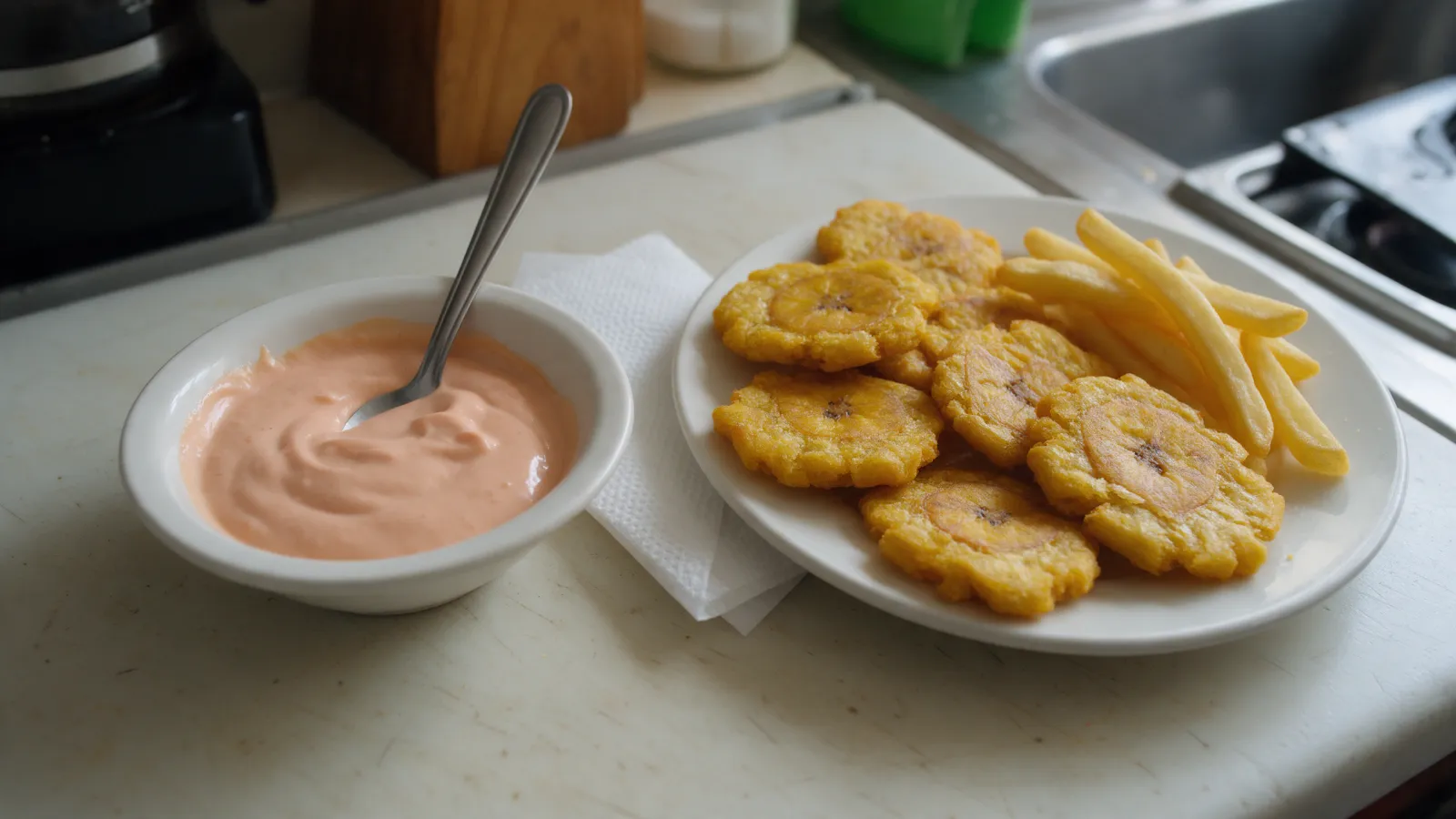

If you’ve ordered a hot dog from a street cart in Bogotá, it most likely came with a line of pale pink sauce running down the sausage: that’s salsa rosada, and it’s nothing more than mayonnaise and ketchup, stirred together two to one. Colombians and Venezuelans put it on fries, burgers, fried plantains and shrimp, the way Utah puts fry sauce on fries and the British put Marie Rose on prawns. The recipe takes 5 minutes. What’s worth knowing is the ratio, the one extra that changes what it’s for, and the fact that once mixed, it stops being a jar that lasts months and becomes a fresh egg-based sauce with a clock on it.
What is salsa rosada, and who is it for?
How do you make salsa rosada? Stir 1 cup (220 g) of mayonnaise with ½ cup (120 g) of ketchup for 1 minute, until it’s an even pink with no streaks, then add 1 teaspoon of lime or lemon juice, taste and adjust. Keep it covered in the fridge and serve it cold. Ready in 5 minutes for 12 servings.
Salsa rosada (SAHL-sah roh-SAH-dah) means “pink sauce” in Spanish. It’s the house condiment of Colombian and Venezuelan fast food: piped over a Colombian hot dog with pineapple sauce, zigzagged over salchipapa, drizzled on a Venezuelan pepito sandwich, and set out in a bowl next to empanadas, fries and fried plantains.
Who it’s for. Anyone feeding kids, a game-night crowd or a backyard full of hot dogs. It costs pennies and can’t go wrong.
Who might skip it. Anyone watching fat: 2 tablespoons (30 ml) carry about 135 calories, almost all from the mayo. And a picnic that will sit for hours in the sun, because it’s an egg-based sauce.
Time and effort. 5 minutes, easy. The only real decision is the ratio.
Salsa rosada vs mayo-ketchup, Marie Rose and fry sauce
They’re cousins, all built on 2 jars, and the difference comes down to the ratio and one extra ingredient.
- Puerto Rican mayo-ketchup → recipes run from equal parts to 3 to 1, almost always with garlic. It’s the dip for tostones.
- British Marie Rose → much more mayo, roughly 4 to 7 parts to 1 of ketchup, plus lemon, Worcestershire sauce and cayenne or Tabasco. It’s the dressing for prawn cocktail.
- Utah fry sauce → commonly given as 2 parts mayo to 1 of ketchup, often with other seasonings; the version at the Arctic Circle drive-in chain, which made it famous, is a company secret.
- Salsa rosada → 2 to 1 with a little lime, and nothing else unless you add it. Argentina, Uruguay and Chile call almost the same thing salsa golf.
What you need, with US and UK supermarket notes
The card makes 1½ cups (about 12 oz, 345 g): 1 cup (220 g) of mayonnaise, ½ cup (120 g) of ketchup and 1 teaspoon (5 ml) of lime or lemon juice. Nothing on the list needs a Latin grocery.
- Mayonnaise → full-fat jarred mayo, any brand, store brands included. Light mayo has less fat and more water and makes a runnier sauce. Commercial mayo is made with pasteurized eggs, which is why it’s the safe choice for kids and pregnant guests.
- Ketchup → regular tomato ketchup. In Colombia it’s simply called salsa de tomate. Skip the low-sugar kinds; the sauce needs that sweetness against the fat.
- Lime or lemon → Colombians use the small Tahiti lime; a lemon does the same job at 1 teaspoon.
Utensils. A bowl, a spoon or small whisk and a lidded jar. For hot dogs, a squeeze bottle with a fine tip; a zip-top bag with a ⅛-inch (3 mm) corner snipped off works too.
The 2-to-1 ratio, and when to break it
Measure by volume with the same cup or spoon for both, 2 parts mayo to 1 part ketchup. By weight it works out a little lower, because ketchup is denser than mayo.
Mayo brings the body and the fat; ketchup brings water, sugar, vinegar and color. At two to one the sauce holds a line on a hot dog without dripping and tastes of both. More ketchup makes it redder, sweeter, tangier and thinner; more mayo makes it paler, milder and heavier.
- 1 to 1 → what I use inside a Venezuelan patacón maracucho, the fried-plantain sandwich, where it has to stand up to beef, ham and cheese.
- 2 to 1 → for hot dogs, fries and Colombian salchipapa.
- Close to 3 to 1 → creamier, for dipping. For tequeños, some Venezuelan cooks go as far as 1 cup of mayo to 6 tablespoons of ketchup.
Start with a little less ketchup than you think, stir and taste. You can always add more.
How to make it and how to tell it’s right
It’s 1 minute of stirring, 15 seconds more for the lime, and into the fridge.
- Color → an even salmon pink. White streaks mean stir longer; brick red means too much ketchup.
- Texture → it falls off the spoon in a thick ribbon that sits on the surface for a moment before sinking. If it pours like water, add mayo.
- Taste → creamy first, then sweet and tangy at the end. If you only taste mayo, add ketchup or lime.
The extras. Per 1½-cup batch: 1-2 tsp of yellow mustard for hot dogs and burgers, ½ grated garlic clove or ½ tsp garlic powder for tostones and fried food, ½ tsp Worcestershire for seafood, ½-1 tsp hot sauce if you want heat. Add one at a time.
Planning ahead, party tables and batches for 20
Make it the night before or an hour ahead: it tastes the same the next day, and on party day it’s one less job. For dipping I count two tablespoons a person; with hot dogs or fries, three. One batch gives 24 tablespoons.
| People | Mayonnaise | Ketchup | Lime or lemon juice |
|---|---|---|---|
| 4-6 | ½ cup (110 g) | ¼ cup (60 g) | ½ tsp |
| 12 | 1½ cups (330 g) | ¾ cup (180 g) | 1½ tsp |
| 20 | 2½ cups (550 g) | 1¼ cups (300 g) | 2½ tsp |
On a long party table, don’t put the whole jar out. Serve a small bowl, ideally nested in a bowl of ice, and after 2 hours swap it for a fresh one from the fridge. Whatever’s left in the bowl goes in the trash, not back in the jar. Same with squeeze bottles: one out, one in the fridge.
Is it safe? Raw egg, storage and the 2-hour rule
Made with jarred mayo, yes, as long as you treat it as a fresh sauce: fridge at 40°F (4°C) or below, 3 to 5 days, and never more than 2 hours out, or 1 hour above 90°F (32°C).
Why days, when a jar of mayo lasts 2 months. Once mixed, the sauce has been through a bowl, a spoon and a table, so I treat it like any fresh sauce. With fresh garlic stirred in, I cut it to 4 days, the same limit I use for garlic sauce.
Homemade mayo and raw egg. Homemade mayo uses raw egg, which can carry Salmonella. For young children, older adults, pregnant guests or anyone with a weakened immune system, use pasteurized in-shell eggs (sold in many US supermarkets) or, in the UK, eggs with the British Lion mark, which are considered safe to eat raw for vulnerable groups, except people who are severely immunocompromised. Homemade versions keep 3 days.
Freezing. Don’t. Mayonnaise separates when it thaws and the sauce turns grainy and watery.
Mistakes to avoid
- Runny sauce → too much ketchup or light mayo. Stir in full-fat mayo a tablespoon at a time.
- Cloying → no acid. Add lime, ½ teaspoon at a time.
- Streaky → rushed. Give it a full minute and scrape the bowl.
- Separated or watery → it was frozen or warmed. It’s always served cold and never reheated.
- Spoiled early → it sat out for hours, or used spoons went into the jar. Serve from a separate bowl.
Heat level. 0 out of 5 unless you add hot sauce. Kids love it; with jarred mayo it’s safe for them. Allergens: egg in the mayonnaise; mustard if you add it; Worcestershire contains anchovies, and some brands, including the British original, use malt vinegar, which contains gluten.
Which version should you make?
- In a hurry → mayo and ketchup, nothing else, in 2 minutes.
- Hot dogs, fries, salchipapa → the card’s 2 to 1, in a squeeze bottle. It’s also the sauce on a Colombian mazorcada, the loaded corn bowl.
- Patacón maracucho → equal parts.
- Dipping → two to one, or a touch more mayo if you want it thicker so it clings. For Venezuelan tequeños I use 4 tablespoons of mayo to 2 of ketchup and a few drops of lime.
- Seafood → the 2 to 1 base with extra lime, finely chopped red onion and cilantro, the way Colombians dress a shrimp cocktail.
- Tostones and yuca fries → with garlic, closer to Puerto Rican mayo-ketchup. Try it with crispy double-fried tostones.
- Lighter → swap half the mayo for ½ cup (110 g) of plain nonfat Greek yogurt, 0% Greek yogurt in the UK. That drops 2 tablespoons to about 78 calories and 7 g of fat; it’s tangier and less thick.
- Egg-free → use a vegan mayo, same ratio.
- Homemade mayo → in a blender, 1 pasteurized egg, 1 tablespoon of lemon juice and a pinch of salt; with the motor on low, pour in 200 ml (¾ cup plus 1 tbsp) of neutral oil (sunflower, soybean or corn) in a thin stream over 3 to 5 minutes, until thick and pale. It makes about 250 g (a heaping cup); stir in the ½ cup (120 g) of ketchup. No extra-virgin olive oil, which can turn bitter. Keeps 3 days.
- A white garlic sauce instead → that’s a different recipe, Venezuelan garlic sauce, and street carts put both on the same hot dog.
What it costs
In the US a batch costs about $1.05, roughly 9 cents a serving. Store-brand mayonnaise lists at about 9.9 cents a fluid ounce in a 30 fl oz jar, so the cup comes to 79 cents; store-brand ketchup at 6.2 cents an ounce in a 32 oz bottle, so ½ cup (120 g, about 4¼ oz) is 26 cents, list prices checked in October 2026. The lime or lemon is a few cents more.
What drives the price. The mayonnaise, every time: it’s three-quarters of the US total. At Bogotá wholesale prices the batch comes to about 6,057 pesos, and homemade mayo cuts the mayo cost nearly in half.
Yield. 12 servings of 2 tablespoons, about 12 oz (345 g); 8 people at 3 tablespoons with fries.
What to expect and what to serve it with
Flavor and texture. Cold and creamy, mayo first and then ketchup’s sweet tang, with lime cleaning up the finish. Lighter than straight mayo, softer than straight ketchup.
How it’s served. In Colombia, in lines over the food, next to pineapple sauce and mustard. In Venezuela, in a bowl for dipping or inside a patacón. Always cold.
Fridge. 3 to 5 days with jarred mayo, 4 with fresh garlic, 3 with homemade mayo, in a clean glass jar at 40°F (4°C) or below. Use a clean spoon and put the jar straight back. If it separates slightly, stir.
Reheating. Never. If it went onto hot food and some is left, that portion is done.
Frequently asked questions
What is Latin pink sauce made of? Mayonnaise and ketchup, two parts to one by volume, with a little lime or lemon juice. Some versions add mustard, garlic, Worcestershire or hot sauce.
What’s the ratio of mayo to ketchup for salsa rosada? 2 to 1 by volume: 1 cup mayo to ½ cup ketchup, or 4 tablespoons to 2. Equal parts for a patacón.
Is salsa rosada the same as fry sauce? Close. Both are mayo and ketchup at roughly two to one. Fry sauce recipes often add other seasonings, and salsa rosada usually adds lime.
What’s the difference between salsa rosada and Marie Rose sauce? Marie Rose uses much more mayo, about 4 to 7 parts to 1 of ketchup, with lemon, Worcestershire and cayenne, and it’s mainly for prawn cocktail.
Is it the same as Puerto Rican mayo-ketchup? Same base. Mayo-ketchup almost always has garlic.
How long does pink sauce last in the fridge? 3 to 5 days covered, made with jarred mayo; 3 days with homemade mayo, 4 with fresh garlic.
How long can it sit out? 2 hours at most, 1 hour above 90°F (32°C). After that, throw it out.
Can you freeze salsa rosada? No. The mayonnaise separates when it thaws.
How much do I need for 20 people? 2½ cups (550 g) of mayo and 1¼ cups (300 g) of ketchup, about 60 tablespoons, 3 a person.
How many calories are in salsa rosada? About 135 calories and 14 g of fat per 2 tablespoons.
Nutrition
Per 2-tablespoon serving (about 1 oz, 29 g), calculated from the card’s full-fat mayo, ketchup and lime:
- Calories: 135 kcal
- Protein: 0 g
- Carbohydrates: 3 g
- Fat: 14 g, of which 2 g saturated
- Sugars: 2 g
- Sodium: 207 mg
The mayo supplies 125 of the 135 calories. The Greek-yogurt version comes to about 78.
In Venezuela, street-cart hot dogs got their mayo, ketchup and mustard in three separate lines, and pink sauce was something I knew from birthday parties, in a bowl next to the tequeños. In Colombia it came already mixed, in a squeeze bottle, always two to one. Now I make it that way for everything except the patacón, which still gets equal parts. Josnaisis.