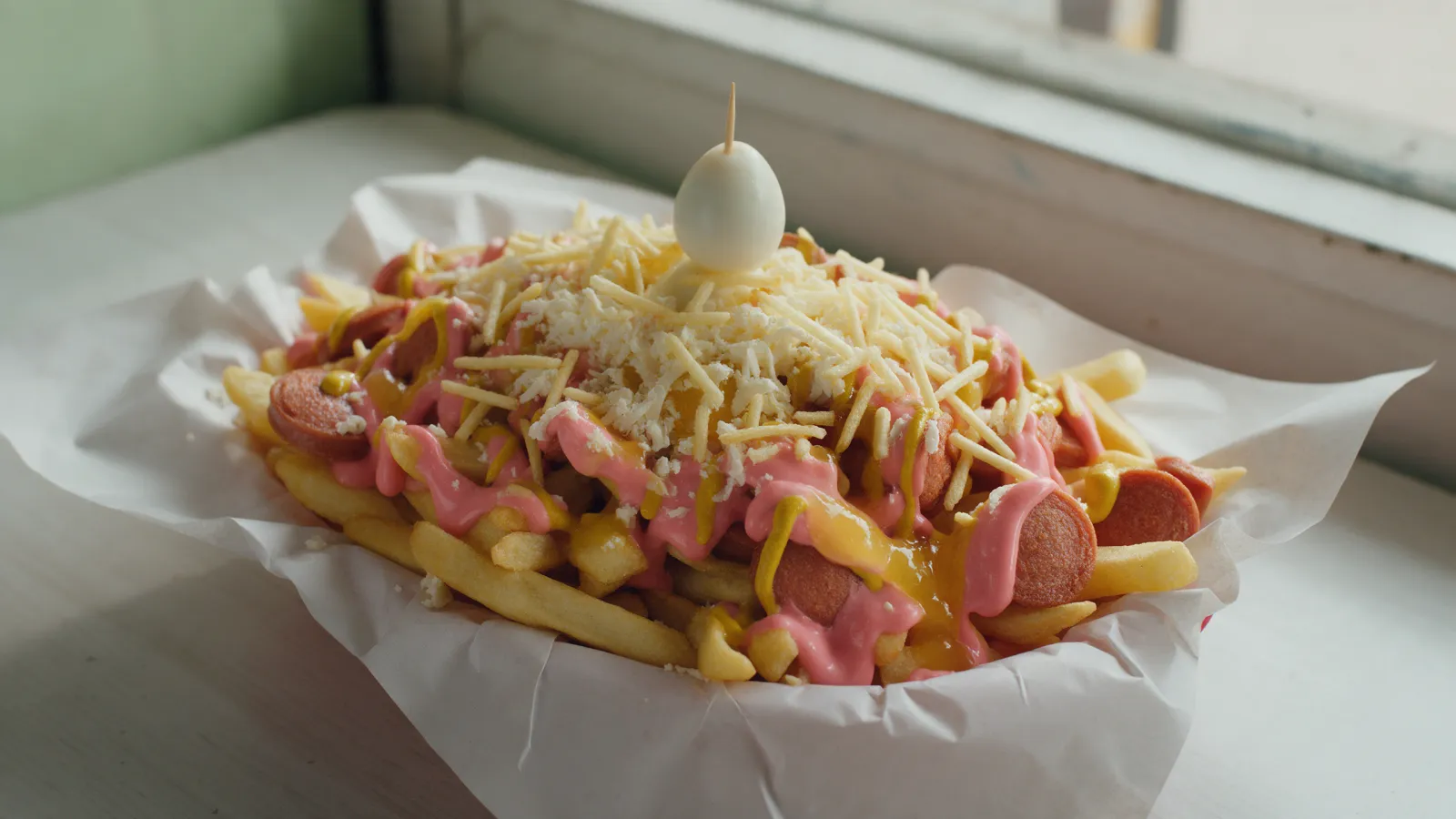

In Colombia, salchipapa (sahl-chee-PAH-pah) is a plate of fries with fried hot dog coins on top, and the name says so: salchicha plus papa, sausage plus potato. It’s sold from street carts and late-night stands, and what makes it Colombian rather than Peruvian is the sauce, a zigzag of pink sauce, sweet-tart pineapple sauce and yellow mustard, often finished with salty grated cheese and a few quail eggs. If you’ve had chili cheese fries, you already understand the appeal. Below is how long it really takes, what to buy in a US or UK supermarket, both sauces from scratch, an air fryer version, how to scale it for a party, and what it costs.
What is Colombian salchipapa, and is it worth making at home?
How do you make Colombian salchipapa? Cut floury potatoes into 1 cm (⅜ in) sticks, soak them 30 minutes in cold water, dry them and fry twice: 6 to 8 minutes at 320°F (160°C), a 10-minute rest, then 3 to 4 minutes at 350°F (175°C). Fry hot dog coins in the same oil for 2 minutes. Top with pink sauce, pineapple sauce, mustard, grated cheese and quail eggs. 100 minutes for 4 servings.
It’s worth it if you’re willing to fry the potatoes yourself. Frozen fries work, but they turn soft under sauce within minutes, and soft fries are where most home salchipapas go wrong.
Where it comes from. Salchipapa is credited to Lima, Peru: Wikipedia and PromPerú, Peru’s tourism board, both describe it as Peruvian street food, and PromPerú admits its origins are poorly documented. The Peruvian plate comes with ají amarillo, huancaína or olive cream and tartar sauce. The Colombian one swaps those for pink sauce and pineapple sauce, and on the Caribbean coast it gets piled high with queso costeño, sausages and smoked meats.
Who it’s for. Movie night, game day, a kids’ birthday, a crowd eating from one big tray. It’s a snack meal, not a side.
Who should skip it. Anyone watching fat or salt: one plate here is about 1,060 kcal and 2,050 mg sodium. Also anyone without decent kitchen ventilation, because 2 liters (2 quarts) of oil at 350°F (175°C) will scent the whole house.
Time and effort. 100 minutes, about 70 of them hands-on, and the difficulty is easy. The only real skills are drying the potatoes and watching a thermometer.
Shopping list, with US and UK swaps
For 4 plates you need 1 kg (2.2 lb) of potatoes, 400 g (14 oz) of hot dogs and 2 liters (2 quarts) of oil, plus two homemade sauces, mustard, cheese and a dozen quail eggs. Exact amounts are in the recipe card.
Potatoes. You want a floury, high-dry-matter potato. The Idaho Potato Commission puts its russets at an average of 21% solids, and Maris Piper is widely used for chips in the UK for its high dry matter. In Colombia the frying potato is capira (the Diacol Capiro variety). Waxy potatoes such as red or new potatoes soak up more oil and go limp.
Hot dogs. Colombian salchipapa uses Frankfurt-style or “ranchera” sausages, pre-cooked pork and beef links sold in packs; a 7-count pack of the Zenú brand weighs 360 g (12.7 oz). Any all-beef or beef-and-pork hot dog does the job in the US; in the UK, frankfurters. Chicken franks work but brown less.
Queso costeño. A firm, salty white cheese from Colombia’s Caribbean coast that grates well. Latin grocers sometimes carry it. Low-moisture mozzarella is the easiest swap: it melts more and is less salty. Cotija is closer in salt but doesn’t melt.
Quail eggs. Asian and Latin grocers stock them. They’re optional; the dish doesn’t change without them.
Equipment. A heavy pot of at least 5 liters (5 quarts), a clip-on or instant-read thermometer, a slotted spoon or spider, and a wire rack. With 2 liters of oil in it, the pot must be no more than half full, with at least 7.5 cm (3 in) of clearance, which is what America’s Test Kitchen asks for. An electric deep fryer with a thermostat replaces both the pot and the thermometer. A shallow frying pan doesn’t: the oil overheats and spits out.
Why the fries are cooked twice, at two temperatures
The first fry at 320°F (160°C) cooks the inside through and forms a thin skin without browning. During the rest, steam escapes and that skin dries. The second fry, hotter and shorter, turns the skin into a crust that holds up under sauce.
The numbers I use sit inside what the sources I checked recommend. America’s Test Kitchen blanches at 325°F (163°C) for 6 to 8 minutes and finishes at 350°F (177°C). British recipes from Heston Blumenthal and Olive Magazine start lower, around 265°F (130°C), and Sainsbury’s Magazine finishes at 180°C (356°F) for 3 to 4 minutes. I stop at 350°F (175°C) because that’s the top of the 160-175°C range the EU acrylamide regulation (2017/2158) recommends for home frying, and the FDA gives the same advice in different words: fry to golden yellow, not brown.
Who this recipe is for
- First time deep-frying → buy the thermometer first; it’s the one tool that decides the result.
- Feeding kids → for children under 4, the American Academy of Pediatrics lists hot dogs among the highest choking risks; cut them lengthwise into strips instead of coins, and quarter the quail eggs.
- Short on time → frozen fries, one fry or oven-baked per the bag, store-bought sauces; about 30 minutes, softer result.
- No deep-frying at home → the air fryer version further down.
Game plan, and what to do the day before
100 minutes on the clock. The trick is overlap: both sauces and the quail eggs fit inside the 30-minute soak, and the hot dogs fry while the blanched potatoes rest.
Make-ahead and freezer.
| What | How far ahead | How to store |
|---|---|---|
| First-fry potatoes | 2 hours, 3 days or 1 month | Room temp (ATK), fridge (Heston Blumenthal) or frozen on a tray, then bagged (ATK) |
| Pink sauce | 3 to 5 days | Covered, in the fridge |
| Pineapple sauce | 1 week | Squeeze bottle or jar, in the fridge |
| Quail eggs | Up to 1 week | Peeled, in a closed container, in the fridge (FSIS gives a week for hard-cooked eggs) |
| Hot dogs | Fry on the day | 2 minutes, while the fries rest |
Frozen first-fry potatoes go straight into the 350°F (175°C) oil without thawing; RecipeTin Eats adds half a minute for frozen.
How to tell each step is right.
- Rinse → cloudy water the first time, clear by the third.
- Dry → the potatoes leave the towel barely damp. If they drip, the oil will foam.
- First fry → after 6-8 minutes the sticks bend without breaking and are still pale. Color means the oil was too hot.
- Hot dogs → the edges split and curl up in about 2 minutes.
- Second fry → golden yellow, not brown, and a hollow rustle when you stir them.
- Between batches → wait for the oil to climb back to temperature before the next one goes in.
Pink sauce and pineapple sauce from scratch
Pink sauce (salsa rosada) is 2 parts mayonnaise to 1 part ketchup: 120 g (½ cup) mayo and 60 g (¼ cup) ketchup with a teaspoon of lime juice. That ratio is the same in all three recipes I compared (My Colombian Recipes, Sweetysalado and Kvalifood). If you know Utah fry sauce, it’s the same family.
Pineapple sauce is the one that surprises people. It isn’t a chunky salsa: it’s a smooth, glossy, pourable syrup, sweet and tart, made from 2 cups (330 g) fresh pineapple, ⅓ cup (80 ml) water, 2½ tbsp sugar and 1 tsp cornstarch, blended, strained, simmered 15 minutes and thickened for 4 more. That’s the method My Colombian Recipes uses for its Colombian hot dogs; Meatwave’s version is close, with brown sugar and 10 plus 10 minutes. It’s ready when it coats a spoon and falls off in a ribbon.
The shortcut is a 20 oz (567 g) can of crushed pineapple blended with its juice and thickened with cornstarch for a few minutes, the way Directo al Paladar and Sweetysalado do it. It comes out sweeter and less tart. Colombians also buy it ready-made, and the La Constancia brand from Colombina turns up in Latin grocers and online.
Mistakes and safety
Mistakes that ruin it.
- Greasy, floppy fries → cold oil or a crowded pot. Fry about 330 g (12 oz) at a time and let the oil recover between batches.
- Brown outside, raw inside → one fry over high heat. Blanch at 320°F (160°C) first.
- Dark, bitter fries → more than 4 minutes or more than 350°F (175°C) on the second fry.
- Fries stuck in clumps → no rinse. Soak 30 minutes and rinse until clear.
- Soggy plate → too much sauce, or the plate sat. Thin zigzags on top, the rest in squeeze bottles at the table.
Oil safety.
- Pot half full at most, 7.5 cm (3 in) of clearance, and stay with it while it’s on the heat.
- If oil catches fire, turn off the burner and slide a lid or sheet pan over the pot, and leave it covered until cool. Never water. The US Fire Administration and the NFPA give the same instruction, and the Cambridge (Massachusetts) Fire Department documented water spreading two real kitchen fires.
- Soybean oil smokes around 453°F (234°C), far above this recipe, but used oil smokes earlier.
- Reusing oil. Cool it, strain it through a fine sieve and store it covered in the dark. Cook’s Illustrated fried potato chips in the same oil at least 8 times without a problem; King Arthur puts it at 2 to 8 uses. Throw it out when it darkens, smells off, foams or smokes before reaching temperature, and never down the drain.
Spice level, 0 out of 5. Nothing here is hot. If you like heat, put Colombian ají on the table.
Allergens. Egg (mayonnaise and quail eggs), milk (cheese) and mustard, which is a declared allergen in the UK and EU. Some hot dogs contain soy protein, starches or wheat; check the label for gluten-free guests.
Which version, air fryer, loaded or for a crowd
- Air fryer → same soak and dry, then 2 batches of 500 g (1.1 lb), each tossed with 1 tbsp oil: 15 minutes at 350°F (180°C) and 15 at 400°F (200°C), shaking every 5 minutes. That’s America’s Test Kitchen’s two-stage method (350°F then 400°F, 2 tbsp oil for 1½ lb). Allow about 110 minutes for 4, because a basket can’t take 1 kg (2.2 lb) at once. Crisp, but drier than fried. In my air fryer the hot dog coins brown in 5-6 minutes at 400°F (200°C).
- Salchipapa especial (loaded) → add 150 g (5 oz) chopped fried bacon to the cheese and quail eggs. On the menus of Colombian stands I looked at, “especial” means fries, hot dog, cheese, bacon and egg, and “súper especial” adds chorizo.
- For a party of 10 to 20 → per person, 250 g (9 oz) potatoes and 100 g (3.5 oz) hot dogs: for 20, 5 kg (11 lb) potatoes and 2 kg (4.4 lb) hot dogs, with the sauces multiplied by 5. Do the first fry the day before and freeze on trays; on the day, two pots with 2 liters (2 quarts) each finish all of it in under an hour. Serve on a big platter with the sauces in squeeze bottles.
- Lighter → half the hot dogs, no cheese and 2 tbsp less mayonnaise: about 780 kcal a plate.
- Vegetarian → plant-based hot dogs; keep the quail eggs if you eat eggs.
What it costs in the US
The Bureau of Labor Statistics tracks only some of these ingredients. With its US city averages for August 2026, 2.2 lb of potatoes at $0.976/lb comes to $2.15, 120 g (0.26 lb) of cheese priced as cheddar at $5.983/lb (the BLS doesn’t track mozzarella) to $1.58, and 30 g of sugar at $1.024/lb to 7 cents. Pineapple was $0.79/lb on average in USDA AMS retail ads for 9 October 2026; a whole fruit gives you more flesh than the 330 g (¾ lb) you need.
The two things that drive the cost aren’t tracked: the BLS stopped publishing frankfurter prices in 2022, and it doesn’t price frying oil. In Colombia, where I priced everything, the hot dogs were 56% of the cost of the dish and the potatoes 7%. Expect the same split in your cart. Oil is cheaper than it looks if you strain and reuse it.
What to expect, how to serve it and how to store it
Taste and texture. Crisp fries that stay floury inside, hot dog coins with toasted edges, pineapple sauce cutting through the fat, creamy pink sauce and a little sharpness from the mustard. Queso costeño adds salt; mozzarella adds stretch.
How it’s served in Colombia. In a paper tray or a big platter, fries at the bottom, hot dogs on top, sauces in zigzags and cheese last, eaten with a toothpick or a plastic fork. The same pineapple sauce goes on the Colombian hot dog with crushed potato chips, the other street-cart classic. To drink, a cold Colombian coconut lemonade. For a bigger spread, add Colombian patacones, Colombian cheese arepas or a Colombian fritanga platter with Colombian chicharrón. Put Colombian ají picante out for anyone who wants heat, and if your crowd likes garlic, Venezuelan garlic sauce is good on the fries too. For another Colombian potato dish with a sauce on top, try papas chorreadas.
Fridge. USDA FSIS guidance: refrigerate leftovers within 2 hours (1 hour above 90°F / 32°C) and eat within 3 to 4 days. Store fries, hot dogs and sauces separately. An opened pack of hot dogs keeps 1 week; unopened, 2 weeks if it has no date.
Freezer. First-fry potatoes freeze well for up to a month. An assembled plate doesn’t: sauced fries thaw soggy.
Reheating. Hot dogs until steaming, 165°F (74°C) in the center per FSIS. Fries, unsauced, in an air fryer at 400°F (200°C) for 3 to 5 minutes, or 1 minute back in 350°F (175°C) oil. The microwave turns them limp. Sauces go on cold, at the end.
Salchipapa FAQ
What is salchipapa? Fries topped with sliced, fried hot dogs and sauces. The name joins the Spanish words for sausage and potato. It’s street food in Peru, Colombia and much of Latin America.
Is salchipapa Peruvian or Colombian? It’s credited to Lima, Peru, though PromPerú says the origin is poorly documented. Colombia has its own version with pink sauce, pineapple sauce and grated queso costeño; Peru’s uses ají amarillo, huancaína and tartar sauce.
What sauce goes on Colombian salchipapa? Pink sauce (2 parts mayo to 1 part ketchup), pineapple sauce and yellow mustard, in thin zigzags over the top.
What is Colombian pineapple sauce made of? Blended, strained fresh pineapple simmered with sugar and lime juice for 15 minutes, then thickened with cornstarch for 4 more. It’s smooth and syrupy, not chunky.
Can I make salchipapa in an air fryer? Yes. Soak and dry the potatoes, toss 500 g (1.1 lb) with 1 tbsp oil, and cook 15 minutes at 350°F (180°C) and 15 at 400°F (200°C), shaking every 5 minutes. Fries come out drier than deep-fried.
What hot dogs are best for salchipapa? Pre-cooked beef or beef-and-pork franks. Chicken franks work but brown less.
How much salchipapa do I need for 20 people? 5 kg (11 lb) potatoes and 2 kg (4.4 lb) hot dogs, with 600 g mayonnaise, 300 g ketchup and pineapple sauce made from 1.65 kg (3.6 lb) of pineapple.
Nutrition per plate
Per plate (about 400 g / 14 oz, with cheese, quail eggs and both sauces), calculated from USDA FoodData Central (SR Legacy). For the fries I used the entry for potatoes French fried in vegetable oil and estimated the fried weight from the carbohydrate in 1 kg of raw potatoes, which works out to about 436 g of fries carrying 64 g of absorbed oil. Hot dogs are the “Frankfurter, meat” entry; cheese is whole-milk low-moisture mozzarella.
- Calories: 1,060 kcal
- Protein: 25 g
- Carbohydrates: 73 g
- Fat: 75 g, of which saturated 19 g
- Fiber: 6 g
- Sugars: 20 g
- Sodium: 2,050 mg
Frying oil and mayonnaise account for just over half the fat, and the hot dogs for about half the sodium (1,090 mg a plate). Leaving off the cheese and quail eggs brings it to about 925 kcal.
I’m Venezuelan and live in Colombia, and salchipapa is Friday movie night at my house. For years I made it with frozen fries and couldn’t work out why they were mush ten minutes after the sauce went on. Frying twice with a thermometer fixed it, and now I blanch the potatoes on Thursday and freeze them. My son Dylan wants his pineapple sauce on the side, for dipping. Josnaisis.