
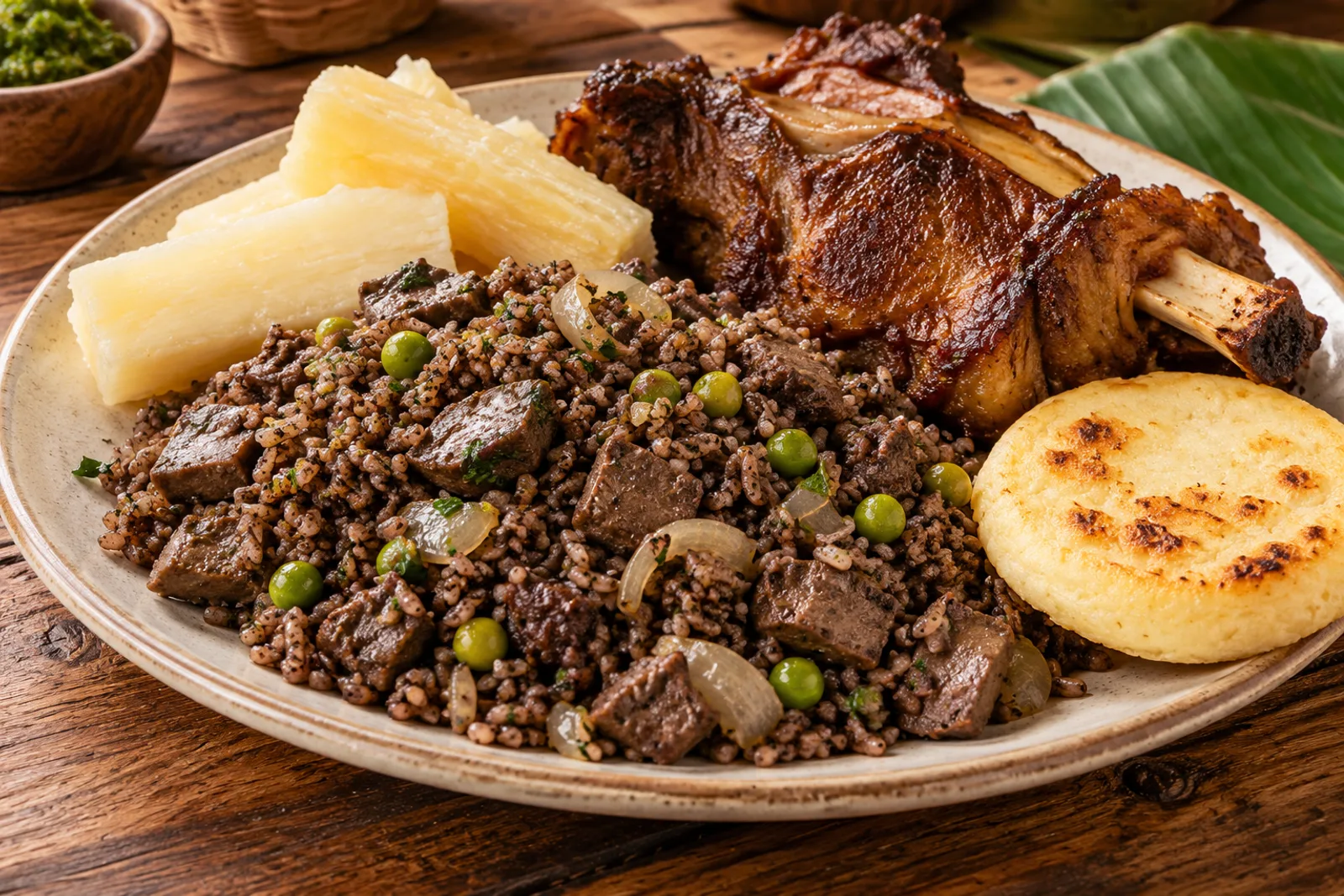

Pepitoria (peh-pee-TOH-ree-ah) is what Santander, in northeastern Colombia, makes with the parts of the goat that don’t go on the grill: the heart, liver and kidneys are simmered and diced, stewed in a cumin and tomato sofrito, then cooked with crumbled coagulated blood until the whole pot turns almost black, and finally mixed with white rice. It’s served next to roast goat, and it tastes deep, savory and iron-rich, somewhere between a dirty rice and a loose black pudding. Below you’ll find the recipe for 6, what to buy in the US or UK, how to tell when the blood is cooked, and how to keep it safe.
What pepitoria is, and who it’s for
How do you make Colombian pepitoria? Simmer 1⅓ lb (600 g) of goat heart, liver and kidneys for 60 minutes and dice them. Stew them 20 minutes in an onion, tomato, bell pepper and cumin sofrito, add 1 lb 10 oz (750 g) of crumbled coagulated blood and stir for 20 minutes until nothing is red and the pot reaches 165°F (74°C). Fold in 1¼ cups (250 g) of rice, already cooked. 145 minutes for 6 servings.
If you enjoy black pudding, Spanish morcilla or a Cajun dirty rice made with chicken livers, you’ll recognize the flavor. If offal isn’t your thing, this isn’t the dish to start with: the blood is the backbone, and there is no hiding it. It’s eaten mostly in the goat country around Barichara, Girón and the Chicamocha Canyon, where in Colombian Spanish the goat is called cabro.
The name trips people up. Spanish pollo en pepitoria is chicken in an almond and egg-yolk sauce with no blood or rice, and in Guatemala pepitoria means the hulled pumpkin seeds that thicken Guatemalan pepián. Colombia’s closest relative is morcilla, the rice and blood sausage, which packs a similar mix into casings instead of cooking it loose.
Total time 2 hours 25 minutes, about 75 of them hands-on. Medium difficulty: nothing is technically hard, but you need good offal and you have to stay at the stove for the blood.
Ingredients, metric and US
| Ingredient | Metric | US | Notes |
|---|---|---|---|
| Coagulated blood | 750 g | 1 lb 10 oz (about 3 cups) | Goat in Colombia; pork blood curd elsewhere |
| Heart | 250 g | 9 oz | Goat or lamb |
| Liver | 200 g | 7 oz | Goat or lamb; 150 g (5 oz) if pork |
| Kidneys | 150 g | 5 oz | Goat or lamb |
| Long-grain white rice | 250 g | 1¼ cups | Cooked first, or use day-old rice |
| Lard | 60 g | 4½ tbsp | Or 4 tbsp vegetable oil |
| Scallions | 150 g | 6 thick ones | UK spring onions |
| Onion, tomatoes, red bell pepper | 150 g, 240 g, 150 g | 1 medium, 2 ripe, 1 medium | |
| Ground annatto (achiote) | 1 tsp | 1 tsp | Sweet paprika works |
Equipment. A 3-quart pot for the offal, a saucepan for the rice, a wide heavy 5-quart Dutch oven, a sieve, a wooden spoon and, ideally, an instant-read thermometer.
Where to find goat blood and offal
- United States. Halal butchers, and Caribbean and Mexican meat markets, sell goat and usually its offal; lamb heart, liver and kidneys are the next best thing. For the blood, Asian supermarkets sell pork blood curd in blocks or cubes, chilled or frozen. It’s already set, so it goes straight into the recipe.
- United Kingdom. Most butchers and many supermarkets carry lamb’s liver, kidneys and hearts. Fresh blood is the hard part: ask a Chinese or Vietnamese grocer for pork blood curd, or make the no-blood version below.
- In Colombia. Order the blood, already coagulated and from that day, from whoever sells the goat at the market.
Swaps and what they change
- Pork blood instead of goat blood. The swap you’ll notice least: slightly milder and a touch lighter in color.
- Lamb or pork offal. Lamb tastes closest to goat. Pork liver is stronger, so use 150 g (5 oz).
- No liver. Increase the heart to 450 g (1 lb). Milder, with firmer cubes.
- No annatto. Sweet paprika, same amount. Once the blood goes in, you’ll barely see the difference.
Cooking it, step by step
Simmering the offal
Halve the kidneys and cut out the white core, which is where the strong smell comes from. If your tripe is raw, boil it for 5 minutes before cleaning it: that cuts down the germs that end up on your hands and counter while you scrub. The liver and kidneys only get the last 20 of the heart’s 60 minutes. Simmered the full hour alongside it, they turn hard and grainy.
The sofrito and the stew
The sofrito takes 10 minutes in all: onions first, until translucent, then the tomato, pepper and spices until the tomato breaks down and the fat glistens on top. Dice the offal into ¼ in (5 mm) cubes: bigger and the liver takes over every bite, smaller and it vanishes into the blood. Stew it covered for 20 minutes so it soaks up the sofrito.
How to tell the blood is cooked
Drain the blood for 5 minutes and crumble it by hand into chickpea-size pieces. A blender would turn it into a paste. In the pot, over medium heat and with constant stirring, it goes through three stages:
- Going in. Wine-red and glossy, releasing liquid that makes the stew look watery.
- At 10 minutes. The crumbles turn brown outside and the liquid starts to evaporate.
- At 20 minutes, done. Everything is a near-black brown, moist and glossy with fat, with no liquid pooling at the bottom. Break a large crumb open: it should be brown all the way through. On a thermometer, 165°F (74°C) in the middle of the pot.
If it catches on the bottom, splash in a little hot water and scrape. Cooked much longer, the crumbles dry out and turn sandy.
Folding in the rice
The rice goes in cooked, in three batches, folded from the bottom until it’s evenly dark, then 5 minutes more to heat through. For the rice itself, the method is the one for Colombian white rice, scaled up. Taste for salt only now: the offal and blood bring their own.
Food safety with blood and offal
- Buying and storing raw. Refrigerate raw blood and offal at 40°F (4°C) or below as soon as you get home, and cook or freeze them within 1 to 2 days. If they smell sour or the blood looks gray-green, throw them out.
- Frozen blood. Thaw it in the fridge overnight, never on the counter.
- Time out of the fridge. Raw or cooked, no more than 2 hours at room temperature, or 1 hour above 90°F (32°C).
- Cook it through. The finished pot must reach 165°F (74°C) in the center. No thermometer? Steam should rise from every part of the pot and no crumb should be red inside.
- Clean up. Wash hands, board and knife in hot soapy water after handling raw blood or offal.
- Pregnancy. Liver is very high in vitamin A, and pregnant women are usually advised to avoid it. Leave it out and use 450 g (1 lb) of heart.
Heat and allergens. It isn’t spicy, just peppery. It contains no gluten, dairy or nuts, and egg only if you add the topping; check the label on any seasoning blend.
Versions, swaps and scaling
- With pork blood. Same recipe, pork blood curd and whichever offal you can find. The practical choice in the US and UK.
- Without blood. Replace the blood with 500 g (1 lb 2 oz) of goat or pork meat in ½ in (1 cm) cubes. Stew it in the sofrito with 1 cup (240 ml) of water, covered over low heat, about 60 minutes until it falls apart when pressed with a spoon, while the offal simmers; then carry on from the offal stewing step, with 2 tsp annatto. It comes out reddish and tastes like a stew, and in Santander it would be called rice with offal rather than pepitoria. For an easier offal rice anywhere, Colombian chicken giblet soup uses supermarket giblets.
- For 12. Double everything and use an 8-quart pot, or two. The blood takes longer to lose its red, so go by color and temperature rather than the clock.
Cost. Offal and blood are among the cheapest things at the butcher; what makes a Santander meal expensive is the roast goat alongside. Pork offal and blood make it cheaper still.
Serving, storing and reheating
Serving. In Santander it shares the plate with roast or braised goat, carne oreada, the air-dried marinated beef, boiled cassava and the Santander arepa made with corn and pork cracklings. At home, fried yuca and some guacamole are plenty. Allow two ladlefuls per person as a main, or one as a side to goat. On a cold day, the other big pot from the same region is Colombian mute.
Make ahead. Simmer and dice the offal the day before, and make the rice too; refrigerate both, covered, within 2 hours. Buy the blood for the day you cook.
Fridge. In a sealed container, within 2 hours of cooking: 3 to 4 days.
Freezer. 2 to 3 months in portions. The rice softens a little. Thaw in the fridge overnight.
Reheating. In a covered skillet over medium heat with 2 or 3 tbsp water, stirring, 6 to 8 minutes, until steaming and at 165°F (74°C). In the microwave, 1-minute bursts with a stir in between, until steam rises from the whole plate.
Frequently asked questions
Is pepitoria the same as Colombian blood sausage? No. Both use blood and rice, but morcilla is stuffed into casings and poached, while pepitoria is cooked loose in the pot with diced offal.
Can I use frozen blood? Yes, if it was frozen already set. Thaw it in the fridge, drain and crumble it as usual. If it’s liquid after thawing, it never coagulated and needs a different method; it won’t work here.
Can I use leftover rice? Yes, and it stays looser. Add it cold in three batches and cook until everything reaches 165°F (74°C).
What does pepitoria taste like? Savory and deep, like a liver-forward black pudding broken up through rice, with cumin and scallion in the background. The texture is soft and crumbly, not creamy.
Nutrition
Per serving (one sixth of the recipe, without sides), calculated ingredient by ingredient from the amounts above:
- Calories: 490 kcal
- Protein: 37 g
- Carbohydrates: 45 g
- Fat: 18 g, of which 6 g saturated
- Fiber: 3 g
- Sugars: 4 g
- Sodium: 830 mg
Lard adds roughly 90 kcal a serving and rice about 150. The salt in the offal water isn’t counted because that water is discarded, and the optional tripe isn’t included.
For a first try outside Colombia, I’d go with pork blood curd and lamb offal: both are easier to find than goat, a little milder, and the result still tastes like pepitoria. The one thing I wouldn’t skip is breaking open a few crumbs of blood before the rice goes in. If any of them is still red inside, the pot needs more time, whatever the clock says. Josnaisis.