
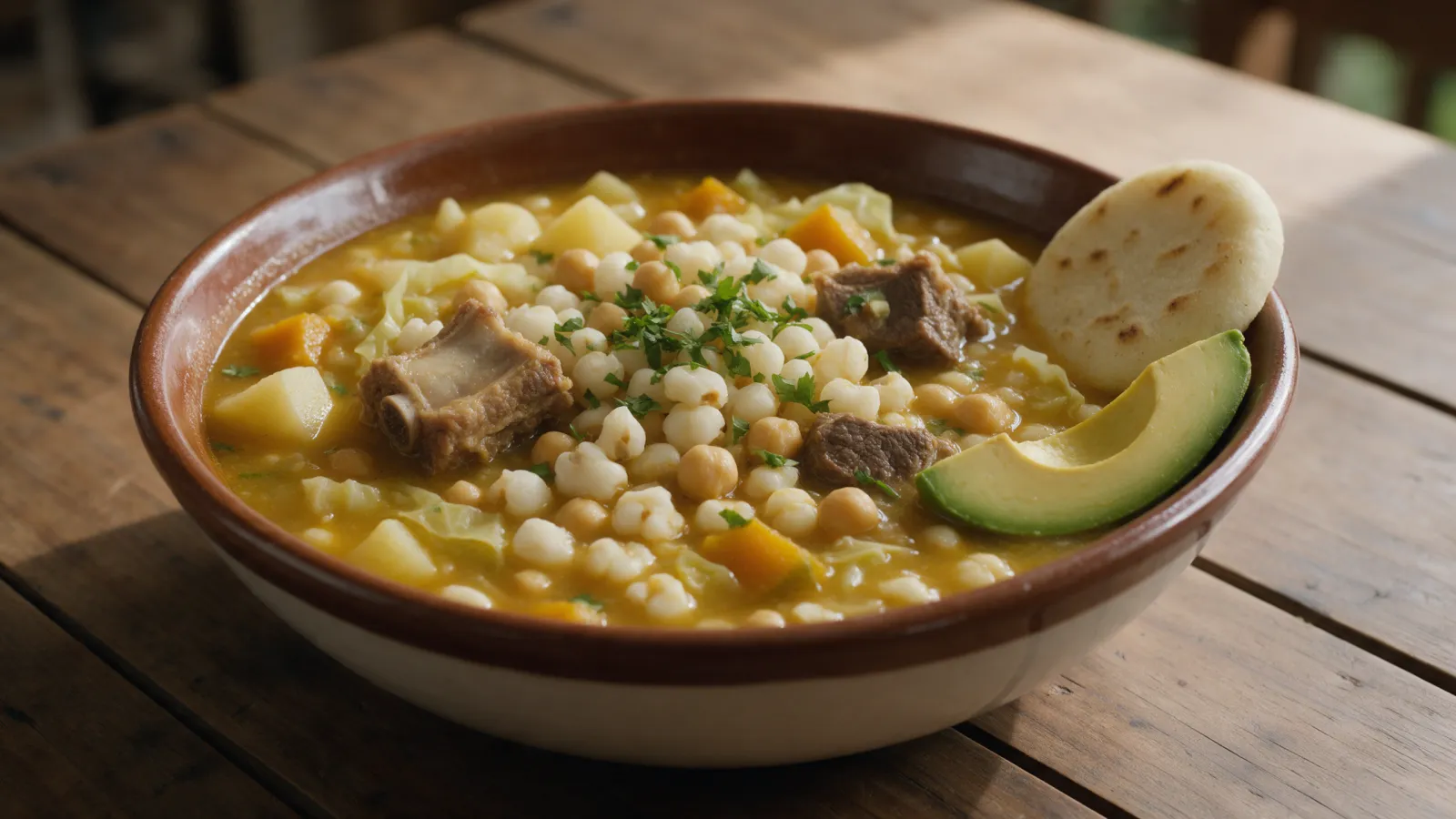

If you’ve had Mexican menudo or pozole, you already know half of mute (MOO-teh): a slow pot of whole white corn and tripe. The other half is Colombian. Mute adds beef short ribs, pork ribs, chickpeas, beans and butternut-like squash that melts into the broth, seasons it with cumin and a tomato sofrito instead of chile, and comes out thick enough to eat with a fork. It’s the soup of Santander, in northeastern Colombia, and of neighboring Boyacá; in Bucaramanga, Santander’s capital, a festival called Maestros del Mute gathered more than 30 restaurants for its third edition in June 2025. This recipe fills a 12-quart pot, feeds 12, and is built for a cook outside Colombia: which corn to buy, how to cook it ahead, and how to make it without tripe.
What is Colombian mute soup?
How do you make Colombian mute soup? Soak dried white corn, chickpeas and beans overnight. Simmer the corn, chickpeas and cleaned tripe in 5 liters (5.3 quarts) of water; add beef ribs after 60 minutes and pork ribs after 120. At 150 minutes add the cooked beans, squash, potatoes and a cumin-tomato sofrito, and small yellow potatoes at 185. 240 minutes for 12 servings.
Mute is a corn stew first and a meat soup second. The corn is maíz blanco trillado, dried white field corn with the hull removed by machine, and, unlike hominy, never treated with lime. Mute corn is threshed white corn, and in Santander everyone makes this dish their own way. A classic family pot uses tripe, cow’s foot, chickpeas, potatoes, squash and hogao, the Colombian tomato and scallion sofrito, and comes with yellow arepas.
There is no single recipe. Santander versions lean on pork, ribs and tripe, sometimes with sausage and short pasta; in Boyacá beef and potatoes are more common, and some versions use goat. This one sits in the middle: three meats, two legumes, two potatoes and squash.
Is it worth making, and who is it for?
Yes, if you’re feeding a crowd and can start the night before. A bowl of about 700 g (25 oz) is a full meal, 754 kcal with 38 g of protein, and the pot freezes well, so the work pays off for weeks.
Make it for. A Sunday lunch for 10 to 15, a game-day pot, a family gathering where you want everything done the day before, or a freezer stash. Cooking for 4 takes almost the same effort as cooking for 12.
Skip it if. You want dinner tonight with dried corn: without the overnight soak there’s no mute (canned hominy changes that, see below). If nobody at your table eats tripe, make the no-tripe version. And if you want something light, this is the wrong pot.
Time. 4 hours on the stove, about 1 hour hands-on, plus 10 minutes the night before to set the soak. With a pressure cooker, about 2½ hours.
Difficulty, medium. Nothing here is technically hard. What goes wrong is the order: pork added with the beef turns to strings before the beef is tender, and yellow potatoes added early disappear.
Which corn to buy outside Colombia
The corn decides how much planning you need. Colombian maíz trillado is the authentic one and the only one without the tortilla flavor of lime-treated corn; canned hominy is the one most US and UK cooks will actually find.
- Dried maíz trillado → Latin grocery stores and online Colombian shops, as maíz pelado or maíz para mute. 12-hour soak, then about 3 hours of simmering, or 60 minutes at high pressure. Clean, sweet corn flavor; kernels stay whole and slightly chewy.
- Dried hominy or dried pozole corn → nixtamalized, so it tastes faintly of tortilla. Soak overnight and simmer about 90 minutes; the kernels open like flowers, the same way they do in Mexican pozole rojo. A good mute, slightly Mexican.
- Canned white hominy → already cooked. Two 29-oz (822 g) cans, drained and rinsed, replace the 1.1 lb (500 g) of dried corn. It goes in with the yellow potatoes for the last 25 minutes. Rinse it: the canning liquid is salty, so salt the pot only at the end.
- Grits or cracked corn → broken corn dissolves and thickens. Tasty, but it reads as porridge, not mute.
My call: canned hominy if you’re outside Colombia and cooking for a crowd, dried trillado if you can find it and have the night before.
The rest of the shopping list, with US and UK swaps
| In Colombia | US | UK | What changes |
|---|---|---|---|
| Callo or mondongo | beef tripe, honeycomb or blanket | dressed tripe from a butcher | nothing; most is sold pre-cleaned |
| Costilla de res | bone-in beef short ribs | short ribs, Jacob’s ladder | nothing |
| Costilla de cerdo | pork spareribs | pork ribs | nothing |
| Ahuyama | butternut or kabocha squash | butternut squash | almost nothing; both melt into the broth |
| Papa pastusa | russet | Maris Piper, King Edward | nothing |
| Papa criolla | frozen papas criollas, or baby Yukon Gold | baby new potatoes | without criolla, less yellow and less buttery |
| Fríjol cargamanto | cranberry or pinto beans | borlotti beans | nothing you’d notice |
| Cebolla larga | scallions | spring onions | slightly milder |
Tripe, cleaned properly. Even pre-cleaned tripe needs 10 minutes of rubbing with lime and coarse salt and a 5-minute boil in water you throw away; that’s where the smell goes. The whole method is in my Colombian mondongo, tripe soup without the smell. If you can find a cow’s foot, many Santander cooks add one with the tripe, and the broth turns more gelatinous.
Equipment. A 12-quart (12-liter) stockpot, a smaller pot for the beans, a skillet and a long wooden spoon. No 12-quart pot? Split it: corn, chickpeas and tripe in an 8-quart pot, meats and vegetables in another, combined for the last 30 minutes. A 6-quart Instant Pot or stovetop pressure cooker works in batches.
The cooking-day schedule, and how to tell each stage is right
4 hours from a cold pot, about 1 hour of real work. The corn and the tripe set the clock, so they start together. Everything else is counted backward from the finish: beef needs about 150 minutes, pork 90, squash and russets 60 (the squash has to fall apart), yellow potatoes 25.
The chart counts from the moment you start cleaning the tripe, so every entry sits 20 minutes later than in the recipe steps, which count from the corn coming to a boil.
Make-ahead options.
- Soak only → 10 minutes the night before: corn, chickpeas and beans in three bowls. That’s the recipe as written.
- Cook the corn and tripe the day before → the traditional Santander method: simmer corn, chickpeas and tripe (about 4 hours, cow’s foot included), then add the meats and vegetables the next day. Cool the pot within 2 hours by splitting it into shallow containers, refrigerate, and serving day takes about 2½ hours.
Pressure cooker or Instant Pot. Corn, chickpeas and tripe, 60 minutes at high pressure; release, add beef and pork and cook 35 minutes more at pressure; then, lid off on sauté, the beans (pressure-cooked separately for 25 minutes), vegetables and hogao for 40 minutes. About 2½ hours in all, still with the overnight soak.
Doneness cues.
| Stage | What you should see |
|---|---|
| After the soak | corn has nearly doubled; a chickpea splits under your thumbnail |
| Tripe, 150 min | gives when you bite it but keeps its shape; still rubbery means it needs time, not salt |
| Corn, about 3 hours | tender, whole, a little bite in the center; still hard means old corn, give it 30 minutes more |
| Beef ribs | meat slides off the bone when nudged with a spoon |
| Body | broth coats the spoon and looks orange from the squash |
| Salt | taste only at the end; the broth concentrates |
Scaling it for 6 or 20
Per bowl, the recipe works out to about 1.4 oz (40 g) dried corn, 0.7 oz (20 g) each chickpeas and beans, 3 oz (85 g) beef ribs, 2 oz (60 g) pork and 2 oz (60 g) tripe, with roughly 1¾ cups (400 ml) of water.
- For 6 → halve everything in a 6- to 8-quart pot. Times stay the same.
- For 20 → multiply by 1.7: 1.9 lb (850 g) dried corn, 3.7 lb (1.7 kg) beef ribs, 9 quarts (8.5 liters) water, in two 10-quart pots. It takes about 20 minutes longer to come to a boil; cooking times don’t change.
Mistakes that ruin mute
- Hard corn after 3 hours → too short a soak, or old corn. Soak 12 hours minimum; add 30 minutes on the stove or 15 under pressure.
- Tripe that smells → skipped the lime and salt rub, or kept the blanching water. Rub 10 minutes, boil 5, discard.
- Pork in shreds → it went in with the beef. Add it an hour later.
- Vanished yellow potatoes → added with the russets. Only the last 25 minutes.
- Scorched bottom → broken-down squash and corn starch settle. Low heat and a wooden spoon along the bottom every 10 minutes after minute 150.
- Too salty → salted early, or unrinsed canned hominy. Salt goes in with the vegetables; adjust at the end.
Spice, 0 out of 5. Nothing in the pot is hot. Set out Colombian ají picante for anyone who wants heat.
Kids. The broth, corn and potatoes usually go down well; tripe often doesn’t. Give them boneless rib meat and keep the tripe for the adults. Check for bone splinters.
Allergens. No gluten, egg, dairy, nuts or fish. It does contain legumes (chickpeas and beans). If you add pasta, as many Santander cooks do, it contains gluten.
Versions, from weeknight-ish to party-sized
- Faster, no soak → canned hominy, two 15-oz (425 g) cans of chickpeas, and a pressure cooker for the meats. About 2 hours, no night before.
- No tripe → leave it out and raise the beef ribs to 1.5 kg (3.3 lb); add a cow’s foot or a split pig’s trotter with the corn if you can find one, for body. Cleaner-tasting, and easier to sell to a mixed table.
- For a party of 20 → two 10-quart pots, corn and tripe cooked the day before, and the pots on the lowest heat through the party.
- Lighter → chill the finished pot overnight and lift off the fat that sets on top; the beef ribs bring nearly half the fat in each bowl. Using 3 tsp of salt instead of 4 lowers sodium by about 190 mg a bowl.
- Vegetarian → not traditional, but it works: 5 liters (5.3 quarts) vegetable stock, double the chickpeas and beans, 500 g (1.1 lb) mushrooms in large chunks, same squash. You lose the body of bone and tripe.
- With pasta → 200 g (7 oz) elbows or small shells in the last 10 minutes, as many Santander households do. If you plan leftovers, cook the pasta separately: it drinks the broth.
- Real regional versions → some Santander grandmothers add fresh corn on the cob in chunks and yellow potatoes; Santander cooks often add chorizo or longaniza sausage.
If you like grain-thickened Colombian soups, cuchuco, the cracked wheat and pork soup from the same highlands is the quicker cousin: broken grain that dissolves, where mute keeps its kernels whole.
What it costs
At US city average retail prices for August 2026, the main items come to $21.55 for the pot, about $1.80 a bowl. Beef is more than half of it.
Short ribs, spareribs, tripe, hominy and squash vary too much by store, so boneless stew beef ($8.587/lb) and pork chops ($4.239/lb) stand in for the meat by weight of edible meat, and the rest is left out. Treat the meat lines as a rough guide to where the money goes, not a receipt. Canned hominy and tripe are easiest to find in Latin and Asian supermarkets.
Yield. 12 deep bowls of about 700 g (25 oz) with broth, corn, beans and a piece of each meat. With rice on the side, 15.
The cheapest saving. Swap some pork ribs for bone-in pork shoulder. At Bogotá’s wholesale meat prices for mid-September 2026, bone-in shoulder cost about 70 percent of what pork ribs did at the same three suppliers.
How to serve it, store it and reheat it
Taste and texture. A thick orange broth with cumin and sofrito in the background, sweetness from squash and corn, kernels that are tender with a little bite, soft gelatinous tripe and ribs that taste of the bone.
At the table. In deep bowls with a piece of every meat and plenty of corn. In Santander it comes with yellow arepas, Santander’s hulled-corn arepa (mine, the Santander arepa made with cassava and pork cracklings, adds cassava to the dough); restaurants add avocado slices and white rice on the side, with hot sauce and lime on the table. When a crowd wants three meats but no corn, the Colombian answer is sancocho trifásico; when it wants tripe with chile, Mexican menudo.
Fridge. Refrigerate within 2 hours, and eat within 3 to 4 days at 40°F (4°C) or below. A full 12-quart pot won’t cool in time on its own; divide it into containers no more than 3 inches (7.5 cm) deep.
Freezer. 2 to 3 months for best quality, like any soup or stew. Corn, tripe, legumes and meat freeze well; potatoes turn a little mealy. I freeze two-bowl containers and, if I’m cooking to freeze, add the yellow potatoes on the day I serve.
Reheating. Mute thickens a lot overnight. Add ½ cup water or stock per 2 cups of soup, then warm over low heat, stirring, to 165°F (74°C) in the center. High heat scorches the bottom. Thaw frozen portions overnight in the fridge.
Frequently asked questions
What is mute in Colombian food? A thick soup-stew from Santander and Boyacá made with whole dried white corn, beef and pork ribs, tripe, chickpeas, beans, potatoes and squash. It’s eaten as a one-bowl meal.
Is mute the same as pozole? No. Pozole uses lime-treated hominy that blooms open and, in its red version, a chile broth. Mute uses untreated threshed corn, adds tripe and legumes, and isn’t spicy.
Can I make mute with canned hominy? Yes. Drain and rinse two 29-oz cans and add them for the last 25 minutes. It skips the overnight soak; the soup tastes slightly of tortilla.
How long do you soak corn for mute? 12 hours, in three times its volume of water. Then about 3 hours of simmering, or 60 minutes at high pressure.
Can I make mute without tripe? Yes. Raise the beef ribs to 3.3 lb (1.5 kg) and, if possible, add a cow’s foot or pig’s trotter for body.
Can I make it in an Instant Pot? Yes, in batches: corn, chickpeas and tripe 60 minutes at high pressure, then meats 35 minutes, then vegetables on sauté with the lid off.
Does mute freeze well? Yes, 2 to 3 months. Potatoes soften a little; everything else holds.
How many people does it feed? This pot makes 12 large bowls, or 15 with rice on the side.
Nutrition
Per bowl, about 700 g (25 oz), without rice or avocado, calculated ingredient by ingredient with the quantities above. That counts about 600 g of edible meat per kilo of bone-in beef ribs, 500 g from the pork ribs, and the full 4 teaspoons of salt.
- Calories: 754 kcal
- Protein: 38 g
- Carbohydrates: 80 g
- Fat: 32 g, of which 10 g saturated
- Sodium: 931 mg
Most of the fat is rib fat: around 14 g per bowl from the beef and about 10 from the pork, and it’s the part you remove when you chill the pot and lift off the top layer. About 775 mg of the sodium is the salt in the pot. Tripe is the leanest of the three meats, 12 g protein and 3.7 g fat per 100 g (3.5 oz). With canned hominy instead of dried corn, the numbers shift: less carbohydrate per bowl and more sodium unless you rinse it.
The first time I made mute, I skipped the soak because the bag didn’t mention it, and four hours later I had soft ribs and corn like gravel. Since then the three bowls of corn, chickpeas and beans go on the counter before I go to bed, and the next morning is just a matter of putting the meats in the right order. Josnaisis.