
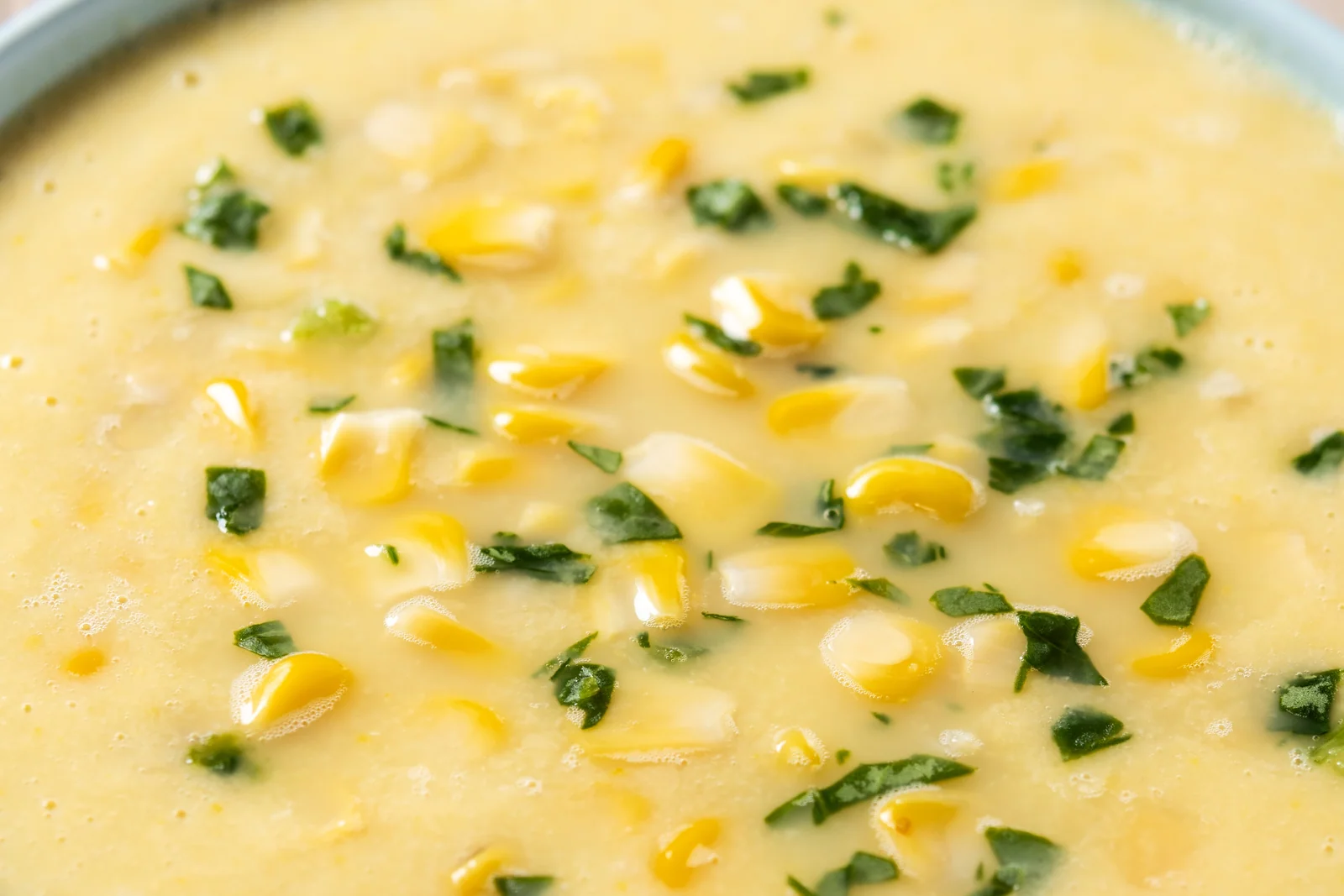

Crema de elote (KREH-mah deh eh-LOH-teh) means cream of corn, and in Mexico it is the soup you get as a first course at a family lunch or a fonda: corn simmered in stock, blended with milk until silky, finished with a little crema and usually topped with strips of roasted poblano chile and fresh cheese. It has no flour and no potatoes. The corn’s own starch does the thickening, which is why it turns out smooth rather than chunky. This recipe works with fresh, frozen or canned corn and covers how long each one needs, how to blend hot soup safely, when straining is worth it and how to keep the dairy from splitting.
What is crema de elote?
How do you make crema de elote? Soften ½ onion in 2 tbsp (30 g) butter for 5 minutes, add 4 cups (600 g) corn kernels and simmer them in 2 cups (500 ml) stock, 12 minutes for fresh corn. Blend with 1 cup (250 ml) milk on high for 2 minutes, strain if you like and finish over medium-low heat with ½ cup (120 ml) crema and roasted poblano strips, without boiling. Ready in 55 minutes for 4 servings.
Elote is the Mexican word for fresh corn on the cob; across much of South America the same thing is called choclo, and in Venezuela, where I’m from, jojoto. If you know Mexican street corn on the cob with cotija or esquites, the same corn served off the cob in a cup, this is the third way the corn ends up on a Mexican table: as a spoonable soup.
It makes about 1.3 liters (5½ cups), four starter bowls, or three bowls as a light lunch. 55 minutes in total: 15 of prep and 40 at the stove, about 15 of them simmering or resting. With frozen corn and no poblano, closer to 30 minutes. It is an easy recipe; the only two moments that need care are blending and adding the crema.
Crema de elote vs corn chowder
An American-style corn chowder is usually chunky, often built on bacon, with diced potatoes, and thickened with flour. Crema de elote shares the sweet corn and the dairy and almost nothing else:
| Crema de elote | Corn chowder | |
|---|---|---|
| Texture | Fully blended, smooth | Chunky, spoonable pieces |
| Thickener | Corn starch from the kernels | Often flour, plus potatoes |
| Fat | Butter and a little crema | Often bacon fat and cream |
| Flavor accent | Charred poblano, fresh cheese | Bacon, black pepper |
| Usual role | Small first-course bowl, about 1⅓ cups (325 ml) | Main-dish bowl |
If you want something closer to chowder, skip the blender for half the corn and stir it back in whole. It will still taste Mexican because of the poblano.
Ingredients, with US and UK swaps
Fresh, frozen or canned corn
- Fresh. You need about 4 large ears for 21 oz (600 g) of kernels. Best corn flavor, but the most skins, so it benefits most from straining.
- Frozen. 4 cups straight from the freezer, simmered 5 to 6 minutes. Almost as good as fresh, with fewer skins. My weeknight choice.
- Canned. Drained, it is already cooked, so 3 minutes is enough. Slightly sweeter, with a faint canned taste, and often salted, so taste before seasoning. Do not use cream-style canned corn in place of kernels: it already contains starch and sugar and throws off the balance.
US supermarket sweet corn is sweeter than the white field-type elote common in Mexico, so expect a sweeter soup. The salt, the poblano and the cheese bring it back into balance.
Dairy
| Recipe calls for | US swap | UK swap | What changes |
|---|---|---|---|
| Mexican crema, ½ cup (120 ml) | Mexican crema in the Hispanic dairy case, or heavy cream | Crème fraîche, or double cream with a few drops of lime | Heavy and double cream lack the slight tang; crème fraîche is closest and holds up to gentle heat |
| Sour cream instead | Works for flavor | Soured cream, same | Splits if it boils: stir it in off the heat |
| Whole milk, 1 cup (250 ml) | Whole milk | Whole (blue top) milk | Skim or semi-skimmed makes a thinner soup |
Take the milk and crema out of the fridge 30 minutes before you need them. Cold dairy poured onto a hot base is more likely to form lumps.
The poblano
The poblano is a large, dark green, mild chile, sold in most US supermarkets. In California it is sometimes labeled pasilla. In the UK it is hard to find fresh; char a green bell pepper the same way for the smoky flavor, and add half a jalapeño if you want a little heat. Canned roasted poblano strips exist in US Latin stores and save 25 minutes, but they are softer and less smoky.
Stock and equipment
Homemade chicken stock gives the most depth; vegetable stock makes the soup vegetarian. Stock cubes and cartons are salty, so add salt only after tasting. You need a 3-quart (3-liter) pot, a countertop or immersion blender, a fine-mesh sieve and tongs. No gas burner? Split and flatten the poblano, skin up, and broil it 3 to 4 in (8 to 10 cm) from the element for 5 to 10 minutes.
How to make it, with the cues for each stage
Start the poblano and the onion at the same time on two burners; done one after the other, it adds about 15 minutes.
The onion cooks 5 minutes over medium heat until translucent and soft enough to crush with a spoon, with no color. Browned onion leaves brown flecks and a toasted taste that hides the corn.
The corn is done when a kernel squashes easily between your fingers: 12 minutes fresh, 5 to 6 frozen, 3 canned.
The poblano chars 12 to 15 minutes, then steams 10 minutes covered so the skin slips off. Peel it by rubbing, never under running water, which washes away the roasted flavor. Without the veins and seeds it is barely spicy; leave the veins of half the chile if you want some heat.
How to blend hot soup without an accident
Steam from a just-boiled soup pushes the blender lid off and sprays the soup. To avoid it:
- Let the pot stand 5 minutes, uncovered.
- Blend in two batches, with the jar no more than half full.
- Take out the center cap, cover the hole with a folded towel and hold the lid down.
- Start on low and work up to high, then run a full 2 minutes. Thirty seconds leaves bits of kernel you can feel.
An immersion blender in the pot is the safest option, but the soup comes out less smooth: strain it afterwards.
Strain or not
With fresh corn, strain: 2 to 3 tablespoons of skins stay in the sieve, and in the mouth they feel gritty. With frozen or canned corn and a powerful blender you can skip it for a slightly more rustic soup.
Getting the thickness right
Done, it coats the back of a spoon and a finger drawn through it leaves a clean line. It thickens a lot as it cools, so keep it a little looser on the stove than you want it in the bowl.
- Too thick. Add hot milk or stock 3 tbsp (50 ml) at a time.
- Too thin. Mix 1 tsp (3 g) cornstarch (cornflour in the UK) with 1 tbsp cold water, stir it in and simmer gently 3 to 5 minutes, until it loses its raw taste.
Why corn soup splits or turns lumpy, and how to fix it
- It boiled hard after the crema went in. The most common cause: the fat separates into white specks. Once the crema is in, keep it at medium-low, small bubbles at the edge only, for 5 minutes. If it already split, blend it again for 30 seconds or whisk it hard off the heat; it usually comes back.
- Sour cream, yogurt or low-fat milk. Less fat or more acid, so they split sooner. Add sour cream off the heat.
- Cold dairy into a boiling base. The temperature shock encourages lumps.
- Short blending. Under 2 minutes leaves kernel bits and skins.
- Lime in the pot. If you like a squeeze, add it to each bowl, never to the pot with the crema.
Allergens: milk, butter, crema and cheese. Made with chicken stock, it is not vegetarian. Heat level: mild to none with a deveined poblano; for kids, serve theirs without the strips.
Versions worth making
- Poblano blended in. Blend half the chile with the base and keep the other half as strips. The soup turns pale green and tastes of chile throughout.
- No crema. Replace the ½ cup (120 ml) crema with the same amount of whole milk, 1½ cups (370 ml) in total. Less rich, just as smooth, and the version that freezes best whole.
- Dairy-free. Oil instead of butter, vegetable stock, unsweetened oat milk instead of milk, no crema. The corn starch still thickens it; the flavor is flatter.
- Party cups. Serve it in 4 oz (120 ml) cups with fried tortilla strips and a dot of crema: one batch fills 10 or 11.
Scaling for 12 or 20
| 4 bowls | 12 bowls | 20 cups (1 cup / 250 ml each) | |
|---|---|---|---|
| Corn kernels | 600 g (21 oz) | 1.8 kg (4 lb) | 2.4 kg (5¼ lb) |
| Butter | 30 g (2 tbsp) | 90 g (6 tbsp) | 120 g (8½ tbsp) |
| White onion | 100 g (3½ oz) | 300 g (10½ oz) | 400 g (14 oz) |
| Stock | 500 ml (2 cups) | 1.5 l (6⅓ cups) | 2 l (8½ cups) |
| Whole milk | 250 ml (1 cup) | 750 ml (3 cups) | 1 l (4¼ cups) |
| Crema | 120 ml (½ cup) | 360 ml (1½ cups) | 480 ml (2 cups) |
| Poblanos | 1 | 3 | 4 |
| Queso fresco | 60 g (2 oz) | 180 g (6 oz) | 240 g (8½ oz) |
You need an 8 to 10 quart pot and 6 to 8 blender batches. Make the base the day before and finish it with the crema and poblano on the day. With store-bought stock, start with half the salt. The crema and cheese are what drive the cost up; frozen corn out of season keeps it cheap.
Serving, storing, freezing and reheating
Serving. In bowls, with the reserved kernels, the poblano strips, about ½ oz (15 g) of queso fresco each and, if you like, tortilla strips or chips. As a starter before corn tortilla quesadillas with Oaxaca cheese it makes a full meal. For a brothy Mexican soup instead, try tortilla soup with pasilla chile or caldo de pollo with vegetables. And rajas con crema uses the same charred poblano and corn as a taco filling, and leftover kernels go into a Mexican sweet corn cake with condensed milk. Queso fresco has no exact UK match; paneer holds its cubes the same way and is milder, so salt the soup a touch more.
Fridge. In a covered container, within 2 hours of cooking, it keeps 3 to 4 days. Store the cheese separately.
Freezer. 2 to 3 months. Best is to freeze the blended base before adding the crema and without the poblano, then finish it when reheating. Frozen with the crema, it may look grainy or separated once thawed; whisk it hard or blend it for 30 seconds as it heats and it comes back. Do not freeze the queso fresco.
Reheating. Thaw overnight in the fridge. Warm it in a pot over medium-low heat for 5 to 8 minutes, stirring and loosening it with a splash of milk or stock, until it steams and reaches 165°F (74°C), without a hard boil. In the microwave, use medium power and stir every minute; on full power the edges boil and split.
Frequently asked questions
Does crema de elote need flour or cornstarch? No. Blended corn thickens itself. Cornstarch is only a fix for a soup that came out thin.
Can I make it with canned corn? Yes. Drain it, simmer just 3 minutes and taste before adding salt, since many brands are already salted.
Is crema de elote spicy? Barely. A deveined poblano is mild. For heat, leave in some veins or add half a jalapeño with the onion.
Can I make it ahead for a dinner party? Yes. Make, blend and strain the base the day before, refrigerate it, and finish it with the crema and poblano in about 5 minutes before serving.
Nutrition
Per bowl (about 1⅓ cups / 325 ml), worked out ingredient by ingredient from the recipe amounts, with homemade chicken stock, the poblano and ½ oz (15 g) queso fresco:
- Calories: 425 kcal
- Protein: 15 g
- Carbohydrates: 43 g
- Fat: 25 g, of which 14 g saturated
- Fiber: 4 g
- Sugars: 19 g (from the corn, milk and onion)
- Sodium: 745 mg
The corn brings about 130 kcal per bowl, the crema 88, the butter 54 and the cheese 45. Without the cheese and poblano, about 365 kcal. Stock cubes or cartons push the sodium up noticeably, so taste before salting.
I grew up calling corn jojoto, and in Colombia, where I live now, the fresh corn I find makes a thicker, less sweet soup than US sweet corn, so I loosen it with an extra splash of milk. Most weeks I use frozen kernels and save fresh ears for the weekend. Dylan likes his plain, with the cheese softening on top. Josnaisis.