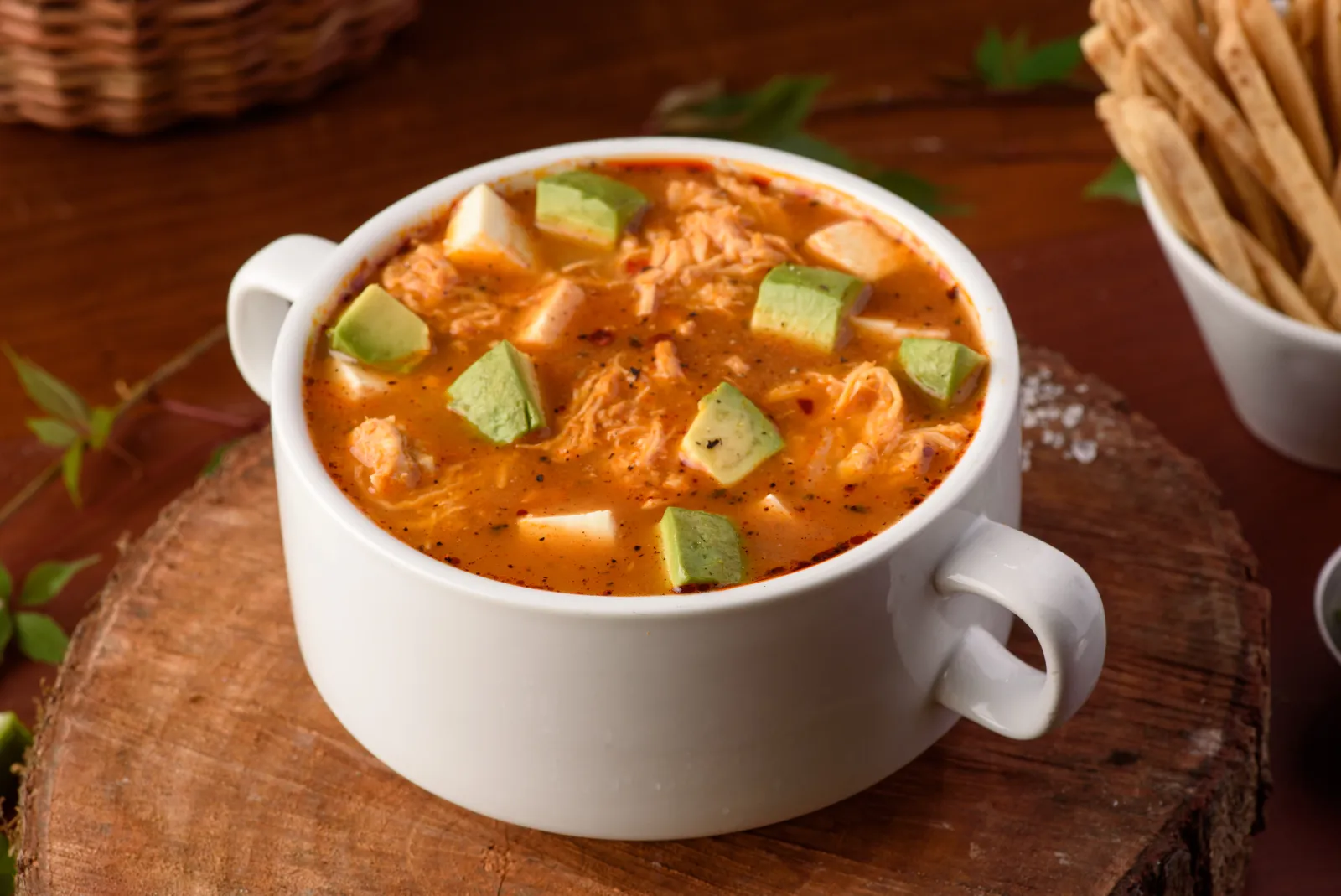

If the only tortilla soup you know is the chunky chicken one from a US chain restaurant, the Mexican original will surprise you: a thin, dark red broth of charred tomato and dried pasilla chile, ladled at the table over a pile of crisp fried corn tortilla strips, avocado, cheese and crema. In Mexico it’s mostly called sopa azteca (SOH-pah ahs-TEH-kah). The strips stay crunchy for the first few spoonfuls and then soften into the broth, and that change is the point. What follows covers the chile, the stock, the strips and the timing, with grocery swaps for US and UK kitchens.
What is sopa azteca, and how is it different from chicken tortilla soup?
How do you make Mexican tortilla soup? Char tomatoes, onion and garlic in a dry skillet, blend them with toasted and soaked dried pasilla chiles, and fry that sauce in the pot until it turns dark brick red. Add chicken stock and epazote and simmer 15 minutes. Pour the broth over fried tortilla strips, shredded chicken, avocado and cheese in each bowl. 70 minutes for 4 servings.
Sopa azteca and sopa de tortilla are the same dish; El Universal notes that sopa azteca is the name used mostly in Mexico, and that the name has no documented link to Aztec cooking. The Tex-Mex soup that took the name north is a different thing.
Neither is wrong. They’re two soups. If you want the Tex-Mex one, this isn’t that recipe; if you’ve had it and wondered what the Mexican version tastes like, it’s lighter, more about chile and tomato than about chicken, and the tortilla does far more of the work.
Is it worth making from scratch?
Yes, and it costs very little. 70 minutes on the clock, about 40 of them hands-on, if you make the stock; with good boxed stock and leftover chicken, it’s 40 minutes. Difficulty is medium only because three small things can go wrong: a scorched chile, an unfried sauce and soggy strips. All three are covered below.
When it shines. A weeknight once the stock is made, a cold evening, or a dinner where you put the toppings in the middle and let everyone build their own bowl.
When to skip it. For a packed lunch: the strips go soggy in a thermos unless you carry them separately.
Ingredients, and what to buy in the US and UK
The recipe card has exact amounts: 400 g (14 oz) of tomatoes, 3 dried pasilla chiles, 1.5 liters (6 cups) of stock and 8 corn tortillas make 4 bowls.
Pasilla chiles, and the labeling trap
A pasilla is a dried chilaca: long, 15-20 cm (6-8 in), nearly black and wrinkled, sometimes sold as chile negro. It rates under 4,000 Scoville units, so it’s mild; what it brings is a raisin-and-cocoa depth rather than heat. One dried pasilla weighs about 7 g (¼ oz).
Here’s the trap. In some US stores, fresh poblano peppers are labeled “pasilla”. Those are green, fleshy and fresh; what you need is dried, black and about a hand’s length. Check the bag, not the shelf tag.
Two go into the sauce (14 g / ½ oz) and one gets fried as a garnish. With only one, the soup is red and flat; with four, dark and edging toward bitter. If you want more heat, leave a few seeds in when you blend.
| Ingredient | What it does | US swap | UK swap | What changes |
|---|---|---|---|---|
| Dried pasilla | dark color, dried-fruit flavor | dried ancho (James Beard’s suggested substitute) | ancho from online chilli specialists | sweeter, less dark |
| Epazote | herbal, slightly piney note | dried epazote from Latin stores | dried, online; or leave it out | without it, still a good soup; don’t swap in another herb |
| Mexican crema | cools and softens the broth | crème fraîche | crème fraîche | almost nothing; sour cream can split in hot broth, as Rick Bayless warns |
| Queso fresco | mild, salty, softens in the heat | queso fresco is widely sold | mild feta, crumbled | feta is saltier, so use less |
| Corn tortillas | the strips | any supermarket corn tortilla | corn (not flour) tortillas, Mexican brands online | flour tortillas puff and go chewy; don’t use them |
In the UK, dried Mexican chillies and corn tortillas come from online specialists and Mexican import shops; buy the chiles first, since they keep for months in a sealed jar.
Homemade stock or a carton, and the sodium
The stock is three quarters of the bowl, so it matters. Homemade, from bone-in breast simmered 30 minutes, has more body from the collagen and lets you choose the salt. A carton saves half an hour but arrives salted: USDA data puts regular ready-to-serve chicken broth at 371 mg of sodium per 100 g, about 924 mg per cup.
With a carton, don’t salt until the very end, and taste first. If you want the broth itself to be the meal, clear and full of whole vegetables, Mexican caldo de pollo with corn and chayote uses the same bone-in method. Reduced-sodium broth lands at about the same number as homemade with salt.
Plan your time, make ahead and scale it up
70 minutes from cold, about 40 of them hands-on. The skillet work, the chiles and the tortilla strips all fit inside the 30 minutes the stock simmers.
Make ahead. The day before, make the strained stock, the shredded chicken and even the fried sauce, all refrigerated separately. Fry or bake the strips up to 2 days ahead and keep them in an airtight tin at room temperature. On the day, it’s 20 minutes to bring stock and sauce together and simmer.
How to tell each stage is right.
- Charred tomatoes → black blisters on the skin and they give when pressed, after 10-12 minutes.
- Toasted pasilla → smells of dried fruit, skin turns a shade lighter, no smoke.
- Fried sauce → after 6-8 minutes it’s dark brick red, spits less, and a spoon dragged through shows the bottom of the pot for a second.
- Strips → bubbling almost stops and they’re golden, not brown.
- Finished broth → thin and terracotta-colored. It’s not a cream soup.
| Ingredient | 4 bowls | 10 bowls |
|---|---|---|
| Bone-in chicken breast | 500 g (1.1 lb) | 1.25 kg (2¾ lb) |
| Water for the stock | 1.75 L (7½ cups) | 4.4 L (4⅔ quarts) |
| Plum tomatoes | 400 g (14 oz) | 1 kg (2.2 lb) |
| White onion | 110 g (4 oz) | 275 g (10 oz) |
| Dried pasilla chiles | 3 (21 g / ¾ oz) | 7-8 (50-55 g / 2 oz) |
| Corn tortillas | 8 | 20 |
| Hass avocados | 1 | 2-3 |
| Queso fresco | 100 g (3½ oz) | 250 g (9 oz) |
For 10 you need a 6-quart (6-liter) pot or bigger. Only two things slow down at that size: the stock takes longer to come to a boil, and the bigger batch of sauce needs closer to a dozen minutes to darken. Twenty tortillas are easier baked on two sheet pans than fried in seven batches.
Fried or baked tortilla strips, and when to add them
Fried strips go into oil at 350-360°F (175-180°C), 1-2 minutes per batch. By my calculation from USDA composition data for fried tortilla chips, 8 tortillas absorb roughly 21 g of oil, about 47 kcal per bowl. Baked strips, tossed with 1 tablespoon of oil, take 8-12 minutes at 400°F (200°C), stirred halfway, the method the University of Kentucky’s extension recipe uses: about 31 kcal of oil per bowl. That’s a difference of roughly 16 kcal, so choose on texture. Fried strips are richer and hold their crunch longer in the broth; baked ones are drier and soften sooner.
When to add them. In the bowl, with the broth poured over at the table, right before eating. In the pot they dissolve within minutes and turn the broth pasty. I put about 30 g (1 oz) under each serving and leave a plate of extra strips on the table.
Mistakes to avoid, spice level, kids and allergens
- Bitter broth → a chile scorched while toasting or frying. No fix; next time, seconds and no smoke.
- Tastes of raw tomato → the sauce wasn’t fried long enough. It has to darken before the stock goes in.
- Greasy, limp strips → oil below 350°F (175°C), or strips added to the pot.
- Bits of skin in the broth → blended too briefly. Strain the sauce into the pot.
- Too salty → boxed broth plus salt. Season only at the end.
Spice level, 1 out of 5. Seeded pasillas barely register. For more heat, leave seeds in or put a dish of fried chile de árbol on the table.
Will kids eat it? Mostly, yes: crunchy strips and melting cheese do the persuading. Serve their broth a little cooler and give them the strips on the side.
Allergens. Dairy from the cheese and crema; leave them off and the soup is dairy-free. Corn tortillas are naturally gluten-free, but check the packet and the stock carton if you cook for someone with celiac disease. Chicharrón is pork.
Which version to make
- Weeknight, 40 minutes → reduced-sodium boxed stock, leftover or rotisserie chicken, and baked strips in the oven while the sauce fries.
- Party for 10 → stock, chicken, sauce and strips the day before; on the day, a 20-minute simmer and a toppings bar.
- Lighter → baked strips, no crema or pork rinds. With homemade stock and only ½ tsp of salt, a bowl drops to about 365 mg of sodium.
- Vegetarian or vegan → 1.5 liters (6 cups) of vegetable stock and no chicken: each bowl loses about 113 kcal and 21 g of protein. The pasilla and the fried sauce carry the flavor. Skip cheese and crema, add extra avocado, and it’s vegan.
- No pasilla → dried ancho or guajillo, toasted and soaked the same way.
What it costs
At the US city average prices the Bureau of Labor Statistics published for August 2026, a whole chicken was $2.012 per pound and tomatoes $1.977 per pound. With the advertised prices in USDA AMS’s report of October 9, 2026 (Hass avocado $1.09 each, lime $0.50, white onion $1.22 per pound), the chicken, tomatoes, onion, avocado and lime come to $5.84, or $1.46 a bowl. Tortillas, dried chiles, cheese and crema aren’t in those datasets, so they’re left out; of them, the cheese usually costs the most.
In Mexico City, at SNIIM’s wholesale prices for the Central de Abasto the same day, a kilo of pasilla cost about eight times a kilo of tomatoes, yet the 21 g a pot needs come to roughly 4 pesos.
Yield. 4 large bowls with about 375 ml (1½ cups) of broth each plus strips, chicken and toppings, enough as a main. As a starter, it serves 6.
Toppings, serving and storage
What to expect. A light, terracotta broth with charred tomato and the dried-fruit depth of pasilla, very little heat. Strips that crackle, then soften. Avocado and crema cool it; chicharrón and fried chile bring salt and toast.
Toppings, by the numbers. Per bowl, ¼ avocado adds about 57 kcal; 25 g (1 oz) queso fresco, 75 kcal and 188 mg sodium; 1 tablespoon crema, 30 kcal; 7 g of chicharrón, 38 kcal and 127 mg sodium. Cheese and pork rinds are where the extra salt comes from.
What to serve with it. It’s a meal in a bowl; a dish of authentic Mexican guacamole with chips beforehand is all it needs, or a bowl of fresh pico de gallo if you want something lighter. For a bigger Mexican spread, Mexican pozole rojo is the heartier party soup, red menudo with beef tripe is the weekend-morning one, and leftover strips and salsa become chilaquiles verdes the next morning. If you like a homemade bone broth as the base of a soup, Colombian ajiaco and Colombian sancocho are built the same way, thick and mild where this one is thin and smoky.
Fridge. Broth and chicken in a sealed container, 3 to 4 days at 40°F (4°C) or below, per USDA FSIS, and into the fridge within 2 hours. Strips never go in the fridge or the broth: keep them airtight at room temperature, and I use them within 2 or 3 days. If they soften, 3 minutes in a hot oven brings them back.
Freezer. The broth, with or without chicken, keeps 2 to 3 months (FSIS guidance for soups). Freeze it without strips, avocado or dairy.
Reheating. Bring the broth back to a boil, or at least 165°F (74°C) in the center, and pour it over fresh or re-crisped strips.
Frequently asked questions
Is sopa azteca the same as tortilla soup? Yes. Sopa azteca is the name used most in Mexico; sopa de tortilla, tortilla soup, is the generic one.
What’s the difference between tortilla soup and chicken tortilla soup? Mexican tortilla soup is a thin tomato and dried pasilla broth poured over fried tortilla strips. The Tex-Mex chicken tortilla soup is a chunkier chicken soup, often with cumin, corn and beans, and tortilla on top.
What can I use instead of pasilla chiles? Dried ancho is the closest; the soup comes out sweeter and less dark. Guajillo makes it redder. Don’t use fresh poblanos labeled “pasilla”.
How do I keep the tortilla strips from getting soggy? Put them in the bowl and pour the broth over at the table, just before eating. Never add them to the pot, and fry them at 350-360°F (175-180°C) so they don’t soak up oil.
Can I bake the tortilla strips instead of frying? Yes: toss with 1 tablespoon of oil and bake at 400°F (200°C) for 8-12 minutes, stirring halfway. They’re drier and soften faster, and save only about 16 kcal a bowl.
Can you freeze tortilla soup? Freeze the broth for up to 3 months, never the strips. Add strips, avocado and dairy fresh when you serve.
Is tortilla soup spicy? Barely. Seeded pasilla chiles are mild; leave some seeds in, or add chile de árbol, for heat.
Nutrition
Per bowl (serves 4, without avocado, cheese, crema or pork rinds), calculated ingredient by ingredient from USDA FoodData Central (SR Legacy) with the amounts above, counting 375 g (13 oz) of meat in 500 g (1.1 lb) of bone-in breast, the salt in the pot, and about 21 g of oil absorbed by the fried strips, estimated from the composition of fried tortilla chips:
- Calories: 340 kcal
- Protein: 26 g
- Carbohydrates: 30 g
- Fat: 14 g, of which 2 g saturated
- Fiber: 6 g
- Sugars: 4 g
- Sodium: 946 mg
The full set of toppings (¼ avocado, 25 g cheese, 1 tablespoon crema, 7 g pork rinds) adds about 200 kcal and 315 mg of sodium per bowl. Almost all the soup’s own sodium is the salt in the pot, 872 of the 946 mg.
I’m Venezuelan, cooking in Colombia, and Mexican soups weren’t part of how I grew up. What won me over with this one was the table: a pot of dark broth, a plate of strips and four bowls that each end up different. Toast the chile for seconds, fry the sauce until it darkens, and keep the strips out of the pot. Josnaisis.