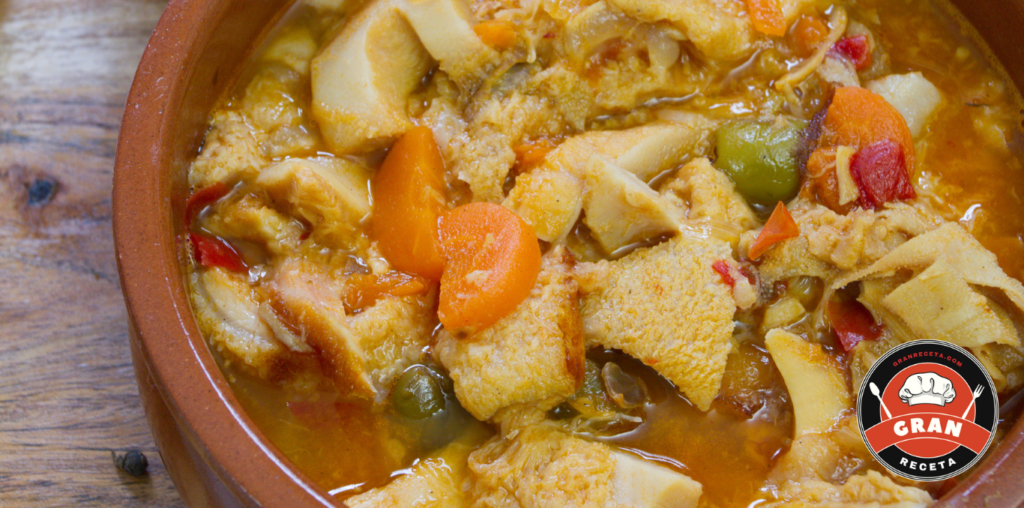
Mondongo paisa, the Colombian tripe soup, has two problems, and both are settled before the pot goes on the heat: the smell and the texture of its 1 lb of tripe. The smell goes with lime, coarse salt and 15 minutes of scrubbing, plus a first boil you pour away; no amount of seasoning rescues badly cleaned tripe. The texture is a matter of time: tripe is almost pure collagen and needs an hour under pressure, or two and a half in a regular pot, to stop being rubbery. Get both right and you have 8 bowls of 380 calories with 28 g of protein in 160 minutes.
How do you make mondongo? Scrub the tripe with lime and coarse salt, rinse it well, boil it briefly and discard that water, then pressure-cook it for an hour. Add the strained broth, pork ribs, chorizo and a tomato sofrito for 30 minutes, then the vegetables in stages. About 160 minutes for eight bowls.
Cleaning the tripe
Most tripe sold in US supermarkets and Latin butchers comes pre-cleaned and bleached, and it still benefits from a scrub: lime and coarse salt strip the film left in the folds, which is where the smell lives. Work it the way you’d hand-wash a garment, into the creases, and rinse until the water runs clear.
Then the step most people skip: a 5-minute first boil whose water gets thrown away. In those five minutes a gray foam rises carrying whatever the scrub didn’t take. Keep that water “so as not to lose flavor” and the broth stays cloudy with the background smell people associate with tripe and that is, in fact, avoidable.
How long it actually needs
Tripe is connective tissue: per USDA, a 100 g portion carries 12 g of protein and under 4 g of fat, almost all of it collagen. That collagen only softens with moist heat and time, and until it turns to gelatin the texture stays rubbery, which is what makes people call tripe chewy.
One hour in a pressure cooker from the moment it comes to pressure, or two and a half hours in a regular pot, is the mark: the tripe yields to the bite but holds its shape. Past four hours it goes the other way and shreds into threads with no bite left.
And unlike the first boil, the broth from this cooking does not get thrown out: it carries the gelatin that gives the soup its body. Strain it and it goes back in.
The order of everything else
The soup is built in layers of time. Tripe goes first and alone, because it takes longest. Then the pork ribs and chorizo, which need half an hour and bring the fat that rounds out the broth. Vegetables come last, in stages: the cassava and cubed potatoes get a head start, then corn, carrot, small potatoes and peas join for the final stretch.
Putting everything in at the start is the classic mistake: by the time the tripe is ready, the vegetables have been disintegrating for two hours and the soup is a purée.
The sofrito goes in with the meats, not at the beginning: tomato cooked for three hours loses its acidity and its color, and takes the soup brown with it.
Paisa, coastal and menudo
If you know Mexican menudo, this is its Colombian cousin with vegetables: same tripe, but a full soup with potato, cassava, corn, peas and carrot, seasoned with a tomato sofrito and cumin rather than guajillo chile. Coastal Colombian mondongo swaps potato for yam and uses annatto and ají dulce.
On a paisa table, mondongo is a one-dish meal in the way sancocho is, and it comes with white rice on the side.
Step by step
The pressure cooker, nearly essential
You can make it without one, and for centuries people did, but that’s two and a half hours of tripe instead of one, with the pot occupied and water evaporating. If you use one, count the time from when the valve starts hissing, not from when you light the burner.
When you open it, taste a piece before going on. If it still feels rubbery, give it 15 more minutes under pressure; nothing added later will soften it.
Who this recipe is for
- If your tripe isn’t pre-cleaned → any Latin butcher sells it parboiled; scrub it with lime regardless
- If you have no pressure cooker → 150 minutes over medium heat, topping up with hot water
- If you can’t find Colombian chorizo → fresh Mexican chorizo, browned and drained, or double the pork ribs
- If you want the coastal version → swap the potato for yam and the cumin for annatto and ají dulce
- If you’re cooking for 16 → double everything except the vegetables, which go by eye depending on the pot
What goes wrong
Skipping the cleaning. The smell doesn’t leave with spices. Lime, coarse salt, 15 minutes.
Keeping the first boil. That water holds what the scrub didn’t take. Pour it away.
Cutting the cooking short. The tripe stays rubbery and nothing later fixes it. Taste before adding anything else.
Everything in at once. The vegetables disintegrate while the tripe softens. In stages.
Sofrito from the start. Tomato loses color and acidity over two hours of cooking. It goes in with the meats.
What to serve it with
White rice on the side, sliced avocado and lime, which is how a 380-calorie bowl is served in Antioquia. The lime isn’t garnish: it cuts the fat and lifts the broth. A bowl of this soup carries as much protein as a chicken breast, which is why mondongo needs nothing beyond the rice. For dessert, something cool like mazamorra or a stovetop flan. In Venezuela we call it mondongo too, though ours carries more green vegetables and no chorizo, closer to a sancocho than to this soup. For the coastal soup at the other end of the effort scale, Colombian mote de queso needs 2 ingredients and 70 minutes, and for the big Sunday pot with three meats in it, sancocho trifásico. And for offal handled the same way, scrubbed first and cooked long, there is Colombian beef tongue. For a long braise of a different old bird, Colombian stewed hen.
Storage
The soup keeps 4 days in the fridge, within the USDA window for cooked dishes, and should be chilled within 2 hours. It improves overnight, as the tripe keeps drinking the broth.
It freezes well for 3 months, better without the potato, which disintegrates on thawing and clouds the broth. If you plan to freeze it, pull the potato out and add it fresh when reheating. Reheat over medium heat with a splash of water until it simmers.
Questions people ask
How do you get rid of the smell? Scrub it with lime and coarse salt for a quarter of an hour, rinse until the water runs clear, and give it a brief first boil whose water you throw away. That’s the whole secret.
How long does tripe cook? An hour in a pressure cooker from the point it comes to pressure, or two and a half hours in a regular pot. Less than that leaves it rubbery.
What is mondongo? Beef tripe, the stomach lining, the same cut sold as menudo or pancita elsewhere. It’s connective tissue, lean for an offal cut: per USDA the fat stays under 4 g per 100 g, and the protein is mostly collagen.
Can I use honeycomb tripe from the supermarket? Yes, and it’s the easiest to find in the US. It’s usually pre-cleaned, so the scrub is shorter, but don’t skip the first boil.
How many calories in a bowl? Around 380, and the protein is the notable part, calculated from the USDA database for the tripe, pork ribs, chorizo and vegetables.
Can I freeze it? Yes, up to 3 months, better without the potato, which falls apart and clouds the broth on thawing.
Nutrition
Per bowl, one eighth of the pot, from the USDA database: about 380 kcal, 32 g carbohydrate, 14 g fat of which 5 g saturated, 28 g protein, 4 g fiber, 3 g sugar and 640 mg sodium.
It’s one of the highest-protein soups on this site, because tripe carries 12 g of protein per 100 g with only 3.7 g of fat per USDA; most of the fat in the bowl comes from the chorizo and the pork ribs. The carbohydrate is potato, cassava and corn.
Mondongo divides people like few dishes do: you either love it or won’t touch it. It won me over in a fonda in Medellín, the bowl scalding and a wedge of lime beside it, and I came to think most people who say they don’t like it have only had one that was badly cleaned. It’s a dish of patience and a big pot, made on a Sunday and better still on Monday. Josnaisis.