
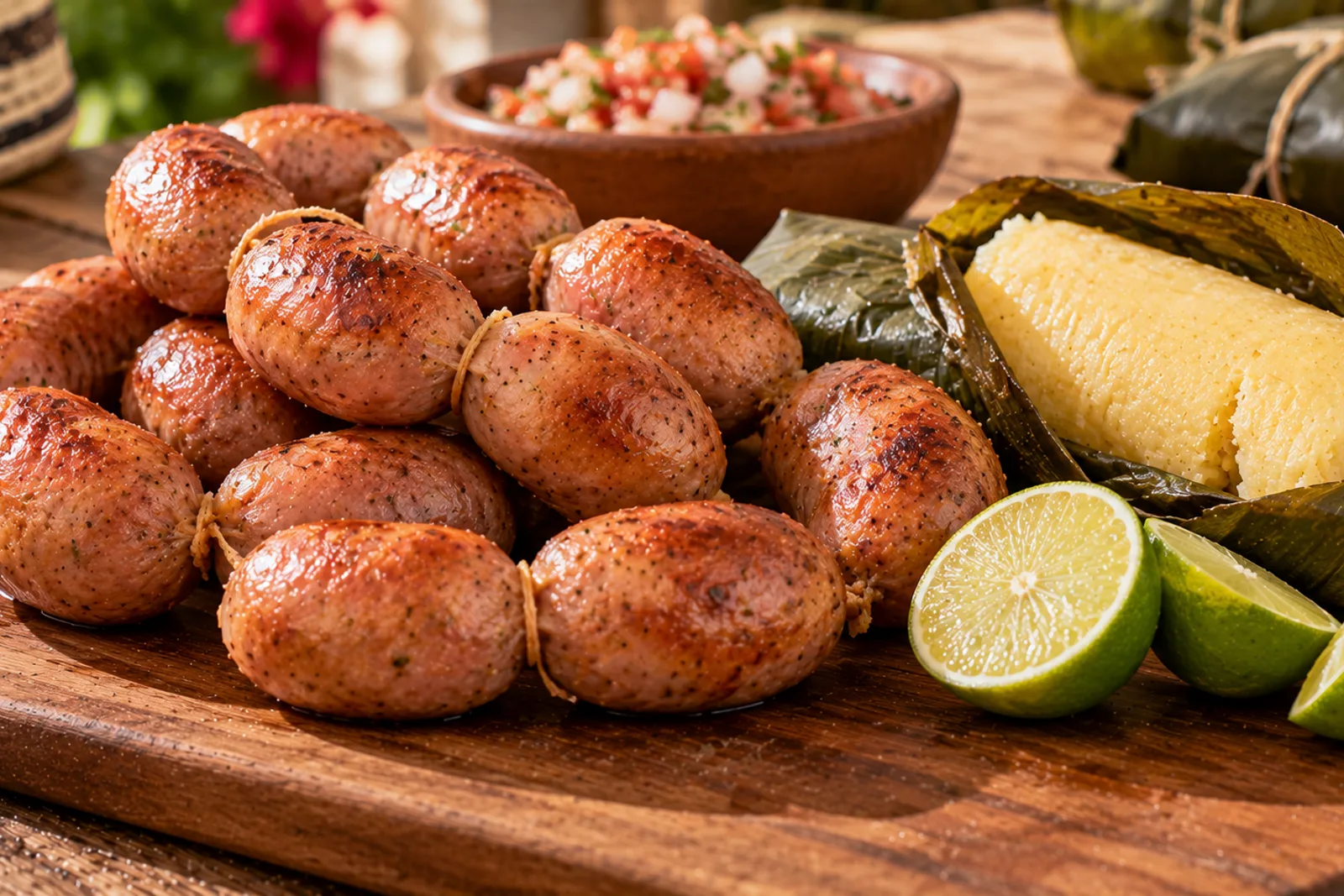

Butifarras are the little sausages of Soledad, the town next to Barranquilla on Colombia’s Caribbean coast: beef, pork and pork fat ground with salt, black pepper and garlic, stuffed into casings, tied off into balls with string and poached in water that never boils. They come out firm, juicy and a little peppery, and they are eaten warm with lime and a cassava roll. One kilo (2.2 lb) of meat makes about 26 balls of 40 g (1½ oz) in 2 hours, and three things decide how they turn out: very cold meat, casings filled without strain and water held at 176–185°F (80–85°C).
What Colombian butifarras are like
How do you make Colombian butifarras? Grind 500 g (1.1 lb) beef, 300 g (10.5 oz) pork shoulder and 200 g (7 oz) pork fat while very cold, knead with 15 g salt, pepper, garlic and ¼ cup ice water, stuff into natural hog casings and tie every 4 to 5 cm (1½ to 2 in). Poach for 25 to 30 minutes at 176–185°F (80–85°C), without boiling, until the center hits 160°F (71°C). 120 minutes for 6 servings.
In Soledad they are sold on the street from metal basins and cut off the string with a knife, as many as you ask for. The mix leans more on beef than pork, black pepper is the main seasoning, and the fat is what keeps the inside tender. They are a snack, a breakfast and a party food all at once.
Not the Catalan botifarra. If you know Spanish botifarra, that one is all pork, long, and the fresh kind is grilled. The Colombian one mixes beef and pork, is tied into balls about the size of a large walnut, and is cooked in water.
It also isn’t Colombian chorizo, which is pork with green onion and gets browned after poaching, or Colombian blood sausage, which is made with rice and blood. Butifarras go straight from the pot to the table.
Time and difficulty. 2 hours, about one of them hands-on, the rest soaking, chilling and poaching. Medium: nothing tricky, but stuffing and tying take a while the first time.
Ingredients and meat ratio, 2.2 lb for 26 butifarras
The recipe serves 6, about 4 balls each as a snack with cassava rolls.
Beef, pork and fat
- Lean beef, 500 g (1.1 lb). In Soledad the leg shank is the usual cut. In the US, beef shank or chuck; in the UK, shin of beef or chuck steak.
- Pork shoulder, 300 g (10.5 oz). Boston butt in the US; pork shoulder in the UK.
- Pork fat, 200 g (7 oz). Unsmoked and skinless: fatback, or belly with the rind off. It is 20% of the mix and it is what keeps each ball juicy. In the UK, ask the butcher for pork back fat. Cut it down and they turn dry.
Some cooks flip the ratio and use more pork than beef. The result is milder and paler, and still a butifarra.
Using ground meat. Ask the butcher to grind the beef, pork and fat together once through a medium plate. Supermarket ground beef and ground pork (beef mince and pork mince in the UK) work if they are not the lean kind; very lean meat makes hard, dry balls.
Salt, pepper and garlic
15 g of salt per kilo (2.2 lb) of meat, 1.5% by weight: less and the mixture doesn’t bind, more and it’s salty. Kosher salt is lighter by volume, so weigh it rather than measuring by the spoon. Pepper is the flavor of a butifarra, and freshly ground smells and bites more than pre-ground. Cumin is optional. Some butifarra makers add allspice; if you do, only a pinch, because it takes over quickly.
Casings, where to buy them and how much
Use natural hog casings, 32 to 35 mm, the standard bratwurst and Italian sausage size. They come packed in salt, in hanks or on plastic tubes, and keep a long time in the fridge in their salt.
- US. Butcher counters, Latin meat markets and sausage-making suppliers online, sold as natural hog casings 32-35 mm.
- UK. Many independent butchers can order them, and sausage-making suppliers sell them online.
One kilo (2.2 lb) of meat fills about 1.3 m (4½ ft) of casing; buy 2 m (6½ ft) to leave room for the knots and any torn piece. Pack leftovers back in coarse salt and keep them in a sealed jar in the fridge.
No natural casings? Collagen casings of the same width work, but they don’t tie into balls as neatly and the skin is less snappy. With no casing at all you end up with poached meatballs, not butifarras.
Equipment. A meat grinder with a 6 mm (¼ in) plate (or pre-ground meat), a sausage stuffer or the stuffing horn for your grinder, a large pot and an instant-read thermometer. Without a stuffer, a piping bag with a wide plain tip will do for one batch; it’s slower and lets in more air.
How to plan the 2 hours
The casings go into the water first thing, and the meat chills in the freezer at the same time, so both are ready together.
Make ahead. The kneaded mixture keeps 1 day, covered, in the fridge, so on the day you only stuff, tie and poach. The casings can soak overnight in cold water in the fridge.
How to make butifarras, step by step
Cleaning the casings
Rinse off the salt and soak them in warm water, around 86°F (30°C), for 1 to 2 hours: cold water won’t soften them and hot water starts to cook them. Before stuffing, slip one end over the tap and run water through: it flushes the inside and shows any holes. If a stretch leaks, cut there. A final rinse in water with lime juice takes away the smell.
Grinding and kneading with nearly frozen meat
The cubes should go into the grinder firm and almost hard at the edges, after 30 minutes in the freezer. If the meat is warm, the fat smears instead of cutting cleanly and the sausage turns crumbly.
Dissolve the salt and spices in the ice water before adding them: they spread more evenly than sprinkled. Knead for 3 minutes. At first the mixture looks loose and grainy; when it’s ready it sticks to your fingers and pulls into threads. That is what holds each ball together when you cut it.
Always test. Fry a teaspoon for 2 minutes and taste. Once stuffed, the salt can’t be fixed.
Stuffing
Slide the casing onto the horn like a stocking, leaving 10 cm (4 in) hanging free and untied for now, so the first air can escape. Fill with steady pressure, guiding the casing with your other hand so it fills evenly. Firm but not tight: if it doesn’t give at all when you press it, it’s overstuffed and will split when you tie it or in the pot. Make one long rope and tie both ends.
Tying the balls
Every 4 to 5 cm (1½ to 2 in), pinch the rope between thumb and forefinger, twist that portion 2 turns so it rounds out, and tie a 15 cm (6 in) piece of twine there with a double knot. Keep going without cutting the rope: butifarras are cooked and served on a string.
If you see air bubbles under the casing, prick them with a clean needle before cooking. Only the bubbles: pricking the balls all over lets the juices run out into the water.
Poaching below a boil
The water should be at 176–185°F (80–85°C): steaming, with small bubbles rising from the bottom while the surface stays still. At a full boil, 212°F (100°C), the filling swells faster than the casing can stretch and it splits.
Lower in the string and poach for 25 to 30 minutes, turning the heat down if it starts to boil. They’re done when the center of one ball reads 160°F (71°C), the safe temperature for sausage made from ground pork and beef. To check, lift out one ball and push the probe in from the side, halfway through its thickness, to the center. Color and clear juice don’t guarantee that temperature: if it isn’t there yet, return it to the water for 5 minutes and check again.
Out of the pot, 2 minutes in cold water stops the cooking and tightens the casing. Then drain and let them cool a little.
Why they burst, dry out or look baggy
- They burst in the pot. The water boiled or the casing was too full. If one splits, take it out and eat it yourself; the rest will be fine once you lower the heat.
- Dry and crumbly inside. The meat was warm when ground, or there wasn’t enough fat. You can’t drop the fatback without changing the texture.
- Loose or hollow balls. Air got in or the casing filled unevenly. They taste the same but wrinkle as they cool.
- Tough casing. Not enough soaking. One hour in warm water is the minimum.
- Bland. The salt was measured by eye. That’s what the test patty is for.
Heat and allergens. Mild to medium heat from the pepper; for kids, cut it to 1 teaspoon. No gluten, no dairy.
Variations, and quantities for 12 or 25 people
- More pork than beef. 500 g (1.1 lb) pork and 250 g (9 oz) beef, with no extra fat if the pork is well marbled: paler and milder.
- With vinegar. Some cooks swap the ice water for white vinegar, for a sour note that the lime already adds at the table.
- Hotter. Toast whole peppercorns in a dry skillet for 1 minute before grinding, or go up to 3 teaspoons.
- For a party. Make them the day before, refrigerate them cooked and rewarm them in hot water that isn’t boiling.
For more people, multiply the recipe. Stuffing and tying take longer as the batch grows, so for 4 kg (8.8 lb) it helps to be two: one stuffs, one ties.
How to serve, store and reheat them
Serving. Snip the strings or put the whole string on the table and let everyone cut their own. Squeeze lime over, add a pinch of salt if you like, and serve with Colombian cassava rolls, the pairing nobody in Soledad skips. They also go with hard-boiled eggs, on a Colombian picada platter or a coastal-style fritanga, and next to Barranquilla mullet rice. The casing is edible; some people peel it off.
Warm or at room temperature, the way they’re sold on the street, but don’t leave them out of the fridge for more than 2 hours.
Fridge. Cooked and cooled, in a sealed container, 3 to 4 days. Raw, already stuffed, 1 to 2 days at most before poaching.
Freezer. Best frozen cooked: cool them, freeze them in strings in an airtight bag and they keep their texture for 1 to 2 months. Thaw overnight in the fridge.
Reheating. In hot water that isn’t boiling, 5 to 8 minutes, until hot in the center, 165°F (74°C). In the microwave the casing shrinks and can split; if you use it, cover them and use medium power.
Frequently asked questions
Are butifarras eaten hot or cold? Both. On the street they’re sold warm or at room temperature, freshly cooked. Straight from the fridge the fat tastes hard, so warm them in water for 5 minutes.
Should I prick sausages before cooking them? Only the air bubbles. Pricking the whole ball lets its juices leak into the water.
Can I make them without a sausage stuffer? Yes, with a piping bag and a wide plain tip, or a wide funnel and your thumb. It’s manageable for 1 kg (2.2 lb); for more, the stuffing attachment for a grinder is worth it.
Why are they gray inside instead of pink? That’s the normal color of beef and pork poached in water. Sausages that stay pink inside contain curing salt, which this home recipe doesn’t use.
Nutrition
Per serving (about 4 balls, 1/6 of the recipe), calculated from the raw ingredients:
- Calories: 400 kcal
- Protein: 30 g
- Carbohydrates: 1 g
- Fat: 30 g, of which 11 g saturated
- Fiber: 0 g
- Sugars: 0 g
- Sodium: 1,065 mg
Some of the fat stays in the poaching water, so the real figure is a little lower. Sodium is high because of the 15 g of salt per kilo, the amount that makes the mixture bind; a cassava roll on the side adds no salt.
I always tie them smaller than seems necessary, because they swell in the water and a 4 cm (1½ in) ball ends up at a bite and a half. And I never skip the test patty: the salt in the casings and the fat changes from one purchase to the next, and that’s the only chance to correct it. Josnaisis.