
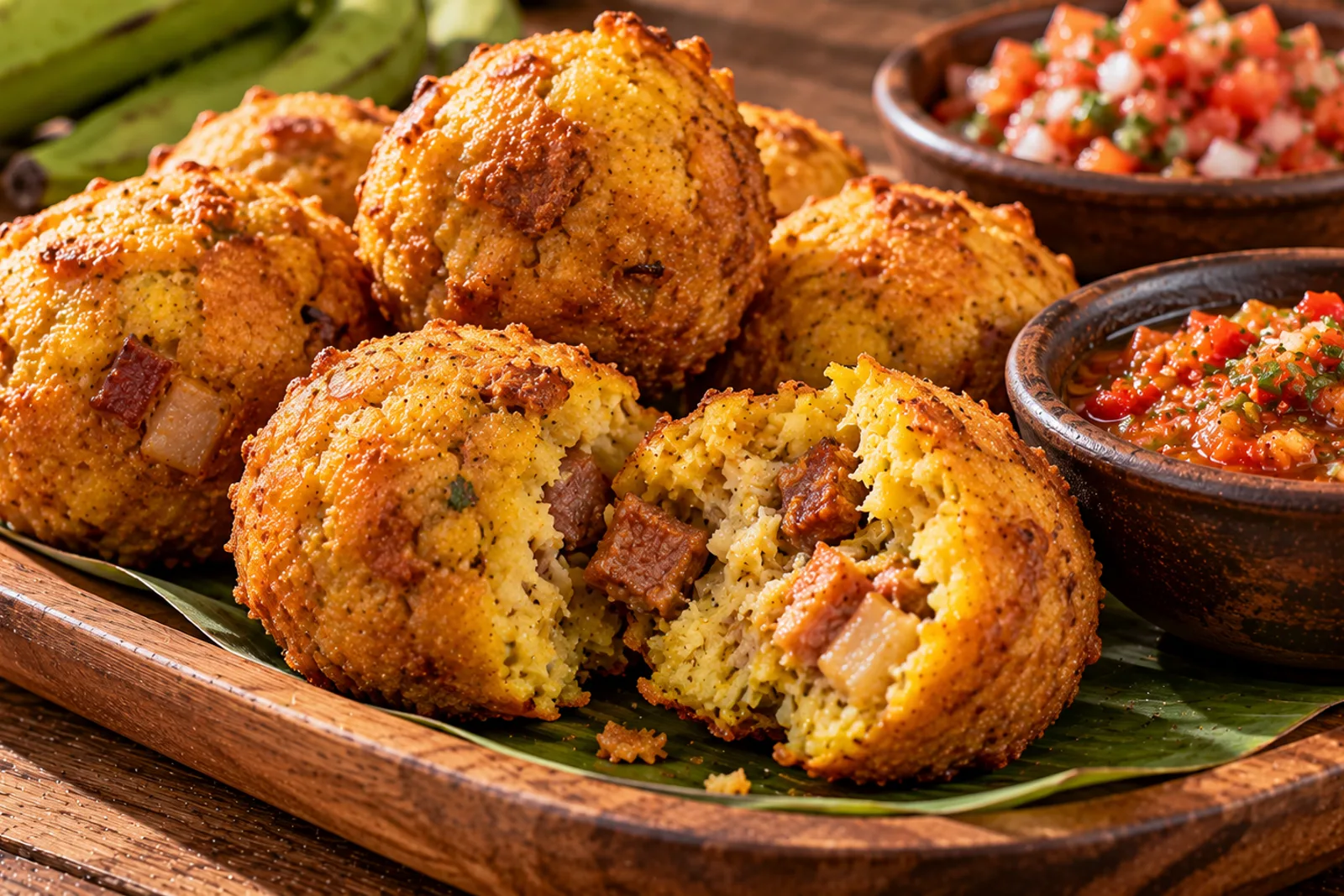

Marranitas (mah-rah-NEE-tahs, literally “little piggies”) are one of the street snacks of Cali, in southwestern Colombia: balls of green plantain about the size of a golf ball, fried once to cook the plantain, wrapped around chopped crispy pork belly and fried again for a hard golden shell. Bite through and you get a crackling outside, a soft layer of starchy plantain and salty, crunchy pork in the middle. In Colombia a pig is a marrano, and pork is the whole point of the filling.
How to make marranitas, the short version
How do you make marranitas? Fry 12 chunks of green plantain at 320°F (160°C) for 10 minutes per batch until soft but pale. Flatten each hot chunk to ¼ in (6 mm), brush it with garlic water, wrap it around 30 g (1 oz) of chopped fried pork belly and squeeze into a ball. Fry the balls at 355°F (180°C) for 4 to 5 minutes until golden. 60 minutes for 6 servings.
Total time 60 minutes if the pork is already cooked: 20 to prep and heat the oil, 40 for the two fries and the shaping. Medium difficulty. The flavors are simple. What takes a little practice is wrapping each ball fast, while the plantain is still hot enough to seal.
Marranitas vs. other plantain snacks. Their cousin from the same region, aborrajados, use very ripe sweet plantain stuffed with cheese and dipped in batter. Ecuador’s bolon de verde mashes all the plantain with lard and mixes the cheese and pork through it, then browns it in a skillet. Tostones go through the same fry, smash and fry again, but are served flat with nothing inside.
Ingredients, and what to buy in the US and UK
One plantain makes 3 marranitas; the recipe makes 12, two per person as a starter, with 30 g (1 oz) of pork in each.
| Ingredient | Amount | What to buy, and what changes |
|---|---|---|
| Green plantains | 4 large, about 750 g (1⅔ lb) peeled | Fully green and hard. Yellow patches mean more sugar: they brown before they soften and tear when flattened. US: most supermarkets. UK: Caribbean and African grocers, bigger supermarkets |
| Chicharrón | 360 g (12¾ oz) cooked, chopped | Fried pork belly with meat. US: Latin butchers. US and UK: about 18 slices (500 g / 1 lb 2 oz raw) bacon, fried crisp and chopped; smokier |
| Garlic water | 120 ml (½ cup) water, 2 cloves, ½ tsp salt | Seasons the plantain and keeps the disc pliable while you fold it |
| Frying oil | 1 liter (about 4¼ cups) | Any neutral oil: vegetable, sunflower, canola (UK rapeseed) |
The pork, honestly. Colombian chicharrón is skin-on pork belly simmered and then fried in its own fat. If you want to make it, the Colombian chicharrón method turns about 600 g (1⅓ lb) of raw belly into the 360 g (12¾ oz) you need, and it keeps 3 to 4 days in the fridge, so do it the day before. Bacon is the easy swap and works well; it just tastes smoky. Pork rinds and UK pork scratchings crunch, but they have almost no meat and the filling ends up dry.
Equipment. An 8 in (20 cm) saucepan, where 1 liter of oil sits about 1¼ in (3 cm) deep, a slotted spoon and two sheets of plastic (a zip-top freezer bag cut open along the sides is ideal). For flattening, a tostonera (the hinged wooden plantain press sold in Latin stores, pataconera in Colombia), a cutting board or the base of a heavy pan. A thermometer makes the two temperatures easy.
Step by step, with the signs to look for
The order matters because the plantain has to be flattened hot: while one batch is in the oil, you shape the one before it.
First fry, soft but pale
Keep the oil at 320°F (160°C). Without a thermometer, drop in one chunk: it should bubble steadily and calmly. If it spits and browns within a couple of minutes, it’s too hot. Fry 6 chunks for 10 minutes, turning halfway. You want soft and pale yellow: a fork reaches the center with no resistance and the chunk gives when you press it. Leave it until golden and the surface hardens, and the disc will snap when you flatten it.
Flatten, fill and seal
Let the chunk sit a minute, just until you can handle it, then flatten it between the plastic sheets with one firm press to ¼ in (6 mm), a disc about 4 in (10 cm) across. Brush both sides with garlic water and hold it, still on the plastic, in your palm.
Put the pork in the center, keeping about ⅜ in (1 cm) of plantain clear around it. Lift the plastic to fold the plantain up over the filling, twist the top closed like a candy wrapper and squeeze the ball with both hands. The plastic keeps you from burning your fingers and stops the plantain sticking. If a crack opens, dab it with garlic water and press it shut.
The shaped balls can wait on a plate until all 12 are done; cooling a little before the second fry does no harm.
Second fry, the shell
Raise the oil to 355°F (180°C) and fry 4 at a time for 4 to 5 minutes, turning so they color evenly. Crowd the pan and the oil cools, the shell takes longer to set and the balls soak up oil. Don’t overshoot either: above about 385°F (195°C) the shell darkens before the center heats through. They’re done when they’re evenly golden and the shell sounds hard when tapped with the spoon. Drain on a wire rack, which lets steam escape underneath and keeps them crisp longer.
If they crack, burst or turn out greasy
Nearly every problem traces back to temperature: plantain that cooled before shaping, or oil that wasn’t hot enough on the second fry.
- Cracks while you close it. The plantain cooled, or got too golden in the first fry. Shape it as soon as you can handle it and pull it out pale; dab cracks with garlic water.
- Bursts in the oil. The seal wasn’t tight, or the filling reached the edge. Twist the top firmly, keep a ⅜ in (1 cm) border and don’t go over 30 g (1 oz).
- Greasy. The oil was under 355°F (180°C) or the batch was too big. Let it come back to temperature between batches.
- Hard and dry inside. The first fry was too long or too hot. At 320°F (160°C), 10 minutes is enough.
- Sticky and sweet. The plantain had started to ripen. Use fully green ones.
Allergens and heat. Contains pork. No gluten, eggs or dairy, though check the label on store-bought chicharrón or bacon. Not spicy at all; the heat is in the ají on the side, so kids usually like them plain. For small children, chop the pork finer, since hard crunchy bits are tough to chew.
Make ahead, freeze and serve
The day before. Fry and chop the pork; it keeps 3 to 4 days in a sealed container in the fridge. The plantain must be fried and shaped in one session, because cold plantain won’t seal. Shaped balls, before the second fry, keep up to 24 hours covered in the fridge.
Freezing. Freeze them shaped but not yet fried a second time, spaced apart on a tray, then bagged, for up to 3 months. I fry them straight from frozen at 340°F (170°C), a few minutes longer than fresh, until golden and the center reaches 165°F (74°C); without a thermometer, cut one open: the pork in the middle should be steaming. Thawed first, the surface turns wet and spatters.
Leftovers. Refrigerate fried marranitas within 2 hours; they keep 3 to 4 days. Reheat in a 350°F (175°C) oven for 10 to 12 minutes, or in an air fryer, until the center reaches 165°F (74°C). The microwave heats them but softens the shell.
Serving. Hot from the oil, with Colombian ají picante, a fresh sauce of green onion, cilantro, chili and lime, or with the tomato and scallion hogao from Colombian patacones. Guacamole or a squeeze of lime also work. For a Cali-style snack spread, serve them alongside Colombian empanadas.
For a party. For 24, use 8 plantains and 720 g (1 lb 9½ oz) of pork; for 48, 16 plantains and 1.44 kg (3 lb 3 oz). Shape everything before guests arrive and do only the second fry at the last minute. For bite-size ones, cut each plantain into 4 and use 20 g (¾ oz) of filling: 4 plantains make 16, and the second fry drops to 3 to 4 minutes.
Marranitas FAQ
Can I skip the tostonera? Yes. Mash each hot batch in a bowl with 2 tbsp of the garlic water, divide it into 6 portions and shape each one around the pork. It’s easier to seal and the plantain layer comes out more even, but denser.
Can I make them in an air fryer? Only the second cook. Brush the shaped balls with a little oil and air-fry them, turning halfway; the shell is drier and less even than deep-fried. Do the first fry in oil, because the plantain needs to come out soft enough to flatten.
Can I add cheese? It isn’t the classic version, but a ⅜ in (1 cm) cube of salty white cheese, such as queso fresco or feta, alongside the pork works. Seal it extra carefully, because melted cheese finds any crack.
How many calories are in one marranita? About 285 kcal each, pork included. Most of it comes from the pork belly and the oil the plantain absorbs.
Nutrition per serving
Per serving of 2 marranitas, calculated ingredient by ingredient from the recipe amounts:
- Calories: 570 kcal
- Protein: 22 g
- Carbohydrates: 47 g
- Fat: 32 g, of which 11 g saturated
- Fiber: 3 g
- Sugars: 3 g
- Sodium: 790 mg
The fried plantain accounts for about 290 kcal per serving and the pork for about 280. Oil from the second fry is not counted separately, since it varies with temperature and batch size. Sodium depends mostly on how salty your chicharrón or bacon is.
I always shape marranitas with the plastic in my hand rather than bare fingers. Plantain fresh out of the oil is hot, and if I wait until it’s comfortable to touch, it won’t close. My routine is chicharrón the night before, plantain the next day, and a few unfried balls set aside in the freezer whenever I make a batch. Josnaisis.