
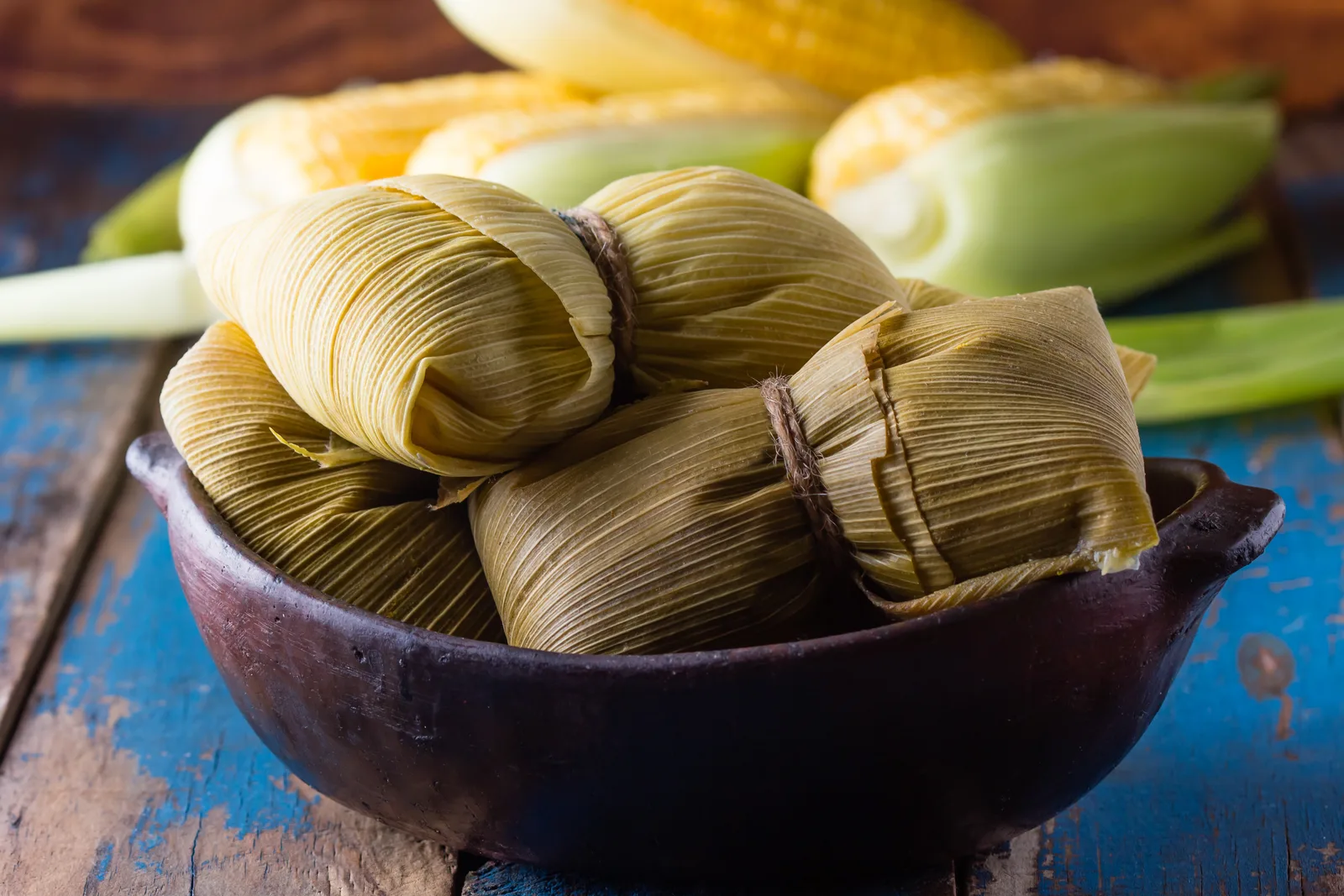

Humitas (oo-MEE-tahs) are what Chileans make from the summer corn crop: raw corn grated off the cob, mixed with onion cooked soft in lard, plenty of fresh basil and a little paprika, then wrapped in two of the ear’s own husks, tied and simmered for 40 minutes. The result is a firm, moist corn parcel with no filling, eaten hot and opened on the plate, either with a spoonful of sugar or next to a tomato salad. The one thing that decides whether yours hold together is the corn: the sweet corn sold in American and British supermarkets is wetter than the starchy Chilean kind, so the dough needs checking, and often a little cornmeal, before you wrap.
What humitas are, and how they differ from tamales
How do you make Chilean humitas? Grind 3¾ lb (1.7 kg) of fresh corn kernels with 30 basil leaves, mix with a large onion softened in ¼ cup (50 g) of lard, salt and sweet paprika, and spoon ⅔ cup (150 g) of dough onto two overlapping corn husks. Fold, tie in a cross and simmer in salted water for 40 minutes, until the dough is firm and peels away from the husk. 120 minutes for 6 servings.
A tamale is made from masa, dried corn that has been cooked in lime and ground, usually beaten with lard and stuffed with meat, salsa or something sweet. A humita uses fresh corn ground raw, so it tastes like the ear itself: sweet, grassy and milky, with the basil and onion right behind. The Chilean version has nothing hidden in the middle and no heat at all; the paprika is only for color.
Two related recipes on this site cover the same corn in other shapes. Colombian corn envueltos are steamed in the husk with butter, sugar and a stick of fresh cheese, and Chilean pastel de choclo spreads almost the same basil-corn paste over a beef filling and bakes it.
Time. 2 hours in all, with about 65 minutes of hands-on work. The 40 minutes in the pot need no attention. Medium difficulty: nothing is technical, but your first few ties will come out crooked.
Ingredients, with US and UK swaps
This makes 12 humitas of about 5 oz (150 g), 2 per person as a main course with salad.
| Ingredient | Metric | US | Notes and swaps |
|---|---|---|---|
| Corn kernels | 1.7 kg | 3¾ lb (12 large ears) | White corn if you can find it |
| White onion | 200 g | 1 large | Yellow onion works |
| Lard or butter | 50 g | ¼ cup | Oil makes it vegan |
| Fresh basil | 15 g | 30 large leaves | Genovese type, not Thai |
| Sweet paprika | 2 g | 1 tsp | Not smoked |
| Fine salt | 12 g | 2 tsp | |
| Fine cornmeal | up to 40 g | up to 4 tbsp | UK: fine polenta. Only for sweet corn |
| Milk | up to 120 ml | up to ½ cup | Only if the corn is old and dry |
The corn problem, and how to fix it
In Chile humitas are made with choclo humero, a creamy white field corn with thick husks and enough starch to set the dough on its own. In the US and the UK, almost all fresh and frozen corn is sweet corn, bred to store sugar instead of starch and full of water. Ground the same way, it gives a looser, sweeter dough that can slump or leak out of the husk in the pot.
The test is the same whatever corn you have: take a spoonful of finished dough and tip it. It should drop off in one mound. If it runs, fix it before wrapping.
- Fresh sweet corn. Grind without water, as in the recipe. If the dough runs, stir in fine cornmeal (fine polenta in the UK) 1 tbsp at a time, up to 4, and give it 5 minutes to absorb. Still loose? Drain it in a fine sieve for 10 minutes, then add the cornmeal.
- Frozen corn. Use 3¾ lb (1.7 kg), thawed and well drained in a colander, with all 4 tbsp of cornmeal from the start. You’ll need husks from somewhere else.
- Canned corn. It’s already cooked and too wet to hold a shape in a husk. Save it for the pot version below.
I reach for white corn in Latin markets in the US whenever I see it: it’s less sweet than yellow and closer to the Chilean kind.
The rest of the dough
The onion should be chopped very fine and cooked until translucent; raw, it releases water and tastes sharp. Lard is the country-style fat and gives the most flavor; butter is milder. Basil has to be fresh, and the common large-leaf kind: Thai basil tastes of anise and takes over. Leave out smoked paprika, which covers the corn.
Equipment. An 8 to 10 quart pot, a food processor (or a blender used in small batches), a long knife and a slotted spoon.
Plan the work
Husks, kernels, grinding, onion, dough, and then put the water on before you start wrapping, so it’s boiling by the time you tie the last one.
Make ahead. The husks can be cleaned the day before and kept wrapped in a damp towel inside a bag in the fridge. I grind the corn on the day: raw dough left overnight weeps water.
How to make humitas, step by step
Removing the husks
Cut straight through the base of the ear 1 cm (⅜ in) above the stem and the husks come off whole instead of tearing. The outermost ones are tough and the innermost are papery; the middle layers are the ones you want. Keep the leftovers for tying strips and for lining the pot. If a husk cracks when you fold it, soak it in hot water for 10 minutes.
Folding and tying
- Overlap two husks at their wide ends by about 3 cm (1¼ in), points facing out. One husk is too small for ⅔ cup of dough.
- Spoon 150 g (⅔ cup) of dough into the middle, keeping it away from the edges.
- Fold one long side over the dough, then the other on top. Don’t press.
- Fold both pointed ends underneath, one over the other, to make a closed rectangle.
- Tie in a cross with a husk strip, once lengthwise and once across, and knot. Knot two strips together if they’re short, or use cotton twine.
Snug, not tight: the dough swells a little in the water and an over-tight strip splits the husk. Lift the humita by its knot as a test; nothing should open or ooze from the ends.
Boiling, and how to tell they’re done
Into the water once it’s boiling, fully covered, at a gentle, steady boil for 40 minutes. Barely moving water sets the dough slowly; a hard boil knocks them about and can open them. A plate on top keeps floaters under.
The husks fade from bright green to a straw color and the parcels feel firm when you squeeze them with tongs. For certainty, sacrifice one: lift it out after half an hour or so (30 to 35 minutes) and cut it open. Firm, opaque dough that comes away cleanly from the husk means the batch is ready. Sticky and glossy in the middle means it goes back in until 40. Let them drain for 5 minutes before serving so they settle and unwrap neatly.
No fresh husks? Three ways around it
In the UK, corn on the cob is often sold with the husks trimmed or stripped, and outside summer the same happens in many US stores. You still have options.
- Dried corn husks for tamales. Sold year-round in the Hispanic aisle in the US and online from Mexican food suppliers in the UK. Soak them in hot water for 30 to 60 minutes until they fold without cracking. They’re smaller, so use three per humita. They seal less well than fresh ones, so steam them instead of boiling: 50 to 60 minutes in a covered steamer, standing up or lying in a single layer.
- Foil. 10 in (25 cm) squares folded into parcels and steamed for the same time. They set fine, but you lose the husk aroma.
- Humita en olla. No wrapping at all: cook the same dough in a heavy pot over low heat, stirring and scraping the bottom constantly, for 20 to 25 minutes, until it thickens and the spoon leaves a trail showing the bottom of the pot for a moment. Serve it in bowls. This is the only version canned corn can handle.
Common mistakes
- They burst in the pot. Runny dough or loose ends. Do the spoon test and fold both ends under.
- Soft or wet inside. Uncorrected sweet corn, or pulled out too soon. Add cornmeal and always open a test humita.
- Dry and crumbly. Old, starchy corn. Add milk 2 tbsp at a time.
- Bland. Salt goes in the dough; very little gets through the husk from the water. To check without tasting raw dough, cook a teaspoon of it in a small covered skillet for 2 to 3 minutes and taste that before wrapping.
- Husks split. Dry husks or strips tied too tight. Soak the husks and ease off the knot.
Allergens and kids. No heat, and children usually like them, especially with sugar on top. Butter adds dairy; lard or oil don’t. Gluten-free as long as your cornmeal is.
Versions from other countries, and bigger batches
Humitas are made all along the Andes, and each country does them differently. In Argentina, humita en chala is wrapped in the husk, often with cheese in the north, and humita en olla is grated corn cooked in a pot with onion and sometimes squash and bell pepper. In Peru there are savory ones with lard, fresh cheese and sometimes anise, and sweet ones with sugar, cinnamon and raisins. In Ecuador the dough takes egg, cheese and lard, and they’re steamed rather than boiled.
For 24, double everything and use two pots, or boil in two rounds: crowded humitas bring the water off the boil and the middle ones stay raw. For 6, halve it; the time in the pot doesn’t change.
Serving, storing and reheating
Serving. Hot, opened on their husks. Sprinkle with sugar, as many Chileans do, or serve them savory with a salad of sliced tomato and onion and pebre, the Chilean tomato, onion and cilantro salsa. For a summer Chilean table, porotos granados with corn and basil use the same season’s corn, and in winter, with humitas out of the freezer, charquicán, the Chilean beef, squash and potato stew is the other everyday Chilean plate.
| Storage | How | How long | To reheat |
|---|---|---|---|
| Fridge | In husks, covered, within 2 hours | 3 to 4 days | 15 min steamed or in boiling water |
| Freezer | Cooked and cold, in husks, airless bag | 3 to 4 months (best quality) | 25 to 30 min from frozen, no thawing |
In Chile it’s common to make a big batch in summer and freeze it for winter. I always freeze them cooked: frozen raw, the dough weeps when it thaws. Reheat until the center is piping hot, 165°F (74°C). A dry skillet works too, 4 to 5 minutes per side with the husk on, which toasts the husk and gives the corn a smoky edge. In the microwave, wrap each in a damp paper towel and heat 1 to 2 minutes; they come out softer.
FAQ
Are humitas sweet or savory? In the Chilean version the dough itself is savory. Sugar goes on at the table for anyone who wants it sweet, and the tomato salad goes with the savory version.
Can I steam fresh-husk humitas instead of boiling them? Yes, and it’s the safer choice if your husks are small or torn: about 50 to 60 minutes in a covered steamer, checked the same way.
Can I make them entirely with frozen corn? Yes, with 3¾ lb (1.7 kg) well drained and all 4 tbsp of cornmeal. The husks are what you’ll have to find separately: fresh from other ears or dried and soaked.
Can humitas be baked? Some cooks in southern Chile bake them. I’ve only tested boiling and steaming, so I won’t give you an oven time.
Nutrition per serving
Figures are for one serving of two humitas made with lard, calculated from the ingredient amounts in the recipe card:
- Calories: 334 kcal
- Protein: 10 g
- Carbohydrates: 57 g
- Fat: 12 g, of which 4 g saturated
- Fiber: 8 g
- Sugars: 11 g
- Sodium: 819 mg
Corn supplies nearly all the calories, fiber and sugar; the lard adds about 75 kcal per serving. If the dough needed cornmeal, add roughly 25 kcal per serving for the full amount. Sugar sprinkled at the table isn’t counted.
I make humitas by the look of the spoon more than by the clock. Good corn makes a dough that holds its shape and everything after that is easy; with supermarket sweet corn I would rather spend five minutes fixing the dough than lift the lid and find half of them burst. I’m generous with the basil, because it’s what sets these apart from every other corn dough wrapped in a husk. Josnaisis.