
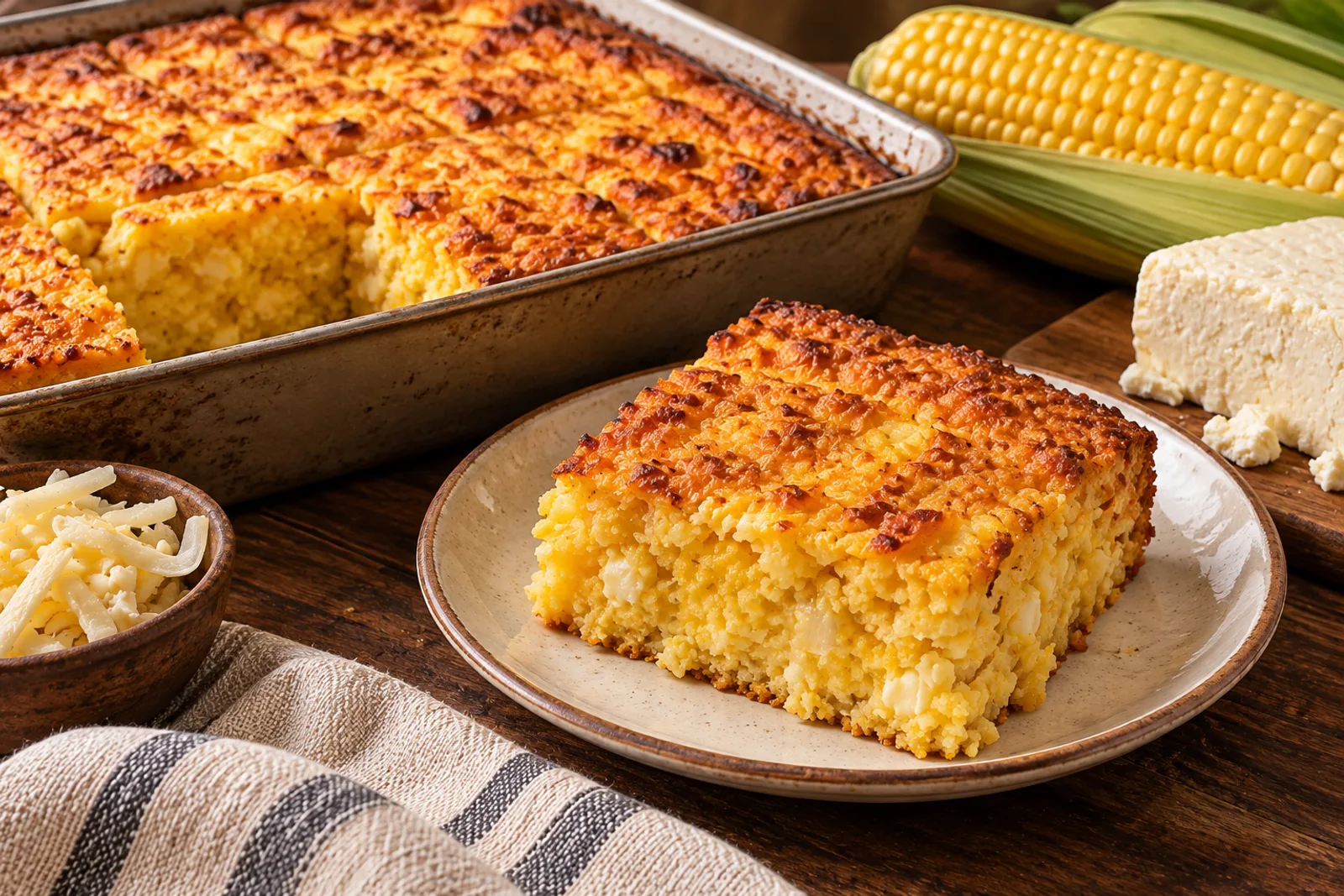

In Paraguay, sopa paraguaya (SOH-pah pah-rah-GWHY-ah) is a soup in name only. It’s the country’s savory cornbread: a dense, moist slab of cornmeal, fresh cheese, soft onion, eggs and milk, baked in a sheet and cut into squares. Nothing about it is sweet, it has no wheat flour, and it’s heavier on cheese than any American cornbread. This version fills a 9 x 13 in pan, uses cornmeal and cheese from a regular US or UK supermarket, and spells out the one thing that decides whether it comes out moist or crumbly, which is how loose the batter is before it goes in.
What sopa paraguaya is, and how it compares to cornbread
How do you make sopa paraguaya? Soften 12 oz (350 g) of onion in butter without browning, cool it, and whisk it with 5 eggs, 2½ cups (600 ml) of milk and ½ cup of melted butter. Stir in 3¼ cups (500 g) of raw yellow cornmeal and 14 oz (400 g) of fresh cheese, rest 10 minutes, pour into a 9 x 13 in pan and bake at 350°F (180°C) for 45 to 55 minutes, until the center is firm. 100 minutes for 12 servings.
Compared with Southern or Northern US cornbread, it’s softer and wetter inside, closer to a spoonbread you can slice, with melted cheese running through it and a gentle sweetness that comes only from the onions. In Paraguay it sits next to grilled meat at an asado the way a bread basket would, and it’s a fixture of the Christmas and Easter table.
Three dishes it gets mixed up with:
- Chipa guasu has the same cheese and onion but is made from fresh corn kernels blended to a purée instead of cornmeal, so it bakes up creamier, almost like a soufflé.
- Sopa so’o is this same batter baked with a layer of seasoned ground beef in the middle (see the variations).
- Sweet corn bakes. Mexican pan de elote and Venezuelan corn cake are both made from fresh sweet corn and sugar, with no cheese in the basic recipe. They’re dessert; this is a side.
If you came here looking for an actual corn soup, Argentinian locro is the hearty spoon-and-bowl one, with hominy, squash and beans.
Ingredients, and what to buy in the US or UK
Makes 12 squares of about 3 in (8 cm), enough for 12 people as a side.
| Ingredient | Metric | US | Notes |
|---|---|---|---|
| Yellow cornmeal, fine or medium | 500 g | 3¼ cups | Raw, not precooked; see below |
| Firm fresh cheese | 400 g | 14 oz | Queso fresco, panela or Monterey Jack |
| Onions | 2 large, 350 g | 12 oz | Yellow or white |
| Unsalted butter | 150 g | 10½ tbsp | 2 tbsp for the onions, the rest melted |
| Eggs | 5 large | 5 large | Room temperature |
| Whole milk | 600 ml | 2½ cups | Up to 100 ml (scant ½ cup) more if needed |
| Fine salt | 6 g | 1 tsp | Less with a salty cheese |
| Baking powder | 9 g | 2 tsp | Optional; traditional versions skip it |
The baking powder makes the crumb a little lighter. Paraguayan cooks traditionally use beef fat or lard; butter tastes milder and is easier to find, and vegetable oil gives an equally moist but blander bread.
The cornmeal
You need plain raw yellow cornmeal, the same thing Paraguayans buy as harina de maíz.
- US. Fine or medium yellow cornmeal, the kind in a canister in the baking aisle. Coarse stone-ground works but gives a grittier crumb.
- UK. Fine cornmeal, or polenta that is not the quick-cook or instant kind. Instant polenta is precooked and behaves like the flours below.
Don’t use masa harina, precooked arepa flour or cornflour (UK cornflour is cornstarch). Masa harina and arepa flour are already cooked: they drink the milk at once and bake into something pasty that tastes of tortilla. A boxed cornbread mix won’t work either, since it’s sweetened and most contain wheat flour.
The cheese
The original is queso Paraguay, a firm, fresh cow’s milk cheese, slightly tangy and salty, that softens in the oven without turning stringy. It’s hard to find outside South America, so swap in another firm fresh cheese and adjust the salt.
- US. Queso fresco or panela from the Latin dairy case is closest. Monterey Jack melts more and gives softer, gooier pockets.
- UK. Latin shops and online grocers sell queso fresco. Otherwise use half block mozzarella (not the fresh balls in whey, which make the batter wet) and half mild Cheddar; it melts more than the original and tastes a little sharper.
- Avoid feta, which makes it far too salty, and pre-grated hard cheese like Parmesan on its own, which leaves it without the moist cheesy pockets.
Equipment. A 9 x 13 in (23 x 33 cm) glass, ceramic or metal baking dish, a skillet, a large bowl and a long toothpick or skewer. An instant-read thermometer helps but isn’t essential.
How to make it, and the batter check
Onions first. Cook them in 2 tbsp butter over medium heat for 8 to 10 minutes, until they’re soft enough to crush with a spoon. Keep them pale: browned onion turns faintly bitter and leaves dark streaks in the crumb. Cool them for 10 minutes, because hot onion starts cooking the eggs and the batter turns lumpy.
Some Paraguayan cooks simmer the onion in the milk, covered, for 10 minutes instead, then let it cool completely. The onion comes out milder and the milk picks up its flavor.
Mix. Whisk the eggs until frothy, whisk in the milk, cooled butter, salt and onions, then stir in the cornmeal and baking powder until no dry lumps remain. Fold in the cheese.
Reading the batter
This decides the texture. Leave the batter alone for 10 minutes and judge it then, because the cornmeal keeps absorbing milk.
- Right. It falls from a spoon in a thick ribbon and levels itself in the dish within a few seconds, like soft polenta or loose mashed potatoes.
- Too stiff. It holds a mound and you have to push it into the corners. Add milk 50 ml (3½ tbsp) at a time, up to 100 ml.
- Too thin. It runs like milk and the cheese sinks. Rare with these amounts; if it happens, stir in 2 tbsp cornmeal and wait 5 more minutes.
Err on the loose side. A stiff batter bakes into a dry, crumbly bread.
Baking and knowing when it’s done
Pour into the dish (about 1¼ in / 3 cm deep) and bake at 350°F (180°C) for 45 to 55 minutes. Keep the door shut for the first 35; the middle is still liquid and sinks if the oven cools.
It’s done when the top is golden all over, the darker edges pull away from the dish, the center feels firm and no longer wobbles, and a toothpick in the middle comes out with dry crumbs. Wet batter on the toothpick means 5 more minutes.
With a thermometer, look for 200 to 205°F (93 to 96°C) in the center. The eggs are safely set at 160°F (71°C), but at that point the inside is still pasty.
Rest it 10 minutes in the dish before cutting. Straight from the oven it crumbles.
Make-ahead plan and scaling
- Night before. Cook the onions and refrigerate them covered, and grate the cheese. Mix the batter on the day: with the onion in it, it shouldn’t sit overnight.
- Bake a day ahead. It reheats well, wrapped in foil, and slices more cleanly cold.
- For 24. Double everything and use two 9 x 13 in dishes. If they’re on two racks, swap them at 30 minutes.
- For 6. Halve it and use an 8 x 8 in (20 x 20 cm) pan. It comes out almost as deep, so start checking at 40 minutes.
Troubleshooting, from dry to sunken
- Dry and crumbly. The batter went in too stiff, or it was overbaked. Keep it at the thick-ribbon stage and pull it at 200 to 205°F.
- Pasty and heavy. Masa harina, arepa flour or instant polenta. Only plain raw cornmeal works.
- Raw middle, dark top. Oven running hot, or a smaller, deeper pan. Tent with foil and keep baking until the toothpick shows dry crumbs.
- Sunken center. The door opened too early, or it came out underbaked. More noticeable with baking powder.
- Bits of scrambled egg. The onions or butter were still hot.
- Too salty. A salty cheese. Taste the cheese first and halve the salt if it’s strong.
Allergens. Contains milk and eggs. There’s no wheat flour; for celiac guests, buy cornmeal and baking powder labeled gluten-free. No chile heat, and kids tend to love it.
Cost. Cheese is the expensive part. Dropping to 300 g (10½ oz) makes it less rich but still recognizably sopa paraguaya.
Variations
- Sopa so’o (with beef). Brown 400 g (14 oz) ground beef with an onion, a garlic clove and half a red bell pepper until the juices have cooked off, then cool it. Spread half the batter in the dish, scatter the beef leaving a ⅜ in (1 cm) border, and cover with the rest. Bake the same way and test the top layer of batter, not the meat.
- With corn kernels. Fold in 1 cup (about 150 g) cooked fresh corn, or drained canned or thawed frozen corn, at the end. You get sweet, juicy bites; it’s still sopa paraguaya, not chipa guasu.
- Lighter. Replace the melted butter with 120 ml (½ cup) vegetable oil and use reduced-fat milk. Still moist, less buttery.
- Cheesy top. Scatter 50 g (½ cup) grated aged cheese over the batter before baking for a crisper, browner crust.
Serving, storing and reheating
Serving. Cut it into squares and put it where the bread would go, next to anything off the grill, with Argentinian chimichurri and a pan of grilled provoleta. It also works next to a stew or chili, or on its own in the afternoon. For another wheat-free cheese bread with a completely different texture, hollow and chewy, try Brazilian cheese bread, made with tapioca starch, or Paraguay’s own afternoon cheese bread, chipa rings, flavored with anise.
Fridge. Wrap or box it within 2 hours of baking, once cool. Keeps 3 to 4 days at 40°F (4°C) or below.
Freezer. Wrap squares individually and freeze for up to 2 months. Thaw overnight in the fridge.
Reheating. Wrapped in foil in a 350°F (180°C) oven until hot in the middle. Or fry squares in a little butter until crisp on both sides, which is the best way to eat day-old sopa. In the microwave, 30 to 45 seconds a square; longer and it toughens.
Frequently asked questions
Is sopa paraguaya a soup? No. It’s a baked cornbread eaten in squares. There are several popular stories about how it got the name, and none of them is documented.
Can I use Jiffy or another cornbread mix? No. Mixes are sweetened and most contain wheat flour, so you’d get a sweet, cakey bread rather than this savory, dense one.
Is sopa paraguaya gluten-free? It has no wheat, only cornmeal. For anyone with celiac disease, check that both the cornmeal and the baking powder are labeled gluten-free.
Can I make it with polenta? Yes, with regular polenta, which is just medium-ground raw cornmeal. Use it dry, straight from the bag, and stir it into the batter without cooking it first. Not instant or quick-cook polenta, which is precooked.
Nutrition
Per square (1/12 of the pan), worked out ingredient by ingredient from the quantities above, including baking powder:
- Calories: 416 kcal
- Protein: 14 g
- Carbohydrates: 40 g
- Fat: 22 g, of which 12 g saturated
- Fiber: 2 g
- Sugars: 5 g
- Sodium: 560 mg
The cornmeal brings about 154 kcal a square, the cheese about 100 and the butter about 90. Most of the sodium comes from the cheese, so a saltier cheese pushes it up.
The first thing I check now is the cheese, not the oven: I taste a crumb before any salt goes in, because the same recipe can come out perfect or too salty depending on that one block. The second is the batter after its rest. If I have to push it into the corners, more milk goes in. Josnaisis.