
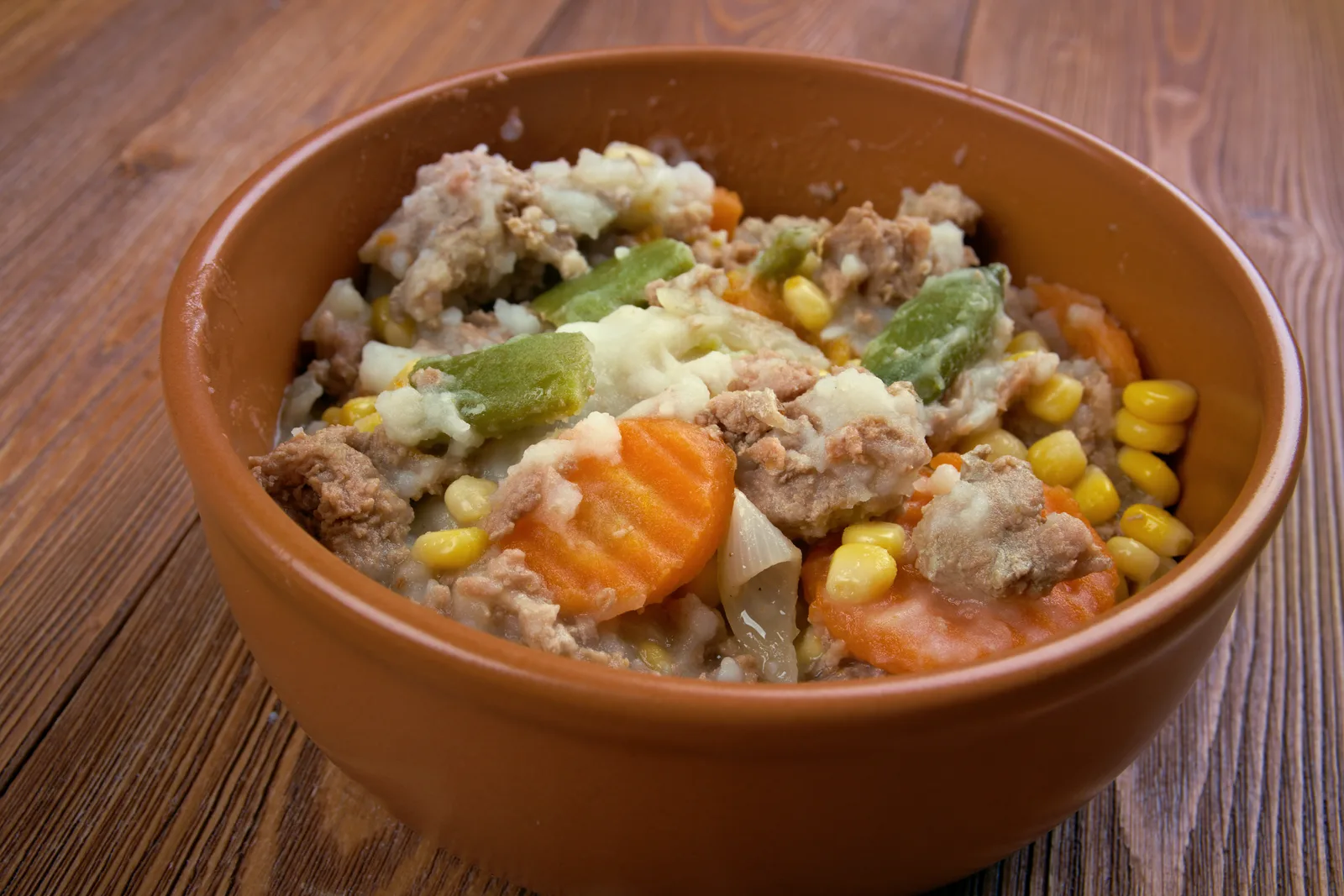

Charquicán (char-kee-KAHN) is what a Chilean family eats on a Tuesday: potatoes and orange squash simmered with ground beef in very little water, crushed with a masher into something between a stew and a chunky mash, and crowned with a fried egg. It is named after charqui, the dried salted meat it was made with before fresh beef became the norm. It is filling, cheap, mild and done in about an hour in one pot.
What charquicán tastes like, and how long it takes
How do you make Chilean charquicán? Brown 500 g (1.1 lb) ground beef with onion, bell pepper, garlic, cumin and sweet paprika. Add 1 kg (2.2 lb) cubed potatoes, 600 g (1⅓ lb) cubed squash and 500 ml (2 cups) water, cover and simmer 25 minutes. Stir in corn, peas and green beans for 7 minutes, mash roughly and top each plate with a fried egg. 65 minutes for 6 servings.
The squash collapses and turns everything orange and slightly sweet; the potato keeps some shape, so every forkful has soft and chunky bits, plus corn, peas and beef running through it. It is not spicy at all. If you know shepherd’s pie or a hash, you are in the right neighborhood, but charquicán is wetter than hash and everything is cooked and mashed together.
Time. 65 minutes: 20 of peeling and chopping, 45 at the stove, of which 25 are a covered simmer you can walk away from. Difficulty, easy.
Shopping list, and US and UK swaps
Everything is in a regular supermarket. The one thing to think about is the squash.
Which squash to use
In Chile the squash is zapallo camote, a dense, sweet, orange-fleshed winter squash. The closest match in the US is kabocha (sometimes sold as Japanese pumpkin), which is dry and sweet in the same way. Butternut works everywhere and is the easy choice in the UK; it is sweeter and wetter, so use 100 ml (scant ½ cup) less water. Canned pumpkin puree won’t do: there are no pieces to mash, and the stew turns to baby food.
If you shop at Latin markets, Caribbean calabaza (also called auyama) is a good option too; if it looks very juicy when you cut it, hold back the same 100 ml of water. Zucchini and other summer squash don’t work: they neither melt nor color the pot.
Potatoes
You want potatoes that soften at the edges and hold in the middle. Yukon Gold or russet in the US, Maris Piper or King Edward in the UK. Red-skinned waxy potatoes also work, but they barely thicken the stew and it ends up looser.
Beef, or jerky like the original
- Ground beef, 85% lean, is the everyday Chilean way. Very lean beef turns dry and grainy here.
- Beef chuck in 1 cm (⅜ in) cubes. Brown it in two batches so it sears rather than steams, add the water and simmer 15 minutes covered before the potatoes go in. That adds 15 minutes overall and gives you juicier, meatier bites.
- Jerky. Chilean charqui is plain dried salted beef. Most US jerky is marinated with sugar and soy sauce, and those flavors come through. For a cured, smoky note, chop 50 g (1¾ oz) plain or original jerky finely and brown it with the ground beef, not instead of it, and taste before adding all the salt.
The rest
Use sweet paprika, not smoked, as a stand-in for Chilean ají de color. It burns in seconds, so it goes in last with the heat on low. Frozen corn, peas and green beans are fine straight from the bag. Some cooks add a diced carrot with the potatoes; it cooks in the same time.
Equipment. A 4 to 5 liter (4 to 5 quart) pot with a lid and a potato masher. No masher? A large fork or the back of a ladle.
Cooking it
Brown the beef properly
Medium-high heat, and leave the beef alone long enough to brown on the bottom, about 6 minutes in all. That brown crust is most of the flavor in a dish with very few seasonings. Onion and pepper go in next for 5 minutes, scraping the bottom. Paprika is last, 30 seconds on low; if it darkens, it has burned and will taste bitter.
Little water, lid on
500 ml (2 cups) of water only reaches halfway up the vegetables. The squash releases its own liquid and the potatoes steam under the lid. After 25 minutes, press a cube of potato against the side of the pot with a fork: it should crush with no effort. If it fights back, give it 5 more minutes.
Green vegetables last
Corn, peas and green beans go in for the last 7 minutes. Added with the potatoes, the beans go gray and limp. This is a good moment to fry the eggs.
How far to mash
Heat off, then no more than a dozen presses with the masher, spread around the pot. You are there when:
- you can no longer see cubes of squash and the whole pot is orange,
- potato pieces about the size of a hazelnut remain,
- a spoon dragged across the bottom leaves a path that doesn’t fill with liquid.
Keep going and you have orange mashed potatoes with corn in them. Tasty, but it isn’t charquicán anymore.
The egg
One per plate, fried in oil over medium heat for about 4 minutes, until the white is fully set. Many people like the yolk runny so it breaks into the stew. For young children, pregnant people or older adults, cook the yolk firm: cover the pan for the last minute.
When it goes wrong
Almost every problem comes from two things, too much water or too much mashing, and the fixes are quick.
Allergens and heat. Contains egg. It is gluten-free and dairy-free as written, and it isn’t spicy; serve hot sauce or a fresh salsa on the side for those who want heat.
A vegetarian charquicán, and cooking for a crowd
- With textured vegetable protein (TVP). Rehydrate 100 g (3½ oz) TVP following the package, squeeze it dry and brown it in the oil as if it were the beef. It comes out very close, slightly drier.
- With cochayuyo. The classic Chilean meatless version uses this thick dried seaweed, which you can find in Chilean shops or online. Soak it for a few hours until soft, chop it finely and use it in place of the beef. It tastes of the sea and stays chewier.
- No meat, no substitute. Double the corn and peas and serve with the egg on top.
- For 12. Double everything in an 8 to 10 liter (8 to 10 quart) pot, water included. A bigger pot takes longer to boil, so go by the fork test, not the clock, and mash in two batches.
The beef is what drives the cost. Half the beef with double the corn and peas still makes a satisfying plate for 6.
Serving, storing and leftovers
Serve with a fried egg on each plate and a simple salad of sliced tomato and onion, the way it’s done in Chile. If you are cooking a Chilean spread, squash sopaipillas or Chilean humitas, fresh corn and basil tied in the husk make a good starter, and the beef empanadas de pino use the same ground beef, onion and cumin in a baked turnover.
Fridge. Without the egg, in a closed container within 2 hours, it keeps 3 to 4 days. Fry the eggs fresh.
Freezer. 2 to 3 months in portions. The potato turns a bit watery and grainy after thawing; stirring while it reheats brings most of it back, but it won’t be quite like fresh. Thaw overnight in the fridge.
Reheating. It thickens a lot in the fridge. Warm it in a covered pan over medium-low with 2 to 3 tablespoons of water per portion, stirring, until it steams throughout, about 165°F (74°C). In the microwave, covered, in 1-minute bursts with a stir in between.
Leftover patties. Shape cold charquicán into 1.5 cm (⅝ in) thick patties, dust with flour and fry in a little oil over medium heat 3 to 4 minutes per side until crusted. With an egg on top they are a second dinner.
Frequently asked questions
Is charquicán the same as Chilean pastel de choclo? No. Pastel de choclo is a baked dish of seasoned beef under a sweet corn topping. Charquicán is a stovetop potato and squash stew mashed together. For another squash-thickened Chilean pot, try porotos granados, a summer stew of fresh beans, squash and corn.
Is zapallo camote a sweet potato? No. It is a winter squash; the “camote” in its name means sweet potato in Peru and Mexico, which causes the mix-up. Sweet potato gives a similar color but a sweeter, heavier stew, so I stick to kabocha or butternut.
Do I have to put an egg on it? No, but it is how most people eat it in Chile, and it turns the plate into a full meal. Without the egg and its oil, a serving drops to about 450 kcal.
Nutrition
Per serving (one of six, with its fried egg), worked out ingredient by ingredient from the amounts above:
- Calories: 545 kcal
- Protein: 29 g
- Carbohydrates: 54 g
- Fat: 25 g, of which 7 g saturated
- Fiber: 8 g
- Sugars: 8 g
- Sodium: 744 mg
The beef accounts for about 180 kcal of each plate and the potatoes about 128.
When the squash I find is a deep orange, I use more of it than the recipe asks for, because the stew turns sweeter and that’s how Dylan likes it. What I never change is the short mash: the one time I kept going, it tasted fine, but the bits of potato that make the dish were gone. Josnaisis.