
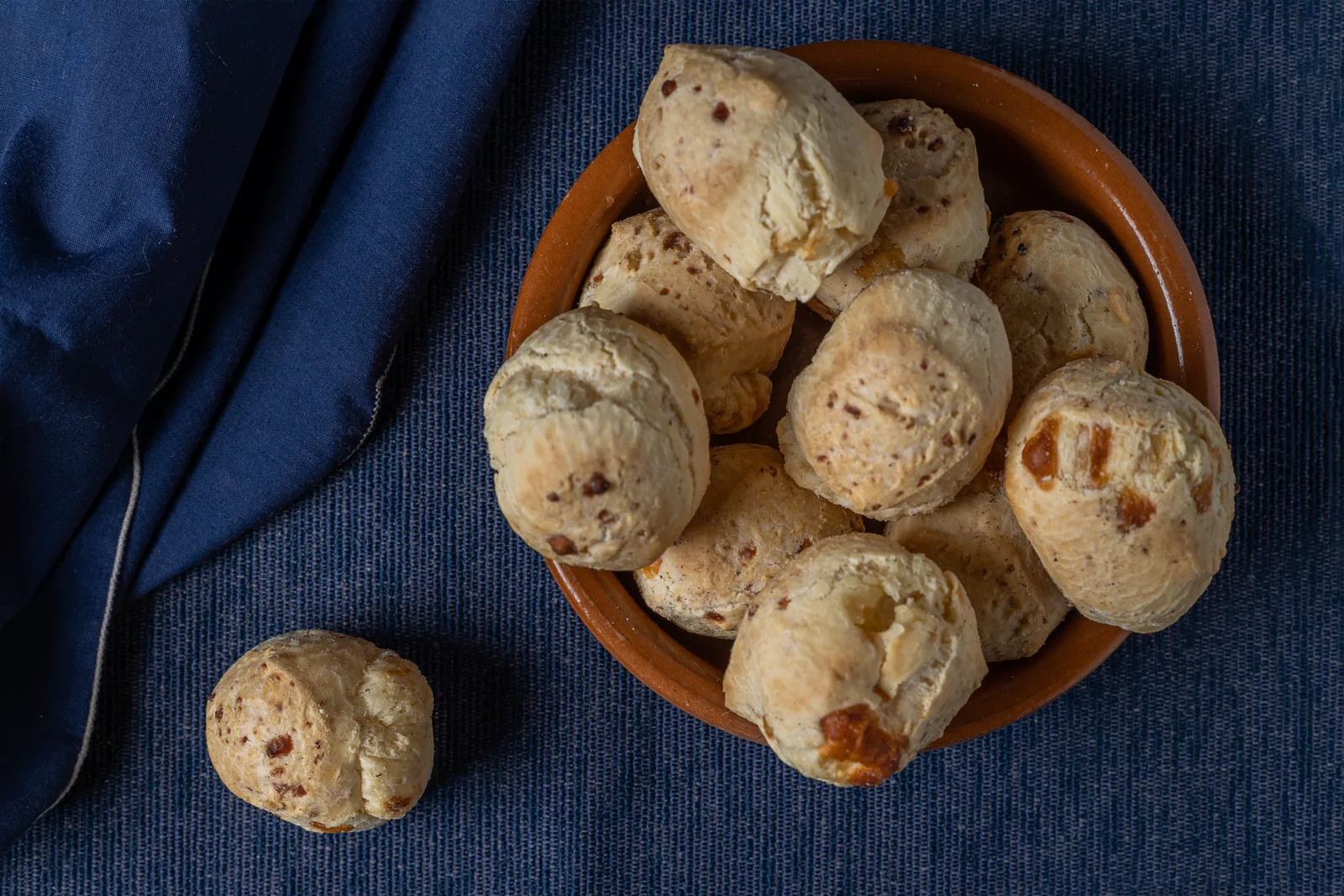

Chipa is the bread Paraguay eats with its morning coffee: a small ring of cassava starch, cheese, lard and egg, perfumed with aniseed, with no wheat flour and no yeast. Street vendors sell it all over the country, even on buses, and it is just as common in northeastern Argentina. Nothing in it contains gluten, though for celiacs the starch label matters (more on that below). If you know Brazilian pão de queijo, chipa is its firmer cousin: a crisp golden crust, a dense, moist, salty crumb, and none of the hollow stretch.
What chipa is, and how long it takes
How do you make Paraguayan chipa? Beat 120 g (4¼ oz) of lard with the salt, add 3 eggs and 300 g (10½ oz) of grated cheese, then knead in 500 g (1 lb 2 oz) of tapioca starch, aniseed and just enough milk for a smooth dough that doesn’t stick. Shape 50 g rings and bake at 425°F (220°C) for 15 to 20 minutes, until golden underneath. Ready in 85 minutes for 23 servings.
Time. 85 minutes in total: about 45 to beat, knead, rest and shape, and 40 of baking in two batches. Difficulty, easy. There’s no scalding, rising or proofing; the one thing to learn is how the dough should feel.
Who it suits. Anyone who wants a gluten-free bread that doesn’t taste like a substitute, and anyone who likes a savory breakfast. It isn’t spicy. The anise is noticeable; leave it out for kids who don’t like it.
Chipa next to other cassava cheese breads
All four of the cheese breads on this site use cassava starch, but the starch and the method decide the texture.
The Brazilian cheese bread is scalded with boiling milk and oil and uses sour starch, so it puffs and goes hollow. Colombian pandebono also relies on fermented sour starch to rise. Colombian pandeyuca gets its lift from baking powder and bakes up dry and crisp. Chipa uses plain starch, no leavening and plenty of fat, which is why it’s the densest of the four.
Ingredients and US or UK swaps
The batch makes 23 rings from 50 g (1¾ oz) of raw dough each, enough for about a dozen people at two apiece.
| Paraguayan ingredient | US supermarket | UK supermarket | What changes |
|---|---|---|---|
| Almidón de mandioca | Tapioca starch or tapioca flour, gluten-free baking aisle | Tapioca flour or starch, Asian grocers and health food shops | Nothing, it’s the same product |
| Queso Paraguay | Low-moisture mozzarella plus firm queso fresco or Monterey Jack | Block mozzarella plus a little mild Cheddar | Slightly milder; Cheddar tastes more of itself |
| Grasa de cerdo | Lard, often labeled manteca in the Latin aisle | Lard, sold in blocks | Nothing |
| Lard, if you prefer | Butter, same weight | Butter, same weight | Softer crumb, buttery taste |
| Anís en grano | Anise seed, spice aisle | Aniseed, spice aisle | Nothing; never use star anise |
Tapioca starch, and why not sour starch or cassava flour
In a US store, tapioca starch and tapioca flour are the same thing: the fine, squeaky white starch extracted from cassava root. That is exactly what Paraguayans buy as almidón de mandioca.
- Sour cassava starch (polvilho azedo) is fermented. It’s what makes pão de queijo and pandebono balloon. In chipa, expect it to make rings that puff more, are less dense and taste a little sour.
- Cassava flour is the whole dried root, ground. It gives a heavy, gritty dough. Don’t swap it in.
Which cheese to use outside Paraguay
Queso Paraguay is a fresh, salty cow’s milk cheese, and bakers use it aged a few days. Fresh, it weeps whey, the dough gets wet, you add more starch to fix it, and that extra starch is exactly what bakes into hard, dry chipa. So outside Paraguay look for the same qualities: a cheese that melts, tastes salty and holds little water.
- Grate it yourself. Bagged pre-shredded cheese is coated in anti-caking powder and dries the dough out.
- Fresh mozzarella balls and ricotta are far too wet.
- A little Parmesan, 50 g (1¾ oz) of the 300 g, adds a sharper cheese flavor but a lot of salt, so halve the salt if you use it.
Lard or butter
Lard is traditional and gives the tenderest crumb and the roundest flavor. The same weight of butter works well and bakes up slightly softer and more buttery. Margarine works too, with less flavor.
How to make chipa, step by step
Fat first, then eggs and cheese, then starch with only as much milk as the dough asks for. Here’s how the 85 minutes fall.
Beat the fat
Give the lard and salt a full 5 minutes, until pale and creamy. It aerates the dough and spreads the fat evenly, and the crumb comes out more tender. Cold lard won’t beat; leave it out for half an hour.
Read the dough, not the recipe
Every brand of tapioca starch and every cheese absorbs liquid differently, so add the milk 1 tablespoon at a time. The dough is right when it:
- Feels smooth and soft, like warm modeling clay.
- Doesn’t stick to clean hands.
- Doesn’t crack at the edge when you flatten a small ball between your palms.
Cracks mean another spoonful of milk. Sticky means a spoonful of starch. Within those 8 minutes, the more you knead, the softer the inside and the crisper the crust.
Shaping rings or rolls
Roll 6-inch (15 cm) ropes, ½ inch (1.5 cm) thick, overlap the ends and pinch hard, or the rings open in the oven. Weighing each piece at 50 g (1¾ oz) means every ring bakes in the same time. For small rolls, shape 30 g (1 oz) balls instead.
Baking at 425°F (220°C)
Turn the oven on while the dough rests, so it’s fully at 425°F (220°C) when the first sheet goes in. Bake one sheet at a time on the middle rack so the tops and bottoms brown together.
Check underneath: flip one ring with a spatula and look for a golden bottom. The top only needs to be lightly golden, with the thin spots a little darker. Straight from the oven the ring is firm outside and gives slightly when squeezed; it settles during 5 minutes on the rack.
Why chipa turns out hard, and other problems
Nearly every failure is fixed before the sheet goes into the oven.
- Hard straight from the oven. A wet, fresh cheese that needed extra starch, an oven that wasn’t hot, or more than 22 minutes of baking.
- Hard the next day. That’s normal: cassava starch firms as it cools. The fridge makes it happen faster, so don’t store chipa there. A few minutes in a hot oven brings it back.
- Cracks while shaping. Not enough milk, or the fat was cold.
- Sticks to your hands. Too much milk or a damp cheese. Add starch by the spoonful, or chill the dough for 10 minutes.
- Rings open or spread. The ends weren’t sealed or the dough got warm in your hands.
- Pale and gummy inside. The oven was too cool or the sheet too low.
Allergens. Contains milk and egg. There’s no wheat, so chipa is usually safe for a gluten-free diet; for celiac guests, buy a starch labeled gluten-free, since cross-contact can happen at the mill.
Make ahead and freeze the raw rings
Chipa is best within hours of baking, so the trick is to keep dough ready and bake only what you’ll eat.
- The day before. Wrapped dough keeps 24 hours in the fridge. Let it sit out for 30 minutes, knead for a minute and add a spoonful of milk if it feels dry.
- Frozen. Shape the rings, freeze them on the sheet until hard, then bag them. They keep up to 3 months and bake straight from frozen at 425°F (220°C), adding 3 to 5 minutes. This dough has no baking powder, which is why it freezes so well.
- For a crowd. For 20 to 24 people, double everything: 1 kg (2¼ lb) of starch gives about 46 rings. Bake in batches and keep the shaped rings somewhere cool while they wait.
The cheese is what drives the cost: it weighs more than half as much as the starch. Using block mozzarella for most of it keeps the batch cheap.
Variations
- Chipa mestiza. Replace 100 g (3½ oz) of the starch with fine cornmeal for a firmer, more rustic crumb with a corn flavor.
- Butter instead of lard. Same weight; about 10 calories less per ring.
- Small rolls. 30 g (1 oz) balls make about 39. Start checking at 12 minutes.
- More or no anise. Up to 1 tbsp per 500 g of starch for a strong anise note, or none at all.
Serving, storing and reheating
Serve chipa warm for breakfast or an afternoon snack. In Paraguay it comes with milky coffee or cocido, yerba mate toasted with sugar and served with milk. A mug of Colombian hot chocolate is a good match outside Paraguay.
Store completely cooled rings in a bread bag or a closed container at room temperature for 2 days, or freeze baked rings for up to 3 months.
Reheat in a 350°F (180°C) oven or a toaster oven for 4 to 5 minutes, a few minutes longer from frozen, until the crust crackles again. In the microwave, 15 seconds at most: any longer and it goes rubbery, then rock-hard.
Chipa FAQ
Is chipa the same as pão de queijo? No. Both use cassava starch and cheese, but pão de queijo is scalded and uses sour starch, so it’s hollow and stretchy. Chipa uses plain starch, lard and aniseed and is denser and firmer.
Does chipa have baking powder or yeast? Traditional chipa has neither. Some recipes add a teaspoon of baking powder for a lighter ring; if you do, the frozen dough doesn’t rise as well later.
Why is my chipa gummy in the middle? It needed more time, or the oven wasn’t at 425°F (220°C) when it went in. Check the bottom: if it isn’t golden, it isn’t done.
What is chipa guasu? A different Paraguayan dish: a baked casserole of fresh corn, cheese, egg and milk, cut into squares. It has no cassava starch and isn’t shaped by hand. Its closest relative is sopa paraguaya, the Paraguayan cornbread, made the same way but with dry cornmeal.
Nutrition
Per ring made from 50 g (1¾ oz) of raw dough, calculated from the recipe’s ingredients with lard, and with 200 g of block mozzarella and 100 g of queso fresco as the cheese:
- Calories: 178 kcal
- Protein: 4 g
- Carbohydrates: 20 g
- Fat: 9 g, of which 4 g saturated
- Sugars: 1 g
- Sodium: 207 mg
Almost all of the carbohydrate comes from the starch, which has no fiber. The fat is split roughly half and half between the cheese and the lard.
I always make chipa with lard, and I knead the dough longer than seems necessary, because the crumb shows it. There are three of us at home, so I shape all 23 rings, bake one sheet and send the other straight to the freezer for another morning. And I taste the cheese first: if it’s very salty, the salt in the dough drops by half. Josnaisis.