
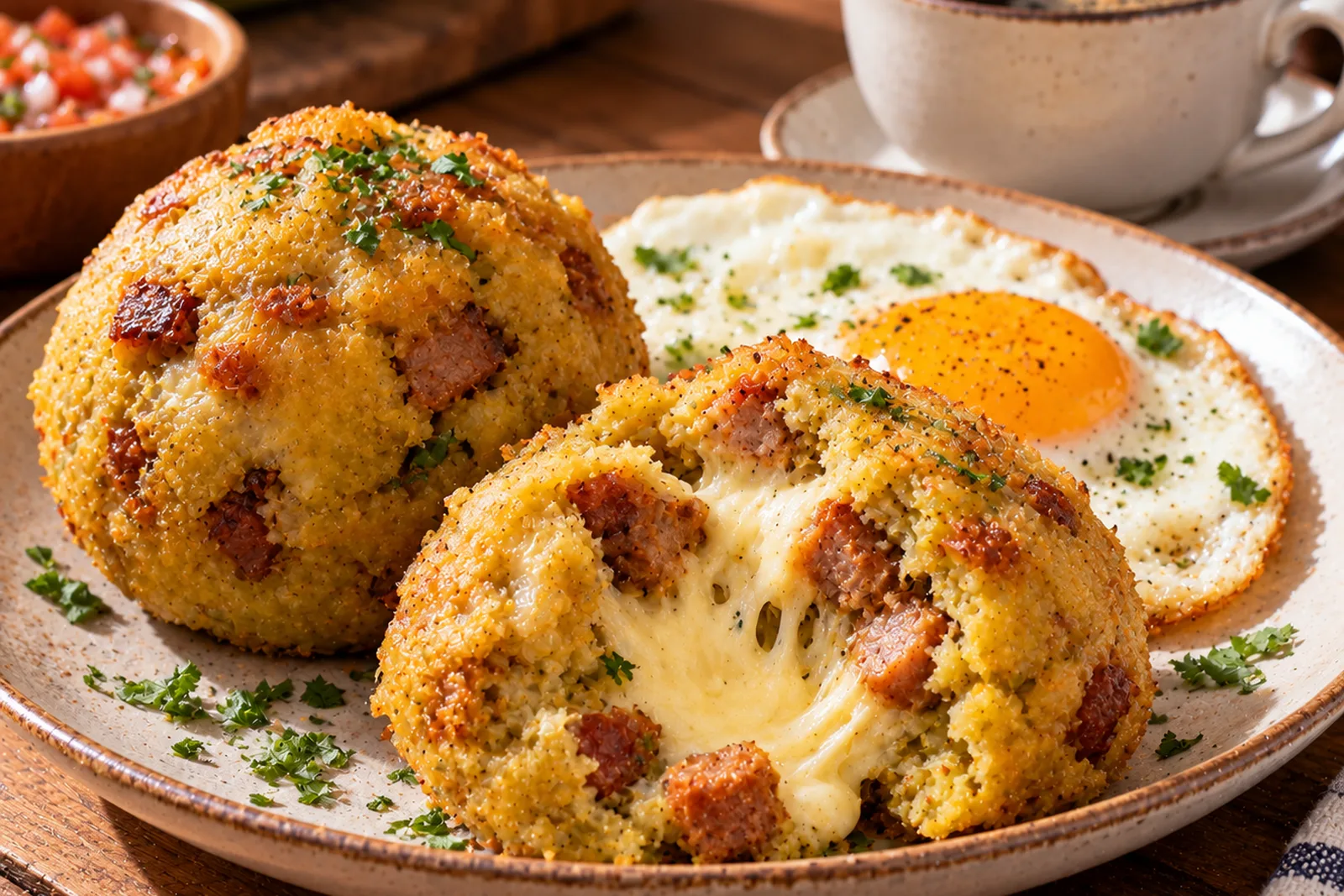

A bolon de verde (boh-LOHN deh VEHR-deh) is a fist-sized ball of mashed green plantain from the coast of Ecuador, studded with fresh cheese, chunks of fried pork belly or both, and browned in a skillet until it has a thin golden crust. Think of it as a savory, starchy dumpling: dense, salty and filling, with soft cheese inside. It is breakfast there, served with a fried egg on top and a cup of black coffee, and the mixto version with both cheese and pork is the one most people order.
How to make bolon de verde, the short version
How do you make bolon de verde? Fry 4 green plantains cut into 1¼ in (3 cm) chunks over medium heat for 10 to 12 minutes per batch, until tender but barely golden. Mash them hot with 3 tbsp (40 g) of lard, mix in 120 g (4¼ oz) each of queso fresco and chopped chicharrón, squeeze into 4 tight balls and brown them in a little oil for 8 to 10 minutes. 55 minutes for 4 servings.
Total time 55 minutes: 15 to peel and chop, 40 for frying, mashing and browning. Easy. Two things matter: taking the plantain out of the oil at the right moment and mashing it before it cools.
Bolon vs. mofongo and mangu. Puerto Rico’s mofongo also fries green plantain, but pounds it with garlic and crisp pork rind and serves it as a mound with broth. Dominican mangu boils the plantain and mashes it smooth, like mashed potatoes. A bolon has no garlic, is shaped into balls and goes back into the pan for a crust. And it is nothing like tostones, which are flattened slices fried twice until crisp.
What you need, with US and UK swaps
One plantain makes one large bolon, a full breakfast for one person. For smaller, tangerine-sized bolones, the same dough makes 8.
| Ingredient | Amount | What to buy, and what changes |
|---|---|---|
| Green plantains | 4 large, about 750 g (1⅔ lb) peeled | Fully green and hard. Any yellow means more sugar and a sweeter, stickier dough. US: most supermarkets. UK: Caribbean and African grocers, larger supermarkets |
| Queso fresco | 120 g (4¼ oz) | US: Mexican queso fresco in the Latin dairy case. UK: 80 g (3 oz) block mozzarella plus 40 g (1½ oz) feta, for melt plus salt |
| Chicharrón | 120 g (4¼ oz) | Fried pork belly with meat, not puffed rinds. US: Latin butchers. US and UK: 6 slices (170 g / 6 oz) bacon, fried crisp and chopped; smokier |
| Lard | 3 tbsp (40 g) | Traditional and porky. Butter is milder; half and half works well. Oil binds the dough but tastes flat |
| Frying oil | 750 ml (about 3 cups) | Any neutral oil: vegetable, sunflower, canola (UK rapeseed) |
Which cheese, honestly. Ecuadorian fresh cheese is white, salty and only half melts, leaving strands in the dough. Mexican queso fresco is the closest thing in a US store. Block mozzarella or Monterey Jack melts more and stretches, but is milder, so salt the dough a little more. In the UK, the mozzarella and feta mix gets you close; fresh ricotta or cottage cheese are too wet.
Pork, if you don’t fry your own. The chicharrón here is fried pork belly cut into small pieces. You can make it with the Colombian chicharrón method, rendered in its own fat; 120 g (4¼ oz) is just a few pieces. Bacon is the easy supermarket swap.
Equipment. An 8 in (20 cm) saucepan for frying, where 750 ml of oil sits about 1 in (2.4 cm) deep; a large bowl; a potato masher, mallet or heavy glass; and a 10 in nonstick skillet, plus a small second pan if you’re serving eggs. A thermometer helps but isn’t essential.
Step by step, and what to look for
Fry the plantain until tender, not golden
Keep the oil at medium heat, about 330°F (165°C). Without a thermometer, drop in one chunk: it should bubble steadily and quietly. If it spits and browns within 2 minutes, the oil is too hot and the outside will crust before the inside softens. Fry in two batches of 10 to 12 minutes, turning halfway.
You want tender and pale gold: a fork goes to the center with no resistance and the chunk gives when you press it with the spoon. Leave it until deep golden and the crust turns hard in the bowl, so the dough cracks.
Mash while it is hot
Mash straight out of the oil. Cold plantain stiffens and won’t bind, which is why the first batch waits covered in the bowl. Add the lard and salt and mash firmly for 3 to 4 minutes, until no whole pieces remain. You are not after a smooth purée like mangu, but a compact dough with a few small lumps.
The squeeze test: press a handful in your fist. If it holds with only fine cracks, it’s ready. If it crumbles, add warm water 1 tbsp at a time and mash again.
Mixed in or stuffed
The recipe mixes the cheese and pork through the dough, the usual mixto. For a stuffed bolon with a molten center, mix in only half, shape the ball, push your thumb into the middle, add the rest of the cheese and squeeze it closed. You get more melted cheese in one place, but the ball splits more easily if you don’t seal it well.
Shape and brown
Squeeze each portion hard, passing it from hand to hand like a tightly packed snowball. That pressure is what keeps it whole in the pan. Barely damp hands stop the dough sticking.
Brown over medium heat for 8 to 10 minutes, turning every 2 minutes with two spoons. They’re done when they have a golden crust on several sides and the cheese inside is soft. To deep-fry instead, use the same oil at about 350°F (175°C), one ball at a time on a slotted spoon, just until golden.
Fried or boiled plantain, what changes
The traditional bolon fries the plantain, but boiling works too.
- Boiled. Simmer the chunks in salted water for 20 to 25 minutes, until a fork slides in. Save ½ cup (120 ml) of the water, drain, and mash hot the same way, using that water instead of the warm water. The dough comes out paler, wetter and softer, tastes more of cooked plantain than toasted, and is a bit harder to keep round. Here the skillet browning is not optional: it is the only crust you get.
- Calories. Boiled, the mixto drops to about 660 kcal, because the plantain absorbs no oil.
Why bolones crack or fall apart
- Crumbles as you shape it. The plantain cooled before mashing, or was undercooked. Mash it the moment it leaves the oil and fry until a fork slides in. If it’s already cold, add 1 to 2 tbsp of hot water and mash again.
- Hard lumps that won’t break down. The plantain was over-browned. Next time pull it at pale gold; this time, mash with a little extra warm water.
- Sticky and sweet. The plantain was turning yellow. It’s still edible, but it’s a different bolon; for the classic, use fully green.
- Splits in the pan or leaks cheese. It wasn’t squeezed hard enough, or cheese sat at the edge. Compact it firmly, keep the cheese in the middle, and turn it with two spoons, never by stabbing it.
- Tastes flat. It needs salt. Cheese and pork add some, but not always enough: taste the dough before shaping.
Allergens and heat. Contains dairy (cheese and, if used, butter) and pork. Naturally gluten-free; check the label on packaged chicharrón or bacon. Not spicy: hot sauce goes on the side. Kids usually love the cheese version.
Variations
- Cheese only (vegetarian). 200 g (7 oz) queso fresco and butter instead of lard. About 715 kcal.
- Pork only. 200 g (7 oz) chopped chicharrón. Heartier and saltier. About 810 kcal.
- With peanuts. In Manabí province they add ground peanuts or salprieta, toasted peanuts with spices: about 2 tbsp while mashing.
- With achiote. ½ tsp ground achiote (annatto) in the lard turns the dough orange with little change in flavor.
- Esmeraldas style. A wetter dough with more lard and warm water, sometimes shaped long instead of round, served with shrimp in coconut sauce.
- Ripe plantain. Yellow plantain makes a sweet, soft bolon. It’s a different dish from the green one.
- For 8 or 12. One plantain per person. Fry in batches that fit in one layer, mash in two bowls so the dough doesn’t cool while you work, brown in two skillets and keep finished ones on a rack in a warm, switched-off oven.
Cost. The plantains are cheap; the cheese and pork are what you pay for. The cheese-only version costs less than the mixto.
Serving, make-ahead, storing and reheating
Serve with a fried egg sitting in the dent on top, so the yolk runs into the dough, and black coffee. Hot sauce, a saucy beef steak or a bowl of encebollado, Ecuador’s tuna and cassava soup, are other classic partners. For another Ecuadorian breakfast, llapingachos are cheese-stuffed potato patties.
Make ahead. The night before, chop the pork and crumble the cheese. Fry and mash the plantain on the day. Shaped, unbrowned bolones keep 2 days in the fridge wrapped in plastic; brown them when you’re ready.
Fridge. Browned leftovers, refrigerated within 2 hours in a sealed container, keep 2 days in my kitchen; they firm up as they cool.
Freezer. Best unbrowned, shaped and individually wrapped, for up to 3 months. Thaw overnight in the fridge; the dough is a little drier than fresh.
Reheat in the oven at 350°F (175°C) for 12 to 15 minutes, or in a skillet over medium-low heat, turning, until hot right through (165°F / 74°C). In the microwave, covered, on medium power: fast, but the crust goes soft.
Bolon de verde FAQ
Can I make bolones in an air fryer? You can use it to brown shaped bolones instead of the skillet, brushed with a little oil, but the plantain still has to be fried or boiled first. Watch the first one closely, because timing depends on your machine and the size of the ball.
How many calories are in a bolon de verde? The mixto in this recipe is about 808 kcal without the egg, about 900 with one fried egg, and about 660 if the plantain is boiled.
Is a runny yolk safe? It’s how bolon is usually served. For young children, pregnant women or older people, fry the egg until the yolk is firm.
Nutrition per bolon
Per mixto bolon (one plantain with its lard, cheese and pork, no egg), calculated from the recipe amounts:
- Calories: 808 kcal
- Protein: 18 g
- Carbohydrates: 70 g
- Fat: 51 g, including 17 g saturated
- Fiber: 5 g
- Sugars: 6 g
- Sodium: 879 mg
Fried plantain accounts for about 430 kcal including the oil it absorbs, the pork about 140, the cheese about 90 and the lard about 90. All the browning oil is counted, although some stays in the pan. Sodium depends heavily on the cheese and pork you buy.
What I’ve learned making bolon is that the oil sets the pace. Medium heat and patience until the fork slides in on its own give you plantain that squeezes into a ball almost without effort; rush it and you spend the next ten minutes patching cracks. I make mine mixto, with lard and butter half and half. Josnaisis.