
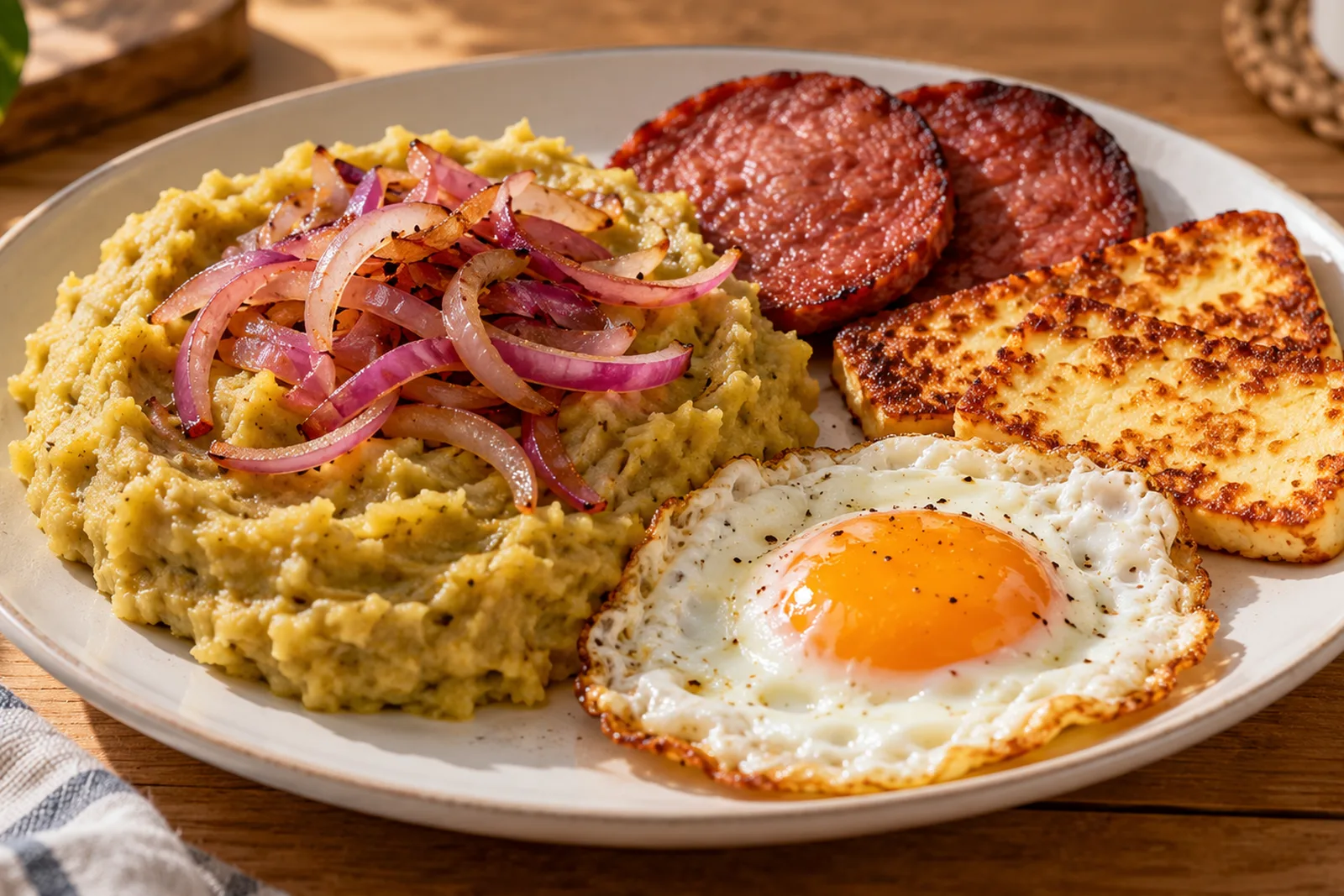

Mangu (mahn-GOO) is the Dominican Republic’s everyday breakfast: green plantains boiled until very soft, then mashed with butter and a splash of their own cooking water into a thick, smooth purée, a bit like mashed potatoes but with a savory, faintly earthy plantain flavor. It comes topped with red onions softened in vinegar. Served with fried Dominican salami, fried cheese and a fried egg, it becomes mangu con los tres golpes, “the three hits,” the full plate served across the Dominican Republic and in Dominican neighborhoods of New York.
How to make mangu, the short version
How do you make mangu? Boil 4 peeled green plantains in salted water for 20 to 25 minutes, until a fork slides in with no resistance. Save the cooking water, drain, and mash the plantains while still hot with 4 tbsp (56 g) of butter, adding about 1 cup (240 ml) of the hot cooking water a little at a time until smooth and slightly loose. Top with red onion sautéed in vinegar. 50 minutes for 4 servings with los tres golpes.
Total time 50 minutes: 15 to peel and slice, 35 at the stove, with the onions, salami and cheese cooked while the plantains boil. Easy. The one thing that matters is timing: mash the plantains hot.
Mangu vs. mofongo. Puerto Rico’s mofongo fries the plantain and pounds it with garlic and pork cracklings into a firm, chunky mound. Mangu boils it and mashes it smooth, with no garlic. And neither is the crisp, twice-fried tostones or the sweet, ripe fried plantains you may know from Latin restaurants. Ecuador’s bolon de verde goes the other way: fried plantain mashed with cheese and pork, shaped into balls and browned.
What you need, with US and UK swaps
One plantain per person is a full breakfast. As a side for a stew, the same amount stretches to 6.
| Ingredient | Metric | US | What to buy, and what changes |
|---|---|---|---|
| Green plantains | 4 large, about 750 g peeled | 4 large, about 1⅔ lb peeled | Fully green and hard. UK: Caribbean grocers, larger supermarkets, markets |
| Butter | 56 g | 4 tbsp (½ stick) | Salted; with unsalted, add a little more salt |
| Plantain cooking water | about 240 ml | about 1 cup | Save twice what you think you’ll need |
| Red onion | 150 g | 1 medium | A yellow onion works but won’t turn pink |
| Vinegar | 60 ml | ¼ cup | Apple cider is closest to the fruit vinegars used in the DR |
| Dominican salami | 225 g | 8 oz | Thick-cut bologna or mortadella as a stand-in |
| Queso de freír | 225 g | 8 oz | Plain halloumi (no mint) in the UK |
| Eggs | 4 large | 4 large |
Green plantains, not bananas and not ripe ones
A plantain is a starchy cooking banana, larger and firmer than a dessert banana, and it’s never eaten raw. For mangu you want it green from end to end and hard. Once it shows yellow patches it has more sugar and the mash turns sweeter, softer and slightly sticky. A green dessert banana won’t work at all.
In the US, green plantains are in the produce section of most supermarkets, often next to the bananas. In the UK, look in Caribbean and African grocers, street markets and the world-food section of larger supermarkets.
Dominican salami and frying cheese, and what to use instead
Dominican salami is nothing like Italian salami: it’s a smoky, salty, soft-textured sausage that’s always eaten fried, in thick slices. If the casing is plastic, peel it off before slicing. In the US, it’s sold in supermarkets with a Latin section, especially in New York, New Jersey and Florida, and online. If you can’t get it, the closest thing in texture is thick-cut bologna or mortadella, fried the same way: less smoky, but it browns well and stays juicy. A dry cured salami or chorizo burns before it browns. Longaniza sausage is another option used on the island itself.
Queso de freír (“frying cheese”) is a firm white cheese with a high melting point: in a hot pan it browns outside and goes creamy inside instead of melting. In the US, look for it by name in the Latin dairy case. In the UK, plain halloumi is the best substitute; it’s squeakier and a little saltier, and it never needs the cornstarch dusting. Paneer also fries without melting but tastes of very little, so salt it lightly first.
Equipment. A 4 to 5 quart (4 to 5 liter) pot, a potato masher or a sturdy fork, a small skillet for the onions and a medium one for frying.
Game plan so everything is hot at once
Mangu stiffens as it cools, and fried cheese goes rubbery, so the order matters more than any single step.
- Minute 0. Slice the onion into the vinegar and salt. Peel and chunk the plantains and start them in cold salted water.
- Minutes 10 to 35. While the plantains boil, sauté the onions for 3 to 5 minutes, then fry the salami and cheese. Keep them covered with foil; they hold well for 10 minutes.
- Minute 35. Test the plantains with a fork. Drain, saving 2 cups (480 ml) of the water, and mash right away. Cover the pot.
- Minute 40. Fry the eggs, 2 to 3 minutes, and plate.
Boiling until the fork slides in
Start the chunks in cold salted water, covered by about 1 in (2 to 3 cm). After it boils, give them 20 to 25 minutes at a steady medium boil. Fresher, thicker plantains take longer, so trust the fork, not the clock: it should slide into the center of the thickest piece with no resistance, and the piece should squash against the side of the pot. A firm core now is a lump later, so if you feel one, boil 5 minutes more.
Mashing hot, with the water a little at a time
Mash in the same pot, which holds the heat, with the butter first. When no whole pieces remain, add the hot cooking water ¼ cup (60 ml) at a time, mashing and stirring hard after each. Around 1 cup (240 ml) in, it should look like creamy mashed potatoes.
How to tell it’s right. Smooth, glossy from the butter, and slightly looser than you want to eat it, because it firms up within 5 minutes on the plate. If it clings to the spoon like dough, it needs more water; if it runs across the plate, it has too much, so stir it over low heat, uncovered, for 2 minutes.
Many Dominican cooks finish with a splash of cold water for a softer mash. I use 2 to 4 tbsp; more than that and it turns watery. I never use a blender or food processor: hot plantain starch whipped at speed turns gluey.
The three hits
- Salami. 1 cm (⅜ in) slices, 1 to 2 minutes per side in hot oil, until the edges brown and curl a little.
- Cheese. Pat dry so it doesn’t spit, then 1 to 2 minutes per side until golden. Fry a test slice first; if it melts and sticks, dust the rest in cornstarch. Don’t crowd the pan, or the oil cools and the cheese softens before it browns.
- Eggs. Fried in 1 tbsp of the same oil, runny yolk being the classic. For pregnant women, young children and older adults, cook the yolk until set.
Why mangu turns out lumpy, stiff or runny
- Lumpy. The plantains weren’t fully cooked or were mashed lukewarm. Boil until the fork slides in and mash immediately. To rescue it, return the pot to low heat with 2 tbsp hot water and mash for 1 more minute.
- Stiff as cement. Not enough water, or it sat too long. Stir in hot water a tablespoon at a time over low heat.
- Runny. All the water went in at once. Stir it uncovered over low heat for 2 to 3 minutes.
- Gluey and sweet. Plantains that were starting to ripen, or a blender. There’s no fix; next time, fully green plantains and a masher.
- Limp, dull onions. Overcooked. Three to five minutes on low is enough.
- Cheese melted in the pan. The oil wasn’t hot enough or it isn’t a frying cheese. Cornstarch, hot oil, a few slices at a time.
- Too salty. The salami and cheese are already salty, so go easy on the mash.
Allergens and heat. Contains dairy (butter, cheese) and egg. No chile heat at all. The mangu itself is gluten-free; check the salami label, and use cornstarch rather than flour on the cheese to keep the plate that way. Kids usually love it, especially the fried cheese.
Variations and cooking for a crowd
- Sweet plantain mangu. With ripe yellow plantains it’s sweeter and softer and needs almost no water; butter alone is enough. Some cooks mix 2 green and 2 ripe for something in between.
- Los cuatro golpes. The three hits plus sliced avocado.
- With a cold drink. For a late breakfast, a Dominican morir soñando made with milk and orange juice takes 10 minutes and can be stirred together while the plantains boil.
- For lunch or dinner. Serve it under something saucy, like a Colombian stewed chicken or a beef stew, allowing 1 cup of stew per person. On the coast it’s also eaten with fried fish.
- For a bigger Dominican spread. Add a platter of crispy Dominican yaniqueques, the paper-thin fried flour rounds that also turn up at breakfast with café con leche.
- Lighter. Just the onions and one egg, no salami or cheese: about 550 kcal instead of 946 per plate.
- For 8 to 12. One plantain per person, with 1 tbsp butter and about ¼ cup (60 ml) water per plantain. Use two pots or one 8 quart (8 liter) pot, and mash in two or three batches so the plantain stays hot. Fry the salami and cheese ahead and hold them, covered, in a 200°F (90°C) oven for up to 15 minutes.
Cost. Plantains and onions are cheap; what pushes the price up outside the Caribbean is imported salami and frying cheese. With bologna and eggs, it’s a budget breakfast.
Storing and reheating leftovers
Fridge. Refrigerate within 2 hours in a covered container; it keeps 3 to 4 days. It will set firm, which is normal. The onions are best the day they’re made, since they go limp in the fridge, and the salami and cheese keep better stored separately.
Reheating. For one serving, add 2 to 3 tbsp water, cover and microwave at medium power in 1 minute bursts, stirring and mashing between each, until steaming and 165°F (74°C) in the center. On the stove, use low heat with the same splash of water for 4 to 5 minutes, mashing as it warms. Add more water a spoonful at a time if it’s still stiff.
Freezer. I don’t recommend it: thawed mangu turns watery and mealy.
Mangu FAQ
What does “los tres golpes” mean? “The three hits” or “the three blows,” the popular name for the three fried sides: salami, cheese and egg. Add avocado and it’s los cuatro golpes.
Can I make mangu the night before? Yes, though it loses some creaminess. Reheat it with water as above. I’d rather mash it in the morning, since most of the 50 minutes is the boil, which needs no attention.
My plantains are turning yellow. Can I still use them? Yes, but the mangu will be sweeter and softer. Start with half the water, about ½ cup (120 ml), and taste before adding more.
Mangu nutrition
Per serving (one plantain mashed with its butter and onions, 2 slices of salami, 2 slices of cheese and 1 fried egg), calculated from the recipe amounts:
- Calories: 946 kcal
- Protein: 33 g
- Carbohydrates: 75 g
- Fat: 57 g, of which 24 g saturated
- Fiber: 5 g
- Sugars: 8 g
- Sodium: 2,147 mg
The mangu and onions account for about 463 kcal, the salami about 189, the cheese about 174 and the egg about 90. Close to half the sodium comes from the salami, so that’s the first thing to cut back for a lighter plate.
Where I grew up in Venezuela, green plantain meant frying, and in Colombia it means patacones, so my first plate of mangu looked like mashed potatoes to me until I tasted it. Now it’s a Sunday breakfast at home, and the hardest part is not eating the fried cheese straight from the pan. Dylan wants his salami with the edges very brown and his onions on the side. Josnaisis.