
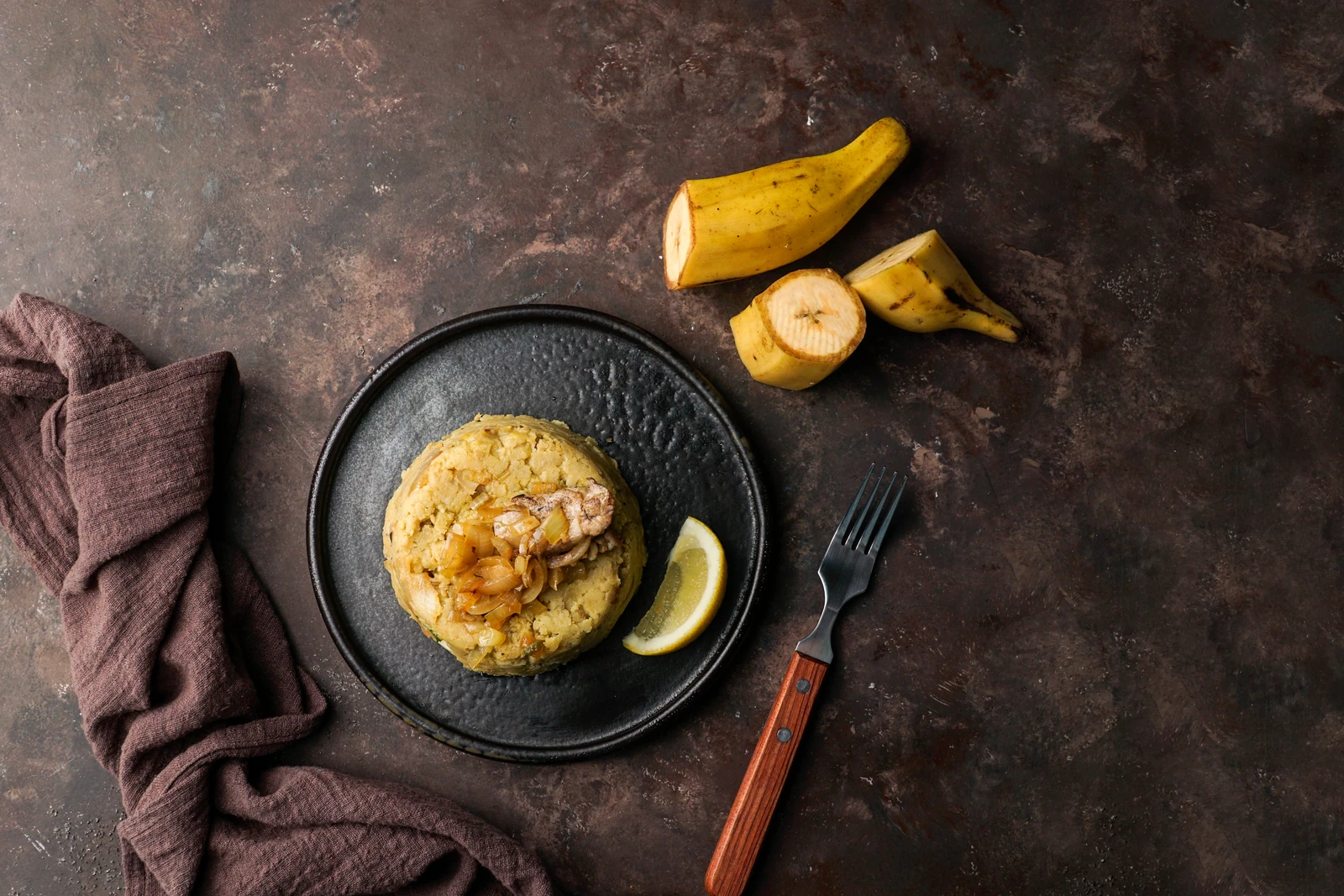

Mofongo (moh-FOHN-goh) is Puerto Rico’s pounded plantain: green plantains fried at 350°F (175°C), then crushed hot in a wooden mortar with garlic, olive oil and crunchy pork cracklings until they pack into a dense, savory mound. It’s one of the island’s best-known dishes, eaten with a cup of chicken broth, under a stew, or hollowed out and filled with shrimp in tomato sauce. The method takes two things most first attempts get wrong: a single fry at a moderate temperature, and mashing each portion the moment the plantain leaves the oil. A potato masher works if you don’t own a pilón.
What mofongo is, and what it isn’t
How do you make mofongo? Fry 4 green plantains, cut into 1 in (2.5 cm) rounds, at 350°F (175°C) for 8 to 10 minutes until tender and pale gold. While they’re hot, pound them one portion at a time with garlic mashed into olive oil, broken pork cracklings and 2 tbsp of chicken stock, then press the mash into a bowl and turn it out. 50 minutes for 4 servings.
Think of it as a mash with backbone. It isn’t smooth like mashed potatoes: it holds its shape, cuts cleanly with a fork, and has small lumps and crunchy pork running through it. Plantain is starchy and not sweet when green, so the main flavors are garlic and toasted plantain. Because it’s dense, it’s always served with something wet.
Mofongo vs. tostones. Same green plantain, different idea. Tostones are fried, flattened and fried again to make crisp coins; mofongo is fried once and pounded into a mass. Colombia’s patacones with hogao and the patacon maracucho sandwich belong to the tostones family.
Mofongo vs. mangú. Dominican mangu boils the plantains and mashes them smooth with butter, more like a purée, and it’s usually a breakfast dish. Ecuador’s bolón and the tacacho of the Peruvian Amazon are closer relatives: green plantain mashed with pork, rolled into balls (bolón, which is fried again) or served with smoked cured pork (tacacho).
Time and difficulty. 50 minutes in all, 20 of prep and 30 of frying and pounding. Medium difficulty, only because the pounding takes some muscle and has to happen fast.
Mofongo without a pilón
A pilón is a deep wooden mortar and pestle, and it’s the traditional tool, but the job is just crushing hot plantain with garlic and pork until it packs together. Anything that does that works.
| Tool | How to use it | What you get |
|---|---|---|
| Wooden pilón | One plantain’s worth at a time | The classic texture, lumpy and compact |
| Stone mortar or molcajete | Same as a pilón | The same result |
| Potato masher and a deep bowl | Press hard, turn the bowl, press again | Very close to the pilón; the best stand-in |
| Bottom of a heavy glass or metal cup | Pound in a small, sturdy bowl | Works, just slower |
| Food processor | 5 or 6 short pulses, stop as soon as no whole slices remain | Fast but risky: run it longer and the starch turns gluey, with no way back |
With a masher or a glass, make the garlic paste first in the bowl, crushing the cloves with the salt using the back of a spoon or a fork, then add the oil and the hot plantain.
Ingredients and where to find them
The recipe works out at one plantain per person, which is mofongo as a main course. Served as a side with a stew, it feeds twice as many.
Green plantains, not green bananas
Plantains are the large, thick-skinned cooking bananas, and for mofongo they must be fully green and hard, with no yellow patches. A plantain that has started to ripen has more sugar: it browns before it cooks through and turns sticky and sweet in the mortar. (Ripe plantains make a softer, sweeter mofongo de amarillo, which is a different dish, and layered with beef and cheese they become pastelón, Puerto Rican sweet plantain lasagna.) Green bananas won’t work either.
- US. Most supermarkets sell green plantains in the produce section, often next to the bananas; Latin and Caribbean grocers always have them.
- UK. Afro-Caribbean and Asian grocers, market stalls and some larger supermarkets, sometimes labeled just “plantain”. Pick the greenest ones.
Pork cracklings, or bacon
Puerto Rican chicharrón is pork skin fried until puffed and crunchy. You need 4 oz (115 g) for 4 plantains, and up to twice that if you want the pork to come through strongly.
- US. Bags of chicharrones or pork rinds in the snack or Hispanic aisle, or chicharrón with meat from a Latin butcher. Plain or salted, never flavored.
- UK. Pork scratchings are harder than chicharrones, so crush them finely before pounding.
- Bacon. 6 slices (about 6 oz / 170 g) of streaky bacon, fried crisp and crumbled. It brings a smoky flavor the cracklings don’t have, and its fat can replace some of the olive oil.
Bagged cracklings are already salty, and so is boxed stock. Taste before you add more salt.
Garlic, olive oil and stock
One garlic clove per plantain gives the garlicky flavor mofongo is known for; go up to 6 if you love it. The olive oil carries the garlic through the mash and makes it glossy. Hot chicken stock, 2 tbsp per portion, loosens the mash so it binds. Stock from a cube is fine, just saltier.
Equipment
An 8 in (20 cm) heavy pot for frying, a frying thermometer if you have one, a slotted spoon, a mortar or one of the alternatives above, and four 1 cup (250 ml) bowls for shaping.
How to make mofongo step by step
Peel and soak
Green plantain peel doesn’t come off by hand like a banana’s. Cut off both ends, score the peel along its ridges and lever it away with your thumb. The sap stains fingers and boards, so a little oil on your hands helps. The 1 in (2.5 cm) rounds soak for 10 minutes in salted water while the oil heats, then get dried thoroughly: water hitting hot oil spits hard.
One fry, at 350°F (175°C)
Unlike tostones, mofongo doesn’t need a double fry. At 350°F (175°C), thick rounds cook to the center in 8 to 10 minutes and stay pale gold. No thermometer? Drop in one slice: it should bubble steadily straight away, not violently. Oil that’s too hot browns the outside and leaves the middle raw; oil that’s too cool soaks in and makes the mofongo heavy.
Judge doneness with a fork, not by color. It should slide into the center with no resistance. A deeply browned plantain forms a hard crust that won’t break down in the mortar.
Pound it hot, one portion at a time
A home pilón comfortably holds one plantain’s worth, so split everything into 4: plantain, garlic oil, cracklings and stock. Add the hot slices with the garlic and pork, pound firmly, and every few strokes scrape the mash off the sides with a spoon and turn it over. Once no whole slices are left, pour in the stock for that portion and keep pounding for about a minute.
How it should look. When you press it with the spoon, it packs together and comes away from the mortar in one piece, with small lumps and visible bits of crackling. It’s not a smooth purée. If it cracks when pressed, it needs more stock or it has cooled; if it’s soft and shiny, there’s too much stock.
Shape it
Rub a 1 cup (250 ml) bowl with a few drops of oil, press the mash in and turn it out onto the plate. For a stuffed mofongo (mofongo relleno), push a spoon into the center before turning it out and open a 1½ to 2 in (4 to 5 cm) hollow. Many restaurants in Puerto Rico serve it straight from the pilón.
Shrimp mofongo with creole sauce
The most popular way to fill mofongo is with shrimp in salsa criolla, a quick stew of tomato, onion, pepper and garlic. The sauce goes inside and around the mound and supplies the moisture the plantain doesn’t have. For 4 mofongos:
- 600 g (1⅓ lb) medium raw shrimp, peeled and deveined
- 2 tbsp olive oil
- 1 medium onion (150 g / 5 oz), chopped
- ½ green bell pepper (75 g / 2½ oz), chopped
- 3 garlic cloves, chopped
- 2 tbsp recaito or sofrito, optional (sold in jars in the Hispanic aisle)
- 1 can (8 oz / 225 g) plain tomato sauce (in the UK, sieved tomatoes or passata)
- 60 ml (¼ cup) dry white wine or chicken stock
- ½ tsp dried oregano, salt, and 2 tbsp chopped cilantro (UK coriander)
Method. Cook the onion and pepper in the oil over medium heat for 5 minutes, until soft. Add the garlic and recaito for 1 minute, then the wine for 1 minute more. Stir in the tomato sauce and oregano and simmer gently for 8 to 10 minutes, until slightly thickened. Season, add the shrimp and cook for 3 to 4 minutes, just until pink, opaque and curled into a loose C, when they reach 145°F (63°C). A tight O shape means they’ve gone rubbery.
Make the sauce before you start frying, or the day before, and drop in the shrimp while you pound the last portion. Fill the hollow and spoon the rest around. The sauce and shrimp add about 30 minutes to the 50 for the mofongo; made the day before, you just reheat it and cook the shrimp for 3 to 4 minutes. For a faster filling, garlic shrimp take 25 minutes start to finish and their garlic butter soaks into the mash nicely.
Broth, other fillings and what to serve with it
With broth. Plain mofongo is usually eaten with hot chicken broth: a cup alongside for spooning over, or about 1 cup (240 ml) per person poured around the mound in a shallow bowl. The broth has to be very hot, because mofongo cools quickly.
Other fillings and toppings.
- Chicken. Shredded stewed chicken with its sauce, about 4 oz (120 g) of meat per mofongo.
- Pork. Fried, marinated pork chunks are the traditional partner, along with chicken broth. Leftover Cuban roast pork, shredded and warmed in its juices, does the same job.
- Steak. Sliced skirt steak on top, with some of its juices.
- Vegetarian. Skip the pork, add 1 more garlic clove and 1 extra tbsp of olive oil, use vegetable stock and top with Puerto Rican stewed beans or vegetables. It’s softer and milder, since the cracklings bring salt and fat, so season more.
On the side. A green salad with tomato and avocado. Mofongo already takes the place of rice, so you don’t need another starch.
Allergens and heat. Plain mofongo isn’t spicy and is naturally gluten-free if the cracklings and stock are (check labels). The shrimp filling contains shellfish. Most kids like it, especially with broth on the side.
Cost. The plantains are the cheap part; the filling is what makes it expensive, especially shrimp. With homemade broth and bagged cracklings, plain mofongo is an inexpensive meal.
Timing it for a crowd, and keeping it hot
Mofongo doesn’t wait. Freshly pounded it’s compact and tender; within 20 minutes or so it turns hard. So everything else gets done before the pounding starts.
- The day before. Creole sauce (without the shrimp) and broth, in the fridge.
- Up to 1 hour ahead. Peel and slice the plantains and keep them in the salted water; make the garlic oil and break up the cracklings.
- At the end. Fry, pound and serve, without stopping.
For 8 or more. Fry all the plantain until tender but still pale, and set it on a tray. Just before pounding each portion, give its slices another 1 to 2 minutes in the hot oil so they go in hot and golden. That way you can pound portion after portion without the plantain cooling, and with a helper one person fries while the other pounds.
Holding. I put shaped mofongos on a tray, cover them with foil and keep them in the oven at its lowest setting, around 200°F (90°C), for no more than 20 minutes. The very hot broth at the table brings them back.
What goes wrong
- It cracks and won’t hold together. It was pounded lukewarm, or it needs stock. Pound each portion straight from the oil and add stock 1 tbsp at a time.
- Hard bits that won’t break down. The plantain was over-browned or undercooked inside, from oil hotter than 350°F (175°C) or slices thinner than 1 in (2.5 cm).
- Heavy and greasy. The oil was too cool or the pot was crowded. Fry in two batches and let the oil come back to temperature in between.
- Gluey, like dough. A plantain that had started to ripen, too much stock, or a food processor left running. It can’t be fixed; next time use firm green plantains and short pulses.
- Too salty. Bagged cracklings plus cube stock. Salt at the end, after tasting.
Leftovers
Leftover mofongo keeps 3 to 4 days in a closed container in the fridge, as long as it goes in within 2 hours. It hardens as it cools and never returns to its freshly pounded texture, so I’d rather pound only what will be eaten and keep any extra fried slices instead.
Reheating. Crumble it into a skillet with 1 tbsp oil and 3 to 4 tbsp stock, cover and warm over medium-low for 5 to 6 minutes, stirring, until steaming, then press it back into a bowl. Or shape it into ⅝ in (1.5 cm) patties and brown them for 3 minutes a side. The microwave dries it out unless it’s covered with stock added.
Freezing. It can be frozen for 2 to 3 months, but it comes back drier and mealy. I don’t recommend it.
Mofongo FAQ
Can I make mofongo with boiled plantains or in an air fryer? Yes, with differences. Boiled plantain makes a wetter, softer mash, closer to mangú. In an air fryer, with the slices brushed with oil, it comes out drier and needs extra stock and olive oil in the mortar. Neither has the fried-plantain flavor of the original.
Can I make it ahead? Not the pounded mofongo: it sets hard within about 20 minutes. You can make the sauce, the broth, the garlic oil and the broken cracklings ahead, and fry the plantains up to an hour early, refrying them briefly just before pounding.
Is mofongo the same as fufu? They’re related but not the same. West African fufu is a smooth, stretchy dough of pounded boiled starch eaten with soups; mofongo uses the same pounding idea with fried plantain, garlic and pork.
Is mofongo Puerto Rican or Dominican? It’s Puerto Rican, and it’s just as popular with Dominicans, both on the island and in New York. In Moca, in the Dominican Republic, there’s a local version topped with shredded cheese.
Nutrition per serving
One plantain with its share of garlic, cracklings, olive oil and mashing stock, without filling or serving broth, worked out from the recipe quantities:
- Calories: 684 kcal
- Protein: 20 g
- Carbohydrates: 70 g
- Fat: 36 g, of which 10 g saturated
- Fiber: 5 g
- Sugars: 5 g
- Sodium: 741 mg
Roughly two thirds of the calories come from the fried plantain, which soaks up about ½ oz (16 g) of frying oil per serving; the cracklings and the olive oil make up most of the rest. Most of the sodium comes from bagged cracklings. A 5 oz (150 g) serving of shrimp in creole sauce adds about 200 kcal.
Where I grew up in Venezuela, green plantain meant patacones, flattened and crunchy, so a pounded mash of it with garlic seemed odd to me as a whole meal. Now I make the shrimp version when there’s something to celebrate and the plain one with chicken broth on an ordinary Sunday. Dylan gets his with extra cracklings and no hollow: he says the filling gets in the way. Josnaisis.