
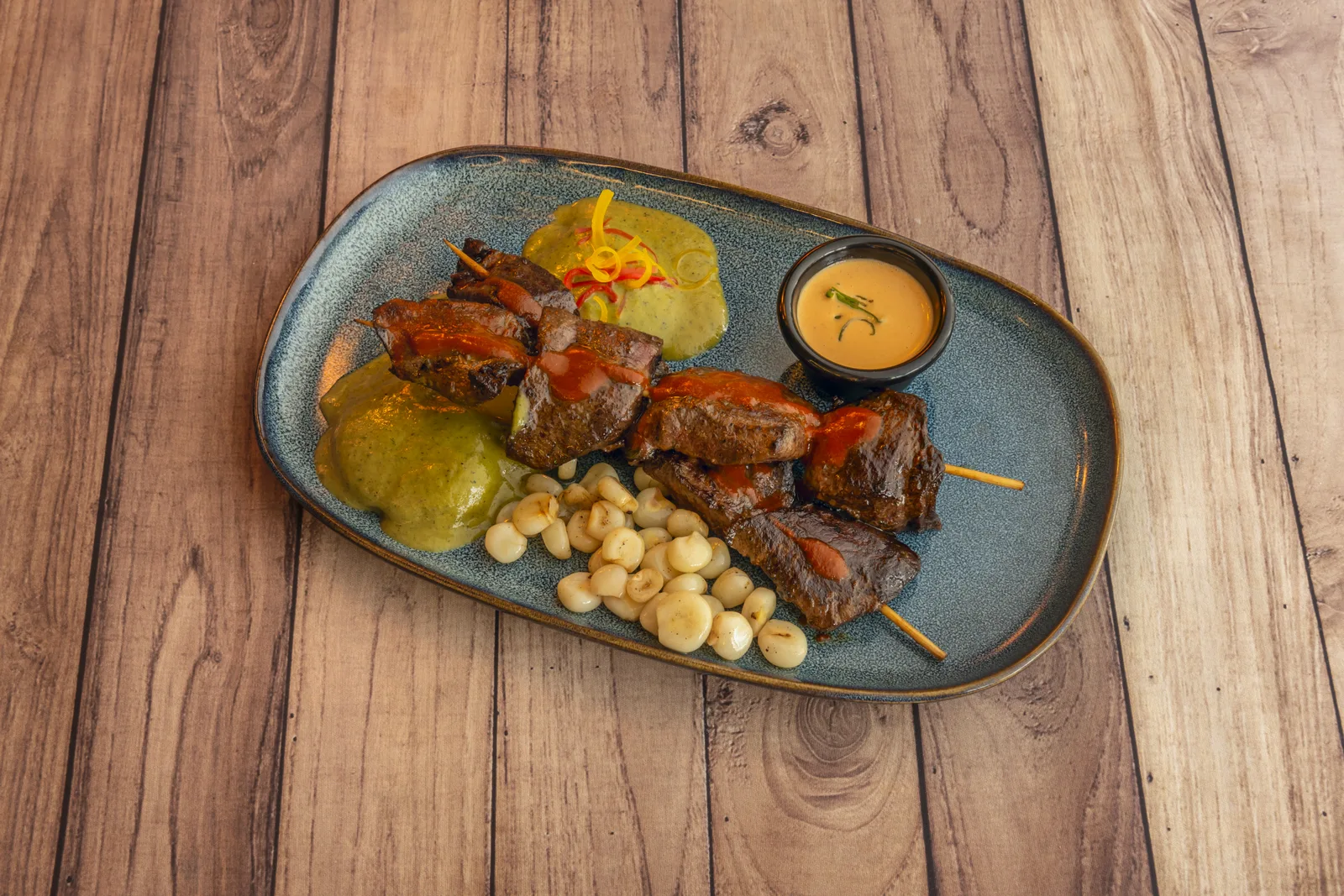

Anticuchos (ahn-tee-KOO-chohs) are Peru’s beef heart skewers: lean pieces of heart soaked overnight in a dark-red paste of aji panca chile, vinegar, garlic and cumin, then charred over a very hot fire for 2½ to 3 minutes a side and brushed with more marinade as they cook. If heart sounds like a stretch, it’s worth knowing it eats like a firm, beefy steak, not like liver. Below is the recipe for 4, a step-by-step guide to trimming the heart, where to buy one in the US and UK, how to cook them in a grill pan, the rocoto sauce, and how chicken or sirloin compares.
What anticuchos are and what beef heart tastes like
How do you make anticuchos? Trim 1¾ lb (800 g) of beef heart, cut it into ⅝ in (1.5 cm) thick pieces and marinate at least 3 hours in aji panca paste, red wine vinegar, garlic, cumin, oregano and oil. Thread onto skewers and grill over very high heat for 2½ to 3 minutes per side, basting with reserved marinade, until the center reaches 160°F (71°C). Serve with potatoes, corn and rocoto sauce. 255 minutes for 4 servings.
In Peru, anticuchos are street-stall and backyard-grill food: a couple of skewers per person with a slice of potato browned on the same grill, a piece of big-kernel corn, and a fiery sauce on the side. The marinade isn’t hot. Aji panca is a mild, fruity, slightly smoky dried chile that gives the meat its deep color; all the heat lives in the sauce.
What does beef heart taste like? Heart is a working muscle, not a soft organ like liver or kidney. It tastes like lean beef with a faint mineral note, and has a dense, firm bite, a little like a well-trimmed sirloin. Cooked fast and hot, it’s juicy. Cooked slowly or too long, it gets rubbery, and that’s where its bad reputation comes from.
If you’ve made Colombian beef skewers or Mexican carne asada, this is a different animal: those use steak cuts and citrus or beer, and they’re about the meat. Anticuchos are about the marinade and the char. The same aji panca, garlic and cumin base also goes into Peruvian roast chicken, pollo a la brasa.
Time and effort. 255 minutes in all: 40 minutes of hands-on work, at least 3 hours of marinating and 35 minutes of cooking, which includes boiling the potatoes and corn; the skewers themselves take 5 to 6 minutes per batch. Boil the potatoes and corn while the meat marinates and the last stretch to the table is about 15 minutes. Medium difficulty, only because of the trimming.
How many it feeds. 7 oz (200 g) of trimmed heart per person, 2 skewers each, makes a full dinner for 4 with the potatoes and corn. As a starter or party snack, it stretches to 8, one skewer each.
Ingredients, and where to find them in the US and UK
Beef heart, or ox heart in the UK
A whole beef heart weighs 3½ to 4½ lb (1.5 to 2 kg) and comes with fat, arteries and sinew that you’ll cut away, so buy more than you need or ask for it already in pieces. Freeze whatever trimmed meat is left over.
- In the US. Look for “corazón de res” at Mexican and Latin carnicerías, the meat counter of Hispanic supermarkets, and Asian grocers with a butcher counter. It’s often sold frozen. If you don’t see it, ask at the counter; many butchers can order it in.
- In the UK. Ask a butcher for ox heart, usually to order a couple of days ahead. Lamb hearts are easier to find but much smaller; they work, with more trimming per pound of meat.
- Fresh or frozen. Cook fresh heart within 1 to 2 days. Thaw frozen heart overnight in the fridge; it’s easier to trim while it’s still a little firm.
Heart is one of the cheapest beef cuts. What drives the cost up outside Peru are the jars of aji panca and rocoto paste, and each one covers several batches.
Aji panca and what to use instead
Aji panca paste comes in jars at Peruvian and Latin shops in the US, and online in both the US and UK. It’s the flavor of the dish, so it’s worth ordering.
- Dried aji panca. Stem and seed it, soak 20 minutes in hot water and blend with a splash of the soaking water. You need 6 tbsp of paste.
- Dried ancho or guajillo chiles, from Mexican groceries or larger supermarkets. Prepare them the same way: 3 anchos or 6 guajillos give about 6 tbsp of paste. This is the closest match; ancho is earthier, guajillo a little sharper.
- Paprika. As a last resort, 2 tbsp sweet paprika with a pinch of cayenne. The color is right but the flavor is flatter.
Use red wine vinegar; cider vinegar works and is a little softer. Don’t add more than the recipe says: the marinade should taste tangy, not catch in your throat.
Potatoes, corn and the rocoto sauce
- Potatoes. Yukon Gold in the US; in the UK, a waxy yellow potato such as Charlotte, or any that holds its shape when boiled.
- Corn. Peruvian choclo has huge, pale, starchy kernels and isn’t very sweet. US Latin shops sell it frozen on the cob. Supermarket sweet corn is fine, just sweeter.
- Rocoto. A thick-fleshed Peruvian chile with serious heat. Look for paste or frozen rocoto at Peruvian shops or online. Without it, ½ habanero (UK Scotch bonnet), seeded, gives similar heat and more perfume; 2 red Fresno or red jalapeño chiles are milder.
- Aji amarillo sauce instead. Stir 3 tbsp aji amarillo paste with the scallion, lime and salt for a fruitier, gentler sauce. A creamier aji amarillo sauce, the one from papa a la huancaína, is also good alongside. If you have huacatay (Peruvian black mint) paste, 1 tsp in either sauce adds a herbal note somewhere between mint and anise.
Equipment
A charcoal or gas grill, or an 11 in (28 cm) cast-iron grill pan or skillet and a well-ventilated kitchen. 8 skewers, wooden ones soaked 30 minutes, or metal. A basting brush. An instant-read thermometer earns its keep here, because heart is hard to judge by color.
How to trim a beef heart
Work with the heart straight from the fridge: cold, the membrane and cords come away cleanly. Allow about 20 minutes the first time.
- Open it. Cut it lengthwise and open it like a book so you can see the chambers.
- Cut off the top. The wide end has a cap of white fat and the thick, rubbery tubes of the arteries and veins. Cut all of that away.
- Pull out the inside cords. The chambers are lined with white strings and flaps of membrane. Lift them out with the tip of your knife; they’re what turns chewy on the grill.
- Peel the outer membrane. It’s a thin, shiny film, like the silverskin on a tenderloin. Slide the knife tip under it, lift, and run the blade along it keeping it close to the membrane.
- Rinse and dry. Rinse away any clots in cold water and pat dry with paper towels.
- Cut. Pieces about 1½ × 1¼ in (4 × 3 cm) and ⅝ in (1.5 cm) thick, roughly 1 oz (30 g) each. 1¾ lb (800 g) gives 26 or 27 pieces, enough for 8 skewers of 3 or 4.
What’s left should be dark red, smooth and firm, with no white strands. Scraps with some meat on them can go in the freezer for stock.
How to grill anticuchos, or cook them in a grill pan
Marinate 3 hours to overnight
3 hours in the fridge is enough for the flavor to get in; overnight is deeper and gets the work done ahead. I don’t go past one night, because with this much vinegar the surface starts to turn soft. The 4 tbsp you set aside before the raw meat went in are the ones for basting.
On a charcoal or gas grill
You want the fire very hot. With charcoal, glowing coals under a layer of white ash, hot enough that you can hold your hand 5 in (12 cm) above the grate for only 2 to 3 seconds. With gas, preheat on high with the lid closed for 10 minutes.
Lay the skewers down and leave them alone for 2½ to 3 minutes. Baste, turn and repeat. The edges should be charred, almost black at the tips, with the marinade lacquered on. If dripping oil causes flare-ups, slide the skewers aside for a few seconds.
In a grill pan or cast-iron skillet
Heat a cast-iron grill pan or skillet over the highest heat for 5 minutes and rub it with a few drops of oil. Add the skewers without crowding, in 2 batches if needed, and cook 2½ to 3 minutes per side, basting. Turn on the fan or open a window, as the marinade smokes on hot iron. You lose the smoke of the coals but get the same doneness.
When they’re done, 160°F (71°C)
Beef heart is safe when the center of the thickest piece reaches 160°F (71°C). Push the thermometer in from the side into the middle of a piece. At ⅝ in (1.5 cm) thick over high heat, that usually takes 5 to 6 minutes in all.
Without a thermometer, cut one piece open: the inside should be pale pink to brown with no glossy red, and juicy. Gray and dry all the way through means it’s gone too far. Squeezed with tongs, a good one gives slightly and springs back; one that feels like a rubber ball is overcooked.
Planning ahead and cooking for a crowd
The day before. Trim, cut and marinate the heart, and make the rocoto sauce, which keeps 3 to 4 days covered in the fridge.
On the day. Boil the potatoes and corn in the morning or while the grill heats. Thread the skewers, brown the potatoes on the grill, then cook the anticuchos last, because they wait badly.
Scaling. Keep to 7 oz (200 g) of trimmed heart per person for a main course. Triple the recipe for 12 and multiply by 5 for 20; as finger food, one skewer each, the base recipe serves 8. Trimming is the slow part with several hearts, so do it the day before. Grill in batches and serve each batch as it comes off.
Chicken or steak anticuchos instead of heart
- Chicken. 1¾ lb (800 g) boneless, skinless thighs in 1¼ in (3 cm) cubes, in the same marinade for 2 to 4 hours. Cook over medium-high heat, turning, 10 to 12 minutes, to 165°F (74°C) in the center. Softer and milder; a good starting point for anyone wary of heart.
- Steak. 1¾ lb (800 g) top sirloin (UK rump) cut ⅝ in (1.5 cm) thick, marinated 3 hours to overnight. Grill just as fast to 145°F (63°C) and rest 3 minutes. More tender and less beefy-mineral than heart: a different anticucho, but a good one.
Mistakes that make anticuchos tough
- Low heat or too long on the grill. Over a lazy fire the heart steams instead of charring and dries out before it browns. Very high heat, off at 160°F (71°C).
- Chewy strands. Cords or membrane left on. More marinating won’t fix it; trim more carefully.
- Uneven pieces. Thin ones dry out while thick ones finish. Cut everything ⅝ in (1.5 cm) thick.
- Harsh vinegar taste. Too much vinegar or marinated past one night. Stick to ⅓ cup (80 ml) and let excess marinade drip off before threading.
- Burned skewers. Not soaked. 30 minutes in water, and keep the handle end off the fire.
- Pale, gray meat. The grill or pan wasn’t hot enough, or the meat was too wet. Let the marinade drip off and wait for full heat.
Heat, kids and allergens. The skewers themselves are barely spicy; the rocoto sauce is very hot, so serve it on the side. That also makes them easy for kids, who are more likely to notice the firm texture than any heat. No gluten or dairy, but check the label on your aji panca paste, as some brands add other ingredients.
Serving, storing and reheating
Serving. Straight off the fire, on the skewer, with 2 slices of browned potato and half an ear of corn per person and the sauce alongside. A sliced onion and tomato salad finishes the plate; for a bigger Peruvian spread, add lomo saltado. To drink, a pitcher of ice-cold chicha morada, Peru’s purple corn drink, can be made the day before.
Raw heart. Fridge, 1 to 2 days. Trimmed and cut, it freezes raw for 3 to 4 months; thaw it in the fridge.
Cooked anticuchos. Refrigerate in a sealed container within 2 hours; they keep 3 to 4 days, or 2 to 3 months frozen. Reheated, they lose juice, so don’t make extra on purpose.
Reheating. In a very hot skillet, uncovered, with a few drops of oil, about 1 minute per side until hot through (165°F / 74°C). The microwave makes them rubbery.
If you’re coming to heart from liver, the Latin liver and onions is the softer, richer cousin; heart is the one that eats like steak.
Anticuchos questions
Are anticuchos always beef heart? The classic Peruvian version is. Chicken, steak and other offal versions exist, but plain “anticuchos” on a Peruvian menu means beef heart.
Is beef heart tough? Not when it’s trimmed well and cooked fast. It has a firm, steak-like bite; it turns rubbery when it’s cooked low and slow or left on the heat after it reaches 160°F (71°C).
Can I make anticuchos in the oven? Not really. They need direct, fierce heat to char in a few minutes. A smoking-hot cast-iron grill pan gets far closer than a regular oven.
How long should I marinate them? At least 3 hours in the fridge, and no more than overnight. Under an hour, the flavor stays on the surface.
Anticuchos nutrition
Per serving (7 oz / 200 g trimmed heart with its marinade, 7 oz / 200 g potato, half an ear of corn and the rocoto sauce), calculated ingredient by ingredient from the recipe amounts:
- Calories: 670 kcal
- Protein: 42 g
- Carbohydrates: 58 g
- Fat: 30 g, including 6 g saturated
- Fiber: 6 g
- Sugars: 7 g
- Sodium: 1180 mg
The heart accounts for about 224 kcal, the potato about 174, and the oil in the marinade, potatoes and sauce about 186. Some marinade stays behind in the bowl, so actual fat and sodium are a little lower. The skewers alone, without potato or corn, come to about 370 kcal per person.
For me, anticuchos are won at the cutting board, not at the grill. I buy the heart the day before, trim it cold and slowly until not a single white strand is left, and let the marinade sit overnight. The next day dinner is fifteen minutes of high heat, and nobody finds anything chewy on their skewer. Josnaisis.