
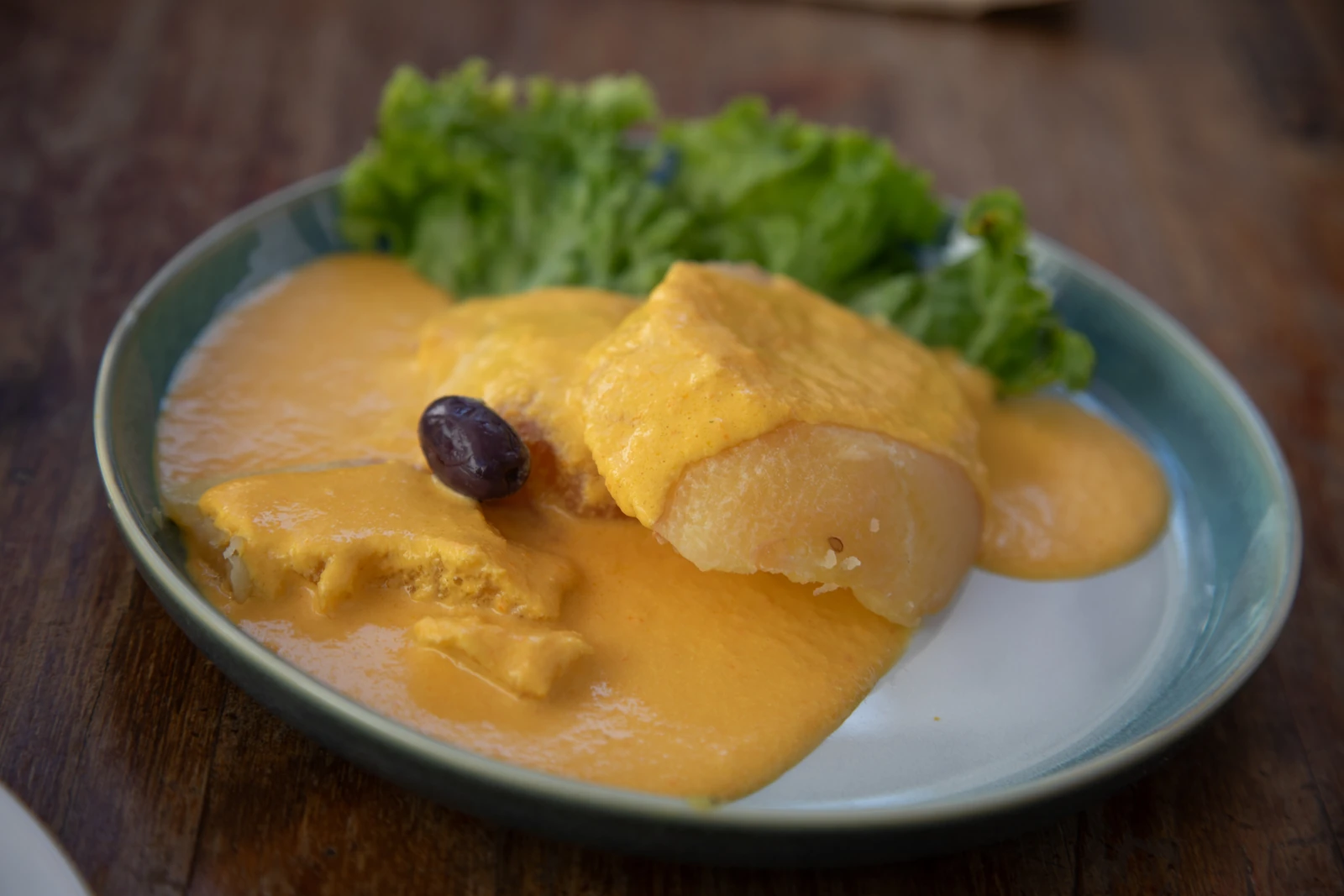

Papa a la huancaina (PAH-pah ah lah wan-kah-EE-nah) is boiled potato, served cold, under a blended sauce of aji amarillo, a fruity yellow Peruvian chile, with fresh cheese, evaporated milk, oil and a few saltine crackers. There’s no cooking technique to master. The two things that matter are how much heat you leave in the chile and how thick you blend the sauce, and both are easy to steer once you know where they come from. Below is the recipe for 4, what to buy in a US or UK supermarket, and how far ahead you can make it.
What papa a la huancaina is, and how it’s served
How do you make papa a la huancaina? Boil 2¼ lb (1 kg) of yellow potatoes in their skins for 20 to 25 minutes and let them cool. Soften 4 seeded aji amarillo chiles with onion and garlic, then blend them with 9 oz (250 g) of queso fresco, ½ cup (120 ml) of evaporated milk, 3 tbsp of oil and 4 saltines until thick and smooth. Spoon the sauce over sliced potatoes on lettuce and top with hard-boiled egg and black olives. 50 minutes for 4 servings.
It’s one of Peru’s best-known starters, eaten cold or at room temperature: thick potato slices on a lettuce leaf, blanketed in a creamy sauce that tastes of mild cheese and bright chile, with a little heat at the finish. The name points to Huancayo, a city in the central Andes, though where the dish was first made is disputed.
Time and effort. 50 minutes, about 15 of them hands-on; the rest is the potatoes simmering. Four servings make a light main; as a starter it feeds 6.
If you know Colombian papas chorreadas with tomato and cheese sauce, that’s the hot, melted-cheese cousin. Huancaina is the opposite: the cheese never melts, it’s blended cold into the sauce.
Ingredients and US and UK swaps
| Ingredient | Amount | What to buy in the US | What to buy in the UK |
|---|---|---|---|
| Aji amarillo | 4 chiles or 2 to 4 tbsp paste | Jarred paste in the Hispanic aisle, frozen whole chiles in Latin stores | Paste online or in Latin American shops |
| Queso fresco | 250 g (9 oz) | Queso fresco or queso blanco, sold in most supermarkets | Feta, soaked to remove salt, or Latin shops |
| Evaporated milk | 160 ml (⅔ cup) | Any canned evaporated milk | Any canned evaporated milk |
| Crackers | 4 | Saltines | Cream crackers |
| Potatoes | 1 kg (2¼ lb) | Yukon Gold | Waxy-to-floury yellow potatoes |
Aji amarillo, and what to do without it
Aji amarillo gives the sauce its color and its fruity flavor, and nothing else tastes quite like it. Fresh chiles are rare outside Peru, but frozen whole ones turn up in Latin grocery stores, and you treat them like fresh: thaw, split and scrape out the ribs.
Paste is the easy route. It already contains the ground ribs, so you can’t control the heat by seeding, and brands vary a lot. Start with 2 tbsp (30 g), blend, taste, and work up to 4 tbsp. With paste, skip the blanching and stir it into the onion only for the last minute.
If you can’t get aji amarillo in any form, a seeded yellow bell pepper sautéed with a small piece of fresh hot chile gives you a yellow, gently spicy sauce. Be honest with yourself about the result: it’s a pleasant cheese and pepper sauce, not huancaina.
The cheese
Peruvian queso fresco is white, salty and crumbly, and it doesn’t melt, which is why the sauce turns out smooth rather than stringy. In the US, Latin-style queso fresco is the closest match, with queso blanco or farmer’s cheese next. In the UK, feta is the practical choice: it’s saltier and tangier, so I crumble it, soak it in cold water for 20 minutes, drain it and skip the added salt. The sauce keeps a slight tang. Ricotta works only as a last resort; it’s mild and makes a looser sauce, so hold back some of the milk.
Milk and crackers
Evaporated milk makes a denser, slightly sweet sauce. Regular whole milk works but runs thinner, so use less and add half a cracker more. The crackers are just a thickener and you won’t taste them. A slice of crustless white sandwich bread does the same job.
The potatoes
Peruvian yellow potatoes are floury with golden flesh and split open when they’re done. Yukon Gold is the closest widely sold match; Latin stores sometimes carry frozen Peruvian yellow potatoes. In the UK, pick a yellow-fleshed boiling potato. Colombian papa criolla, the small golden potato, is yellow and floury too but much smaller and softer: start checking it after 10 minutes.
How to make huancaina sauce in 10 minutes
The sauce comes together while the potatoes boil.
- Seed the chiles. Split them and scrape out every white rib and seed with a teaspoon. Gloves help; otherwise wash your hands well before touching your eyes.
- Blanch for a mild sauce. 3 minutes in boiling water, drain, repeat with fresh water. Skip this if you like heat.
- Soften. Cook the onion and garlic in the skillet oil over medium heat for 3 minutes, add the chiles and give them another 3 to 4, until soft. Don’t let them brown, or the sauce turns darker and bitter.
- Blend 1 minute with the cheese, ½ cup (120 ml) milk, 3 tbsp oil and the crackers.
The texture test. Dip a spoon and turn it over. The sauce should coat it and slide off in a thick ribbon. If you can see the spoon through it, blend in another cracker. If it clings like mashed potato, add milk a tablespoon at a time, up to the full ⅔ cup.
Heat levels. Most of the heat sits in the white ribs rather than the seeds, so scraping out every rib is what counts. Seeded and blanched twice, it is usually mild and many kids eat it, but chiles vary: taste a sliver of blanched chile before you blend the batch. Seeded but not blanched, it’s medium. If you overshoot, blend another 50 g (1¾ oz) of cheese with a splash of milk and stir it in.
Boiling the potatoes and plating
Start the potatoes whole and unpeeled in cold, unsalted water; the sauce brings the salt. A medium Yukon Gold takes about 22 minutes from the boil. Start testing at 18: they’re ready when a knife reaches the center without pushing. Peruvian yellow potatoes crack open when they’re cooked and fall apart soon after, so pull them promptly.
Let them cool uncovered, peel, and slice ⅜ in (1 cm) thick; thinner slices break when you plate. For each plate: a lettuce leaf, 5 or 6 slices, about ⅔ cup (150 ml) of sauce, 2 egg halves and 2 olives. Some cooks scatter boiled corn kernels on top.
Serve it cold or at room temperature, never hot. If the potatoes were boiled the day before, take them out of the fridge 20 minutes ahead.
Common problems and fixes
- Too spicy. Ribs left in the chile, or a strong paste. Scrape with a spoon, and start paste at 2 tbsp.
- Runny sauce. All the milk went in at once, or a wet cheese like ricotta. Add milk in two goes; thicken with a cracker.
- Grainy sauce. Not blended long enough, or a dry cheese. Give it the full minute, plus 1 tbsp milk if needed.
- Bitter or dull color. The garlic or chile browned. Keep the heat at medium.
- Potatoes crumble when sliced. Overcooked, or sliced while hot. Pull them as soon as the knife slides in and slice them warm, not hot.
- Too salty. Cheese and crackers are already salty. Taste before adding the ¼ tsp.
Allergens. Contains milk, wheat (crackers) and egg. For gluten-free, leave out the crackers and add the milk gradually until the sauce is thick enough. It’s a little less firm but coats just as well.
Make ahead and storage
- The day before. Make the sauce and boil the potatoes and eggs, then refrigerate each separately. Assemble just before serving.
- Sauce. In a sealed jar in the fridge, up to 2 days. It thickens as it chills; loosen with 1 or 2 tbsp evaporated milk.
- Boiled potatoes. Covered, 3 to 4 days in the fridge.
- Hard-boiled eggs. In the shell, up to 1 week refrigerated.
- Freezing. The sauce can be frozen in a sealed container, but it may separate as it thaws in the fridge; blend it again with a splash of milk. Don’t freeze the potatoes, they turn watery.
- On the table. Don’t leave the plated dish out more than 2 hours, or 1 hour above 90°F (32°C), because of the cheese and egg.
Other ways to use huancaina sauce
- For a crowd of 12. Triple the recipe, 3 kg (6½ lb) of potatoes and 750 g (1 lb 10 oz) of cheese, and blend the sauce in two or three batches.
- Party dip. Small boiled potatoes on toothpicks, or quail eggs, with the sauce in a bowl.
With leftover yellow potatoes, make Peru’s other cold potato starter, causa limeña, riced potato layered with chicken and avocado. Both sit well on the table next to a Peruvian fish ceviche in leche de tigre, which is the one starter that has to be made at the last minute.
- With roast chicken. Serve it as a yellow dipping sauce for the meat and fries of a Peruvian chicken, pollo a la brasa with green sauce, next to the green one.
- With cassava. Spoon it over boiled cassava or serve it as a dip for crispy fried yuca.
- With pasta. Toss hot cooked noodles with the sauce off the heat, thinned with a splash of milk. In Peru that plate is sometimes topped with lomo saltado, the soy-and-vinegar beef stir fry.
- On fried rice. A spoonful over Peruvian arroz chaufa with chicken, egg and ginger works the way chili sauce does at a chifa table, adding creaminess and gentle heat.
For a Peruvian December spread, the drink alongside is the spiced Peruvian hot chocolate served with panettone.
Papa a la huancaina FAQ
Can I make it with an immersion blender? Yes, in a tall cup with the cheese well crumbled. It takes 2 to 3 minutes longer. By hand with a fork it won’t get smooth.
What is aji mirasol, and can I use it instead? Aji mirasol is the dried form of aji amarillo. It needs soaking in hot water before blending and gives a darker, toastier sauce. Good, but not classic huancaina.
Is huancaina sauce supposed to be heated? No. It’s served cold or at room temperature and only warms up when tossed with freshly cooked pasta or cassava.
Nutrition per serving
Per serving (a quarter of the recipe, with potatoes, sauce, egg, olives and lettuce), worked out ingredient by ingredient:
- Calories: 680 kcal
- Protein: 26 g
- Carbohydrates: 59 g
- Fat: 39 g, of which 14 g saturated
- Fiber: 5 g
- Sugars: 7 g
- Sodium: 835 mg
The potatoes bring about 195 kcal per serving and the sauce about 390, mostly from the cheese and oil. Split as a starter, each plate comes to roughly 455 kcal for 6 people.
I keep a jar of aji amarillo paste in the fridge door just for this sauce, and I never add it all at once. Two spoonfuls, blend, taste, then decide. Whatever sauce is left goes on boiled yuca the next day. Josnaisis.