
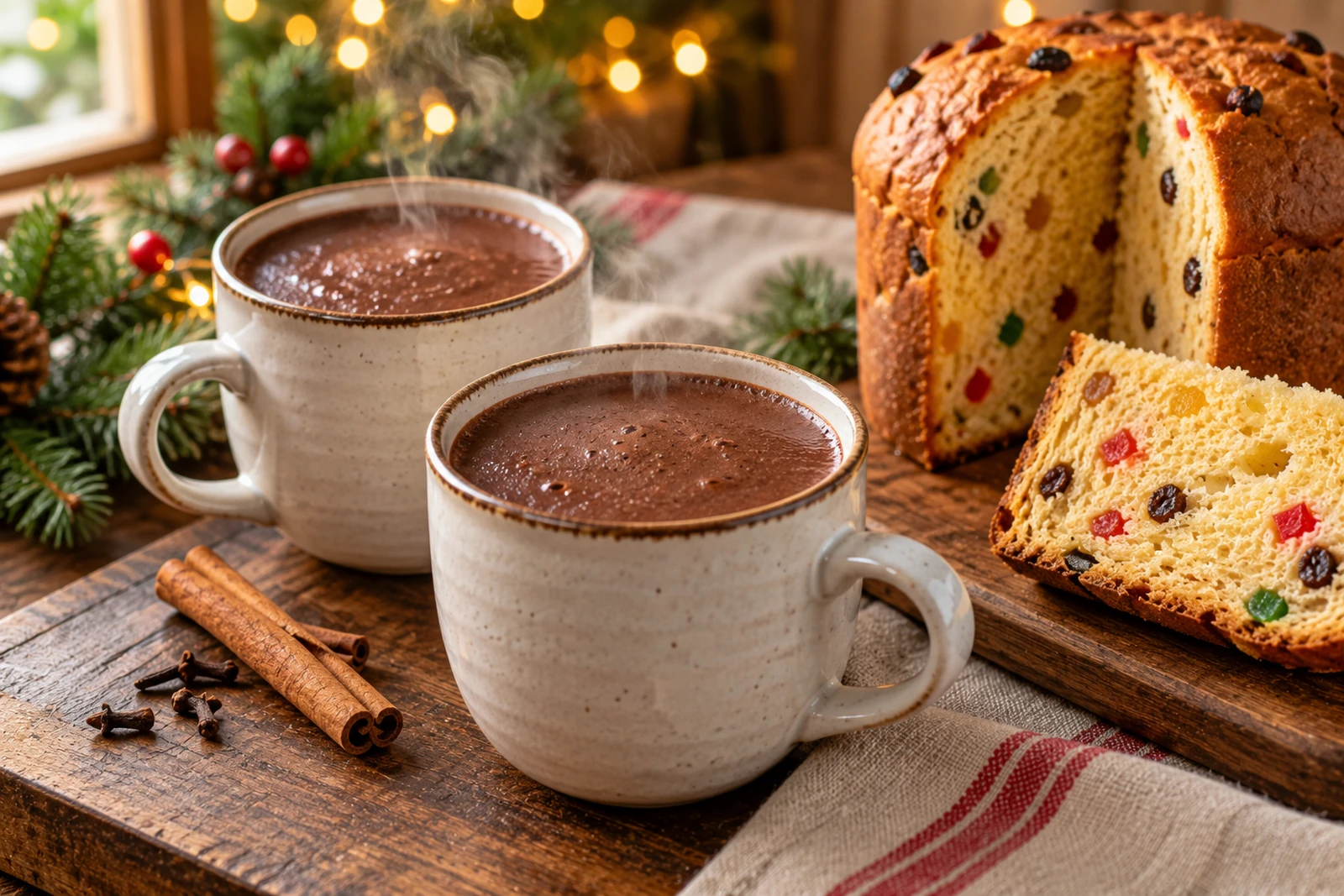

Chocolatada (choh-koh-lah-TAH-dah) is the hot chocolate Peruvians drink at Christmas: chocolate melted into water steeped with cinnamon and cloves, then made creamy with a can of evaporated milk. It’s thicker and less sweet than a packet mix, with a faint caramel note from the canned milk. The can is also what makes it easy to scale, so below you’ll find the recipe for 4 mugs, the shopping list for 20 or 50 people, how thick to make it, and what to buy in an American or British supermarket.
What Peruvian hot chocolate is
How do you make Peruvian hot chocolate? Simmer 2 cups (500 ml) of water with 2 cinnamon sticks and 4 cloves for 10 minutes and remove the spices. Melt 4¼ oz (120 g) of chopped dark chocolate in it, add a can of evaporated milk and sugar to taste, and heat while stirring until it steams; for a thick version, add 1 tbsp of cornstarch slurry and let it bubble for 2 minutes. 30 minutes for 4 servings.
In Peru, a chocolatada is both the drink and the gathering. Through December, schools, churches and neighborhood groups host chocolatadas where hot chocolate is poured with slices of panettone (panetón in Peru), often for children and families with less. At home, a mug with panettone closes Christmas Eve dinner, even though December is summer in Lima.
It isn’t the frothy, cheese-in-the-mug Colombian hot chocolate, which is whipped with a wooden whisk and made with fresh milk, and it isn’t Mexican champurrado, which is thickened with corn masa. What sets chocolatada apart is evaporated milk: more body than fresh milk, and that slightly cooked, caramel flavor.
Total time 30 minutes, 10 of them hands-off while the spices steep. Easy: the only thing to watch is the bottom of the pan.
What to buy in a US or UK supermarket
The chocolate
In Peru it’s made with tablets of chocolate para taza, drinking chocolate. You don’t need them. Any dark chocolate with 50 to 70% cacao from the baking aisle works: semisweet or bittersweet bars in the US, dark or plain chocolate in the UK.
- Mexican drinking chocolate tablets from the Latin aisle also work, but they already contain sugar and cinnamon. Skip the sugar, use just one cinnamon stick and expect a slightly grainy texture.
- 100% cacao or unsweetened baking chocolate gives the deepest flavor; you add all the sweetness, about 4 to 5 tbsp (50 to 60 g) sugar for this recipe.
- Peruvian drinking chocolate turns up in Latin grocers and online. Read the label: some bars are mostly sugar and vegetable fat and say “chocolate flavored”; look for cocoa paste or cocoa mass as the first ingredient.
- Skip milk chocolate candy bars. Too much sugar, too little cocoa, and the drink turns pale and cloying.
Evaporated milk
Evaporated milk is milk with roughly half its water cooked off, sold in cans next to the condensed milk. Don’t mix them up: sweetened condensed milk is a different product and will make this far too sweet. The US can is 12 fl oz (354 ml) and the UK one 410 g; either works here. Mixed with an equal amount of water, evaporated milk behaves like whole milk, which is the ratio this recipe uses.
No evaporated milk? Use 3 cups (750 ml) whole milk instead of the can and steep the spices in just ⅔ cup (150 ml) water so the drink isn’t watery. It comes out lighter, without the caramel note.
With cocoa powder
It works, but the cornstarch stops being optional: 1 tbsp (8 g) as a cold slurry, added after the milk exactly as in the thick version, with its 2 minutes of bubbling. For 4 mugs, mix 4 tbsp (22 g) unsweetened cocoa with 4 tbsp (50 g) sugar, then stir in a few spoonfuls of the hot spiced water to make a smooth paste, and add it to the pan where the chocolate would go, right after the spices come out. Cocoa has had most of its fat pressed out, so on its own it gives flavor but little body.
Equipment. A heavy-bottomed saucepan of at least 3 quarts (3 liters), a wooden spoon or spatula that reaches the corners, and a fine sieve if you’d rather not fish out cloves.
How to make it, step by step
Steep the spices. Water, cinnamon and cloves, covered, for 10 minutes once it boils. It’s ready when it looks like weak tea. Take the spices out before the chocolate goes in; one stray clove in a mug is bitter.
Melt the chocolate in the water. Chop it into ½ in (1 cm) pieces so it melts evenly. Over low heat it takes 3 to 4 minutes to become a dark, glossy liquid with no specks.
Add the milk. In go the evaporated milk and sugar, and the heat goes up to medium. From now on, keep scraping the bottom. In about 5 minutes it steams and tiny bubbles appear around the edge. Stop here if you want it light.
How thick, and why the cornstarch has to bubble
Without cornstarch, chocolatada is like a rich chocolate milk. With 1 tbsp (8 g) per can, it coats the back of a spoon and feels thick in the mouth, the way many Peruvian families like it. For a nearly spoonable version, use 2 tbsp.
Cornstarch only thickens once it bubbles. Always mix it with cold water first, pour it in a thin stream while stirring, and give it 2 minutes at a gentle bubble. It keeps thickening as it cools, so take it off the heat slightly thinner than you want it in the mug.
Hot chocolate for a crowd of 20 or 50
Think in cans. Each can of evaporated milk (the 12 fl oz / 354 ml US can or the 410 g UK one, which is about 385 ml; the difference barely shows in the mug), with 2 cups (500 ml) water, 4¼ oz (120 g) chocolate, 2 tbsp sugar and 1 tbsp cornstarch, makes about 4 mugs of 7½ fl oz (220 ml).
| Guests | Evaporated milk | Water | Chocolate | Sugar | Cornstarch | Spices | Pot |
|---|---|---|---|---|---|---|---|
| 4 | 1 can | 2 cups (500 ml) | 4¼ oz (120 g) | 2 tbsp (25 g) | 1 tbsp (8 g) | 2 sticks, 4 cloves | 3 qt (3 L) |
| 20 | 5 cans | 2½ qt (2.5 L) | 1 lb 5 oz (600 g) | ⅔ cup (125 g) | 5 tbsp (40 g) | 6 sticks, 12 cloves | 8 qt (8 L) |
| 50 | 13 cans | 1¾ gal (6.5 L) | 3¼ lb (1.5 kg) | 1⅔ cups (325 g) | ¾ cup (100 g) | 12 sticks, 25 cloves | 5 gal (20 L), or two 10 qt |
I don’t scale the spices all the way: in a big pot I’d rather go light on cloves, which take over quickly. Taste the infusion after 10 minutes and leave the sticks in longer if you want more spice.
The batch for 50 is only 11 to 12 liters (about 3 gallons), but you still want a 5-gallon pot: room to stir without slopping and to let the cornstarch bubble. With smaller pots, split everything into two equal batches.
Planning a big batch
- The day before. Chop the chocolate and bag up the sugar and cornstarch per batch.
- An hour before. Start the water and spices. Six and a half liters on a home burner take far longer to boil than two cups.
- Melting. Add the chocolate in three or four handfuls, letting each one melt before the next.
- Cornstarch. Mix the full amount with 2 cups (500 ml) cold water; one person pours in a thin stream while another stirs.
Keeping it hot during the party
Keep the pot on the lowest heat and scrape the bottom every 5 minutes, since milk and cornstarch catch there first. To serve away from the stove, use insulated jugs or a hot drink dispenser, preheated with boiling water for a few minutes. For food safety over a long event, it should stay at 140°F (60°C) or above. Check that with an instant-read thermometer in the middle of the pot or jug; steam alone doesn’t prove it. If it thickens too much, loosen it with hot water, a cup at a time.
Troubleshooting
- It caught on the bottom. The heat was too high once the milk went in, or it wasn’t stirred. Don’t scrape the burnt layer up; pour the chocolate into a clean pan and leave the bottom behind.
- Chocolate lumps. The pieces were too big, or they went into thick, hot milk. Chop finely and melt in the water first. To rescue it, blend briefly with the lid vented and a towel over it.
- Cornstarch lumps. It went in dry or without stirring. Always as a cold slurry, in a thin stream.
- Looks split, with fat on top. It boiled hard for too long and the cocoa fat separated. Lower the heat and whisk to bring it back. Evaporated milk is already heat-treated, so true curdling is rare.
- Too thin. Too much water or no cornstarch. One tablespoon of slurry per liter (quart) and 2 minutes of gentle bubbling fixes it.
- Skin on top. It forms when the pot sits uncovered. Stir before serving or keep the lid on.
Allergens and kids. Contains milk. Many chocolates contain soy lecithin and may carry nut traces, so check the label. It isn’t spicy and children usually love it; serve it warm rather than hot to little ones, because the thickened version holds heat for a long time.
Serving with panettone, storing and reheating
In Peru it’s poured with a slice of panettone, store-bought or a homemade panettone with instant yeast baked a few days ahead. Plan on one slice per person. For the kids’ table, Christmas butter cookies are an easy extra.
Cost. Chocolate is the expensive part. A bar of 100% cacao plus your own sugar usually stretches further than several sweetened bars.
Fridge. Get it into the fridge within 2 hours of turning off the heat. A big pot takes far too long to cool as a whole, so divide leftovers among shallow containers or small jugs, chill them uncovered until cold, then put the lids on. It keeps 3 to 4 days. It thickens a lot as it chills, especially with cornstarch.
Reheating. Over medium-low heat, stirring, with a splash of hot water or milk until it’s back to the right thickness and steaming. In the microwave, in 1-minute bursts, stirring in between.
Freezing. I don’t. Cornstarch-thickened drinks weep and turn grainy after thawing. It’s easier to make it the day before without cornstarch, as in the last question below.
Peruvian hot chocolate FAQs
How much chocolate per quart (liter)? About 4¼ to 4½ oz (120 to 130 g) per liter of finished drink, which is what one can plus 2 cups of water gives you. With 100% cacao you can drop to 3½ oz (100 g) and add more sugar.
How many cans of evaporated milk for 100 people? About 25 cans, with 12.5 liters (3¼ gallons) of water and 6½ lb (3 kg) of chocolate, for 7½ fl oz (220 ml) mugs. Use two or three pots rather than one.
Can I make it in a slow cooker? You can keep it warm in one on the low or warm setting, stirring now and then. Make it on the stove first, because the cornstarch needs to bubble to thicken.
Can I make it ahead? Yes. Make it without cornstarch, cool it and refrigerate. When you reheat it, add the slurry and give it the 2 minutes of bubbling.
Nutrition for Peruvian hot chocolate
Per 7½ fl oz (220 ml) mug, made with semisweet chocolate, whole evaporated milk, 2 tbsp sugar and cornstarch, calculated from the recipe amounts:
- Calories: 310 kcal
- Protein: 8 g
- Carbohydrates: 37 g
- Fat: 17 g, of which 10 g saturated
- Fiber: 2 g
- Sugars: 33 g
- Sodium: 110 mg
The evaporated milk accounts for about 134 kcal per mug and the chocolate about 144. With a sweeter drinking chocolate, leave out the added sugar and you save about 24 kcal.
In my house the December hot chocolate is the Colombian one, with cheese in the mug, but when there are a lot of us I make this one, because counting by the can never fails and the cornstarch keeps it rich even when it has to be stretched with water. The spices go on first, and while they steep I chop the chocolate and set out the mugs. Josnaisis.